If you spend even a few minutes on TikTok, Instagram, Snapchat, or texting apps, you’ve probably seen someone write “POV” before a caption or video. At first glance, it can feel confusing. Some people use it seriously, others use it sarcastically, and sometimes it barely seems connected to the content at all.
That confusion is exactly why so many people search for what does POV mean in text.
The term has exploded across internet culture because it changes how people tell stories online. Instead of simply posting a thought, users invite others into a specific emotional perspective. It makes content feel more personal, immersive, and emotionally relatable.
Whether you saw it in a text message, TikTok caption, meme, or Instagram Reel, understanding POV helps you understand modern digital communication more deeply. It’s not just slang anymore. It’s become part of how people express feelings, humor, awkward moments, romance, and identity online.
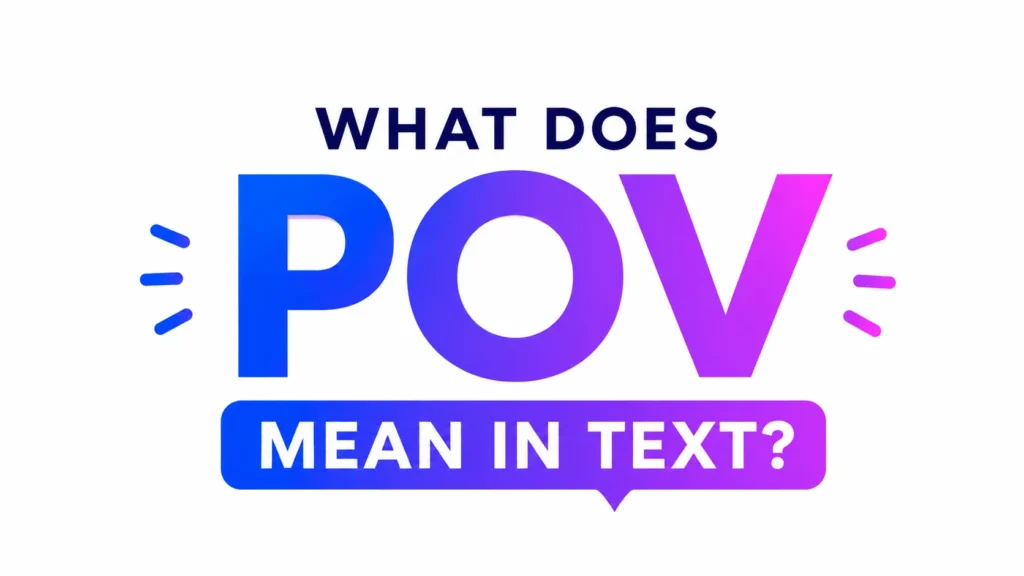
What Does POV Mean in Text? – Quick Meaning
Simple Definition
POV stands for “Point of View.”
In texting and social media culture, it usually introduces a situation from a specific perspective. It tells the audience:
“You are experiencing this moment from this angle.”
Quick Examples
- “POV: You finally text your crush back after 3 days.”
- “POV: Your mom walks in while you’re pretending to study.”
- “POV: It’s Friday night and everyone canceled plans.”
What It Usually Means Online
POV is commonly used to:
- Create relatable content
- Put viewers into a scene
- Express emotions indirectly
- Add humor or irony
- Make storytelling feel personal
Short Quoted Examples
“POV: You realize the teacher forgot about homework.”
“POV: You opened the fridge hoping new food appeared.”
“POV: You’re trying to act calm during an interview.”
Origin & Background
Where POV Originally Came From
The phrase “point of view” existed long before social media.
It originally came from literature, filmmaking, and storytelling. Writers and directors used it to describe the perspective from which a story is told.
For example:
- First-person POV
- Third-person POV
- Camera POV shots in movies
In films, a POV shot lets viewers see exactly what a character sees. That same idea eventually moved into internet culture.
How Social Media Changed It
When TikTok and short-form video content became popular, POV evolved into a storytelling format.
Creators started using captions like:
- “POV: You’re the new student.”
- “POV: We’re best friends in high school.”
- “POV: You finally moved on.”
Instead of just describing a scene, creators emotionally placed viewers inside it.
That emotional immersion made POV incredibly powerful online.
Why It Became So Popular
POV works because modern internet culture values emotional relatability.
People no longer just consume content. They want to feel part of it.
A good POV post can instantly make someone think:
- “That’s literally me.”
- “I’ve experienced this.”
- “Why is this so accurate?”
The format spread rapidly across:
- TikTok
- Instagram Reels
- YouTube Shorts
- Snapchat stories
- Meme culture
- Text conversations
How Meaning Evolved
Originally, POV was used correctly to indicate perspective.
Over time, internet users began using it more loosely. Sometimes people label videos “POV” even when the viewer isn’t truly in that perspective.
That’s why online jokes often mock “incorrect POV usage.”
Still, the emotional meaning remains clear: the creator wants you to emotionally step into a moment.
Real-Life Conversations
WhatsApp Conversation
Person A:
I finally sent the apology text.
And
Person B:
POV: character development.
Person A:
Honestly, that’s exactly what it feels like.
Instagram DM Conversation
Person A:
Did you see her new Reel?
Or,
Person B:
Yeah 😭 “POV: you pretend you’re over them.”
Person A:
Way too relatable.
TikTok Comment Section
Person A:
POV: me acting confident before presentations.
Person B:
Meanwhile my hands shaking like crazy.
More,
Person C:
Why is every POV video secretly therapy?
Text Message Conversation
Person A:
POV: You wake up motivated at 2 AM instead of 8 AM.
And,
Person B:
The most painful kind of motivation.
Person A:
Exactly 😭
Emotional & Psychological Meaning
Why People Use POV
POV allows people to express emotions without directly admitting them.
Instead of saying:
“I feel lonely.”
Someone might post:
“POV: everyone slowly stopped checking on you.”
That indirect style feels safer emotionally.
It creates distance while still expressing vulnerability.
What Emotion Does It Usually Express?
Depending on context, POV can communicate:
- Humor
- Nostalgia
- Sadness
- Romance
- Anxiety
- Embarrassment
- Confidence
- Irony
- Self-awareness
The emotional flexibility is one reason the format became so universal.
The Psychology Behind POV Content
POV content activates empathy.
When viewers imagine themselves inside a scenario, they emotionally connect faster. That connection increases engagement because people naturally respond to experiences that feel personal.
This is why POV videos often go viral even when they’re simple.
They feel emotionally familiar.
A Realistic Personal-Style Scenario
Imagine sitting alone late at night scrolling through TikTok after a stressful day.
Then you see:
“POV: You’re exhausted but still pretending everything’s okay.”
You pause instantly.
Not because it’s dramatic, but because it quietly reflects something you haven’t said out loud.
That emotional recognition is the real power of POV culture.
Usage in Different Contexts
Social Media
POV is most common on:
- TikTok
- Snapchat
- X posts
- YouTube Shorts
Creators use it to make relatable storytelling content.
Examples include:
- Dating situations
- Family moments
- School stress
- Workplace humor
- Emotional confessions
Friends & Relationships
Among friends, POV is often playful or sarcastic.
For example:
- “POV: your friend disappears after getting into a relationship.”
- “POV: we said one quick call and talked for 4 hours.”
In relationships, POV captions can feel romantic or emotionally revealing.
Work & Professional Settings
POV occasionally appears in professional social media marketing.
Examples:
- “POV: You finally cleared your inbox.”
- “POV: Your coffee kicks in before the meeting.”
However, using overly emotional or meme-heavy POV language in formal workplace communication can feel unprofessional.
Casual vs Serious Tone
POV can sound:
- Funny
- Dramatic
- Reflective
- Emotional
- Sarcastic
The tone depends entirely on context.
That flexibility is why it works across so many platforms.
When NOT to Use It
Formal Business Communication
Avoid POV in:
- Official emails
- Academic writing
- Legal documents
- Serious workplace reports
It may appear immature or unclear.
Sensitive Emotional Situations
Using POV jokingly during serious moments can seem insensitive.
For example, making sarcastic POV jokes about grief, trauma, or personal hardship may upset people.
Situations Where Clarity Matters
Sometimes POV captions are intentionally vague.
That works socially, but not when direct communication is needed.
If someone genuinely needs clarity, indirect POV messaging can create misunderstandings.
Cultural Awareness Matters
Not everyone understands internet slang equally.
Older audiences or non-native English speakers may misinterpret POV entirely.
Always consider who you’re communicating with.
Common Misunderstandings
People Think POV Is Always Literal
Many users assume POV must strictly show first-person perspective.
Internet culture doesn’t always follow that rule anymore.
Today, POV often means:
“Imagine this situation.”
Confusion About Tone
A POV post can sound:
- Serious
- Satirical
- Romantic
- Passive-aggressive
Without context, tone gets misunderstood easily.
Incorrect POV Usage
Some creators misuse POV entirely.
For example:
“POV: me watching you.”
Technically, that isn’t a true POV because viewers are not experiencing the creator’s perspective directly.
Still, casual internet users rarely care about technical accuracy anymore.
Mistaking It for a Personal Attack
Sometimes emotional POV posts are general observations, not direct messages aimed at specific people.
Readers occasionally overanalyze them.
Comparison Table
| Expression | Meaning | Tone | Similarity to POV |
|---|---|---|---|
| POV | Point of view perspective | Emotional/immersive | Main term |
| IMO | In my opinion | Personal opinion | Less immersive |
| Mood | Relatable emotional state | Casual | Similar emotional connection |
| Storytime | Sharing an experience | Narrative | More direct storytelling |
| Main character energy | Feeling important/confident | Dramatic/funny | Similar internet culture vibe |
| Relatable | Shared experience | Casual | Often overlaps with POV |
| IRL | In real life | Literal | Less emotional framing |
| Perspective | Viewpoint or angle | Neutral | Formal version of POV |
Key Insight
POV stands out because it doesn’t just describe feelings. It places people emotionally inside an experience. That immersive quality makes it more powerful than many other internet expressions.
Variations / Types
POV Challenge
A trend where creators act out specific scenarios from one perspective.
Funny POV
Humorous or exaggerated situations designed for laughs.
Sad POV
Emotionally reflective content about heartbreak, loneliness, or anxiety.
Romantic POV
Relationship-centered storytelling or fantasy scenarios.
POV Meme
A meme format using relatable perspective humor.
POV TikTok
Short-form immersive videos built around emotional storytelling.
POV Audio Trend
Using trending sounds while acting out a perspective scenario.
First-Person POV
Content directly showing the viewer’s imagined perspective.
Cinematic POV
Highly edited storytelling designed to feel movie-like.
Sarcastic POV
Ironically exaggerated situations mocking common behavior.
How to Respond When Someone Uses POV
Casual Replies
- “That’s way too relatable.”
- “Literally me.”
- “I felt this.”
- “So accurate.”
Funny Replies
- “Why are you exposing all of us?”
- “Delete this before my friends see it.”
- “This attacked me personally.”
Mature Replies
- “That actually makes a lot of sense.”
- “I understand the feeling behind that.”
- “You explained that really well.”
Respectful Replies
- “Hope you’re doing okay.”
- “Thanks for sharing something honest.”
- “A lot of people probably relate to this.”
Regional & Cultural Usage
Western Culture
In Western internet culture, POV is heavily connected to humor, dating, self-expression, and emotional storytelling.
TikTok culture accelerated its mainstream popularity.
Asian Culture
Many Asian online communities use POV creatively in fandom culture, anime edits, K-drama content, and emotional storytelling videos.
The format often feels more aesthetic and cinematic.
Middle Eastern Culture
POV content is growing rapidly among younger social media users in the Middle East, especially on TikTok and Instagram.
However, humor and emotional openness may still vary depending on cultural expectations.
Global Internet Usage
POV has become nearly universal online.
Even users who speak English as a second language recognize it through memes and social media trends.
Gen Z vs Millennials
Gen Z tends to use POV more naturally and creatively.
Millennials usually understand it but may use it less frequently or more literally.
Gen Z often blends POV with irony, emotional humor, and layered internet references.
Is It Safe for Kids?
General Safety
POV itself is generally harmless.
It’s simply a storytelling or perspective format.
What Parents Should Know
The concern isn’t the term itself, but the content surrounding it.
Some POV videos may include:
- Mature themes
- Emotional manipulation
- Romantic scenarios
- Dark humor
Parents should focus more on platform supervision than the slang itself.
Context Matters
A child saying:
“POV: school before summer break”
is completely normal.
The meaning changes depending on the content attached to it.
FAQs
What does POV mean in texting?
POV means “point of view.” It introduces a situation from a specific perspective or emotional experience.
Why do people use POV on TikTok?
People use POV to create immersive, relatable, and emotionally engaging content that makes viewers feel part of a scenario.
Is POV always first person?
Not anymore. Internet culture often uses POV loosely, even when the perspective isn’t technically first person.
Can POV be sarcastic?
Yes. Many POV posts use irony, exaggeration, or sarcasm for humor.
What’s the difference between POV and opinion?
POV creates an experience or perspective, while an opinion directly states what someone thinks.
Is POV slang?
Originally, no. It came from storytelling and filmmaking. However, social media transformed it into modern internet slang.
Can you use POV in professional settings?
Sometimes casually on social media marketing posts, but it’s usually best avoided in formal communication.
Conclusion
Understanding what does POV mean in text helps decode a huge part of modern internet culture.
At its core, POV simply means “point of view,” but online it has evolved into something much more emotional and creative. It allows people to turn ordinary feelings, awkward moments, humor, heartbreak, and memories into experiences others instantly recognize.
That’s why POV content feels so powerful. It creates connection in just a few words.
Whether you see it in TikTok captions, Instagram Reels, memes, or text messages, you now understand not only what it means, but why people use it so often. Once you notice how POV shapes online storytelling, you’ll start seeing it everywhere.
And honestly, that realization feels a little like its own POV moment.