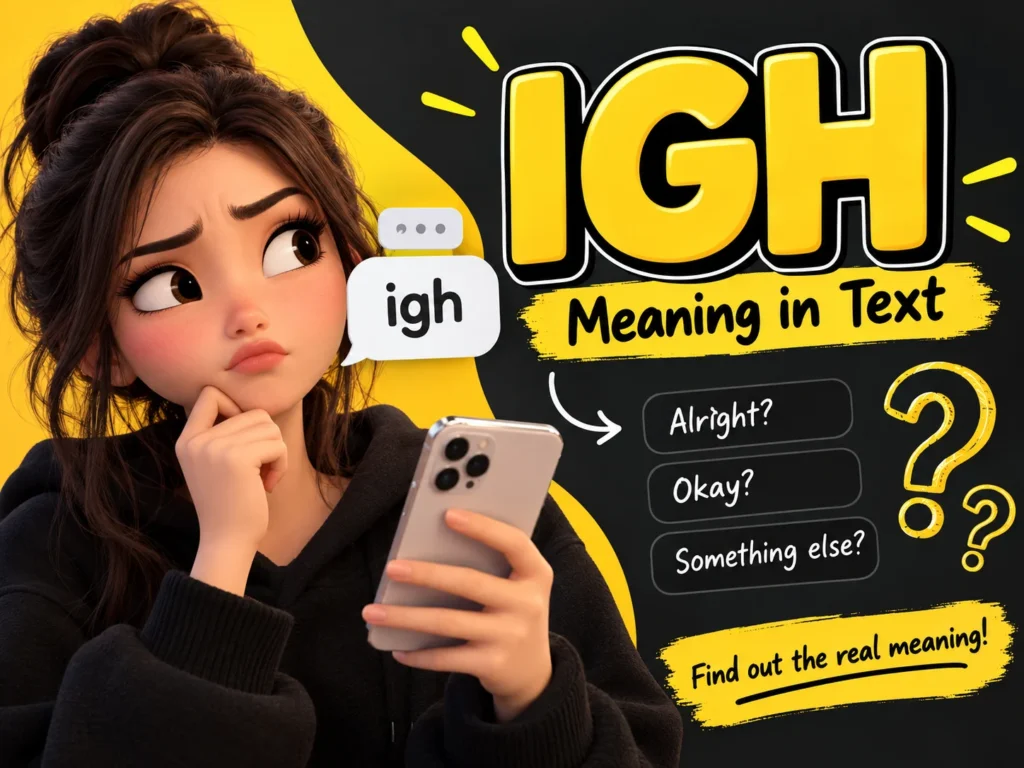
IGH usually means “Alright” or “Okay” in text messages. It’s an informal slang abbreviation people use to agree, acknowledge something, or show they’re ready to move on. When someone texts you “igh,” they may simply mean “okay,” “sure,” or “alright,” depending on the conversation’s tone.
Let’s explore what IGH means, how people use it in texting, and how to respond without misunderstanding the sender.
What Does IGH Mean in Text?
IGH is an informal abbreviation of “Alright.” In casual texting, it can work as a shortened way to agree with someone or confirm that you’ve understood their message.
For example:
- A: Are we meeting at 6?
- B: Igh, sounds good.
Here, “igh” means “Alright” or “Okay.”
The abbreviation doesn’t always communicate excitement. Depending on the surrounding words, it can sound relaxed, brief, or slightly uninterested. You need to consider the context before deciding what the sender means emotionally.
Is IGH an Acronym, Abbreviation, or Slang?
IGH is best described as an informal abbreviation or slang spelling, rather than a conventional initialism where each letter represents a separate word.
It commonly appears in lowercase (igh) and can also be written as IGH. The lowercase version often fits casual conversations, while capitalization may simply reflect a person’s typing habits.
READ MORE: NSFW Meaning in Slang: What Does NSFW Mean in Text?
IGH on Different Messaging Platforms
| Platform | How IGH Is Used |
|---|---|
| SMS and iMessage | Quick agreement or acknowledgment |
| Casual replies between friends and family | |
| Instagram DMs | Informal responses to messages |
| Snapchat | Short, relaxed conversations |
| Discord | Casual acknowledgment in chats |
IGH is primarily useful in informal written communication. The precise frequency of its use varies by community and individual typing habits.
Common Meanings of IGH in Chat
The most common interpretation in casual texting is “Alright” or “Okay.” However, the intended tone can differ.
1. Alright or Okay
Someone might use IGH to accept a suggestion or confirm a plan.
Example:
“Igh, I’ll call you later.”
Meaning: “Alright, I’ll call you later.”
2. Agreement
IGH can indicate that someone agrees with what you said.
Example:
“We should finish this tomorrow.”
“Igh, that’s fine.”
The sender accepts the suggestion without providing a lengthy response.
3. Acknowledgment
Sometimes, IGH simply signals that the person has read and understood your message.
Example:
“Don’t forget to send the document.”
“Igh.”
In this situation, the sender may mean “Okay, I understand.”
Important: A short response doesn’t automatically prove that someone is annoyed or upset. The relationship, previous messages, and punctuation can help you interpret the tone.
How IGH Changes With Tone
Although IGH generally expresses agreement or acknowledgment, the conversation around it can change how it feels. Here are four common tone variations.
1. Funny Tone
A friend may use IGH in a playful exchange.
A: You said you wouldn’t buy more shoes.
B: Igh, but these are different.
A: You said that last week!
B: Ighhh, let me live. 😂
The extended spelling and emoji add a playful feel. This interpretation depends on the full exchange.
2. Sarcastic Tone
IGH can appear in a sarcastic conversation when someone responds to an obvious or repeated statement.
A: Please don’t be late again.
B: Igh, boss.
A: I’m serious this time.
B: Igh, Igh. I’ll be there early.
The phrase “Igh, boss” creates a teasing tone. The sarcasm comes from the surrounding wording, not from IGH alone.
3. Playful Tone
Friends or partners might use IGH when making casual plans.
A: Movie tonight?
B: Igh, but you pick the movie.
A: Deal. No horror films this time.
B: Fine, you’re no fun. 😭
Here, IGH works as a relaxed agreement.
4. Serious Tone
In a serious conversation, IGH can acknowledge a request without resolving the entire issue.
A: We need to discuss what happened yesterday.
B: Igh, I understand.
A: Can we talk after work?
B: Yes, I’ll message you.
In this context, the abbreviation doesn’t necessarily indicate that the sender has accepted responsibility or resolved the disagreement.
10 Realistic Texting Examples Using IGH
These examples show how the abbreviation can function in different relationships and everyday situations.
Example 1: Friends Making Plans
A: Are you coming to dinner?
B: Igh, I’ll be there at 8.
A: Don’t be late this time.
B: No promises 😂
Example 2: Between Partners
A: Can we talk later? I had a long day.
B: Igh, take your time.
A: Thanks for understanding.
B: Of course ❤️
Example 3: Siblings
A: Mom said to clean the kitchen.
B: Igh, I’ll do it after lunch.
A: You said that yesterday.
B: Okay, okay. I’ll do it now.
Example 4: Classmates
A: Did you finish the assignment?
B: Igh, almost. What about you?
A: I’m still working on the conclusion.
B: Let’s compare our outlines later.
Example 5: Coworkers
A: The meeting has moved to 3 PM.
B: Igh, thanks for letting me know.
A: Please bring the updated file.
B: Sure, I’ll have it ready.
Example 6: Parent and Child
A: Please call me when you reach home.
B: Igh, I will.
A: And don’t forget your keys.
B: Got it, Mom.
Example 7: Online Friends
A: Want to join the game tonight?
B: Igh, send me an invite.
A: Around 9?
B: Works for me.
Example 8: A Casual Stranger Interaction
A: I can send the details tomorrow.
B: Igh, no problem.
A: Thanks for your patience.
B: You’re welcome.
Example 9: When Someone Is Busy
A: Can you check this file?
B: Igh, give me a few minutes.
A: No rush.
B: I’ll get back to you soon.
Example 10: Disagreement
A: I think we should leave earlier.
B: Igh, if you want.
A: It’s better to avoid traffic.
B: Fair enough, let’s go at 6.
The last exchange shows why context matters: “Igh, if you want” could be neutral, reluctant, or mildly dismissive, depending on the relationship and conversation.
Grammar and Language Role of IGH
IGH functions as an informal conversational response. It commonly appears at the beginning of a reply or as a standalone message.
| Feature | Explanation |
|---|---|
| Part of speech | Informal interjection or conversational response |
| Sentence position | Often at the beginning or by itself |
| Can stand alone? | Yes, in casual texting |
| Capitalization | igh, Igh, and IGH may all appear |
| Register | Informal |
| Formal writing | Avoid it in professional or academic writing |
Lowercase vs. Uppercase
The spelling may affect the visual impression, but capitalization doesn’t have a fixed meaning.
- igh: Casual and understated.
- Igh: May reflect normal sentence capitalization.
- IGH: Could be emphasis or a personal typing preference.
Don’t assume that uppercase IGH always means anger. Look at the rest of the message.
How to Reply When Someone Texts IGH
Your response should match the context and what you want to communicate.
Funny
“Ighhh, why do you sound like my teacher? 😂”
Serious
“Okay, let’s talk about it when you’re ready.”
Flirty
“Igh, so that’s a yes? 😉”
Neutral
“Okay, sounds good.”
IGH vs. Related Texting Terms
The following terms have overlapping conversational functions, but they’re not exact synonyms in every situation.
| Term | Meaning | Usage Context | Tone | Popularity | Confusion Risk |
|---|---|---|---|---|---|
| IGH | Alright / Okay | Casual replies | Informal | Varies | Medium |
| Alr | Alright | Texting and DMs | Casual | Common abbreviation | Medium |
| Aight | Alright | Spoken-style slang | Relaxed | Established slang | Medium |
| Bet | Okay / Agreed | Confirming plans | Confident or casual | Common slang | Medium |
| Ight | Variant of IGH / Aight | Informal texting | Casual | Varies | High |
| Nvm | Never mind | Withdrawing a request or thought | Neutral or dismissive | Common abbreviation | Low |
Popularity labels here are descriptive rather than based on a single verified usage-frequency dataset.
Who Uses IGH in Text Messages?
IGH is an informal expression that may appear among people who use abbreviated or slang-heavy texting. However, there isn’t enough reliable evidence to assign a precise age-group percentage or establish that one generation uses it more than another.
Gen Z vs. Millennials
Both Gen Z and Millennials may use casual abbreviations, but individual typing preferences differ. You shouldn’t assume someone’s age from a single abbreviation.
For example, a person may use igh, aight, or alr based on their online community, friends, or personal habits.
Regional Usage
IGH can be encountered in English-language informal messaging, but reliable data establishing distinct US, UK, and global usage rates is limited. Avoid treating it as exclusive to a particular country or age group.
Origin and Internet Culture
IGH is associated with informal shortened spellings of “alright.” However, a specific, well-documented first appearance or definitive origin for the exact three-letter form is not established here.
It is safer to distinguish the broader history of abbreviated texting from an unverified claim that IGH was invented on a particular platform or by a specific community.
The related spelling “aight” has a longer documented history in informal English and popular culture. That doesn’t, by itself, prove a single origin for every modern spelling of IGH.
Is IGH Rude or Offensive?
IGH is not inherently offensive or profane. It is generally an informal expression.
However, a very short response can sometimes appear dismissive, especially during a disagreement or when the other person expects a detailed answer.
Is IGH Appropriate at Work or School?
It’s best to use clearer language in formal communication.
Instead of texting your manager:
“Igh.”
You could write:
“Okay, understood. I’ll complete it by the deadline.”
Use context and your relationship with the recipient to decide whether slang is appropriate.
Real-World Observation: Why IGH Is Interesting
IGH illustrates how short text replies can carry more than their literal meaning. A message such as “igh, fine” may signal agreement, hesitation, or frustration depending on the preceding conversation. The abbreviation saves typing, but it also leaves room for interpretation. This makes the surrounding words, punctuation, and relationship more important than the abbreviation alone.
Frequently Asked Questions About IGH
1. What does IGH mean in text from a girl?
IGH usually means “Alright” or “Okay,” regardless of the sender’s gender. A girl using IGH may simply be acknowledging your message or agreeing with a suggestion. The abbreviation alone doesn’t establish romantic interest, anger, or any other personal feeling. Look at the wider conversation to understand the intended tone.
2. What does IGH mean from a guy?
A guy texting IGH is generally using the same informal abbreviation. He may be saying “Okay,” “Sure,” or “Alright.” The meaning depends on what you discussed before the message. Don’t assume that the abbreviation has a different definition based on who sends it.
3. Is it rude to reply with just IGH in a text?
A standalone IGH isn’t automatically rude. It may be perfectly normal between friends who prefer short replies. However, during an emotional or serious conversation, a one-word response might seem dismissive. If you want to sound considerate, add a few words to clarify your response.
4. What’s the difference between texting IGH and saying “Alright” out loud?
Texting IGH is a shortened written form, while saying “alright” aloud includes vocal tone and delivery. In text, readers rely on wording, punctuation, and context to interpret your attitude. The same abbreviation can feel relaxed or abrupt depending on the exchange. Speaking allows you to communicate tone through your voice.
5. Does IGH mean the same thing in a group chat and a one-on-one text?
The basic meaning can remain “Okay” or “Alright” in both settings. In a group chat, IGH might acknowledge a shared plan or message. In a one-on-one conversation, the recipient may interpret the response based on your personal communication style. The specific discussion determines its intended meaning.
6. Is IGH the same as Ight?
IGH and Ight can be used as informal variants of “Alright” in some texting communities. They don’t have a universally fixed distinction in meaning. People may choose one spelling based on habit or preference. Consider the context rather than assuming the spellings always communicate different emotions.
7. Can I use IGH in professional messages?
You can encounter informal abbreviations in workplace chats, but IGH isn’t ideal for formal communication. A clear response such as “Understood” or “Okay, I’ll take care of it” is usually easier to interpret. Follow your workplace’s communication norms. When in doubt, choose clarity over slang.
Conclusion: Understanding IGH in Text
IGH generally means “Alright” or “Okay.” It’s an informal texting abbreviation used for agreement, acknowledgment, and casual replies.
Quick Usage Tips
- Use IGH in relaxed conversations with people who understand informal texting.
- Read the surrounding messages before interpreting its tone.
- Use clearer wording for serious or professional communication.
- Don’t assume that a short reply automatically means someone is annoyed.
Common Mistakes to Avoid
- Treating IGH as a fixed sign of anger.
- Assuming it always means enthusiastic agreement.
- Using it in formal writing without considering the audience.
- Confusing a casual abbreviation with a universal definition.
When to use: Informal texts, friendly chats, and casual DMs.
When to avoid: Formal emails, academic writing, and situations where you need to communicate precise meaning.