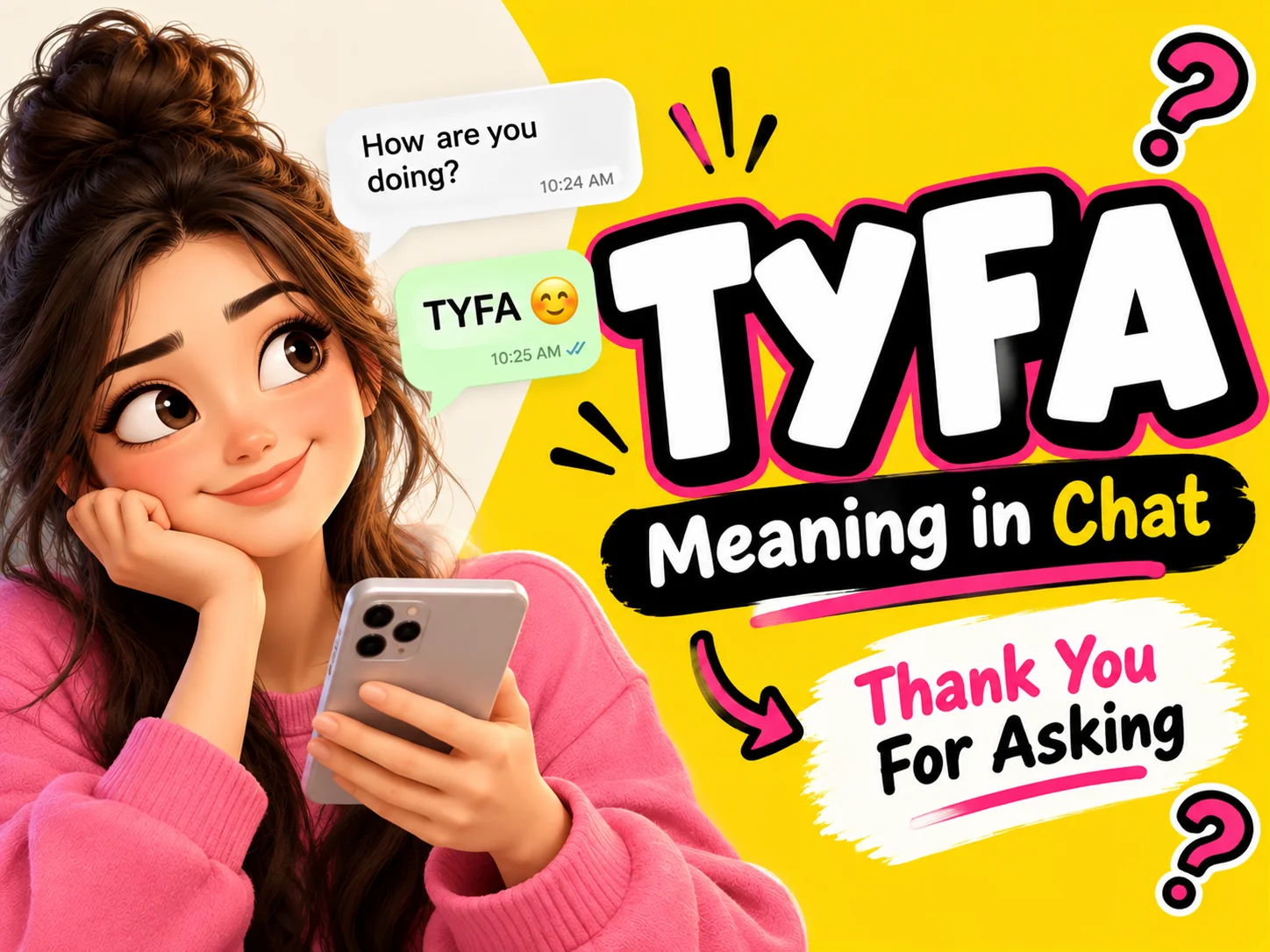

TYFA usually means “Thank You For Asking” in chat. When someone texts TYFA, they’re thanking you for showing interest or checking in, often after you ask how they are, what happened, or how something is going.
What Does TYFA Mean in Chat?
TYFA = Thank You For Asking.
It is an informal texting abbreviation. People use it when they want to acknowledge someone’s question or concern without typing the entire phrase.
For example:
A: How are you feeling today?
B: Better, TYFA!
Here, TYFA means “Thank you for asking.”
The abbreviation is generally polite and appreciative. Depending on the conversation, it can sound warm, casual, sincere, or slightly formal compared with other texting shortcuts.
TYFA Full Form
The most common expansion is:
T — Thank
Y — You
F — For
A — Asking
So:
TYFA = Thank You For Asking
It isn’t normally used to introduce a new question. Instead, it responds to someone else’s question or expression of concern.
What Does TYFA Mean When Someone Texts It to You?
If someone replies “TYFA,” they’re essentially saying:
“I appreciate you asking.”
For example:
You: Did your interview go well?
Them: Yeah, it did. TYFA!
The abbreviation acknowledges that you took the time to ask.
How TYFA Is Used in Text Messages
TYFA can appear at the beginning or end of a reply.
Beginning:
“TYFA, I’m doing much better now.”
End:
“I’m doing okay, TYFA.”
As a short response:
“TYFA 😊”
The third version depends heavily on context because a short abbreviation can sometimes sound less expressive than a complete sentence.
READ MORE: MIRL Full Form in Chat: What Does MIRL Mean in Text?
TYFA on Different Messaging Platforms
SMS, iMessage and WhatsApp
TYFA can be used in casual one-on-one conversations when somebody asks about your situation.
A: Did you get home safely?
B: Yes, TYFA!
Instagram and Snapchat DMs
It can also appear in casual direct messages when someone checks in or asks about something personal.
Discord
In informal Discord conversations, someone might use TYFA after another person asks about their day, project, game, or situation.
The abbreviation isn’t tied to one particular messaging service. TYFA is simply shorthand that can work wherever informal text conversations happen.
TYFA Tone Variations
Funny
A: Did you finally fix your laptop?
B: Nope.
A: Oh no 😂
B: TYFA for reminding me of my problems.
Here, the abbreviation is technically appreciative but the rest of the exchange makes the sarcasm clear.
Sarcastic
A: How’s your Monday going?
B: Absolutely wonderful.
A: That’s not convincing.
B: TYFA for exposing me 😂
Playful
A: Did you miss me?
B: Maybe.
A: That’s not an answer.
B: TYFA for asking, though 😌
Serious
A: How are you doing after everything?
B: I’m taking it one day at a time. TYFA for checking in.
A: Of course.
B: I really appreciate it.
10 Realistic Chat Examples
1. Friends
A: How was your exam?
B: It went better than I expected.
A: Nice!
B: TYFA 😊
2. Coworkers
A: Did you finish the report?
B: Yes, I sent it this morning.
A: Great.
B: TYFA for checking.
3. Siblings
A: Are you feeling better now?
B: A little.
A: Glad to hear that.
B: TYFA ❤️
4. Parent and child
A: Did you get there safely?
B: Yes, I just arrived.
A: Good.
B: TYFA.
5. Partner
A: How did your meeting go?
B: It was stressful, honestly.
A: Want to talk about it?
B: Maybe later. TYFA for asking.
6. Classmates
A: How’s your assignment coming along?
B: Almost finished.
A: Need any help?
B: I’m okay for now, TYFA!
7. Online friend
A: You disappeared yesterday. Everything okay?
B: Yeah, I was just busy.
A: Okay, just checking.
B: TYFA.
8. Casual acquaintance
A: How’s the new job going?
B: Pretty well so far.
A: That’s good!
B: TYFA for asking.
9. Friend after an event
A: Did you enjoy the concert?
B: It was amazing!
A: I’m glad.
B: TYFA for asking!
10. Someone checking in
A: Are things okay at home?
B: They’re getting better.
A: I’m here if you need anything.
B: TYFA. I appreciate that.
Is TYFA an Acronym or Abbreviation?
TYFA functions as an initialism/texting abbreviation formed from the first letters of “Thank You For Asking.”
People generally type the letters individually rather than treating TYFA as a normal English word.
You may see:
- TYFA
- tyfa
- Tyfa
The meaning normally stays the same.
Can TYFA Stand Alone?
Yes, although context matters.
For example:
A: How are you doing?
B: TYFA 😊
The recipient can understand that the speaker appreciates the question.
However, in a more meaningful conversation, a complete response often sounds warmer:
“TYFA. I’m doing much better now.”
That gives the other person both appreciation and an actual answer.
Does Capitalization Change TYFA’s Meaning?
Usually, no.
TYFA and tyfa generally mean the same thing.
Capital letters can make an abbreviation more noticeable:
“TYFA!”
Lowercase can feel more relaxed:
“tyfa :)”
Punctuation and emojis can influence the tone more than capitalization does.
How to Reply to TYFA
Your response depends on the relationship and context.
Funny Reply
“Of course 😂 I had to ask!”
Serious Reply
“Of course. I genuinely wanted to know how you’re doing.”
Flirty Reply
“Always. I like knowing how you’re doing 😉”
Neutral Reply
“Of course! No problem.”
If someone says TYFA after discussing something serious, a supportive response is generally more appropriate than a joke.
TYFA vs. Similar Texting Abbreviations
| Term | Meaning | Usage Context | Tone | Popularity | Confusion Risk |
|---|---|---|---|---|---|
| TYFA | Thank You For Asking | Responding to a question | Polite/casual | Less common | Medium |
| TY | Thank You | General thanks | Casual | Very common | Low |
| TYSM | Thank You So Much | Stronger appreciation | Warm | Common | Low |
| TYVM | Thank You Very Much | Strong appreciation | Polite | Common | Low |
| TYIA | Thank You In Advance | Before receiving help | Polite | Common | Medium |
| TQ | Thank You | Short form of thanks | Casual | Varies | Medium |
The important distinction is that TYFA specifically acknowledges that someone asked about something.
For example:
TY = Thanks.
TYSM = Thanks a lot.
TYFA = Thanks for asking.
Who Uses TYFA?
TYFA belongs to informal digital communication rather than formal English. People who are familiar with texting abbreviations may understand it immediately, while others may prefer the full phrase.
There isn’t a reliable basis for saying that TYFA belongs exclusively to Gen Z, Millennials, or a particular country. Individual texting habits vary considerably.
Gen Z vs. Millennials
Both generations can use abbreviated texting language, but there’s no fixed generational rule governing TYFA.
A person might choose:
“TYFA 😊”
or simply:
“Thanks for asking.”
The choice depends more on personal texting style and the relationship between the people chatting.
Origin and Internet Culture
TYFA follows the long-standing pattern of creating texting shortcuts from the initial letters of common phrases.
Unlike slang terms that originate from a particular meme or viral trend, TYFA is best understood as functional internet shorthand. Its purpose is straightforward: shorten “thank you for asking” in casual digital communication.
There isn’t a strong reason to attribute the abbreviation to one specific social-media platform or viral event.
Is TYFA Rude or Offensive?
No. TYFA isn’t inherently rude, offensive, or profane.
In most contexts, it communicates appreciation.
However, tone can change based on punctuation or surrounding wording:
“TYFA.”
could sound somewhat brief.
Whereas:
“TYFA!! 😊”
usually feels more enthusiastic.
Is TYFA Appropriate at Work?
It can be acceptable in casual workplace chats, depending on the workplace culture.
For a formal email to a manager, client, lecturer, or professional contact, writing:
“Thank you for asking.”
is safer and more polished.
It’s also better to avoid texting abbreviations in academic assignments and formal documents.
A Real-World Observation About TYFA
TYFA has an interesting role in conversation because it does more than say “thanks.” The phrase recognizes the other person’s effort to show interest. When someone asks, “How are you?” or checks on a situation, responding with TYFA acknowledges both the question and the social gesture behind it. That’s why it can feel especially appropriate after a personal check-in, even though a simple “TY” would also technically express gratitude.
FAQ: TYFA Meaning in Chat
What does TYFA stand for in chat?
TYFA most commonly stands for “Thank You For Asking.” It is an informal texting abbreviation used to acknowledge someone’s question. People often use it after someone checks on their wellbeing or asks about a situation.
What does TYFA mean when someone texts it to you?
It generally means “Thank you for asking.” The person is showing appreciation because you took the time to ask about something. The exact warmth of the message depends on the rest of the conversation.
Is TYFA rude in a text?
No, TYFA isn’t inherently rude. It is normally a polite way to acknowledge someone’s question. However, a very short “TYFA” without additional context can sometimes feel less warm than “Thank you for asking.”
What’s the difference between TYFA and TY?
TY simply means “thank you.” TYFA specifically means “thank you for asking.” Therefore, TYFA is appropriate when someone’s question is the reason you’re expressing thanks.
What’s the difference between TYFA and TYSM?
TYFA means “thank you for asking,” while TYSM means “thank you so much.” TYFA focuses on the person’s question, whereas TYSM emphasizes the strength of your gratitude.
Can TYFA be used in a group chat?
Yes. TYFA can work in a group chat when one or more people ask you a question. For example, if friends ask how your interview went, you could answer, “It went well, TYFA!”
Can I use TYFA in a professional text?
You can use it in an informal workplace chat if abbreviations are normal in your workplace. For formal professional communication, “Thank you for asking” is clearer and more appropriate.
Is TYFA the same as “thanks for checking”?
They are similar but not identical. TYFA literally means “thank you for asking,” while “thanks for checking” specifically acknowledges someone checking on a situation. In many casual conversations, either phrase can express appreciation for someone’s concern.
TYFA Meaning: Quick Summary
TYFA = Thank You For Asking.
It is an informal texting abbreviation used when someone wants to thank another person for asking about them or about a particular situation.
Usage tips
- Use TYFA when responding to someone’s question.
- It works best in casual texts and DMs.
- Add a sentence after it when the conversation is more meaningful.
- Use the full phrase in formal communication.
Common mistakes
- Don’t confuse TYFA with TYIA (“Thank You In Advance”).
- Don’t assume TYFA simply means “thank you.”
- Remember that the FA refers to “for asking.”
- Avoid unexplained texting abbreviations in formal writing.
When to use TYFA
Use it with friends, family, classmates, partners, or casual online contacts when someone asks how you’re doing or asks about something that matters to you.
When to avoid TYFA
Avoid it in formal academic writing, formal emails, official documents, or professional situations where the recipient may not be familiar with texting shorthand.
Final Answer
When you see TYFA in chat, it usually means “Thank You For Asking.” Someone uses it to appreciate your question, especially when you’ve checked on their wellbeing, situation, work, studies, or plans.
Example:
A: How are you doing now?
B: Much better, TYFA! 😊
Here, TYFA = Thank You For Asking.