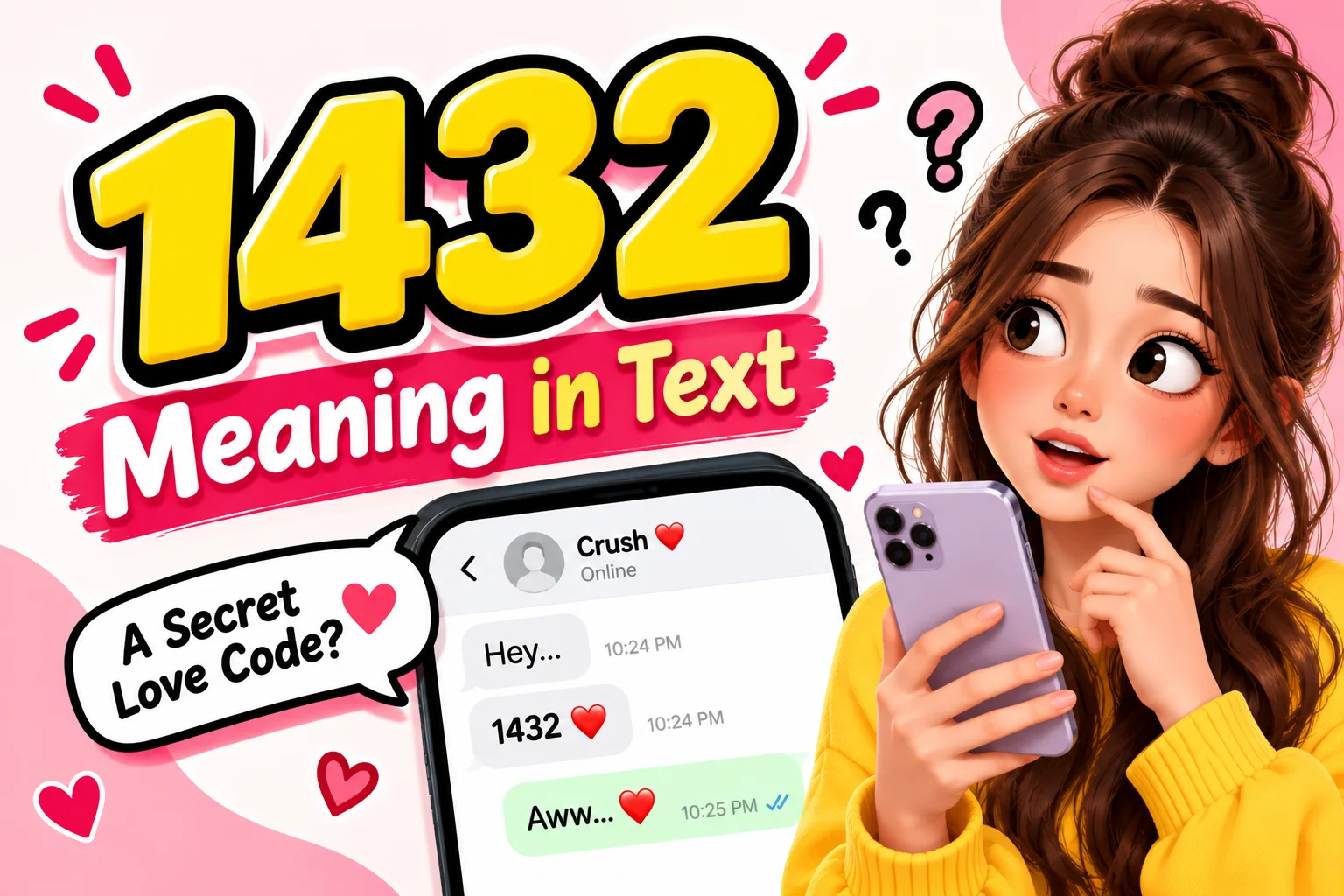

1432 usually means “I love you too,” or more specifically, a numeric texting code built from the phrase “I love you.” In many contexts, 143 = “I love you,” while the added 2 can mean “too” or “to.” However, numeric codes can vary by community, so context matters when someone texts you “1432.”
What Does 1432 Mean in Text?
The number 1432 is a form of numeric texting shorthand. It belongs to the same family of number codes where numbers represent words based on their length or sound.
The most common interpretation is:
1432 = I love you too
The underlying code is:
- 1 = I
- 4 = love
- 3 = you
- 2 = too
So when someone sends:
“1432 ❤️”
they’re generally expressing “I love you too.”
Is 1432 an acronym?
No. 1432 isn’t an acronym. It’s a numeric code/texting abbreviation.
The numbers act as substitutes for words rather than initials.
Why Do People Text 1432?
Numeric expressions can make messages shorter, more playful, or slightly less direct.
Someone might use 1432 after another person says:
“143 ❤️”
Replying with “1432” communicates the equivalent of “I love you too” without typing the full phrase.
It can also add a playful sense of familiarity to a private conversation.
READ MORE: OTD Meaning in Text — What Does OTD Mean?
How 1432 Appears in Text Messages
SMS and iMessage
A person might send:
“1432 ❤️”
as a quick affectionate response.
You may see it in a relationship or close-friend conversation:
“Goodnight ❤️”
“1432”
The intended meaning depends on the conversation and whether both people understand the number code.
Instagram, Snapchat, and DMs
The same numeric shorthand can appear in private messages, particularly when people already use number-based expressions with each other.
It’s less useful when the recipient doesn’t know the code, because 1432 isn’t immediately obvious to everyone.
1432 Tone Variations
Romantic
A: I love you.
B: 1432 ❤️
A: I know what that means 😂
B: Good, then we’re on the same page.
Funny
A: 143
B: 1432
A: Look at you getting technical.
B: I had to upgrade the reply 😂
Playful
A: Miss you.
B: Miss you too.
A: 1432 🥰
B: Okay, that’s actually cute.
Serious
A: I just wanted you to know how much you mean to me.
B: 1432.
A: Thank you. That means a lot.
B: Always.
1432 in Real Text Conversations
1. Between partners
A: Love you ❤️
B: 1432 ❤️
A: Goodnight.
B: Goodnight.
2. After a heartfelt message
A: I’m really grateful you’re in my life.
B: 1432
A: ❤️
B: Always.
3. Playful texting
A: 143
B: 1432 😌
A: I see what you did there.
B: Had to.
4. Long-distance relationship
A: Wish you were here.
B: Same.
A: 1432 ❤️
B: Love you too.
5. Goodnight text
A: Sleep well. Love you.
B: 1432 ❤️
A: Talk tomorrow?
B: Definitely.
6. Between close friends
A: Thanks for always being there.
B: 1432 ❤️
A: You’re the best.
B: You too.
7. Reassurance
A: Everything’s going to be okay.
B: I hope so.
A: 1432.
B: ❤️
8. After an apology
A: I’m sorry about earlier.
B: It’s okay.
A: 1432 ❤️
B: Love you too.
9. Casual affectionate exchange
A: Thinking about you.
B: Same here.
A: 1432
B: 🥹❤️
10. Private inside joke
A: You know the code.
B: 1432 😂
A: Exactly.
B: Never gets old.
Grammar and Language Role of 1432
Unlike ordinary slang, 1432 doesn’t behave like a normal grammatical word.
Part of speech
It functions as a complete texting expression rather than a conventional noun, verb, adjective, or adverb.
Sentence position
1432 can appear:
- As a standalone reply: “1432 ❤️”
- At the end of a message: “Goodnight, 1432.”
- Alongside emojis: “1432 🥰”
Can 1432 stand alone?
Yes. In the right conversation, 1432 can be a complete response.
For example:
A: “I love you.”
B: “1432 ❤️”
The recipient is expected to understand the numeric code.
Capitalization
Capitalization isn’t relevant because the expression consists of numbers.
Formal or informal?
1432 is highly informal. It belongs in personal messages rather than formal communication.
How Should You Reply to 1432?
If someone sends you 1432, your response depends on your relationship.
Romantic reply
“I love you too ❤️”
Funny reply
“Okay, Mr. Secret Code 😂”
Playful reply
“1432 right back at you 🥰”
Neutral reply
“Aww, thank you ❤️”
If you don’t understand the context, you can simply ask:
“Wait, what does 1432 mean? 😂”
1432 vs Related Number Codes
| Term | Meaning | Usage Context | Tone | Popularity | Confusion Risk |
|---|---|---|---|---|---|
| 1432 | I love you too | Affectionate texting | Romantic/playful | Niche | Medium |
| 143 | I love you | Romantic texting | Affectionate | Recognizable | Low |
| 14344 | I love you very much | Affectionate texting | Romantic | Less common | High |
| 459 | I love you | Numeric texting code | Romantic | Less common | High |
| ILY | I love you | Casual texting | Affectionate | Common | Low |
| ILY2 | I love you too | Texting | Affectionate | Recognizable | Low |
The key distinction is that 143 is generally understood as “I love you,” while 1432 adds the idea of “too.”
Who Uses 1432?
Numeric codes such as 1432 are most useful among people who already understand the shorthand.
Younger texters
Younger users may encounter number-based expressions through texting, online communities, or personal inside jokes. However, not every younger texter uses 1432 regularly.
Millennials and older texters
People familiar with older texting shorthand may recognize 143 more readily than newer variations. The exact meaning of 1432 can still depend on the conversation.
Regional usage
The number-code system is not reliably tied to one country or region. 143 has circulated broadly in English-language digital communication, while interpretations of 1432 may be less standardized.
For that reason, don’t assume everyone who receives “1432” will immediately know what it means.
Origin and Internet Culture
143 is commonly explained as a numeric shorthand for “I love you”: 1 letter in “I,” 4 letters in “love,” and 3 letters in “you.”
The 2 in 1432 is generally understood as “too” or “to,” producing the interpretation “I love you too.”
This style of numeric messaging fits the broader history of shorthand used in text messaging and online communication. It isn’t necessary to attribute 1432 to a particular modern social-media trend or meme.
One important point is that numeric codes are not always standardized. A person may use 1432 differently from another person, so context and prior conversation can matter more than a dictionary-style definition.
Is 1432 Rude or Offensive?
No. 1432 isn’t inherently rude, offensive, or profane.
It’s normally affectionate or playful.
However, sending it to someone who doesn’t understand number codes can cause confusion. The recipient might have no idea what you’re trying to say.
Is 1432 appropriate at school or work?
It’s generally inappropriate for formal professional communication because the meaning isn’t universally obvious.
Instead of sending 1432 to a teacher, manager, or client, use clear language appropriate to the relationship.
A Real-World Observation About 1432
The interesting thing about 1432 is that its meaning depends on a small chain of shared assumptions. The sender expects the recipient to know that 1, 4, and 3 correspond to the word lengths in “I love you,” then interpret the final 2 as “too.” That makes the expression feel more like a private code than ordinary slang. In a close relationship, that extra decoding can make the message feel playful or personal; outside that context, it can simply look like four random numbers.
Frequently Asked Questions
What does 1432 mean in text?
1432 commonly means “I love you too.” The numbers represent the word lengths in “I love you,” with the final 2 representing “too.” It’s an informal numeric texting code.
Is 1432 the same as “I love you too”?
In the context where this code is being used, yes. 1432 is commonly interpreted as “I love you too.” However, numeric slang isn’t completely standardized, so context is still important.
Is it rude to reply with just 1432 in a text?
No. If both people understand the code, it can be a warm and playful response. If the recipient doesn’t know the shorthand, though, the message may be confusing.
What’s the difference between texting 1432 and saying “I love you too” out loud?
The basic intended message is similar, but 1432 is more indirect and playful. Saying “I love you too” is immediately clear, while 1432 requires the recipient to understand the numeric code. That’s why 1432 often works best between people who already share that shorthand.
Does 1432 mean the same thing in a group chat vs a 1-on-1 text?
Not necessarily in practice. The underlying code can still mean “I love you too,” but a romantic number code may feel more natural in a private conversation than in a large group chat. Context and the relationship between the people involved can change how the message is interpreted.
Is 1432 a secret code for love?
It can function that way. 1432 is a numeric shorthand associated with an affectionate message, rather than a formal secret code. People may use it because it feels less direct or more playful than spelling out the entire sentence.
What does 143 mean compared with 1432?
143 commonly means “I love you.” The additional 2 in 1432 is commonly interpreted as “too,” making the full expression “I love you too.” These meanings depend on the sender and context.
Can I use 1432 with a friend?
You can if you and your friend understand the expression and use affectionate language comfortably. Because it commonly carries a romantic meaning, however, it could be misunderstood. With a friend, a clear message such as “love you too” may avoid confusion.
1432 Meaning: Quick Summary
1432 = “I love you too” in the common numeric-texting interpretation.
Remember:
- 1 = I
- 4 = love
- 3 = you
- 2 = too
- It’s a numeric texting code, not an acronym.
- 143 usually means “I love you.”
- Context matters because number codes aren’t completely standardized.
Usage tips
- Use 1432 with people who understand numeric texting codes.
- Add an emoji if you want the affectionate tone to be obvious.
- Don’t assume every recipient will recognize it.
- Use plain language when the relationship or situation requires clarity.
Common mistakes
- Assuming 1432 has one universal meaning.
- Confusing 1432 with 143.
- Sending it in a professional conversation.
- Assuming the recipient understands numeric slang.
When to use: Personal texts, romantic conversations, close friendships, and playful DMs.
When to avoid: Formal communication, professional messages, academic contexts, and conversations where the meaning needs to be immediately clear.