
Introduction
Keeping household pets healthy and happy involves more than providing nutritious food, comfortable shelter, and regular veterinary care. Mental stimulation is another important part of animal well-being, particularly for pets that spend most of their time indoors.
Dogs and cats naturally enjoy exploring their surroundings, investigating unfamiliar objects, and participating in activities that challenge their instincts. Without sufficient opportunities for engagement, some pets may become bored, restless, or less interested in their environment.
Interactive toys provide an enjoyable way to introduce mental challenges into everyday routines. From puzzle feeders and treat-dispensing toys to moving objects and scent-based games, these activities encourage animals to think, explore, and remain engaged.
Understanding how interactive toys support mental stimulation can help pet owners create enriching home environments.
1. Understanding Mental Stimulation in Pets
Mental stimulation refers to activities that encourage animals to use their cognitive abilities, senses, and natural behaviors.
Just as physical exercise supports movement and fitness, mental enrichment provides opportunities for learning, exploration, and problem-solving.
Pets may experience mental stimulation through:
- Investigating unfamiliar objects.
- Searching for hidden treats.
- Solving simple puzzles.
- Learning new commands.
- Exploring different textures and scents.
- Participating in interactive play.
Different animals require different types of enrichment depending on their species, age, temperament, and individual preferences.
Providing varied activities helps prevent everyday routines from becoming unnecessarily repetitive.
2. Interactive Toys Encourage Problem-Solving Skills
Puzzle toys challenge pets to discover how to obtain rewards or manipulate objects.
For example, a treat-dispensing puzzle may require a dog to push, rotate, or lift a component before accessing food.
Similarly, cats may explore puzzle feeders that require them to retrieve food using their paws.
These activities encourage animals to experiment with different actions and observe the results.
With repeated practice, pets may become more familiar with the puzzle’s mechanics.
Starting with simple challenges and gradually increasing difficulty helps maintain interest without creating excessive frustration.
3. Reducing Boredom Through Engaging Activities
Household pets may experience periods of inactivity when owners are working, studying, or completing daily responsibilities.
Interactive toys can provide additional activities during these quieter periods.
Food puzzles, safe chewing toys, and exploration games give pets opportunities to remain occupied.
The ASPCA recommends enrichment activities that allow animals to express natural behaviors, including sniffing, investigating, and chewing. ASPCA
Although toys can help reduce boredom, they should complement rather than replace regular exercise, social interaction, and appropriate care.
4. Supporting Natural Hunting and Foraging Instincts
Many interactive toys are designed around behaviors that animals naturally enjoy.
For Dogs
Dogs often use their sense of smell to investigate their environment.
Snuffle mats, scent games, and food-dispensing toys encourage sniffing and searching behaviors.
For example, hiding a portion of a dog’s regular food inside a suitable puzzle feeder can turn mealtime into an engaging activity.
For Cats
Cats naturally engage in stalking, chasing, and pouncing behaviors.
Wand toys, moving toy mice, and interactive balls can encourage these instincts.
Veterinary feline-care guidance emphasizes the importance of providing opportunities for play and predatory behavior, particularly for indoor cats. catvets.com
Allowing cats to successfully catch their toys during play can make activities more satisfying.
5. Encouraging Physical Movement Alongside Mental Activity
Some interactive toys combine mental challenges with physical exercise.
Moving balls, chasing toys, and treat-dispensing objects may encourage pets to walk, reach, jump, or move around their environment.
These activities can be particularly useful for indoor pets with limited opportunities for outdoor exploration.
However, the intensity of play should match the animal’s physical condition.
Older pets or animals with mobility limitations may benefit from slower games that require minimal jumping or running.
The objective is to provide enjoyable movement without causing discomfort or unnecessary strain.
6. Strengthening the Bond Between Pets and Owners
Interactive play offers opportunities for positive communication between animals and their caregivers.
When owners participate in games, pets receive attention, encouragement, and shared experiences.
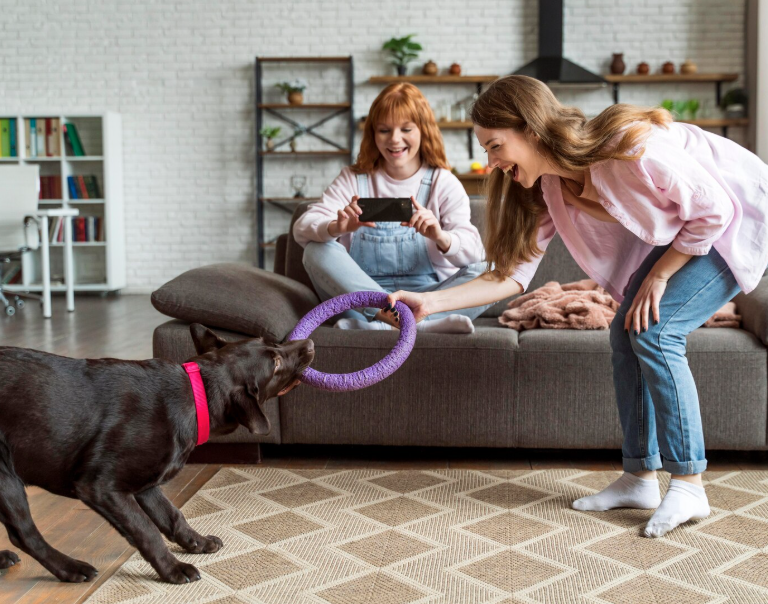
Activities such as fetch, gentle tug games, puzzle-solving, and wand play can become enjoyable daily routines.
Reward-based interactions also create opportunities to reinforce desirable behaviors.
For example, an owner might introduce a simple puzzle and reward the pet for calmly investigating it.
These experiences can strengthen trust while making everyday interactions more engaging.
7. Popular Types of Interactive Pet Toys
Different interactive toys support different behaviors and abilities.
Puzzle Feeders
Puzzle feeders require pets to manipulate objects to access food.
They can encourage investigation and may help slow eating in some animals.
Treat-Dispensing Toys
These toys release small amounts of food when moved or manipulated correctly.
They are particularly useful for pets that enjoy food-related challenges.
Snuffle Mats
Snuffle mats contain fabric sections where food can be hidden.
They encourage dogs to search using their sense of smell.
Interactive Wand Toys
Wand toys allow owners to imitate the movement of prey.
They are commonly used to encourage chasing and pouncing behaviors in cats.
Moving Balls and Electronic Toys
Battery-operated or motion-activated toys can introduce unpredictable movement.
However, owners should check that electronic components are securely enclosed and that the toy is appropriate for the animal.
8. Choosing Toys According to Age and Personality
Not every toy is suitable for every pet.
Puppies and kittens may prefer simple, lightweight toys that encourage exploration.
Adult animals may enjoy more challenging puzzles or active games.
Senior pets may benefit from larger, accessible toys that require less physical effort.
Owners should consider:
- The animal’s size.
- Chewing strength.
- Activity level.
- Previous toy preferences.
- Physical limitations.
- Interest in food rewards.
Observing how a pet responds to different activities can help identify suitable enrichment options.
9. Introducing Interactive Toys Gradually
Some pets may initially feel uncertain when presented with unfamiliar toys.
A gradual introduction can help them develop confidence.
Begin by allowing the animal to investigate the toy without pressure.
For food puzzles, make the first challenge easy so the pet can discover the reward.
As the animal becomes comfortable, increase difficulty gradually.
If a pet becomes frustrated, frightened, or uninterested, simplify the activity or offer a different toy.
Positive experiences are more important than completing complicated challenges.
10. Maintaining Safety During Interactive Play
Safety should remain a priority when selecting and using pet toys.
Damaged toys, loose components, strings, and small detachable objects can create choking or ingestion hazards.
Important precautions include:
- Selecting appropriately sized toys.
- Inspecting toys regularly for damage.
- Removing broken or loose components.
- Supervising play with unfamiliar toys.
- Keeping strings and wand toys stored safely after use.
- Using only pet-safe materials.
- Following manufacturer instructions.
The ASPCA advises against offering dogs toys that are excessively small or likely to break into pieces that could be swallowed. ASPCA
Food-based toys should also use suitable ingredients, with treats accounted for in the pet’s overall diet.
11. Rotating Toys to Maintain Interest
Pets may become less interested in toys that remain continuously available.
Rotating toys can help maintain novelty and encourage exploration.
For example, owners might provide puzzle feeders on certain days and scent-based games on others.
Changing the location or presentation of familiar toys can also introduce variety.
However, frequently changing activities is not necessary for every animal.
Some pets prefer familiar toys and predictable routines.
12. Creating a Balanced Enrichment Routine
Interactive toys work best as part of a broader pet-care routine.
A balanced approach combines:
- Appropriate physical exercise.
- Interactive play.
- Mental challenges.
- Rest and relaxation.
- Positive social interactions.
- A safe and comfortable environment.
Owners can introduce short enrichment sessions throughout the day rather than expecting pets to remain continuously active.
Regular observation helps determine whether activities are enjoyable and suitable.
Conclusion
Interactive toys provide valuable opportunities to support mental stimulation and everyday enrichment in household pets.
By encouraging problem-solving, exploration, foraging, and natural play behaviors, these toys can help make indoor environments more engaging.
Puzzle feeders, scent games, moving toys, and interactive activities also create opportunities for physical movement and positive interactions with caregivers.
However, successful enrichment depends on choosing appropriate toys, introducing challenges gradually, and maintaining safe play conditions.
Ultimately, interactive toys are most beneficial when combined with regular exercise, suitable nutrition, veterinary care, and meaningful human interaction.
By incorporating varied enrichment activities into daily routines, pet owners can help create happier, more stimulating, and more comfortable environments for their animal companions.
Read More : How Community-Based Journalism Helps Bring Local Stories to Wider Audiences
Comments