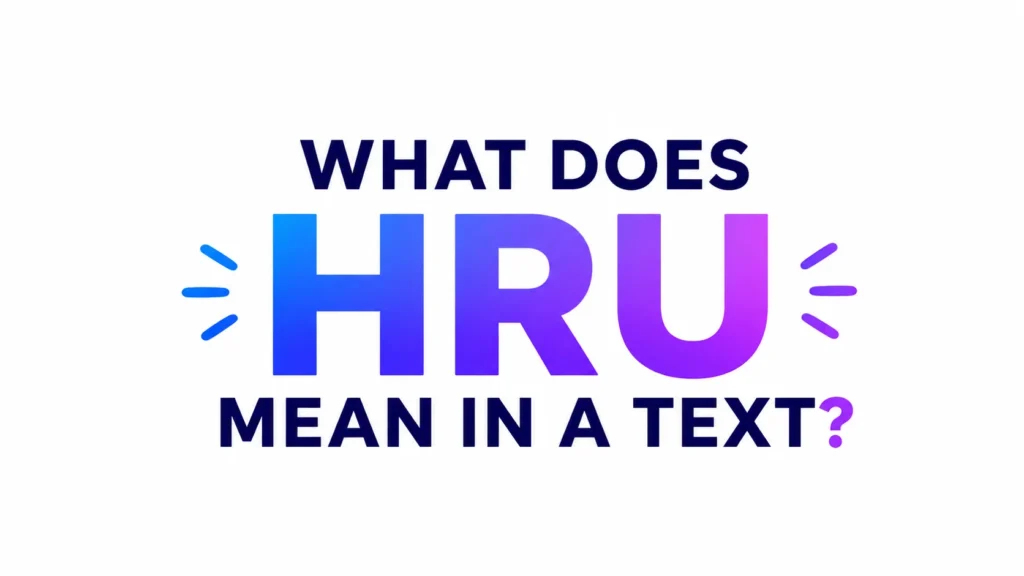
If you’ve ever opened a chat and seen someone type “HRU?”, you’re not alone in wondering what it means. At first glance, it looks like random letters. But in modern texting culture, it carries a very simple and friendly message.
People search what does hru mean in a text because digital communication has changed how we talk. Short forms, slang, and abbreviations are everywhere—especially on WhatsApp, Instagram, TikTok, and Snapchat. These shortcuts make conversations faster, but they also create confusion for those who are not used to them.
HRU is one of those expressions that looks mysterious but actually carries a warm, human tone. It’s often used to check in on someone in a casual way, like asking how they are doing without typing a full sentence.
In this guide, you’ll understand everything about HRU—its meaning, origin, emotional tone, real-life usage, and how to respond naturally in different situations.
READ MORE: What Does “.” Mean? Hidden Contexts You Should Know
2️⃣ HRU Meaning – Quick Explanation
HRU stands for:
“How Are You?”
It is a shorthand version used in texting and online chats.
Simple breakdown:
- H = How
- R = Are
- U = You
Common usage examples:
- “HRU?” → How are you?
- “Hey, HRU today?” → Hey, how are you today?
- “HRU feeling now?” → How are you feeling now?
It’s a quick, informal greeting used mostly in casual digital conversations.
3️⃣ Origin & Background of HRU
HRU comes from the early internet era, especially the time of:
- MSN Messenger
- Yahoo Chat Rooms
- Early SMS texting
Back then, typing on mobile phones was slow. People used abbreviations to save time and character space. That’s how slang like HRU, LOL, BRB, and OMG became popular.
As social media grew, these shortcuts became part of everyday communication. Even today, Gen Z continues to use them, although sometimes more ironically or casually.
HRU survived because it is simple, universal, and emotionally neutral—it can be friendly, caring, or even flirty depending on context.
4️⃣ Real-Life Conversations Using HRU
Here’s how HRU actually appears in real digital conversations.
💬 WhatsApp Chat
Person A: Hey HRU?
Person B: I’m good, just tired from work. You?
💬 Instagram DM
Person A: HRU? Haven’t seen you online lately
Person B: I’m okay, just taking a break from socials
💬 TikTok Comment Section
Person A: HRU after watching that ending??
Person B: Honestly… still processing it 😭
💬 Text Message
Person A: HRU today?
Person B: Better than yesterday, thanks for asking
These examples show how HRU adapts to emotional tone depending on the situation.
5️⃣ Emotional & Psychological Meaning of HRU
On the surface, HRU just means “How are you?” But emotionally, it carries deeper meaning.
People use HRU because:
- They want to show care without sounding too serious
- They want to start a conversation gently
- They are checking emotional well-being in a low-pressure way
What it reveals about modern communication:
Digital communication is fast, but emotions still matter. HRU is a bridge between speed and care.
Personal-style scenario:
Imagine you haven’t talked to a friend in weeks. Instead of sending a long emotional message, you simply text “HRU?” It opens the door without pressure. That’s the beauty of it—it’s simple, but emotionally thoughtful.
6️⃣ Usage in Different Contexts
📱 Social Media
Used in comments or DMs to start engagement:
- “HRU after that episode?”
- “HRU guys today?”
💕 Friends & Relationships
Common between close friends or partners:
- Checking emotional state
- Starting casual conversations
💼 Work / Professional Settings
Rarely used in formal workplaces. It may appear in:
- Informal team chats
- Friendly workplace groups
🎭 Casual vs Serious Tone
- Casual: Friendly and relaxed
- Serious: Can feel slightly shallow if used during emotional situations
7️⃣ When NOT to Use HRU
Even though HRU is widely used, there are moments when it may not be appropriate.
Avoid using it:
- During serious emotional crises
- In formal emails or professional documents
- When someone expects detailed emotional support
- In sensitive cultural or religious conversations
In such cases, full sentences like “How are you feeling today?” are more respectful.
8️⃣ Common Misunderstandings About HRU
Many people misinterpret HRU because of its simplicity.
❌ Common mistakes:
- Thinking it means something sarcastic
- Assuming it is unprofessional slang only
- Believing it has hidden meanings
⚠️ Tone confusion:
Depending on context, HRU can feel:
- Caring
- Casual
- Slightly distant if overused
Literal vs figurative:
It is always literal—it simply means “How are you?”
9️⃣ Comparison Table
| Term | Meaning | Tone | Usage |
| HRU | How are you | Casual | Everyday texting |
| HBU | How about you | Casual | Reply follow-up |
| WYD | What you doing | Casual | Checking activity |
| SUP | What’s up | Very casual | Greeting |
| HOW R U | How are you | Slightly formal | Polite texting |
| HOW ARE YOU | Full phrase | Formal | Professional or emotional |
Key Insight:
HRU is one of the simplest and most neutral slang expressions. It fits almost any casual conversation but should be used carefully in emotional or formal situations.
🔟 Variations / Types of HRU Usage
Here are common variations you may see:
- HRU? – Standard version
- HRU today? – Asking about current mood
- HRU doing? – Slightly informal variation
- Hey HRU? – Friendly greeting
- HRU rn? – “right now” version
- HRU feeling? – Emotional check-in
- HRU bro? – Casual friend tone
- HRU girl? – Gender-specific casual tone
- HRU bae? – Romantic context
- HRU tho? – Emphasis or concern
Each version slightly changes tone but keeps the same meaning.
1️⃣1️⃣ How to Respond When Someone Says HRU
😊 Casual Replies:
- “I’m good, you?”
- “Doing well, thanks!”
- “All good here!”
😄 Funny Replies:
- “Surviving another day 😂”
- “Still loading… 99%”
- “Better now that you texted!”
💬 Mature Replies:
- “I’ve been better, but I’m managing.”
- “Doing okay, just busy lately.”
🙏 Respectful Replies:
- “I’m well, thank you for asking. How about you?”
1️⃣2️⃣ Regional & Cultural Usage
🌍 Western Culture
Very common in everyday texting. Seen as normal casual greeting.
🌏 Asian Culture
Popular among younger generations, especially in urban digital spaces.
🕌 Middle Eastern Culture
Used mainly among youth in online chats, less common in formal interaction.
🌐 Global Internet Culture
HRU is universally understood in online communication.
👶 Generational Differences:
- Gen Z: Uses it casually and sometimes ironically
- Millennials: Used it heavily in early internet days
- Older generations: May find it confusing
1️⃣3️⃣ Is HRU Safe for Kids?
Yes, HRU is completely safe for kids. It is just a friendly abbreviation for “How are you?”
However, parents should still guide children on:
- Understanding tone in messages
- Recognizing when full communication is better
- Avoiding overuse of slang in school writing
1️⃣4️⃣ FAQs About HRU
1. What does HRU mean in texting?
It means “How are you?”
2. Is HRU formal or informal?
It is informal and used in casual chats.
3. Can I use HRU in emails?
No, it’s better to use full sentences in emails.
4. Is HRU still popular in 2026?
Yes, especially in social media conversations.
5. What is the reply to HRU?
Common replies include “I’m good” or “I’m fine, thanks.”
6. Does HRU mean something else?
No, it only means “How are you?”
7. Is HRU flirty?
It can be, depending on tone and context.
1️⃣5️⃣ Conclusion
Understanding what does hru mean in a text helps you navigate modern digital communication with ease. It’s a simple abbreviation, but it carries a warm intention—checking in on someone’s well-being in a fast, effortless way.
Even though it looks small, HRU reflects something bigger: how people stay emotionally connected in a fast-moving digital world.
When used correctly, it can start conversations, build relationships, and show care without needing long messages. Just remember context matters—use it casually, not formally.
So next time someone texts you “HRU?”, you’ll know exactly what they mean—and how to respond naturally.