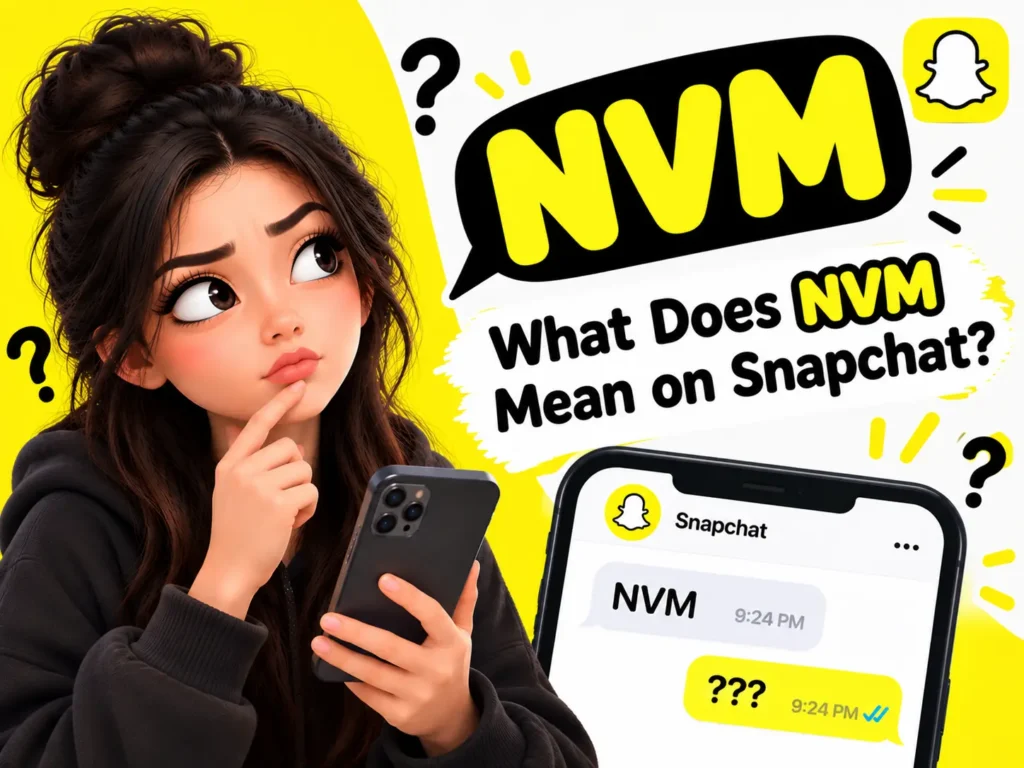
NVM on Snapchat means “Never Mind.” People use it when they want you to ignore an earlier message, stop worrying about something, or understand that they no longer need an answer. If someone sends you “nvm,” they may have changed their mind or solved the problem themselves. The abbreviation is informal and has the same basic meaning in most texting apps.
What Does NVM Mean in Texting?
NVM is an abbreviation for “Never Mind.” It is used in casual digital conversations when a question, request, or topic is no longer important.
For example:
A: Can you tell me what time the movie starts?
B: It starts at 7:30.
A: NVM, I just checked the ticket.
B: Haha, okay!
Here, NVM means the sender has already found the information and no longer needs help.
NVM is not usually a separate slang word with a special Snapchat-only definition. It is a shortened form of an everyday English expression, making it convenient for quick conversations.
READ MORE: What Does KMSL Mean on Snapchat? Full Meaning
Does NVM Have Other Meanings?
“Never Mind” is the most common meaning of NVM in everyday texting. Some references also list “Not Very Much” as an alternative, but that interpretation is less common and depends on the conversation. In a technical discussion, NVM can have unrelated meanings, such as non-volatile memory.
When someone sends NVM in an ordinary Snapchat chat, “Never Mind” is the most likely interpretation.
What Does NVM Mean on Snapchat Specifically?
On Snapchat, NVM usually tells someone to disregard an earlier message or drop a topic. The meaning does not change simply because the conversation takes place on Snapchat rather than through SMS, iMessage, WhatsApp, or Instagram DMs.
You might see it when someone:
- Finds an answer without needing your help.
- Changes their mind about asking something.
- Decides to cancel or change a request.
- Wants to stop discussing a particular subject.
- Feels frustrated and no longer wants to explain something.
For example:
A: Can you send me that picture?
B: Which one?
A: Nvm, I found it in our chat.
The sender has located the picture, so there is no longer a reason to send it again.
Funny, Sarcastic, Playful, and Serious Uses of NVM
The abbreviation stays the same, but the surrounding messages can change how it sounds.
1. Funny NVM
Someone may use NVM after realizing they made a request unnecessarily.
A: Come downstairs and help me find my phone.
B: Give me a minute.
A: NVM, it’s in my hand 😭
B: You need professional help.
2. Sarcastic NVM
NVM can sound sarcastic when a person feels ignored or thinks explaining something is pointless.
A: What were you trying to tell me?
B: Forget it.
A: No, tell me.
B: NVM, you were busy anyway.
This exchange suggests frustration, but the abbreviation alone does not prove the sender is angry.
3. Playful NVM
Friends may use it to change plans without making the situation serious.
A: Should we order pizza tonight?
B: Yes, I’m starving.
A: NVM, my brother just brought burgers 😂
B: Betrayal!
4. Serious NVM
In a serious conversation, NVM may mean the sender no longer wants to discuss something or has decided to handle it independently.
A: You said you needed to talk. What’s wrong?
B: It’s about something that happened today.
A: I’m listening.
B: NVM, I’ll explain when I’m ready.
If someone sends this during an emotional conversation, give them space while letting them know you’re available if they want to talk.
10 Realistic NVM Text Conversations
Here are more examples showing how NVM can appear in different relationships and situations.
Example 1: Between friends
A: Do you remember the name of that restaurant?
B: The Italian one?
A: Yeah, wait, nvm, I found your story.
B: Send me the food pics later!
Example 2: With a partner
A: Are you free tonight?
B: Maybe after dinner. Why?
A: Nvm, we can talk tomorrow if you’re busy.
B: I’m not too busy. Tell me what’s up.
Example 3: Between siblings
A: Did you take my headphones?
B: No, check your desk.
A: NVM, they were under my pillow.
B: Mystery solved.
Example 4: In a family chat
A: Mom, what time are we leaving?
B: Around 5 p.m.
A: Nvm, Dad just told me.
B: Good, be ready on time.
Example 5: With a coworker
A: Do you have the meeting link?
B: I’ll look for it.
A: NVM, I found it in the email. Thanks anyway.
B: No problem.
Example 6: Asking for a favor
A: Can you lend me your charger?
B: Sure, where are you?
A: Nvm, mine was in my bag.
B: Glad you found it.
Example 7: Changing a plan
A: Want to go shopping this afternoon?
B: I might have to study.
A: Nvm, let’s do it this weekend instead.
B: Saturday works better.
Example 8: A slightly awkward conversation
A: Can I ask you something personal?
B: Sure, go ahead.
A: Nvm, I’m not sure how to explain it.
B: That’s okay. Take your time.
Example 9: A quick Snapchat exchange
A: What’s the name of that song in your Snap?
B: I think it’s by The Weeknd.
A: Nvm, Shazam found it 😂
B: Technology wins again.
Example 10: A conversation with a new acquaintance
A: Do you know if the event is still happening?
B: I haven’t heard anything.
A: Nvm, they just posted an update.
B: Great, thanks for letting me know.
Grammar and Usage: How Is NVM Written?
NVM is an informal abbreviation rather than a traditional word.
- Part of speech: It functions as a conversational expression, often used as a short standalone reply or an instruction to disregard something.
- Sentence position: It commonly appears at the beginning or end of a message.
- Capitalization: NVM, nvm, and Nvm generally mean the same thing.
- Standalone use: Someone can send only “nvm” as a complete chat reply.
- Embedded use: People often write “Nvm, I figured it out” or “Actually, nvm.”
- Formality: It is suitable for casual messages but is usually less appropriate in formal emails or professional communication.
Capitalization rarely changes the definition. However, punctuation and context can affect the tone. A message like “nvm lol” may feel lighthearted, while a short “nvm.” after an argument can seem abrupt.
How Should You Reply When Someone Says NVM?
Your reply depends on what happened before the message.
Funny reply
“Too late, my detective skills are already activated 😂”
Serious reply
“Okay, but I’m here if you still need help.”
Flirty reply
“Now you have me curious 👀 Are you going to tell me or not?”
Neutral reply
“Okay, no worries!”
If the sender seems upset, you can ask, “Are you sure? Did something happen?” Avoid assuming that NVM means anger, rejection, or a problem with your relationship.
NVM vs. Similar Texting Abbreviations
| Term | Meaning | Usage Context | Tone | Popularity | Confusion Risk |
|---|---|---|---|---|---|
| NVM | Never Mind | Dropping a topic or request | Neutral or dismissive | Common | Low |
| NM | Often “Not Much”; sometimes “Never Mind” | Short replies and casual chats | Casual | Common | High |
| NVRM | Never Mind | Informal texting | Casual | Less common | Low |
| NP | No Problem | Reassuring someone | Friendly | Common | Low |
| IDC | I Don’t Care | Showing indifference | Blunt or casual | Common | Medium |
| OMW | On My Way | Giving a travel or arrival update | Neutral | Common | Low |
The key distinction is that NVM usually tells someone to drop or disregard something. NM often answers a question about what someone is doing, while NP reassures someone that an issue is not a problem.
Who Uses NVM?
NVM is used by people who communicate through informal text messages and online chats. It is not limited to one age group or a particular gender.
Gen Z and Millennials
Both Gen Z and Millennials may use NVM in quick messages. Individual habits vary, so the abbreviation does not reliably identify someone’s age. Its short form is useful whenever people want to correct a message or stop a conversation from continuing unnecessarily.
Regional Usage
NVM is recognizable in English-language online communication, including conversations among users in the United States, the United Kingdom, and other regions. However, that does not mean everyone in those places uses it equally often. The meaning generally remains “Never Mind” when the surrounding conversation is in English.
Where Can You See NVM?
You may encounter NVM in SMS, iMessage, WhatsApp messages, Snapchat chats, and Instagram DMs. It can also appear in other online conversations. The platform does not normally change its meaning.
Origin and Internet Culture
The expression “never mind” existed long before modern social media. NVM is its shortened written form, used in informal digital communication to save time and space.
There is no need to attribute the abbreviation to a specific Snapchat trend. It works because the full expression already has a familiar meaning in everyday English. Users can type the short form when a message becomes unnecessary, a question has been answered, or they decide to move on.
One interesting feature of NVM is that it can cancel the purpose of the message that came immediately before it. For example, “Can you send me the address?” followed by “Nvm, found it” makes the original request unnecessary without requiring a long explanation.
Is NVM Rude or Inappropriate?
NVM is not profanity and is not inherently offensive. In a friendly conversation, it is usually harmless. However, it can sound dismissive when someone uses it to shut down a discussion or express frustration.
At school or work: It is generally fine in casual chats with people you know. For formal communication, use clearer wording such as “Please disregard my previous message” or “I found the information, so no further action is needed.”
In personal conversations: If the topic is sensitive, consider explaining why you no longer want to discuss it. A bare “nvm” may leave the other person unsure whether you are upset.
Frequently Asked Questions About NVM
1. What does NVM mean on Snapchat from a girl or a guy?
NVM usually means “Never Mind,” regardless of who sends it. The person may have changed their mind, found an answer, or decided not to continue a topic. It does not automatically mean they are upset or uninterested in you. Read the surrounding conversation before deciding what they intended.
2. Is it rude to reply with just NVM in a text?
Not always. A standalone NVM can be perfectly normal when you no longer need help or have answered your own question. However, it may sound dismissive if the other person is trying to help or discuss something important. Adding a short explanation, such as “Nvm, I figured it out,” usually makes your meaning clearer.
3. What’s the difference between texting NVM and saying “never mind” out loud?
The basic meaning is the same: the person wants to drop something, disregard it, or stop worrying about it. In a spoken conversation, facial expressions and voice can help explain the intended tone. In a text, those clues are missing, so the message may be easier to misunderstand. A few extra words can help make the intention clear.
4. Does NVM mean the same thing in a group chat and a private Snapchat message?
Usually, yes. In both settings, NVM most commonly means “Never Mind.” In a group chat, it may cancel a question or request that everyone can see. So, In a private conversation, it may relate to a personal topic, so the relationship and earlier messages can matter more.
5. What should I do if someone sends NVM after asking me a question?
You can respond with “Okay,” “No worries,” or “Glad you figured it out.” If the conversation seems tense, you can gently ask whether everything is fine. You do not need to keep pressing for an answer if the sender has clearly dropped the subject.
6. Is NVM the same as NM?
No, not always. NVM most commonly means “Never Mind,” while NM is often used to mean “Not Much” in replies such as “What are you doing?” “NM.” Some people also use NM for “Never Mind,” so the context matters. If the message is unclear, ask what the person means rather than guessing.
7. Can I use NVM with a teacher or manager?
You can, but it may sound too casual in a formal conversation. A teacher or manager might understand it, yet a complete sentence is more professional. For example, write “Never mind, I found the answer” or “Please disregard my previous question.” Clear wording reduces the chance of sounding abrupt.
8. Does NVM mean someone is angry with me?
No. NVM by itself is not evidence that someone is angry. They may simply have solved a problem or decided that a request is no longer necessary. If it follows an argument or a sensitive exchange, consider the full conversation and ask calmly if something is wrong.
Conclusion: Remember What NVM Means
NVM means “Never Mind” on Snapchat and in most everyday text conversations. It is a quick way to drop a topic, cancel a request, or let someone know that you no longer need an answer.
Tips for Using NVM
- Use it in casual chats with friends, family, or people you know.
- Add a short explanation when you want to avoid confusion.
- Consider the context before assuming the sender is upset.
- Use the full phrase in formal or professional communication.
Common Mistakes to Avoid
- Assuming NVM always means anger or rejection.
- Confusing NVM with NM, which often means “Not Much.”
- Using it to end a serious conversation without explaining yourself.
- Expecting capitalization alone to reveal the sender’s mood.
Use NVM when you genuinely want someone to disregard an earlier message or understand that something is no longer necessary. Avoid relying on it alone when the conversation is sensitive and clarity matters.