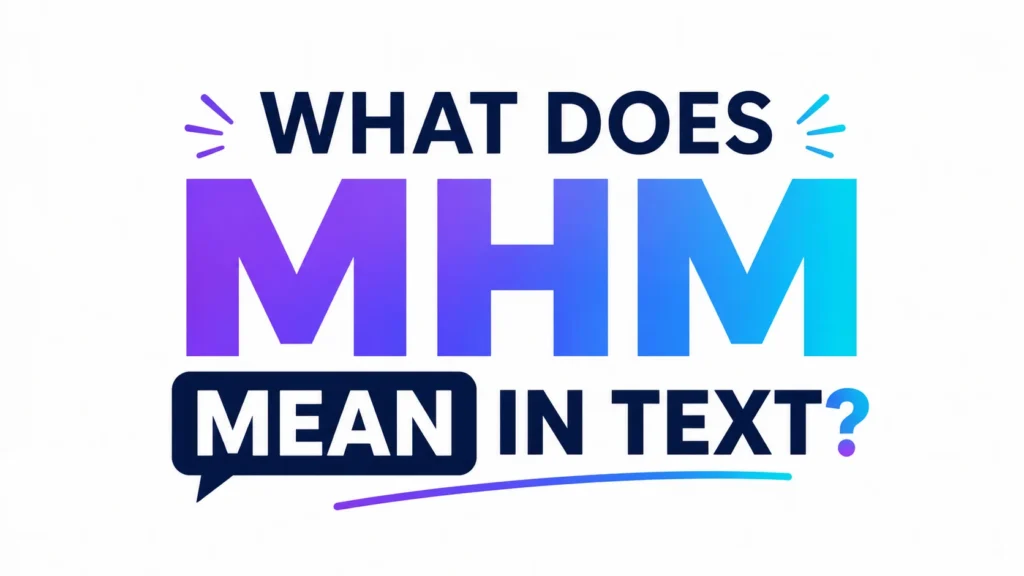
If you’ve ever received a simple “mhm” in a text message and found yourself wondering what it actually means, you’re not alone.
Many people search for “what do mhm mean in text” because this tiny response can carry surprisingly different meanings depending on the situation. Sometimes it signals agreement. Other times it shows interest, understanding, impatience, or even emotional distance.
Unlike traditional words, internet shorthand often relies heavily on tone and context. That’s why a simple three-letter reply can create confusion in conversations between friends, partners, coworkers, and even strangers online.
Understanding what “mhm” means can help you avoid misunderstandings and communicate more confidently in today’s fast-moving digital world.
What Do MHM Mean in Text? – Quick Meaning
Simple Definition
“Mhm” is a casual expression used in text messages and online conversations to mean:
- Yes
- I agree
- I understand
- I’m listening
- That’s true
It is often considered a text version of a humming acknowledgment someone might make during a face-to-face conversation.
Quick Examples
“Are you coming tonight?”
“Mhm.”
“That movie was amazing.”
“Mhm, I loved it.”
“You understand what I mean?”
“Mhm.”
In most cases, the reply shows agreement or acknowledgment without requiring a long response.
Why People Use It
People use “mhm” because it feels natural, quick, and conversational. It allows someone to respond without interrupting the flow of a discussion.
Origin & Background
Where Did MHM Come From?
“Mhm” existed long before texting.
In spoken English, people have used humming sounds like “mm-hmm” for generations to indicate agreement or understanding. Linguists often classify it as a conversational acknowledgment signal.
When texting became popular, users began typing these sounds exactly as they heard them.
As a result, “mm-hmm” gradually evolved into shorter written forms such as:
- Mhm
- Mmhm
- Mhmmmm
- Mm-hmm
Cultural Influence
The expression became especially common in English-speaking countries where conversational listening cues are deeply embedded in everyday communication.
People naturally carried spoken habits into digital conversations.
Social Media Impact
Platforms like TikTok, Instagram, Snapchat, and WhatsApp accelerated the popularity of shorthand responses.
Users increasingly preferred short replies that felt personal and authentic rather than formal.
“Mhm” became one of those expressions that could communicate agreement instantly without sounding robotic.
How Its Meaning Evolved
Originally, “mhm” simply meant “yes.”
Today, it can communicate:
- Agreement
- Understanding
- Passive listening
- Emotional support
- Reluctance
- Mild annoyance
The surrounding conversation usually determines the intended meaning.
Real-Life Conversations
WhatsApp Conversation
Person A:
I finally got the promotion!
Person B:
Mhm! I knew you’d get it.
Person A:
Thanks for believing in me.
Person B:
Always.
Instagram DM Conversation
Person A:
That vacation looks incredible.
And,
Person B:
Mhm, it was honestly the best trip I’ve ever taken.
Person A:
Now I’m jealous.
TikTok Comments
Person A:
This song has been stuck in my head all week.
And,
Person B:
Mhm, same here.
Person A:
It’s impossible to stop listening to it.
Text Message Conversation
Person A:
I think we need to talk about what happened yesterday.
Person B:
Mhm.
Or,
Person A:
Are you upset?
Person B:
A little, but I’m listening.
In this example, “mhm” shows attention rather than agreement.
Emotional & Psychological Meaning
What Emotion Does MHM Express?
The emotional meaning depends heavily on context.
It may express:
- Agreement
- Comfort
- Validation
- Patience
- Interest
- Indifference
This flexibility is what makes it so common and sometimes confusing.
Why People Use It
Human conversations require feedback signals.
When someone speaks in person, listeners often nod, smile, or make sounds such as “mm-hmm.”
Texting removes these physical cues.
“Mhm” helps fill that gap.
What It Reveals About Modern Communication
Modern communication values speed and efficiency.
People often want to stay engaged without writing lengthy messages.
“Mhm” functions as a quick emotional acknowledgment that keeps conversations moving.
A Realistic Scenario
Imagine explaining a stressful day to a close friend.
You send several messages describing what happened.
Your friend responds with:
“Mhm, I get why you’re frustrated.”
That simple reply can feel reassuring because it shows they’re paying attention without taking over the conversation.
Usage in Different Contexts
Social Media
On social media, “mhm” commonly expresses agreement with a post, comment, or opinion.
Example:
“Mhm, that’s exactly what I was thinking.”
Friends & Relationships
Among friends, it usually feels casual and supportive.
In relationships, however, tone matters.
“Mhm ❤️” feels warm.
“Mhm.” may sometimes seem distant depending on the discussion.
Work and Professional Settings
Professional environments generally favor clearer language.
Instead of “mhm,” consider:
- Yes
- I understand
- Agreed
- Absolutely
While not inappropriate, “mhm” can appear overly casual in workplace communication.
Casual vs Serious Tone
Casual conversation:
“Mhm, sounds good.”
Serious discussion:
“Mhm, I understand how difficult that was.”
The same word works differently based on emotional context.
When NOT to Use It
Professional Communication
Avoid using “mhm” in:
- Formal emails
- Business proposals
- Client communications
- Academic writing
More direct language appears professional and respectful.
Sensitive Conversations
When someone shares emotional news, a simple “mhm” may seem dismissive.
Examples include:
- Family emergencies
- Personal loss
- Serious conflicts
A fuller response often shows greater empathy.
Cultural Sensitivity
Not everyone interprets “mhm” the same way.
Some people view it as friendly acknowledgment.
Others perceive it as uninterested or rude.
Situations That May Cause Confusion
“Mhm” can be misunderstood when:
- Context is unclear
- Emotions are high
- The relationship is strained
- The conversation requires detailed feedback
Common Misunderstandings
People Assume It Always Means Yes
Although often affirmative, “mhm” doesn’t always mean agreement.
Sometimes it simply means:
“I hear you.”
Tone Confusion
Text messages lack vocal tone.
As a result, readers often project their own emotions onto a message.
One person may read “mhm” as friendly.
Another may interpret it as cold.
Literal vs Figurative Meaning
Literally, “mhm” is a sound representing acknowledgment.
Figuratively, it can communicate emotional support, agreement, or passive listening.
Relationship-Based Interpretation
The meaning changes depending on who sends it.
A close friend’s “mhm” may feel comforting.
A stranger’s “mhm” may feel neutral.
Comparison Table
| Expression | Meaning | Tone | Usage |
|---|---|---|---|
| Mhm | Yes, I understand | Casual | Texting and chats |
| Yep | Yes | Friendly | Everyday conversations |
| Yeah | Agreement | Neutral | General communication |
| Uh-huh | Spoken agreement | Informal | Conversations |
| Okay | Acceptance | Neutral | Casual and professional |
| Sure | Willing agreement | Flexible | Many contexts |
| Nope | No | Casual | Informal chats |
| Nah | Informal no | Relaxed | Friends and social media |
Key Insight
“Mhm” is unique because it often communicates both acknowledgment and emotion. Most alternatives focus primarily on agreement, while “mhm” can subtly signal attention, empathy, or understanding.
Variations / Types
Mhm
Basic acknowledgment or agreement.
Mmhm
A slightly stronger version of agreement.
Mhmmmm
Often indicates enthusiasm or deeper thought.
Mm-Hmm
Traditional written form of the spoken expression.
Mmmm
May suggest thinking, enjoyment, or reflection.
Mhm Yup
Combines acknowledgment with confirmation.
Mhmmm Okay
Shows agreement after consideration.
Mhm Sure
Suggests acceptance of an idea.
Mhm Exactly
Strong agreement with someone’s statement.
Mhm I Know
Indicates agreement combined with familiarity.
How to Respond When Someone Uses It
Casual Replies
- Cool.
- Glad you agree.
- Sounds good.
- That’s what I thought.
Funny Replies
- I’ll take that as a yes.
- Such a detailed response.
- Wow, very expressive.
- Your enthusiasm is overwhelming.
Mature Replies
- Thanks for understanding.
- I appreciate your perspective.
- Glad we’re on the same page.
- That’s helpful to know.
Respectful Replies
- Thank you for listening.
- I understand your point.
- I appreciate the acknowledgment.
- Thanks for your feedback.
Regional & Cultural Usage
Western Culture
In North America and many Western countries, “mhm” is widely understood as agreement or acknowledgment.
Most people interpret it positively.
Asian Culture
Interpretations can vary.
Some users may prefer more direct responses, especially in formal communication.
Among younger internet users, however, “mhm” is becoming increasingly familiar.
Middle Eastern Culture
Online communities often adopt English texting habits, including “mhm.”
Meaning generally remains close to acknowledgment or agreement.
Global Internet Usage
Social media has made “mhm” recognizable across many countries.
Even non-native English speakers frequently encounter and use it online.
Generational Differences
Gen Z
- Uses it casually and frequently
- Understands tone variations
- Often combines it with emojis
Millennials
- Uses it for acknowledgment
- May interpret tone more carefully
- Often sees it as conversational shorthand
Is It Safe for Kids?
Understanding the Context
Yes, “mhm” is generally safe for kids.
It is not offensive, inappropriate, or harmful.
The expression simply functions as a conversational acknowledgment similar to saying “yes,” “I understand,” or “I’m listening.”
Parents should focus on teaching context and communication skills rather than worrying about the word itself.
FAQs
What does mhm mean in text from a girl?
Usually it means agreement, understanding, or acknowledgment. The exact meaning depends on the conversation and emotional context.
Is mhm the same as yes?
Often yes, but not always. Sometimes it simply means the person is listening rather than agreeing.
Can mhm be rude?
It can appear rude if used during an emotional or serious discussion without additional context.
What is the difference between mhm and yeah?
“Yeah” directly expresses agreement, while “mhm” often combines agreement with acknowledgment.
Why do people text mhm instead of yes?
It feels more conversational and resembles natural spoken language.
Does mhm mean someone likes you?
Not necessarily. It usually reflects communication style rather than romantic interest.
Is mhm positive or negative?
Most of the time it is neutral or positive. The surrounding conversation determines its emotional tone.
Conclusion
Understanding what do mhm mean in text is less about the word itself and more about the context behind it.
In most conversations, “mhm” serves as a simple acknowledgment that signals agreement, understanding, or active listening. Yet its emotional flexibility is what makes it so interesting. The same three letters can feel supportive, thoughtful, enthusiastic, or occasionally distant depending on who uses them and why.
As digital communication continues to evolve, small expressions like “mhm” help recreate the natural rhythms of face-to-face conversation. Once you recognize the subtle cues surrounding it, you’ll be able to interpret it more accurately and use it with confidence in your own messages.