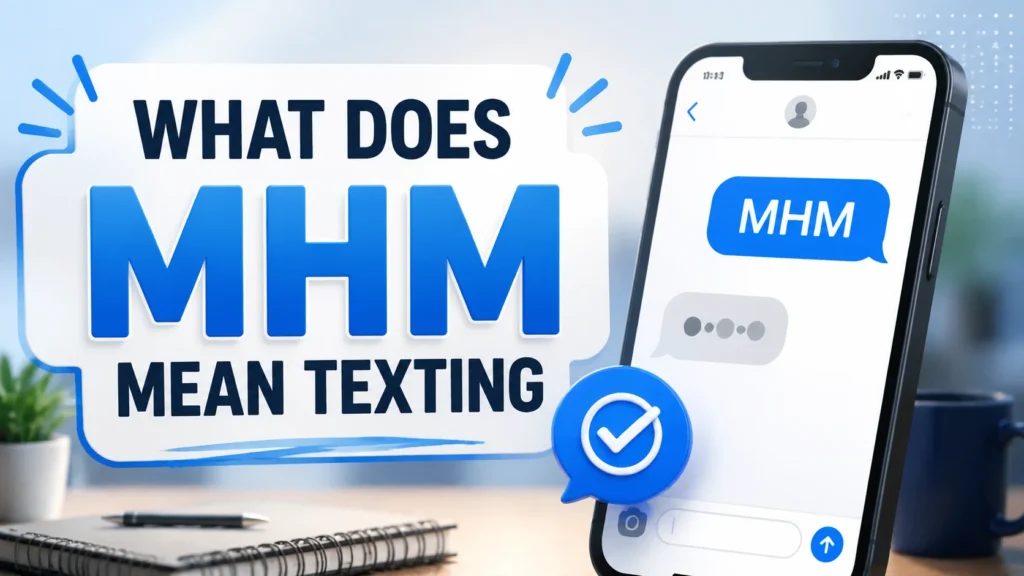
If you have received a text message containing “mhm”, you may have wondered what the person is trying to say.
Many people search for “what does mhm mean texting” because this small expression does not look like a traditional word. However, it is one of the most common ways people show agreement or acknowledgment in digital conversations.
In texting, MHM usually means “yes,” “yeah,” or “I agree.”
It is a casual way of showing that someone understands or accepts what another person has said.
For example:
Person A:
“Are you coming to the party tonight?”
Person B:
“Mhm.”
Meaning:
“Yes, I am.”
However, the meaning of mhm can change depending on tone and context.
Sometimes it can mean:
- Yes
- I agree
- I understand
- I’m listening
- Maybe a hesitant response
The feeling behind the word often depends on the conversation.
MHM is commonly used in:
- Text messages
- WhatsApp chats
- Instagram DMs
- Snapchat
- Online conversations
Understanding this simple expression helps you read emotions and intentions in modern digital communication.
What Does MHM Mean in Texting – Quick Meaning
Simple Definition of MHM
MHM = Yes / Yeah / I agree
It is an informal response used to show agreement or acknowledgment.
It can mean:
- “Yes.”
- “That’s true.”
- “I understand.”
- “I’m following what you are saying.”
Examples of MHM in Text Messages
“Did you finish your homework?”
“Mhm.”
Meaning:
“Yes, I did.”
“This movie was amazing.”
“Mhm, I loved it.”
Meaning:
“I agree.”
“You know what I mean?”
“Mhm.”
Meaning:
“Yes, I understand.”
Is MHM Positive or Negative?
Usually, mhm is positive or neutral.
However, the tone can change its meaning.
Positive:
“Mhm, that sounds great!”
Meaning:
“Yes, I like that idea.”
Neutral:
“Mhm.”
Meaning:
“I’m listening.”
Hesitant:
“Mhm… I guess.”
Meaning:
“I’m not completely sure.”
The surrounding conversation explains the real meaning.
Common Uses of MHM in Conversations
1. Showing Agreement
The most common use of mhm is agreeing with someone.
Example:
Person A:
“The weather is really nice today.”
Person B:
“Mhm.”
Meaning:
“Yes, I agree.”
2. Showing Understanding
People use mhm when they understand information.
Example:
Person A:
“First click this button, then select the option.”
Person B:
“Mhm, I understand.”
3. Showing They Are Listening
Sometimes mhm means:
“I’m paying attention.”
Example:
Person A:
“I had a really stressful day at work.”
Person B:
“Mhm, tell me more.”
Here, it shows attention rather than simple agreement.
4. Giving a Short Response
Some people use mhm because they want to reply quickly.
Instead of typing:
“Okay, I understand.”
they write:
“Mhm.”
This is common in casual conversations.
Examples of MHM in Different Situations
Example 1: Friends
Person A:
I think we should watch that new series.
Person B:
Mhm, everyone says it’s good.
Meaning:
“I agree.”
Example 2: Relationship Conversation
Person A:
I miss spending time with you.
Person B:
Mhm, me too.
Meaning:
“Yes, I feel the same.”
Example 3: Advice Conversation
Person A:
You should take some rest today.
Person B:
Mhm, you’re right.
Meaning:
“I agree with your advice.”
Example 4: Online Chat
Person A:
This update fixed many problems.
Person B:
Mhm, it’s much better now.
Meaning:
“I agree with this opinion.”
Origin & Background of MHM
Where Did MHM Come From?
MHM comes from spoken English.
People have naturally used sounds like:
- “Mm-hmm”
- “Uh-huh”
for many years to show agreement.
These sounds existed in everyday conversations long before texting became popular.
When people started communicating online, they transferred these spoken expressions into written messages.
From Conversation Sound to Texting Slang
In real-life conversations, someone may respond:
“Mm-hmm.”
This sound means:
“Yes, I understand.”
In digital communication, people shortened it into:
Mhm
or:
mhm
This made it easier to type while keeping the same conversational feeling.
Cultural Influence of Digital Communication
Online communication often tries to copy real-life conversations.
People use expressions like:
- Hmm
- Haha
- Mhm
- Yeah
- Yep
because they add emotion to text messages.
Without facial expressions or voice tone, these small words help show feelings.
Social Media Impact
Platforms like:
- Snapchat
- TikTok
helped make mhm common among younger users.
People use it because it feels more natural than a simple:
“Yes.”
Example:
“Yes.”
can sound formal.
“Mhm.”
sounds more relaxed and conversational.
Real-Life Conversations Using MHM
WhatsApp Conversation
Person A:
Are you okay after everything that happened?
and,
Person B:
Mhm, I’m feeling better now.
Person A:
Good. Take care of yourself.
Here, mhm means “yes.”
Instagram DM Conversation
Person A:
This outfit looks good on you.
Person B:
Mhm, I finally found something comfortable.
Here, mhm shows agreement or acknowledgment.
TikTok Comment Conversation
Commenter:
This creator’s videos keep getting better.
Reply:
Mhm, I agree.
Here, mhm shows support for the opinion.
Text Message Conversation
Person A:
You remember our plan for tomorrow?
and,
Person B:
Mhm.
Person A:
Great, see you then.
Here, mhm means “yes, I remember.”
Emotional & Psychological Meaning of MHM
What Emotion Does MHM Express?
The expression “mhm” often expresses agreement, attention, or understanding.
Unlike a simple “yes,” mhm can feel more conversational because it is closer to a sound people make while speaking.
For example:
“Mhm, I understand what you mean.”
This can communicate:
- “I agree with you.”
- “I’m listening.”
- “I understand.”
The emotional meaning depends heavily on the situation and the relationship between the people.
Why Do People Use MHM?
People use mhm because it feels natural and relaxed.
A simple “yes” can sometimes sound:
- Formal
- Short
- Serious
Mhm feels more like a real conversation.
Compare:
“Yes.”
vs.
“Mhm.”
The first is a direct answer.
The second feels more like someone is actively listening.
People use mhm when they want to:
- Confirm something
- Show agreement
- Encourage someone to continue talking
- Give a quick response
What Does MHM Reveal About Modern Communication?
Modern digital communication tries to recreate real-life conversations.
When people talk face-to-face, they use small sounds like:
- Hmm
- Yeah
- Mm-hmm
- Uh-huh
These sounds show emotions and attention.
Texting removes facial expressions and voice tone, so people use expressions like mhm to add personality.
A single word can show:
“I am here.”
“I understand.”
“I’m listening.”
Personal-Style Scenario
Imagine you are sharing a problem with a close friend:
You:
“I’ve been feeling stressed about my exam.”
Friend:
“Mhm… tell me more.”
Here, mhm does not simply mean “yes.”
It shows that your friend is listening and encouraging you to continue.
The meaning comes from the emotional context.
Usage of MHM in Different Contexts
MHM in Social Media
Mhm is common in social media conversations because users prefer casual and natural expressions.
It appears in:
- Comments
- Direct messages
- Replies
- Group chats
Examples:
“Mhm, that’s true.”
“Mhm, I agree with this.”
It helps conversations feel more personal.
MHM Among Friends
Friends often use mhm as a quick response.
Example:
Person A:
“I think we should order pizza.”
Person B:
“Mhm.”
Meaning:
“Yes, that sounds good.”
Among friends, it usually feels comfortable and friendly.
MHM in Relationships
In romantic conversations, mhm can carry emotional meaning.
Example:
Person A:
“I really care about you.”
Person B:
“Mhm, I know.”
Depending on the tone, it may show:
- Agreement
- Comfort
- Affection
- Quiet understanding
However, a short “mhm” can sometimes feel less enthusiastic if the situation requires a stronger response.
MHM in Professional Communication
Mhm is usually too casual for formal workplace communication.
Avoid:
“Mhm, I understand the report.”
Better:
“Yes, I understand the report.”
or:
“I understand.”
However, during casual workplace chats with familiar coworkers, some people may use it.
MHM in Gaming Communities
Gamers and online communities may use mhm during quick conversations.
Examples:
“Ready for the next round?”
“Mhm.”
Meaning:
“Yes.”
Because gaming chats are fast, short responses are common.
When NOT to Use MHM
In Formal Communication
Mhm is an informal expression.
Avoid using it in:
- Business emails
- Academic writing
- Official messages
- Professional reports
Use:
- Yes
- I agree
- Understood
- Certainly
instead.
When You Need to Show Strong Agreement
Sometimes mhm sounds too weak.
Example:
Someone shares an important idea.
Not ideal:
“Mhm.”
Better:
“I completely agree.”
or:
“That’s a great point.”
During Serious Conversations
A short mhm may accidentally sound uninterested.
Example:
Person:
“I need to talk about something important.”
Reply:
“Mhm.”
This may appear dismissive.
A better response:
“I’m listening. Tell me what happened.”
When Someone Needs Emotional Support
If someone shares feelings, a stronger response is usually better.
Instead of:
“Mhm.”
Say:
“I understand.”
“I’m here for you.”
“Tell me more.”
Common Misunderstandings About MHM
Misunderstanding 1: Thinking MHM Always Means Yes
Although mhm often means yes, it is not always a clear agreement.
Example:
“Are you happy with the decision?”
“Mhm…”
The person may sound uncertain.
Misunderstanding 2: Confusing MHM With Hmm
These expressions are different.
Mhm:
Usually means agreement.
Example:
“Mhm, you’re right.”
Hmm:
Usually means thinking or uncertainty.
Example:
“Hmm, I’m not sure.”
Misunderstanding 3: Thinking MHM Is Always Positive
The tone changes the meaning.
Positive:
“Mhm, that’s a great idea.”
Negative or doubtful:
“Mhm… if you say so.”
Misunderstanding 4: Thinking MHM Is a Full Conversation
Mhm is usually a short response.
If someone gives only “mhm” repeatedly, they may be:
- Busy
- Tired
- Not interested
- Unsure what to say
Misunderstanding 5: Confusing MHM With MHM Meaning “My Heart Matters”
Some people create different meanings for abbreviations online.
However, in normal texting, mhm usually means:
“Yes” or “I agree.”
Comparison Table: MHM and Similar Expressions
| Expression | Meaning | Tone | Example |
|---|---|---|---|
| Mhm | Yes/agreement | Casual | “Mhm, I agree.” |
| Mm-hmm | Yes/agreement | Spoken version | “Mm-hmm, exactly.” |
| Yeah | Yes | Casual | “Yeah, that’s true.” |
| Yep | Yes | Informal | “Yep, I know.” |
| Yup | Yes | Friendly/casual | “Yup, I’m coming.” |
| Hmm | Thinking/uncertain | Neutral | “Hmm, I’m not sure.” |
| Okay | Acceptance | Neutral | “Okay, understood.” |
| Sure | Agreement/willingness | Friendly | “Sure, no problem.” |
Key Insight
MHM is more than a simple “yes.” It is a conversational expression that can show agreement, understanding, or active listening. The true meaning depends on the tone, relationship, and situation where it is used.
Variations and Types of MHM in Texting
The expression mhm can appear in different forms depending on the speaker’s emotion, typing style, and the situation. These variations can slightly change the feeling behind the response.
1. Mhm
Meaning: Yes, I agree, or I understand.
Explanation: The standard texting form used to show acknowledgment.
Example:
“Did you understand the instructions?”
“Mhm.”
Meaning:
“Yes, I understand.”
2. Mhm Yeah
Meaning: Strong agreement.
Explanation: Combines mhm with yeah to show clearer confirmation.
Example:
“Mhm yeah, that’s exactly what I meant.”
3. Mm-Hmm
Meaning: Spoken version of mhm.
Explanation: This is the original conversational sound people make when agreeing.
Example:
“Do you agree?”
“Mm-hmm.”
Meaning:
“Yes.”
4. Mhm…
Meaning: A hesitant or uncertain response.
Explanation: Adding dots can change the emotion.
Example:
“Do you like the idea?”
“Mhm…”
Meaning:
“I’m not completely sure.”
5. Mhmm
Meaning: A longer or more expressive version of mhm.
Explanation: Often used to show stronger agreement or a warmer reaction.
Example:
“That cake was amazing.”
“Mhmm, it really was.”
6. Mhm Sure
Meaning: Agreement or acceptance.
Explanation: Shows willingness but may sometimes sound less enthusiastic.
Example:
“Can you help me later?”
“Mhm sure.”
7. Mhm Exactly
Meaning: Strong agreement.
Explanation: Used when someone completely agrees with a point.
Example:
“Mhm exactly, that’s what happened.”
8. Mhm I Know
Meaning: I understand or already know.
Explanation: Used when someone is confirming information.
Example:
“You should save your work.”
“Mhm, I know.”
9. Mhm Okay
Meaning: Acceptance or acknowledgment.
Explanation: Shows that someone has received information.
Example:
“The meeting is moved to Monday.”
“Mhm okay.”
10. Mhm True
Meaning: Agreement with an opinion.
Explanation: Used when confirming that something is correct.
Example:
“Mhm true, that restaurant is expensive.”
How to Respond When Someone Uses MHM
The best response depends on whether mhm means agreement, listening, or uncertainty.
Casual Replies
If someone says:
“Mhm.”
You can reply:
- “Great.”
- “Exactly.”
- “I know, right?”
- “Same.”
- “Glad you agree.”
Friendly Replies
Among friends:
- “Haha, I knew you’d agree.”
- “Right? It makes sense.”
- “Exactly what I was thinking.”
- “You get it.”
Mature Replies
For thoughtful conversations:
- “I appreciate you understanding.”
- “Thanks for listening.”
- “I’m glad we agree.”
- “That makes sense.”
If MHM Sounds Uncertain
If someone replies:
“Mhm…”
You can ask:
- “Are you unsure?”
- “What do you think?”
- “Do you agree?”
- “Is something wrong?”
This helps avoid misunderstanding.
Regional & Cultural Usage of MHM
Western Culture
In countries where English is commonly spoken, such as the United States, United Kingdom, Canada, and Australia, mhm is widely understood.
It is especially common in:
- Text messages
- Online chats
- Casual conversations
People use it because it feels similar to natural spoken agreement.
Asian Culture
In many Asian countries, English learners encounter mhm through:
- Social media
- Movies
- Online conversations
- International communication
Young users may use it casually, especially when chatting in English.
However, in formal situations, people usually prefer:
- Yes
- I agree
- Understood
Middle Eastern Culture
Among younger internet users, mhm appears through global online communication.
It is commonly used in:
- WhatsApp conversations
- Social media messages
- Friend groups
Professional and formal environments usually avoid such casual expressions.
Global Internet Usage
Mhm has become popular worldwide because it represents a universal human reaction.
People in many cultures use similar sounds to show agreement:
- Mm-hmm
- Uh-huh
- Yeah
- Yep
Digital communication simply changed the spelling.
Generational Differences: Gen Z vs Millennials
Gen Z:
Often uses mhm naturally in texting.
Example:
“Mhm, that’s true.”
Millennials:
Also understand it but may use:
- Yeah
- Yep
- Exactly
more frequently.
Both groups understand the emotional meaning.
Is MHM Safe for Kids?
Yes, mhm is completely safe for children.
It is a normal conversational expression that means:
- Yes
- I understand
- I agree
Children may see it in:
- Text messages
- Online games
- Social media
- Group chats
Parents can explain that the meaning depends on the situation.
For example:
A child replying:
“Mhm, I finished my homework.”
simply means:
“Yes, I finished.”
The important lesson is teaching children that online messages can have different tones.
“Mhm” may show agreement, but “mhm…” may show doubt.
Frequently Asked Questions About What Does MHM Mean in Texting
What does mhm mean in texting?
Mhm usually means “yes,” “yeah,” or “I agree.” It is a casual way to show understanding or acknowledgment.
Is mhm the same as yes?
Mhm is similar to yes, but it feels more conversational and informal.
Example:
“Yes.”
is direct.
“Mhm.”
sounds more like natural speech.
Does mhm mean agreement?
Yes, most of the time mhm means agreement or acceptance.
Example:
“That movie was good.”
“Mhm.”
Meaning:
“I agree.”
Can mhm be negative?
Mhm itself is usually neutral, but the tone can make it sound uncertain.
Example:
“Mhm…”
may suggest doubt or hesitation.
What is the difference between mhm and hmm?
Mhm:
Usually means agreement.
Hmm:
Usually means thinking or uncertainty.
Example:
“Mhm, you’re right.”
“Hmm, I need to think.”
Is mhm rude in texting?
No, mhm is not rude. However, using only “mhm” in an important conversation may seem less interested.
How do you reply to mhm?
You can reply based on the situation:
- “Exactly.”
- “Right.”
- “Thanks for understanding.”
- “What do you think?”
Conclusion
The meaning of mhm in texting is simple: it usually means yes, I agree, or I understand.
This small expression is popular because it feels more natural than a simple “yes.” It brings the feeling of real conversation into digital messages.
However, context matters. A friendly “mhm” can show agreement, while “mhm…” may show uncertainty or hesitation.
Understanding expressions like mhm helps you read online conversations more accurately and recognize the emotions behind short messages.
Whether you see it in a WhatsApp chat, Instagram DM, or text message, you can now understand that mhm is a simple way of saying “I’m listening, I understand, or I agree.”