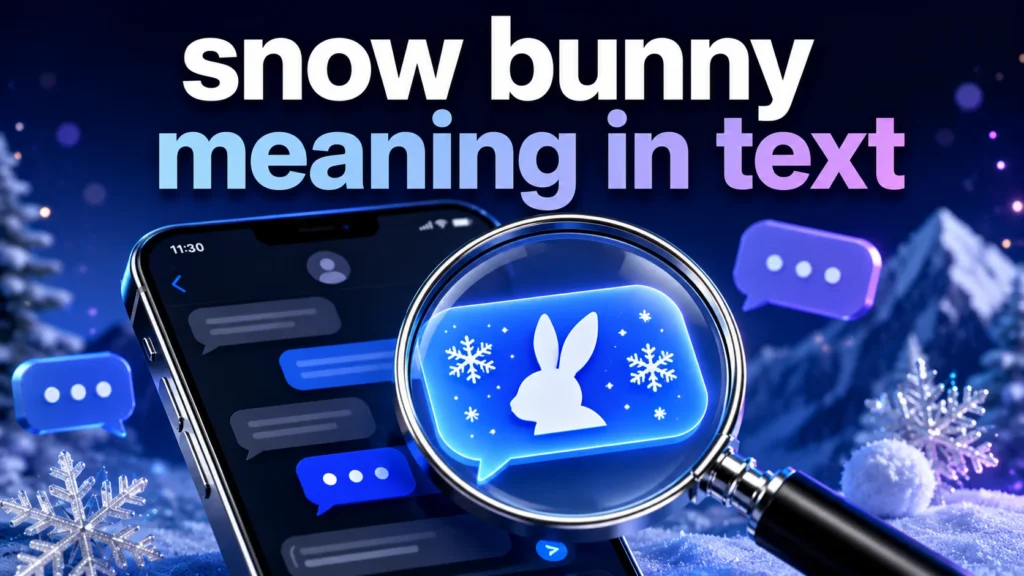
The snow bunny meaning in text can be confusing because the phrase has several possible interpretations. Most importantly, its meaning changes according to the conversation, relationship, and cultural background of the people using it.
Traditionally, a snow bunny is a woman who enjoys skiing, snowboarding, snowy vacations, or winter fashion. However, modern social media and dating culture have given the phrase additional meanings.
For instance, “snow bunny” may refer to an attractive white woman. In some conversations, it more specifically describes a white woman who dates or feels attracted to Black men.
Therefore, a message such as “You look like a snow bunny” is not always easy to interpret. It could be a playful compliment about someone’s winter outfit. On the other hand, it could include racial, romantic, or flirtatious undertones.
This guide explains the phrase’s definitions, background, emotional meaning, cultural usage, and possible responses. As a result, you will be able to understand the sender’s intention more confidently.
Snow Bunny Meaning in Text – Quick Meaning
The snow bunny meaning in text usually refers to one of the following:
- A woman who enjoys skiing or snowboarding
- A woman who regularly visits snowy resorts
- A beginner or casual female skier
- An attractive woman wearing fashionable winter clothing
- A white woman in modern dating slang
- A white woman who dates or prefers Black men
Originally, the phrase was closely connected to winter sports and ski-resort culture. However, its modern slang meaning often focuses on race, attraction, or relationships.
For example:
“That white jacket makes you look like a snow bunny.”
Here, the sender is probably complimenting the person’s winter appearance.
“She spends every winter skiing. She’s a real snow bunny.”
In this case, the phrase refers to someone who loves winter sports.
“He said his new girlfriend is a snow bunny.”
By contrast, this example may have a racial or dating-related meaning.
Consequently, you should never interpret the phrase without looking at the surrounding messages.
Origin and Background of Snow Bunny
The original winter meaning
The expression “snow bunny” developed as informal North American slang connected with skiing and winter resorts.
Historically, the word “bunny” was sometimes used as an affectionate or playful name for a young or attractive woman. Therefore, adding “snow” connected the woman with snowy places, winter activities, or ski culture.
At first, the term often described a woman who visited ski slopes. She might have been an experienced skier, a beginner, or simply someone who enjoyed spending time at the resort.
However, the phrase was not always completely positive. Sometimes, experienced skiers used it to describe women who appeared more interested in fashion, photographs, or socializing than serious skiing.
Even so, many people continued using it as a harmless and playful winter nickname.
How the meaning evolved
Over time, the word “snow” also became associated with whiteness in certain slang communities. As a result, “snow bunny” developed a second meaning: an attractive white woman.
Later, the phrase became connected with interracial dating. In particular, it began describing a white woman who dates, prefers, or feels attracted to Black men.
Nevertheless, this is not the meaning in every conversation. The traditional skiing definition still exists, especially in winter-travel and sports-related discussions.
Therefore, context remains the most important clue.
Social media influence
Social media has significantly expanded the phrase’s popularity. For example, TikTok, Instagram, X, YouTube, memes, music, and online dating discussions frequently include the term.
A creator might post a winter outfit with the caption “Snow bunny season.” In that situation, the phrase probably describes a winter aesthetic.
Meanwhile, someone might comment, “Bro finally found a snow bunny.” Here, the phrase is more likely to refer to race and dating.
Additionally, some posts intentionally use both meanings at the same time. A fashionable white woman standing at a ski resort could fit both the traditional and modern definitions.
Because online communication lacks facial expressions and vocal tone, misunderstandings happen easily. Therefore, the same phrase may feel harmless to one person but uncomfortable to another.
Real-Life Conversations Using Snow Bunny
WhatsApp conversation
Person A: Your ski pictures look amazing. You’re a proper snow bunny now!
Person B: Is that a compliment, or are you making fun of my skiing?
Person A: Definitely a compliment. Your white jacket looks perfect with the snowy background.
In this conversation, “snow bunny” refers to winter appearance and ski-trip energy. Therefore, it does not appear to have a racial meaning.
Instagram DM
Person A: Okay, snow bunny, I see you 👀
Person B: What exactly does that mean?
Person A: You look cute in that winter coat. It’s giving luxury ski-resort vibes.
Here, the eye emoji creates a flirtatious tone. However, the explanation shows that the sender is mainly referring to the woman’s outfit.
TikTok comments
Commenter A: Bro finally got himself a snow bunny.
Commenter B: Why are you bringing race into their relationship?
Commenter A: It was supposed to be a joke. Still, I understand why it sounded strange.
In this example, the phrase refers to a white woman in an interracial relationship. As a result, another user considers the label unnecessary or insensitive.
Text-message conversation
Person A: Are you into snow bunnies?
Person B: Do you mean women who ski or white women?
Person A: White women. I heard the phrase in a song.
This conversation clearly demonstrates why clarification is useful. Instead of assuming, Person B directly asks which meaning the sender intended.
Emotional and Psychological Meaning
“Snow bunny” can express admiration, attraction, teasing, humor, objectification, or social identity. Therefore, the emotional meaning depends heavily on who says it and how the other person feels about it.
Among close friends, the phrase may sound affectionate. For instance, someone might call her best friend a snow bunny after seeing pictures from a winter vacation.
However, the same phrase may feel uncomfortable when it comes from a stranger. In that case, it could sound overly personal, racialized, or sexually suggestive.
People often use slang to show that they understand a particular culture or online trend. Consequently, repeating popular expressions can make them feel socially connected.
Nevertheless, some people copy slang from songs or TikTok videos without understanding its full meaning. As a result, they may unintentionally offend someone.
Consider a simple personal-style scenario. Imagine that you post a photograph wearing a white coat beside a snowy mountain.
Your close friend comments, “My favorite snow bunny!” Because you know her personality, you understand that she is joking about your winter outfit.
Later, an unknown account comments, “I’ve always wanted a snow bunny.” Although the same phrase appears, the message now feels more romantic, racial, or objectifying.
Therefore, relationships and intentions are just as important as dictionary definitions.
Usage in Different Contexts
Social media
On social media, “snow bunny” commonly appears in captions, hashtags, comments, memes, and direct messages.
For example, a caption such as “Entering my snow bunny era” may simply mean that someone is enjoying winter fashion, skiing, or snowy travel.
By contrast, a comment such as “I need a snow bunny” usually sounds more like a statement about romantic preference.
Additionally, emojis can help reveal the intended meaning. Snowflakes, skis, mountains, or white hearts often support the winter interpretation.
Meanwhile, heart-eyes, fire, lips, or suggestive eye emojis may create a more flirtatious meaning.
Therefore, always consider the photograph, caption, emojis, hashtags, and previous comments together.
Friends and relationships
Among friends, “snow bunny” may be an affectionate nickname for someone who loves cold weather.
Similarly, couples may use the phrase as playful flirting. However, both people should be comfortable with the nickname.
In interracial dating conversations, the term may identify a white female partner. Still, some women dislike being described mainly through their race or relationship choices.
Therefore, the nickname should not be used automatically. A term is only affectionate when the person receiving it also views it positively.
Work and professional settings
In most cases, “snow bunny” is unsuitable for professional communication.
The phrase may comment on gender, appearance, race, attractiveness, or dating preferences. Consequently, it can easily sound unprofessional or inappropriate in a workplace.
Instead, use clearer expressions such as:
- Skiing enthusiast
- Winter traveler
- Beginner skier
- Winter-sports fan
- Ski-resort guest
These alternatives communicate the intended idea without creating unnecessary confusion.
Casual versus serious tone
“Snow bunny” is mainly used in casual communication. Therefore, it fits friendly messages, jokes, captions, and informal conversations better than serious discussions.
Among close friends, it may sound playful. However, during an argument or sensitive conversation, it can sound dismissive.
Likewise, using the phrase during a serious discussion about race or relationships may reduce a complex issue to a stereotype.
When Not to Use Snow Bunny
Avoid calling someone a snow bunny when you are unsure whether the person likes the expression.
Most importantly, do not use it simply because someone is white, attractive, or dating a person from another racial background.
The phrase may be inappropriate when:
- You are speaking in a professional environment
- You are commenting on a stranger’s appearance
- You are assuming someone’s romantic preferences
- You are describing a serious relationship
- The person has rejected racial labels
- The conversation involves children
- Your message may sound sexually suggestive
- Race is unrelated to the discussion
Additionally, avoid using the phrase in school assignments, formal introductions, customer messages, or workplace emails.
Even if you intend it as a compliment, the listener may interpret it differently. Therefore, direct and respectful language is usually safer.
Instead of saying, “She’s a snow bunny,” you could say, “She loves skiing,” “Her winter outfit looks beautiful,” or “They are in an interracial relationship.”
These alternatives are clearer and less likely to cause misunderstanding.
Common Misunderstandings
It does not always mean a white woman
Many people assume that “snow bunny” always carries a racial meaning. However, that interpretation is incomplete.
At a ski resort, the phrase may simply describe a woman who loves skiing, snowy travel, or winter clothing.
Therefore, the location and topic of the conversation matter.
It is not automatically a compliment
Some people use “snow bunny” to express attraction or admiration. Nevertheless, the listener may not experience it as flattering.
For example, one woman may enjoy being called a snow bunny because she loves skiing. Another may feel that the same term reduces her to skin color or physical appearance.
As a result, the sender’s intention does not automatically determine the effect.
It is not the same as snowbird
A “snowbird” is usually someone who temporarily moves from a cold region to a warmer place during winter.
For instance, a retired person may leave a northern state and spend the winter in Florida.
A snow bunny, on the other hand, is generally connected with snow, skiing, winter fashion, or modern racial slang.
Therefore, the two terms should not be confused.
Literal versus figurative meaning
Literally, a snow bunny sounds like a rabbit living in the snow. However, the slang phrase normally refers to a person.
Occasionally, someone may use it for a pet, cartoon character, or rabbit photograph. Still, that is not its most common meaning in text messages.
Snow Bunny Comparison Table
| Expression | Meaning | Typical Tone | Main Difference |
|---|---|---|---|
| Snow bunny | A female winter-sports lover or attractive white woman | Playful, flirtatious, or sensitive | Meaning changes with context |
| Ski bunny | A woman associated with skiing or ski resorts | Playful | Usually focuses on skiing |
| Powder hound | Someone who loves skiing in fresh snow | Enthusiastic | Not limited to women |
| Winter girl | A woman who loves winter weather or fashion | Casual and harmless | Usually has no racial meaning |
| Snowbird | Someone who travels somewhere warm during winter | Neutral | Refers to seasonal travel |
| Beach bunny | An attractive woman who spends time at beaches | Casual or objectifying | Connected with beaches |
| Bunny | A cute or attractive woman | Affectionate or suggestive | Broader and less specific |
| White girl | A direct racial description | Neutral or sensitive | Does not include the skiing meaning |
| Interracial couple | Partners from different racial backgrounds | Neutral and respectful | Clearly describes the relationship |
Key Insight
Although several expressions sound similar, “snow bunny” is especially dependent on context. Therefore, winter-related details suggest the traditional definition, while discussions about race or attraction suggest the modern slang meaning.
Snow Bunny Variations and Types
1. Ski snow bunny
A woman who enjoys skiing or regularly spends time at ski resorts.
This variation is closest to the traditional meaning. Therefore, it usually has no racial implication.
2. Beginner snow bunny
A new or inexperienced female skier.
Although the phrase may sound playful, experienced skiers should use it carefully because it can feel patronizing.
3. Fashion snow bunny
A woman known for stylish winter coats, boots, goggles, and accessories.
In this case, the focus is mainly on appearance rather than skiing ability.
4. Resort snow bunny
A woman who enjoys the social atmosphere of winter resorts.
For example, she may prefer restaurants, lodges, parties, photographs, and hot chocolate over difficult ski slopes.
5. Instagram snow bunny
Someone who posts polished winter-fashion or ski-trip content.
Therefore, the description may refer to an online aesthetic instead of the person’s real lifestyle.
6. TikTok snow bunny
A creator who participates in winter-fashion, dating, or racial slang trends.
Because TikTok trends change quickly, the meaning usually depends on the audio, caption, and comments.
7. Dating snow bunny
A white woman described as a romantic interest or partner.
This usage is common in informal dating conversations. However, it may feel objectifying when used without the woman’s approval.
8. Interracial slang snow bunny
A white woman who dates or prefers Black men.
This meaning appears in certain songs, memes, online communities, and relationship discussions.
9. Self-described snow bunny
A woman who chooses to use the label for herself.
She may be referring to skiing, winter fashion, racial identity, dating preferences, or several meanings at once.
10. Flirty snow bunny
A playful nickname used to express romantic attraction.
Therefore, the phrase may combine cuteness, winter imagery, and flirtation.
How to Respond When Someone Uses It
Casual replies
- “Are you talking about my ski outfit?”
- “I love winter, so I’ll accept that.”
- “Snow bunny reporting for duty.”
- “Do you mean skiing or something else?”
These replies keep the conversation relaxed. At the same time, they allow you to ask for clarification.
Funny replies
- “More like a hot-chocolate bunny.”
- “I came for the pictures, not the slopes.”
- “I can barely stand on skis, but thanks.”
- “Only until the temperature drops too low.”
Humor works well when you already feel comfortable with the sender. However, you do not need to joke if the message feels inappropriate.
Mature replies
- “What do you mean by snow bunny?”
- “I understand the joke, but I dislike racial labels.”
- “Please explain how you intended that.”
- “I’m not comfortable with that nickname.”
These responses are calm and direct. Therefore, they are useful when you want clarity without starting an argument.
Respectful replies
- “I know the phrase has several meanings. Which one do you mean?”
- “Thanks, but I would rather you use my name.”
- “I appreciate the compliment, although that term can sound sensitive.”
- “Let’s avoid racial labels when discussing relationships.”
Ultimately, asking a direct question is often the best approach. It allows the sender to explain and gives you an opportunity to set a clear boundary.
Regional and Cultural Usage
Western culture
In the United States and Canada, “snow bunny” may carry both its ski-resort meaning and its racial dating meaning.
People living near popular skiing areas may understand the traditional definition first. Meanwhile, people familiar with hip-hop, dating slang, or online culture may notice the racial meaning immediately.
Therefore, two people from the same country can still interpret the phrase differently.
Asian culture
In many Asian communities, English learners may understand “snow bunny” literally or connect it with winter fashion.
However, those who regularly follow American music, films, or social media may recognize the racial interpretation.
Consequently, someone may use the phrase innocently without realizing that it carries additional meaning elsewhere.
Middle Eastern culture
In Middle Eastern online communities, the expression may appear through imported social media trends.
For example, users may repeat it as a fashionable English nickname after hearing it in a song or video.
Nevertheless, they may not know that the phrase can include racial, romantic, or sexual undertones in American slang.
Global internet usage
The internet has mixed the phrase’s definitions together. As a result, people from different countries may use the same words with completely different intentions.
A single viral video can introduce the expression to millions of viewers. However, the short video may not explain its cultural history.
Therefore, global users should avoid assuming that every speaker understands the phrase in the same way.
Gen Z versus Millennials
Gen Z users often discover the expression through TikTok, memes, viral comments, dating discussions, and song lyrics.
Consequently, they may connect it more strongly with race, attraction, or a carefully designed winter aesthetic.
Millennials, by contrast, may remember the term mainly from skiing, travel, or older entertainment.
Still, both generations may understand several meanings. The difference is usually which definition comes to mind first.
Is Snow Bunny Safe for Kids?
The traditional skiing meaning is generally harmless for children.
For example, a parent might affectionately call a child a “little snow bunny” while she is playing in the snow.
However, the modern slang meaning is less appropriate because it may involve adult attraction, racial labels, or dating preferences.
Therefore, parents and teachers should explain that some expressions have multiple meanings. Children should also avoid using the phrase for classmates unless everyone clearly understands it as an innocent winter nickname.
Frequently Asked Questions
What does snow bunny mean in a text message?
In a text message, “snow bunny” may describe a woman who enjoys skiing, snowboarding, winter fashion, or snowy vacations. However, it can also refer to an attractive white woman, particularly in dating slang.
Is snow bunny a compliment?
It can be a compliment when someone is praising your winter style, appearance, or love of skiing. Nevertheless, it may feel offensive when it reduces a person to race, gender, or romantic preferences.
What does it mean when a guy calls you a snow bunny?
He may be complimenting your winter outfit, flirting with you, identifying you as a white woman, or referring to interracial attraction. Therefore, ask what he means when the surrounding conversation is unclear.
Does snow bunny mean beginner skier?
Yes, “snow bunny” has traditionally described a young woman who is a beginner or casual skier. Additionally, it may refer to someone who enjoys the fashionable and social side of ski resorts.
Is snow bunny racial slang?
Yes, it can be racial slang. In modern usage, the phrase may refer to a white woman and sometimes specifically to a white woman who dates or prefers Black men.
Is calling someone a snow bunny offensive?
It depends on the context, relationship, and personal preference. Although some people view it as playful, others consider it objectifying, stereotypical, or racially insensitive.
What emojis are used with snow bunny?
Common emojis include ❄️, 🐰, ⛷️, 🏂, 🤍, and 👀. Usually, winter emojis support the skiing meaning, while hearts, fire, or eye emojis may create a flirtatious tone.
Conclusion
Understanding the snow bunny meaning in text requires more than reading the phrase alone.
Traditionally, it describes a woman who enjoys skiing, snowboarding, winter travel, or snowy fashion. However, modern slang may use it for an attractive white woman or a white woman involved in interracial dating.
Therefore, the sender’s tone, relationship, emojis, platform, and previous messages are all important.
When the meaning feels unclear, simply ask, “What do you mean by that?” After all, confident communication is better than silently accepting a label that feels confusing or uncomfortable.
Ultimately, “snow bunny” can be playful when everyone understands and accepts it. Nevertheless, respectful language should always matter more than following a social media trend.