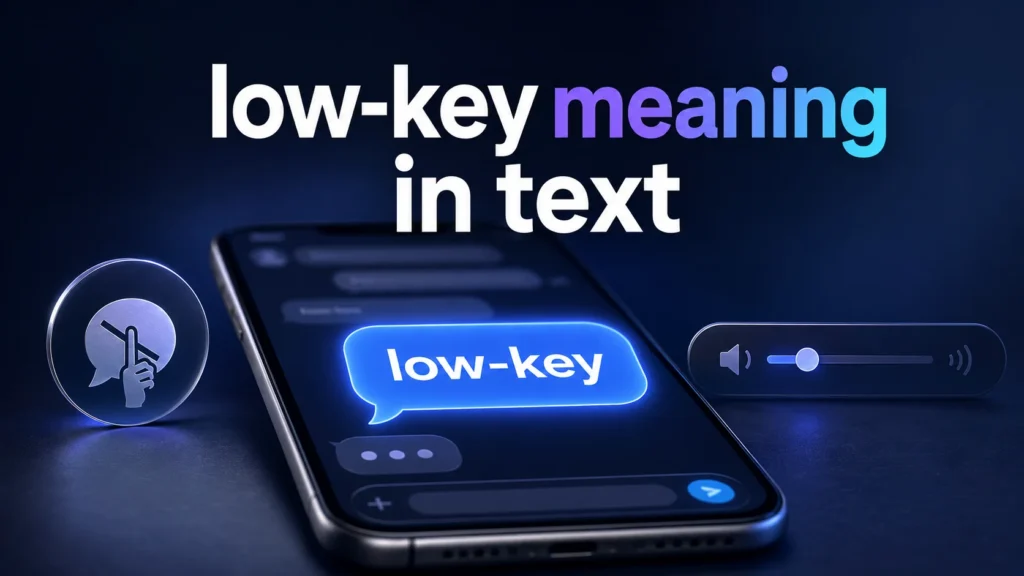
The low-key meaning in text usually relates to something felt, wanted, or believed quietly. When someone uses “low-key” in a message, they are expressing an opinion without making it sound too intense, dramatic, or obvious.
For example, “I low-key miss you” means the person misses you but may feel shy, uncertain, or unwilling to admit the full strength of that emotion.
People often search for this phrase because its tone can be confusing. Does “low-key” mean secretly, slightly, honestly, or casually? In reality, the exact meaning depends on the conversation, relationship, and emotion behind the message.
Understanding “low-key” helps you notice what a person may be revealing indirectly. Sometimes it softens an ordinary opinion. At other times, it hides a surprisingly strong feeling behind casual language.
Low-Key Meaning in Text – Quick Meaning
In texting, low-key generally means quietly, secretly, slightly, or without wanting much attention. People use it to make a confession or opinion sound less serious.
Someone might use “low-key” when they:
- Secretly like something
- Feel slightly embarrassed about an opinion
- Want something without openly admitting it
- Have an emotion they prefer to keep private
- Want to sound relaxed rather than overly enthusiastic
Here are a few simple examples:
“I low-key want to go home.”
This means the person wants to leave, although they may not be ready to say it openly.
“She is low-key really funny.”
The speaker finds her surprisingly funny but expresses the opinion casually.
“I low-key miss talking to you.”
This usually means the person misses the conversations but may feel vulnerable admitting it directly.
The word can indicate a mild feeling, but it does not always mean the emotion is weak. In some messages, “low-key” hides a feeling that is actually quite strong.
Origin and Background of Low-Key
The traditional meaning
Before “low-key” became popular internet slang, it described something restrained, modest, or not designed to attract attention. A low-key celebration, for instance, would be simple and private rather than large and extravagant.
The expression also appeared in photography and visual art. “Low-key lighting” refers to a style that uses darker tones, shadows, and limited bright light. This artistic meaning connects naturally with the modern idea of keeping something subtle or partly hidden.
How it became slang
Over time, people began using “low-key” to describe private emotions and understated opinions. Instead of saying, “I secretly enjoy this,” someone could say, “I low-key enjoy this.”
The slang usage became especially common in casual American English. Music, entertainment, online communities, and youth culture helped spread it beyond its original meaning.
Social media influence
Platforms such as TikTok, Instagram, X, Snapchat, and WhatsApp made the phrase part of everyday digital communication. It works well online because it allows users to share honest thoughts while maintaining a casual tone.
A TikTok user might comment, “I low-key need this outfit,” while an Instagram user might write, “Low-key my favorite picture.” In both cases, the phrase makes enthusiasm sound effortless.
As its popularity grew, “low-key” evolved beyond the literal idea of secrecy. Today, it can communicate hidden desire, mild embarrassment, unexpected approval, emotional caution, or even strong excitement disguised as calmness.
Real-Life Conversations Using Low-Key
WhatsApp conversation between friends
Person A: Are you enjoying the party?
Person B: It’s okay, but I low-key want to leave.
Person A: Same. Let’s stay another ten minutes and then go.
Here, Person B does not want to announce dramatically that the party is boring. “Low-key” softens the confession and invites the friend to agree.
Instagram DM between two people who like each other
Person A: Your new picture looks really good.
Person B: Thank you! I almost didn’t post it.
Person A: Well, I low-key can’t stop looking at it.
Person B: Low-key? That sounds suspiciously high-key to me 😂
In this conversation, “low-key” creates playful romantic tension. Person A expresses attraction without making the message feel too serious.
TikTok comment exchange
Person A: Low-key the best song released this year.
Person B: There is nothing low-key about it. I’ve played it 20 times!
Person A: Honestly, same.
The first commenter uses “low-key” to present a strong opinion casually. The reply humorously suggests that the enthusiasm is far from subtle.
Emotional text-message conversation
Person A: We haven’t talked properly in weeks.
Person B: I know. Life has been stressful lately.
Person A: I low-key miss how close we used to be.
Person B: I miss it too. Maybe we should talk tonight.
In this case, “low-key” acts as emotional protection. Person A shares a vulnerable feeling while reducing the risk of sounding demanding.
Emotional and Psychological Meaning
“Low-key” often communicates emotional caution. It allows people to test how another person will react before expressing themselves more openly.
Saying “I miss you” can feel direct and vulnerable. However, “I low-key miss you” sounds lighter. If the other person responds warmly, the speaker can continue the conversation. If the response feels cold, the speaker can pretend the original message was casual.
People also use the phrase to manage embarrassment. Someone who enjoys an unpopular movie might say, “I low-key love it.” The wording acknowledges that others may disagree, yet it still allows the person to share an honest opinion.
In romantic conversations, “low-key” can signal hidden attraction. Messages such as “I low-key like you” or “We would low-key make a cute couple” often reveal genuine interest. Still, the speaker may not feel confident enough to make a direct confession.
Imagine receiving a late-night message from an old friend saying, “I low-key miss our conversations.” Although the sentence appears casual, its timing and emotional context may reveal loneliness, nostalgia, or a wish to reconnect. The phrase softens the emotion, but it does not erase it.
Modern communication often rewards people for appearing calm and unbothered. As a result, “low-key” gives users a socially comfortable way to be honest without appearing overly emotional.
Usage in Different Contexts
On social media
People frequently use “low-key” in captions, comments, memes, and reaction posts. It can express unexpected approval or a personal opinion.
Examples include:
- “Low-key obsessed with this look.”
- “This song is low-key addictive.”
- “Low-key the funniest video I’ve seen today.”
In these examples, the phrase creates a casual, relatable tone. Interestingly, the actual feeling may be much stronger than the wording suggests.
Among friends
Friends use “low-key” when discussing plans, preferences, or private reactions.
For instance, “I low-key don’t want to invite him” means the speaker would prefer not to invite that person but may want to avoid conflict.
Similarly, “That was low-key awkward” means the situation felt awkward, although the speaker is trying not to exaggerate it.
In relationships and flirting
The low-key meaning in text becomes more emotionally significant when it appears in romantic conversations.
“I low-key like you” usually communicates attraction. Meanwhile, “I low-key get jealous when you talk to her” may reveal insecurity or deeper attachment.
The phrase should not be ignored simply because it sounds casual. Pay attention to timing, previous conversations, emojis, and the overall relationship.
At work or in professional settings
“Low-key” is acceptable in informal conversations with friendly colleagues. Someone might say, “I’m low-key nervous about the presentation.”
However, it may sound too casual in formal emails, reports, job applications, or messages to senior management. In professional writing, clearer alternatives include “somewhat,” “privately,” “subtly,” or “to be honest.”
Casual versus serious tone
In a casual conversation, “low-key” often creates humor or understatement. During a serious discussion, however, it may signal that someone struggles to express a real concern directly.
“I’m low-key tired” is usually casual. In contrast, “I’m low-key not doing well lately” deserves a thoughtful response because the person may be minimizing genuine emotional distress.
When Not to Use Low-Key
Avoid using “low-key” when clarity is essential. The phrase can make serious information sound uncertain or less important than it actually is.
It may be inappropriate in:
- Emergency messages
- Formal workplace communication
- Academic assignments
- Legal or official statements
- Serious apologies
- Conversations requiring direct boundaries
- Discussions about health or personal safety
For example, “I’m low-key having trouble breathing” could cause someone to underestimate an urgent medical situation. A direct statement would communicate the seriousness more effectively.
Likewise, “I low-key need you to stop doing that” may not establish a firm boundary. If something makes you uncomfortable, saying “Please stop” is clearer and more effective.
Cultural and language differences also matter. A person unfamiliar with English-language internet slang may interpret “low-key” literally. Therefore, consider the listener before using it in an important conversation.
Common Misunderstandings
It does not always mean “a little”
One common mistake is assuming “low-key” always describes a weak feeling. Sometimes it does mean “slightly,” but people also use it to hide strong emotions.
“I low-key love this song” may actually mean the speaker has been listening to it all day.
It does not always mean “secretly”
The phrase can indicate secrecy, although many people use it simply to soften an opinion. “This restaurant is low-key amazing” usually means it is surprisingly good, not necessarily that the speaker is hiding the opinion.
It can be serious despite sounding casual
A person may use “low-key” because direct emotional language feels uncomfortable. Therefore, statements involving loneliness, anxiety, jealousy, or sadness should be interpreted with care.
Tone changes the meaning
Compare these two messages:
- “I low-key hate you 😂”
- “I low-key hate how you treat me.”
The first may be playful, especially between close friends. The second sounds more serious and could reflect genuine hurt.
Low-key and lowkey mean the same thing online
In formal writing, “low-key” is generally written with a hyphen. In texts and social media posts, “lowkey” is extremely common and carries the same slang meaning.
Low-Key Compared With Similar Expressions
| Expression | Typical meaning | Tone | Example |
|---|---|---|---|
| Low-key | Quietly, slightly, or secretly | Casual and understated | “I low-key like him.” |
| High-key | Openly or strongly | Bold and enthusiastic | “I high-key love this.” |
| Secretly | Without others knowing | Direct and private | “I secretly want to go.” |
| Kind of | To some degree | Mild and uncertain | “I kind of miss her.” |
| Honestly | Speaking truthfully | Open and sincere | “Honestly, I miss her.” |
| Subtly | In a way that is not obvious | Neutral or descriptive | “He subtly changed the topic.” |
| On the down-low | Kept private or secret | Informal and secretive | “Keep it on the down-low.” |
| No cap | Seriously or without lying | Confident and emphatic | “That was amazing, no cap.” |
| Loudly and proudly | Without hiding enthusiasm | Open and expressive | “I support it loudly and proudly.” |
| Not really | Expressing weak interest or disagreement | Distant or dismissive | “I’m not really interested.” |
Key Insight
“Low-key” sits between hiding a feeling and expressing it openly. Unlike “high-key,” it reduces intensity; unlike “secretly,” it does not always imply complete secrecy.
Variations and Types of Low-Key
1. “I low-key like you”
This usually signals romantic attraction. The speaker likes the other person but may feel nervous about admitting it directly.
2. “I low-key miss you”
This means the sender misses someone while trying to sound emotionally controlled. Depending on the relationship, it may be an invitation to reconnect.
3. “I low-key want this”
The person feels a desire to own, try, or experience something. The phrase makes the desire sound spontaneous and casual.
4. “I’m low-key obsessed”
This describes strong excitement disguised as mild interest. It is commonly used for songs, shows, clothing, food, and celebrities.
5. “That was low-key funny”
The person found something unexpectedly amusing. It may also mean the humor was subtle rather than obvious.
6. “That was low-key rude”
The speaker believes someone behaved disrespectfully but wants to avoid making the accusation sound overly confrontational.
7. “I’m low-key jealous”
This reveals some level of jealousy. Even if it sounds playful, the emotion may be real and worth discussing.
8. “I low-key agree”
The person agrees but may hesitate to support the opinion publicly. Social pressure or uncertainty could explain the cautious wording.
9. “I’m low-key nervous”
This means the person feels anxious but is trying to remain calm. The nervousness may be mild or stronger than they admit.
10. “Low-key the best”
This describes something as surprisingly or arguably the best. It is often used as casual praise in online comments.
11. “Keep it low-key”
This variation keeps the traditional meaning. It means to remain discreet, simple, quiet, or private.
12. “A low-key event”
A low-key event is relaxed and modest, with little formality or attention. For example, a small dinner at home can be a low-key birthday celebration.
How to Respond When Someone Uses Low-Key
Your response should match the emotion and context of the message. A playful statement can receive a playful answer, while a vulnerable confession deserves sincerity.
Casual replies
If someone says, “I low-key want to leave,” you could respond:
- “Honestly, same.”
- “Want to head out?”
- “Give it ten minutes, then we’ll go.”
- “I was waiting for you to say that.”
Funny replies
If someone says, “I low-key love this song,” try:
- “Low-key? You’ve played it 15 times.”
- “That sounds very high-key to me.”
- “Just admit you’re obsessed 😂”
- “Your replay history says otherwise.”
Mature replies
If someone says, “I low-key miss you,” you might answer:
- “I miss you too. Would you like to talk?”
- “Thank you for being honest with me.”
- “I’ve been thinking about you as well.”
- “Maybe we should make time to reconnect.”
Respectful replies
If you do not share the same feeling, remain kind and clear:
- “I appreciate you telling me.”
- “I value you, but I don’t want to give you the wrong idea.”
- “Thank you for being open. I think we should talk honestly.”
- “I understand, although I see our relationship differently.”
A good response acknowledges what the person said without forcing them to become more vulnerable than they intended.
Regional and Cultural Usage
Western culture
“Low-key” is widely understood in the United States, Canada, the United Kingdom, and other English-speaking regions. Younger speakers commonly use it to express understated opinions, hidden desires, and emotional confessions.
Its precise tone can vary. In one conversation, it means “slightly.” In another, it means “secretly” or “honestly.”
Asian culture
English-speaking young people across South Asia, Southeast Asia, and East Asia frequently encounter “low-key” through social media, music, films, and online communities.
In cultures where direct emotional expression may sometimes feel uncomfortable, the phrase can provide a convenient way to share attraction, disagreement, or personal preferences indirectly.
However, older speakers or people with limited exposure to internet slang may not understand it immediately.
Middle Eastern culture
Among younger English and bilingual speakers, “low-key” appears in informal chats and social media captions. It may help communicate a private feeling while maintaining modesty or emotional distance.
Still, context is essential. Slang can carry different implications across families, communities, and levels of language familiarity.
Global internet usage
Internet culture has made “low-key” recognizable far beyond its original setting. Users often mix it with local languages, creating bilingual sentences while preserving its English slang meaning.
Memes have also made the word more exaggerated. People now say “low-key obsessed” even when their behavior is openly enthusiastic.
Gen Z versus Millennials
Millennials helped popularize the slang form across early social platforms, music, and online conversations. Gen Z continues to use it, often humorously or ironically.
Both generations understand the expression, but Gen Z may use “lowkey” without a hyphen more frequently in rapid online communication. Younger users may also contrast it with “high-key” for comic effect.
Is Low-Key Safe for Kids?
Yes, “low-key” is generally safe for children and teenagers. The expression itself is not offensive, sexual, or abusive.
However, parents should consider the complete sentence rather than judging the word alone. “I low-key like this show” is harmless, while a message involving pressure, secrecy, bullying, or emotional distress may require attention.
Teaching children to recognize tone can help them understand whether “low-key” communicates humor, embarrassment, hidden attraction, or a serious feeling being minimized.
Frequently Asked Questions
What does low-key mean in a text message?
Low-key means quietly, secretly, slightly, or without making something seem important. It often softens an honest feeling or opinion.
What does “I low-key like you” mean?
It usually means the sender feels romantic attraction but is nervous or unwilling to express it too directly. The phrase provides emotional protection if the feeling is not returned.
Does low-key mean secretly?
It can mean secretly, but not in every situation. Sometimes it simply means “somewhat,” “unexpectedly,” or “in an understated way.”
What does low-key mean from a guy?
From a guy, “low-key” may soften an opinion, confession, or emotional statement. “I low-key miss you” could indicate genuine interest, but the surrounding conversation matters more than gender.
What does low-key mean from a girl?
From a girl, it carries the same general meanings: quietly, slightly, privately, or indirectly. If she says, “I low-key like you,” she may be testing your reaction before speaking more openly.
Is saying “low-key” flirting?
The word itself is not automatically flirtatious. However, messages such as “I low-key like you,” “You low-key look good,” or “We’d low-key be cute together” often contain playful or romantic interest.
What is the opposite of low-key?
The slang opposite is “high-key,” meaning openly, strongly, or without hiding the feeling. For example, “I high-key love this movie” expresses obvious enthusiasm.
Conclusion
The low-key meaning in text is usually “quietly,” “secretly,” “slightly,” or “without making a big deal about it.” Yet its emotional meaning depends heavily on the conversation.
People use “low-key” to soften opinions, hide embarrassment, test another person’s reaction, or share vulnerable feelings without sounding too intense. Consequently, a low-key statement can carry a high level of emotion beneath its relaxed wording.
When you see it in a message, look beyond the individual word. Consider the relationship, timing, emojis, and subject being discussed. “I low-key love this outfit” is casual enthusiasm, whereas “I low-key miss you” may be a careful attempt to reconnect.
Once you understand its understated tone, you can use “low-key” confidently—and recognize when someone may be saying much more than they appear to admit.