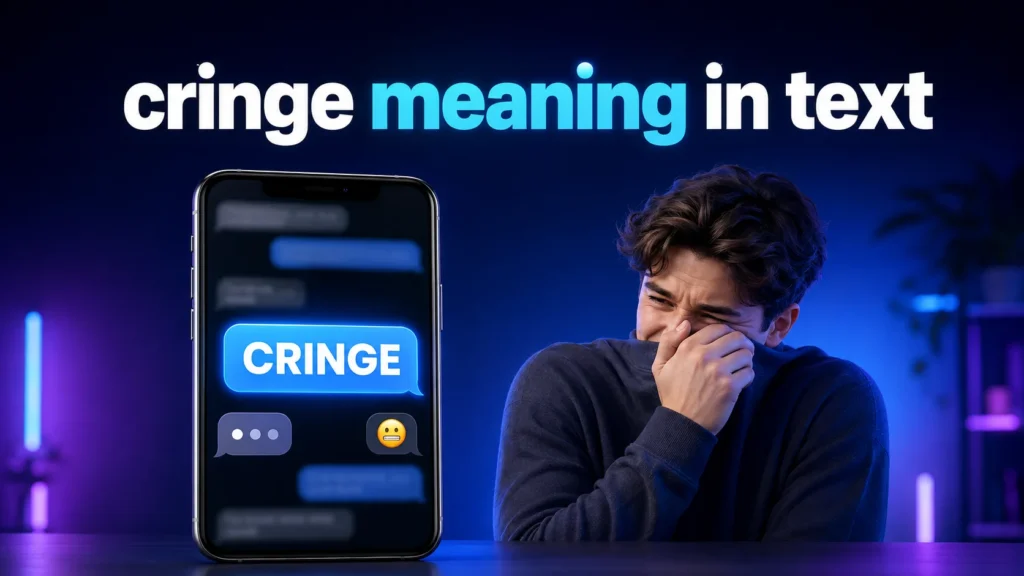
The cringe meaning in text usually describes something embarrassing, awkward, uncomfortable, or painfully difficult to watch. Someone may type “cringe” after seeing a forced joke, an overly dramatic message, an embarrassing video, or behavior that feels socially awkward.
However, the word does not always express serious criticism. Friends often use it playfully to tease one another. In other situations, it can sound dismissive, insulting, or even hurtful.
That difference in tone explains why many people search for its meaning after receiving it in a message. Was the person joking? Did they dislike what you said? Were they embarrassed for you, or were they simply reacting to an awkward situation?
Understanding the context, your relationship, and any accompanying emojis can help you interpret the message correctly.
Cringe Meaning in Text – Quick Meaning
In texting, cringe means that something caused secondhand embarrassment, discomfort, or awkwardness. It can describe a message, joke, video, opinion, fashion choice, romantic gesture, or social interaction.
Someone might use it to mean:
- “That was embarrassing.”
- “This feels awkward.”
- “That was difficult to watch.”
- “You are trying too hard.”
- “I feel embarrassed for that person.”
- “That was so awkward that it was funny.”
Here are a few short examples:
“That pickup line was so cringe.”
“I can’t watch this—it’s making me cringe.”
“Why did I post that? Cringe!”
The word can function as a verb, noun-like reaction, or adjective in casual internet language. Although traditional grammar favors “cringeworthy” as an adjective, phrases such as “that is cringe” have become completely normal in online conversation.
The simplest definition
If someone replies “cringe” to a text, they usually think the message or situation is embarrassing, uncomfortable, forced, or socially awkward.
Still, tone matters. “Cringe 😂” from a close friend may be harmless teasing, while “You’re so cringe” during an argument can be a personal insult.
Origin and Background
The word “cringe” existed long before social media. Traditionally, it meant physically shrinking back because of fear, embarrassment, or discomfort. For example, a person might cringe after remembering an embarrassing mistake.
Over time, the word developed a strong connection with secondhand embarrassment. Instead of physically moving away, people began using it to describe the uncomfortable feeling created by someone else’s behavior.
How internet culture changed the word
Online communities made “cringe” shorter, faster, and more flexible. People started using it as a one-word reaction beneath videos, memes, comments, and screenshots.
Platforms such as YouTube, TikTok, Instagram, Reddit, and X helped popularize expressions like:
- “That’s cringe.”
- “Cringe content.”
- “I cringed so hard.”
- “This gave me secondhand embarrassment.”
- “Cringe but funny.”
Consequently, the word moved beyond physical discomfort. It became a quick social judgment about what appears forced, outdated, overly emotional, attention-seeking, or embarrassing.
How its meaning evolved
Earlier usage focused mainly on a person’s reaction: “I cringed when he said that.” Modern internet usage often labels the thing itself: “That video is cringe.”
Today, people also use the word self-consciously. Someone might describe an old photo as “cringe” without genuinely hating it. In that case, the speaker recognizes that their former style or behavior now seems embarrassing.
Real-Life Conversations
The cringe meaning in text becomes much clearer when you see how tone changes across different platforms.
WhatsApp conversation
Person A: I wrote her a poem after talking to her for two days.
Person B: Bro, that’s a little cringe 😭
Person A: I know, but she actually liked it.
Person B: Then it worked. I take it back 😂
Here, “cringe” is friendly teasing. Person B finds the gesture overly romantic but is not seriously attacking Person A.
Instagram DM conversation
Person A: Did you see that influencer pretending not to recognize the camera?
Person B: Yes! The whole video felt so staged.
Person A: Exactly. Maximum cringe.
In this example, the word describes content that appears fake or forced.
TikTok comment conversation
Person A: Why is everyone calling this dance cringe?
Person B: Because people have seen the same routine too many times.
Person A: I still think they’re having fun.
Person B: Fair enough. Not everything has to impress everyone.
Here, “cringe” reflects personal taste rather than an objective fact.
Text-message conversation
Person A: You called my voice note cringe. Were you making fun of me?
Person B: No! I meant the story was awkward, not your voice.
Person A: Oh, okay. I thought you were insulting me.
Person B: Sorry, I should have explained it better.
This conversation shows how a one-word response can create misunderstanding. Asking calmly often works better than assuming the worst.
Emotional and Psychological Meaning
“Cringe” expresses discomfort, but that discomfort has several emotional layers. It can involve embarrassment, social anxiety, disapproval, surprise, or the feeling that someone has broken an unwritten social rule.
People often cringe when they notice a gap between intention and result. For instance, someone may try to look cool, romantic, intelligent, or funny, but the attempt feels unnatural. The audience experiences secondhand embarrassment because they can see that the effort is not working as intended.
Why people use it
Modern conversations move quickly. Therefore, people use “cringe” because it communicates a complicated reaction with one short word.
It may reveal that the sender:
- Feels embarrassed for another person
- Thinks something looks forced
- Wants to distance themselves from unpopular behavior
- Is teasing a friend
- Feels uncomfortable but cannot explain why
- Wants approval from a social group
- Is judging something according to current online trends
The term can also work as emotional protection. Calling a sincere moment “cringe” sometimes helps people avoid vulnerability. Romantic affection, enthusiastic hobbies, and heartfelt speeches may receive the label simply because they are emotionally open.
A relatable personal-style scenario
Imagine sending a long, honest message to someone you like. They reply, “That’s kinda cringe lol.” Even if they intended to joke, you may immediately feel exposed.
In a situation like this, the word hurts because it does more than criticize the sentence—it appears to reject the emotion behind it. A mature response would clarify their intention before deciding what the comment says about the relationship.
Usage in Different Contexts
The meaning of “cringe” changes according to where it appears and who sends it.
Social media
On social media, “cringe” commonly describes videos, trends, performances, captions, or opinions that seem embarrassing or overly rehearsed.
Commenters may also use it carelessly because online distance makes blunt judgment easier. As a result, the label does not always reflect the actual quality of the content.
Friends and relationships
Close friends often say “cringe” as playful teasing:
“You saved her contact as ‘My Queen’? Cringe 😂”
Within a trusting friendship, that comment may create laughter. In a romantic relationship, however, repeatedly calling sincere affection cringe can make the other person feel emotionally unsafe.
Work and professional settings
“Cringe” is highly informal and usually unsuitable for formal workplace communication. Calling a colleague’s idea, presentation, or email cringe can sound disrespectful and unprofessional.
Instead, use specific language such as:
- “That section may sound too informal.”
- “The wording feels slightly forced.”
- “This approach may not suit our audience.”
- “Could we make the tone more natural?”
Specific feedback helps people improve without humiliating them.
Casual versus serious tone
In casual conversation, the word may be funny and harmless. During conflict, it becomes sharper.
Compare:
“That dance was cringe 😂”
with:
“Everything you do is cringe.”
The first criticizes one action and may be playful. The second attacks the person’s identity and can feel like bullying.
When Not to Use It
Avoid using “cringe” when someone is being sincere, emotionally vulnerable, or courageously expressing themselves. A careless reaction can shut down an important conversation.
You should also avoid it in the following situations:
- When someone shares grief, trauma, or mental-health concerns
- During formal workplace discussions
- When responding to cultural or religious traditions
- When a child proudly shares creative work
- When someone is learning a language or new skill
- When the person has already expressed insecurity
- When your comment could encourage online harassment
Cultural sensitivity
Behavior that appears unusual in one culture may be normal and meaningful in another. Public affection, wedding traditions, humor, clothing, and family interactions vary widely.
Therefore, labeling an unfamiliar custom “cringe” can sound culturally insensitive. Curiosity is usually more respectful than instant judgment.
When misunderstanding is likely
One-word replies lack facial expressions and vocal tone. If your message could be interpreted as personal rejection, explain what you mean.
Instead of writing “cringe,” you could say:
“That joke was awkward, but I know you were kidding.”
The extra context can prevent unnecessary hurt.
Common Misunderstandings
One common mistake is assuming that “cringe” always means hatred. Sometimes it simply means awkward, outdated, or unintentionally funny.
Another misunderstanding involves treating it as a factual judgment. What one person finds embarrassing may feel charming, courageous, or entertaining to someone else.
Tone confusion
Emojis often influence the cringe meaning in text:
- “Cringe 😂” usually suggests amused teasing.
- “Cringe 😭” may mean painfully funny or embarrassing.
- “Cringe 😬” expresses genuine discomfort.
- “Cringe 🙄” sounds dismissive or annoyed.
- “Cringe ❤️” may describe something embarrassing but lovable.
- “You’re cringe.” can feel blunt or insulting.
Nevertheless, emojis do not guarantee harmless intent. Your relationship and the surrounding conversation matter more.
Literal versus figurative meaning
Literally, “to cringe” means to recoil or shrink back. In digital conversation, people rarely mean that they physically moved. Instead, they describe an emotional reaction.
For example, “I cringed at that video” means the video caused intense embarrassment or discomfort.
Cringe Compared With Similar Expressions
| Expression | Meaning | Typical tone | Example |
|---|---|---|---|
| Cringe | Embarrassing or uncomfortable | Teasing or critical | “That speech was cringe.” |
| Awkward | Socially uncomfortable | Usually milder | “That silence was awkward.” |
| Embarrassing | Causes shame or self-consciousness | Direct and neutral | “Forgetting his name was embarrassing.” |
| Corny | Overly sentimental or unoriginal | Lightly critical | “The romantic line was corny.” |
| Cheesy | Predictable but sometimes lovable | Often playful | “It was cheesy, but sweet.” |
| Try-hard | Someone is making an obvious effort to impress | Negative | “That caption feels try-hard.” |
| Secondhand embarrassment | Embarrassment felt for someone else | Descriptive | “That audition gave me secondhand embarrassment.” |
| Based | Boldly authentic or admirable | Often opposite | “That opinion was based.” |
| Cool | Impressive or socially appealing | Opposite | “That performance was cool.” |
| Wholesome | Sincere, positive, and heartwarming | Positive | “Their friendship is wholesome.” |
Key Insight
“Cringe” is stronger than “awkward” but less specific than “embarrassing.” It often judges how natural, socially acceptable, or self-aware something appears.
Variations and Types of Cringe
“That’s cringe”
It means the speaker finds a particular action, message, or piece of content embarrassing.
“You’re cringe”
This labels the person rather than one action, so it can sound more insulting and personal.
“Kinda cringe”
“Kinda” softens the criticism. The sender finds something slightly embarrassing but may not consider it terrible.
“So cringe”
This intensifies the reaction and suggests strong secondhand embarrassment.
“Cringe AF”
“AF” means “as f—” and adds strong emphasis. It is highly informal and contains implied profanity.
“Cringey”
This informal adjective means awkward or embarrassing. Both “cringey” and “cringy” appear in casual writing.
“Cringeworthy”
This is a more standard adjective for something extremely embarrassing or uncomfortable to witness.
“I’m cringing”
The sender is currently experiencing embarrassment or discomfort because of what they saw or read.
“I cringed”
This describes a completed reaction to an awkward moment.
“Cringe but cute”
The action feels embarrassing or overly sweet, yet the speaker still finds it lovable.
“Funny cringe”
Something is awkward enough to cause embarrassment but entertaining enough to make people laugh.
“Self-cringe”
This describes embarrassment about your own past words, appearance, posts, or behavior.
How to Respond When Someone Uses It
Your reply should depend on whether the comment feels playful, fair, unclear, or disrespectful.
Casual replies
- “Fair enough 😂”
- “I knew you’d say that.”
- “Maybe, but I still like it.”
- “A little cringe never hurt anyone.”
- “Okay, I can see why.”
Funny replies
- “Cringe is my brand.”
- “I prefer the term emotionally fearless.”
- “Wait until you see part two.”
- “I have achieved maximum cringe.”
- “At least I’m memorable.”
Mature replies
- “What part felt awkward to you?”
- “I understand that it isn’t your style.”
- “You may find it cringe, but it was sincere.”
- “Could you explain what you mean?”
- “I’m comfortable with it, even if you dislike it.”
Respectful replies
- “Thanks for being honest.”
- “I see it differently, but that’s okay.”
- “Let’s disagree without making it personal.”
- “Please criticize the message, not me.”
- “I’d appreciate a more constructive response.”
If the sender is trying to embarrass you, you do not have to defend everything you enjoy. A calm boundary often carries more confidence than an angry argument.
Regional and Cultural Usage
“Cringe” has become global internet vocabulary, but people use and interpret it differently across cultures.
Western culture
In the United States, United Kingdom, Canada, and other English-speaking regions, “cringe” commonly describes awkward humor, failed attempts to impress, old trends, and overly sentimental behavior.
The word is especially common among younger social-media users. However, adults also use it when discussing entertainment, advertising, or public behavior.
Asian culture
English-speaking internet users across South Asia and East Asia frequently use “cringe” in chats, comments, and mixed-language conversations.
In more reserved social environments, people may use it for excessive public affection, dramatic videos, or attention-seeking posts. Still, cultural standards differ significantly between families and regions.
Middle Eastern culture
Young internet users may use “cringe” to react to content that feels socially inappropriate, overly personal, or inconsistent with community expectations.
Yet English fluency and familiarity with internet slang vary. Therefore, some readers may understand only its traditional meaning.
Global internet usage
Globally, “cringe” has become a reaction word that often needs no complete sentence. Memes and short videos have made its online meaning recognizable even among people who do not speak English as their first language.
Even so, global popularity does not create one universal standard. What counts as cringe changes with humor, religion, age, language, and local values.
Gen Z versus Millennials
Gen Z often uses “cringe” as a fast judgment about outdated trends, forced behavior, or a lack of self-awareness. The expression may also be deeply ironic.
Millennials may use it more often for embarrassing memories, awkward media, or their own older social-media posts. Both generations use the term, but younger users tend to apply it more quickly to online identities and trends.
Interestingly, something considered cringe today can become nostalgic or fashionable later. Internet judgment changes rapidly.
Is Cringe Safe for Kids?
Yes, “cringe” itself is not a swear word or sexually explicit term. Children may encounter it in gaming chats, videos, school conversations, and social-media comments.
However, the way it is used matters. Calling a video cringe is different from repeatedly telling a classmate, “You are cringe.” The second usage can become ridicule or bullying.
Parents and educators can teach children to describe the behavior instead of humiliating the person. For example, “That joke made me uncomfortable” is kinder and clearer than attacking someone’s personality.
Frequently Asked Questions
What does cringe mean in a text message?
Cringe in a text message means something seems embarrassing, awkward, forced, or uncomfortable. It may express playful teasing or genuine criticism depending on the context.
What does it mean when a guy says “cringe”?
When a guy says “cringe,” he may find your message, joke, or action awkward or overly emotional. If he includes laughing emojis, he may simply be teasing. Ask for clarification if the response feels hurtful.
What does it mean when a girl calls you cringe?
She may think something you did felt awkward, forced, outdated, or embarrassing. However, close friends and romantic partners sometimes use it playfully rather than as a serious rejection.
Is calling someone cringe an insult?
It can be. “That joke was cringe” criticizes one action, while “You are cringe” judges the person and sounds more insulting. Tone and relationship determine how harsh it feels.
Does cringe mean disgusting?
Not usually. “Cringe” mainly expresses embarrassment or discomfort, whereas “disgusting” communicates strong dislike or revulsion. In some situations, people may use cringe for behavior they also find unpleasant.
Can cringe have a positive meaning?
Sometimes. Phrases such as “cringe but cute” or “lovably cringe” describe something embarrassing yet sincere, funny, or charming. The positive feeling usually comes from affection or self-aware humor.
How can I tell whether someone is joking?
Look at your relationship, the surrounding conversation, emojis, and their usual communication style. Laughing emojis and friendly follow-up messages often signal teasing, but calmly asking remains the safest option.
Conclusion
The cringe meaning in text is something awkward, embarrassing, forced, or uncomfortable to witness. Nevertheless, the word can range from affectionate teasing to harsh personal criticism.
Context provides the real meaning. A laughing emoji from a close friend may turn it into a joke, while a cold “you’re cringe” can feel dismissive and insulting.
Most importantly, remember that “cringe” is a personal reaction—not an unquestionable fact. Sincere emotions, unusual interests, and harmless creativity do not become worthless because another person finds them embarrassing.
Use the word thoughtfully, and when someone sends it to you, consider the tone before reacting. Confidence sometimes means accepting constructive feedback. At other times, it means enjoying what you love without asking the internet for permission.