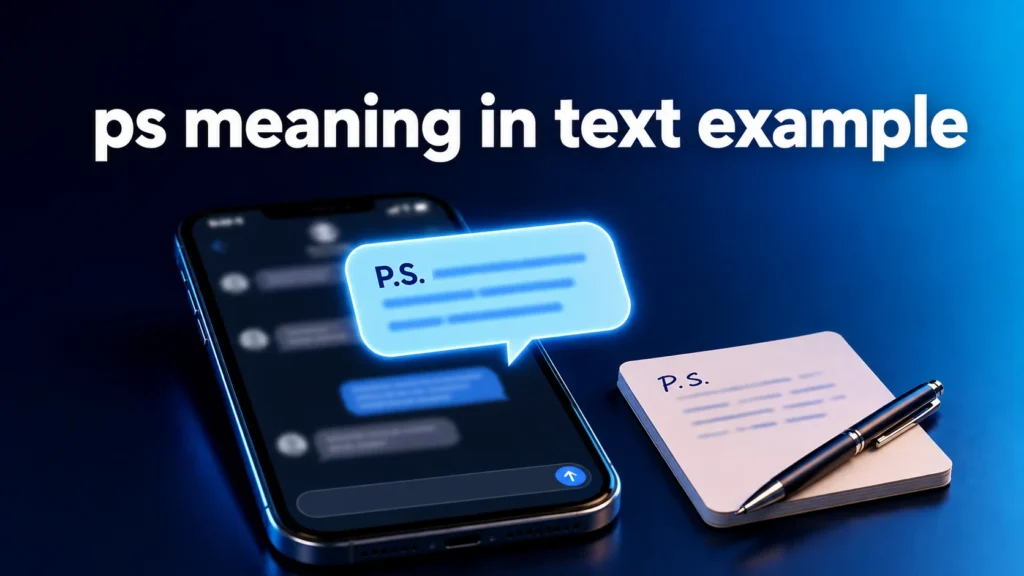
The PS meaning in text example is simple: PS means “postscript,” an extra thought added after the main message has finished. People use it to include a reminder, personal comment, funny detail, or important piece of information they almost forgot.
For example, someone may text, “I’ll meet you at 7. PS: Don’t forget the tickets.” The main message confirms the time, while the PS adds a final reminder.
Although PS originally appeared at the end of handwritten letters, it remains popular in emails, WhatsApp messages, Instagram captions, and casual texts. Its meaning is usually straightforward, but its emotional tone can change depending on what follows it.
Sometimes, a PS feels warm and affectionate. In other situations, it adds humor, urgency, or even a slightly passive-aggressive final comment. Understanding the surrounding message helps you identify the sender’s real intention.
PS Meaning in Text Example – Quick Meaning
PS stands for postscript. It introduces an additional thought written after the main message.
The term comes from the Latin phrase post scriptum, which means “written after.” In everyday texting, people use PS when they want to add something without rewriting their original message.
A quick PS meaning in text example would be:
“Thanks for helping me today. PS: I owe you coffee!”
Other examples include:
“Have a safe journey! PS: Text me when you arrive.”
“The meeting starts at 10. PS: Bring your presentation notes.”
PS can introduce:
- An afterthought
- A forgotten detail
- A friendly reminder
- A private or personal comment
- A joke or playful observation
- An important final instruction
- A romantic message
- A promotional call to action
The simplest definition
In a text message, PS means “one more thing” or “I almost forgot to add this.”
It usually appears at the end of a message, followed by a colon:
“PS: I really liked your new haircut.”
Both “PS” and “P.S.” are acceptable. However, “PS” without periods is more common in modern texting and online communication.
Origin and Background
The abbreviation PS existed long before smartphones, email, or social media. It developed from the Latin term post scriptum, meaning “written after.”
In handwritten communication, changing a completed letter was inconvenient. If someone remembered something after signing their name, they added a postscript underneath the signature rather than rewriting the entire letter.
For example:
Yours sincerely,
Daniel
PS: Please give my regards to your family.
The postscript became a practical solution for forgotten details. Over time, however, writers discovered that it could also draw special attention to a final thought.
From handwritten letters to digital messages
Email made editing easy, so people no longer needed PS for purely practical reasons. They could simply return to the earlier paragraph and insert the missing information.
Nevertheless, PS survived because it gives a final sentence extra emotional or visual importance. Readers naturally notice a short statement placed separately at the end.
Marketers also began using postscripts in promotional emails. A PS could highlight a deadline, repeat an offer, or direct readers toward a link.
Meanwhile, friends and couples used it for affectionate final comments such as:
“PS: I miss you.”
Social media influence
Social media made PS more casual and creative. Today, it appears in Instagram captions, Facebook posts, direct messages, TikTok descriptions, and comment sections.
People sometimes use it even when they have not forgotten anything. Instead, they deliberately save a funny, emotional, or dramatic point for the end.
For instance:
“Had an amazing day at the beach. PS: I lost my sunglasses five minutes after taking this photo.”
Here, the PS works like a punchline. It changes how readers understand the rest of the post.
Real-Life Conversations
The meaning of PS becomes clearer when you see how it works in natural conversations.
WhatsApp conversation
Person A: I’ve sent you the address. We’re meeting there at 6:30.
Person B: Perfect, I’ll leave work early.
And,
Person A: PS: The restaurant only accepts cash.
Person B: Thanks for warning me! I’ll stop at an ATM.
In this conversation, PS introduces a useful detail that Person A forgot to mention initially.
Instagram DM conversation
Person A: Your graduation pictures look amazing!
Person B: Thank you! I was so nervous before the ceremony.
Person A: You couldn’t tell at all. PS: That blue outfit really suits you.
Person B: That’s so sweet of you 😊
Here, PS adds a warm compliment. Separating it from the main message makes it feel more personal.
TikTok comment conversation
Person A: This recipe actually worked on my first attempt.
Person B: Same! I used less sugar, though.
Person A: Good idea. PS: My kitchen looked like a disaster afterward 😂
Person B: That’s the part nobody shows!
In this example, PS introduces a humorous confession rather than essential information.
Text-message conversation
Person A: I understand why you were upset, and I’m sorry about what happened.
Person B: Thank you for saying that. I appreciate it.
Person A: PS: I never wanted you to feel ignored.
Person B: That means a lot. Let’s talk properly tomorrow.
The postscript carries emotional weight here. It allows Person A to add a sincere clarification after the apology.
Emotional and Psychological Meaning
PS is not an emotion by itself. However, it creates the feeling that the sender has one final thought they especially want you to notice.
Because it appears separately at the end, the statement after PS often feels more memorable than information buried inside a longer paragraph. It may seem spontaneous, honest, intimate, or urgent.
What PS can emotionally express
Depending on the wording, PS may communicate:
- Affection: “PS: I love you.”
- Concern: “PS: Please let me know you arrived safely.”
- Humor: “PS: I definitely did not eat the last slice.”
- Excitement: “PS: I got the job!”
- Urgency: “PS: I need your answer by tonight.”
- Appreciation: “PS: Thanks for always supporting me.”
- Flirtation: “PS: You looked really good today.”
- Annoyance: “PS: It would have been nice if you had told me earlier.”
The letters themselves remain neutral. The emotional meaning comes from the sentence that follows.
Why people use it
People sometimes think of their most honest sentence after completing the main message. PS gives them a natural way to include that thought.
It can also make emotional expression feel safer. Saying “I miss you” directly may feel vulnerable, while adding “PS: I miss you” at the end can feel lighter and less intense.
In other cases, the sender wants the final point to remain in your mind. The placement gives it extra emphasis without using capital letters or repeating the message.
A relatable personal-style scenario
Imagine receiving a long birthday message from a close friend who now lives far away. The message includes memories, good wishes, and jokes. At the end, your friend writes, “PS: No matter how far away I am, you can always call me.”
That final sentence may become the most meaningful part of the entire message. Although it appears as an afterthought, its placement makes it feel sincere and emotionally important.
Usage in Different Contexts
PS is flexible, but its style changes according to the platform, relationship, and purpose.
Social media
On social media, PS often adds humor, context, or a small confession to a caption.
For example:
“Finally finished my first 10K run! PS: I can’t feel my legs.”
Creators may also use it to mention photo credits, outfit details, updates, or links. In promotional posts, PS can draw attention to a discount or deadline.
Friends and relationships
Between friends, PS usually sounds casual and playful:
“See you tomorrow. PS: Bring snacks.”
In romantic conversations, it may introduce affection or flirtation:
“Sleep well. PS: I wish you were here.”
A sweet postscript can feel intimate because it resembles a private final thought. Still, you should read it alongside the sender’s normal communication style.
Work and professional settings
PS is acceptable in many professional emails, especially when the tone is friendly. However, essential information should remain in the main body.
A professional example would be:
“Thank you for reviewing the proposal. PS: I have attached the revised timeline for reference.”
Nevertheless, crucial deadlines, payment instructions, policy changes, or safety information should not be hidden in a postscript. Place such details clearly within the main message.
Casual versus serious tone
In casual texting, PS can introduce almost anything. Correct punctuation is not especially important, and people may write “ps,” “P.S.,” or “PS.”
Formal communication requires more care. A postscript should be short, relevant, and professional.
Compare these examples:
Casual: “PS: Your dog is adorable.”
Professional: “PS: Please confirm your availability by Thursday.”
Both are correct, but their tone matches different relationships.
When Not to Use PS
Do not use PS when the additional information is central to the message. Important details deserve a clear place in the main paragraph.
Avoid relying on it for:
- Emergency instructions
- Legal conditions
- Major workplace decisions
- Sensitive medical information
- Formal complaints
- Payment requirements
- Important appointment changes
- Information requiring detailed explanation
For example, writing “PS: Your interview has been moved to another day” may cause confusion. The schedule change should appear prominently in the main message or subject line.
In emotionally sensitive situations
A serious apology should not place all responsibility in a postscript. Writing “PS: Sorry if you were offended” can sound dismissive because the apology appears added as an afterthought.
Similarly, do not end a supportive message with an unrelated criticism. A final negative comment can overpower everything kind you wrote earlier.
When it may seem passive-aggressive
PS sometimes becomes a place for hidden criticism:
“Hope you had a nice evening. PS: Thanks for finally replying.”
Although the sentence looks polite, it communicates annoyance. If the issue matters, discuss it directly and respectfully.
Cultural and language sensitivity
Not everyone knows the Latin origin of PS. English learners may understand it only as an abbreviation without recognizing its purpose.
In international professional communication, “One additional note” or “Please also remember” may be clearer.
Common Misunderstandings
One frequent misunderstanding is believing that PS means “please see.” In most personal messages, emails, and captions, it means postscript.
However, abbreviations can have different meanings in specialized settings. Context remains important.
Is PS part of the original message?
Yes. Although it appears after the main body, it still belongs to the sender’s complete message. It should not be ignored as unimportant.
In fact, some people intentionally place their most memorable point after PS because they know readers will notice it.
Does PS always mean the sender forgot something?
No. Originally, a postscript often included genuinely forgotten information. Today, people also use it deliberately for emphasis, humor, affection, or style.
Does PS mean something romantic?
PS is not automatically romantic. A phrase like “PS: I miss you” carries romantic or affectionate meaning, but “PS: Bring your ID” is simply a reminder.
The words after PS determine the tone.
Is “P.S.” more correct than “PS”?
Both forms are widely understood. “P.S.” reflects the traditional punctuated style, while “PS” is cleaner and more common in texts, emails, and online posts.
PS Compared With Similar Expressions
| Expression | Meaning | Typical use | Example |
|---|---|---|---|
| PS | An additional thought after the main message | Texts, letters, emails, captions | “PS: Call me later.” |
| BTW | By the way | Introduces related information casually | “BTW, I saw your brother today.” |
| FYI | For your information | Shares useful or relevant information | “FYI, the office closes at 5.” |
| Also | Adds another point | Casual or formal communication | “Also, remember your passport.” |
| One more thing | Introduces a final detail | Everyday conversation | “One more thing—bring a jacket.” |
| Note | Highlights useful information | Formal or instructional writing | “Note: Prices may change.” |
| Reminder | Repeats something important | Appointments and tasks | “Reminder: Your payment is due.” |
| Update | Introduces new information | Personal or professional messages | “Update: The event has been moved.” |
| PPS | Adds another thought after the PS | Informal letters and playful messages | “PPS: I saved you some cake.” |
| In conclusion | Summarizes the main discussion | Formal writing | “In conclusion, the plan is practical.” |
Key Insight
PS differs from BTW because it is defined mainly by its position at the end of a message. BTW can appear almost anywhere, while PS normally introduces a separate final thought.
Variations and Types of PS
PS
This is the most common modern form. It means postscript and introduces an additional final detail.
P.S.
This traditional spelling has the same meaning as PS. The periods represent the abbreviated Latin words.
ps
Lowercase “ps” is common in quick texts and casual social-media messages. Its meaning does not change.
PS:
A colon clearly separates the abbreviation from the extra message. This format is neat and easy to read.
P.S.—
Some writers use a dash after P.S. to create a more conversational or dramatic pause.
PPS
PPS means post-postscript. It adds another thought after the first postscript.
“PS: Bring your camera. PPS: Make sure it’s charged.”
PPPS
PPPS introduces a third added thought. It is understandable but usually used playfully rather than professionally.
Friendly PS
A friendly postscript adds warmth:
“PS: It was really good seeing you.”
Romantic PS
A romantic postscript adds affection or flirtation:
“PS: I can’t stop thinking about you.”
Funny PS
A funny postscript functions like a punchline:
“PS: The cake survived, but my diet didn’t.”
Professional PS
A professional postscript highlights a relevant reminder or resource:
“PS: The registration link remains open until Friday.”
Promotional PS
Businesses use promotional postscripts to emphasize an offer, deadline, benefit, or call to action:
“PS: Use SAVE10 before midnight for 10% off.”
How to Respond When Someone Uses PS
You do not need to reply to the letters “PS” themselves. Respond to the information or emotion written after them.
Casual replies
- “Got it, thanks!”
- “Okay, I’ll remember.”
- “Good thing you told me.”
- “No problem!”
- “I was just about to ask.”
Funny replies
- “The PS was the best part 😂”
- “Important information always comes last!”
- “Plot twist at the end.”
- “Noted—especially the snacks part.”
- “Your PS deserves its own message.”
Mature replies
- “Thank you for adding that.”
- “I understand what you mean.”
- “I appreciate the clarification.”
- “That final point is important.”
- “Let’s discuss that part properly.”
Respectful replies
- “Thank you for the reminder.”
- “I’ll take care of it.”
- “I appreciate you letting me know.”
- “I have noted the additional information.”
- “I’ll confirm once it is complete.”
Replies to an affectionate PS
If someone writes, “PS: I miss you,” your response should match your genuine feelings.
You might reply:
- “I miss you too.”
- “That was the sweetest part of your message.”
- “I’ve been thinking about you as well.”
- “Thank you for being honest.”
- “I care about you, but I’d like to take things slowly.”
A kind but honest response is better than giving false emotional reassurance.
Regional and Cultural Usage
PS is recognized throughout much of the English-speaking world, but communication habits influence how frequently people use it.
Western culture
In the United States, United Kingdom, Canada, and Australia, PS commonly appears in personal letters, emails, advertisements, and casual messages.
It may sound nostalgic in handwritten letters but completely normal in digital marketing and friendly emails.
Asian culture
English speakers across South Asia and East Asia frequently use PS in academic, workplace, and personal communication. In Pakistan, India, and other multilingual communities, it may appear inside messages that combine English with a local language.
Some users treat PS as a general way to introduce an extra point, even when the message is not technically finished.
Middle Eastern culture
PS also appears in English-language business and personal messages across the Middle East. However, people communicating across languages may prefer clearer expressions such as “additional note” in formal settings.
In personal conversations, a postscript can add warmth without making the entire message sound overly emotional.
Global internet usage
Online communication has made PS internationally recognizable. It frequently appears in newsletters, captions, direct messages, blogs, and promotional emails.
Its traditional function has expanded. Rather than merely correcting an omission, it can now create humor, suspense, or emphasis.
Gen Z versus Millennials
Millennials often associate PS with letters, emails, blogs, and early online communication. They may use it in a relatively traditional way to add a final thought.
Gen Z users may use PS more playfully in captions, messages, or comments. Sometimes it introduces an ironic confession or a joke rather than forgotten information.
Both generations understand it, although alternatives such as “BTW,” “also,” and “one more thing” may appear more frequently in rapid chats.
Is PS Safe for Kids?
Yes, PS is completely safe for children. It is not a swear word, sexual expression, or offensive slang term.
Children may encounter it in books, school assignments, emails, messages, and handwritten notes. Learning that it means “postscript” can also help them understand how letters are structured.
Still, adults should explain that the content following PS determines whether the complete message is appropriate. The abbreviation itself is harmless, but it can introduce any type of statement.
Frequently Asked Questions
What does PS mean in a text?
PS means postscript. It introduces an extra thought, reminder, joke, or detail added after the main text has ended.
What is a simple PS meaning in text example?
A simple example is: “I’ll see you tomorrow. PS: Don’t forget your notebook.” The PS adds a reminder after the main message.
What does PS mean from a guy?
When a guy uses PS, he is adding one final thought. If he writes something affectionate, such as “PS: You looked beautiful today,” the message may show interest or flirtation.
What does PS mean from a girl?
When a girl uses PS, it usually introduces an additional detail or feeling. Its meaning could be friendly, romantic, humorous, or practical depending on what she writes next.
Does PS mean “please see”?
PS normally means “postscript” in texts, letters, captions, and emails. Some workplaces may create their own abbreviations, but “please see” is not its standard meaning.
What is the difference between PS and BTW?
PS introduces an extra thought at the end of a message. BTW means “by the way” and can introduce related information at almost any point in a conversation.
Can I use PS in a professional email?
Yes, you can use PS in a friendly professional email to add a brief reminder or useful note. Important instructions and essential details should remain in the main body.
Conclusion
The PS meaning in text example refers to a postscript—an additional thought placed after the main message. It often translates naturally as “one more thing” or “I almost forgot to mention this.”
PS may introduce a reminder, joke, compliment, confession, update, or affectionate final sentence. Although the abbreviation itself is neutral, the words following it can make the message funny, romantic, urgent, professional, or passive-aggressive.
Its long journey from handwritten letters to WhatsApp chats and Instagram captions shows why some communication habits never disappear. People still value a simple way to add one final thought—and that thought often becomes the part readers remember most.
Use PS at the end of a message when the extra detail is brief and relevant. For essential information, place the point clearly in the main text. Once you understand that distinction, you can use PS naturally and interpret it with confidence.