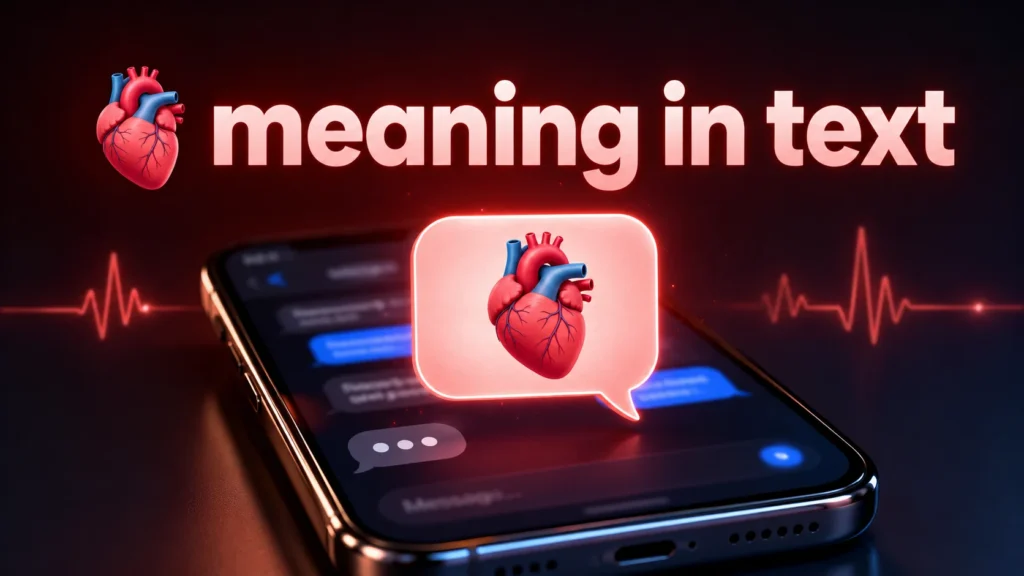
The 🫀 meaning in text usually relates to genuine love, deep emotions, emotional pain, life, or a connection that feels more intense than an ordinary heart emoji.
Unlike ❤️, which often presents love in a familiar and polished way, 🫀 shows an anatomically realistic human heart. For that reason, it can make a message feel raw, vulnerable, dramatic, or deeply personal.
Someone might send 🫀 to say, “I love you with my whole heart.” However, another person could use it to express heartbreak, emotional exhaustion, fascination with anatomy, or appreciation for dark art.
People often search for its meaning because the emoji can look romantic and unsettling at the same time. This guide explains what 🫀 means in different conversations, how tone affects it, and how you can respond appropriately.
🫀 Meaning in Text – Quick Meaning
The 🫀 meaning in text is commonly “my real heart,” “deep love,” “raw emotion,” or “you are important to my life.” It may also refer literally to the human heart, health, medicine, or anatomy.
Depending on the conversation, 🫀 can represent:
- Deep, genuine love
- Raw or unfiltered emotion
- Emotional pain or heartbreak
- Life and human existence
- Strong attachment to someone
- Vulnerability and sincerity
- Heart health or medical topics
- Gothic, dark, or anatomical art
- Emotional intensity
- Giving someone your whole heart
Consider these examples:
“You will always have a place in my 🫀.”
Here, the anatomical heart represents lasting emotional attachment.
“That ending completely broke my 🫀.”
In this example, it adds drama to sadness or heartbreak.
“Studying the cardiovascular system today 🫀.”
This message uses the emoji literally in a medical or educational context.
What Does 🫀 Mean in One Sentence?
The 🫀 emoji represents the real human heart and commonly expresses deep love, emotional vulnerability, heartbreak, life, or medical interest.
Is 🫀 Romantic?
It can be romantic. When used between partners, 🫀 often suggests a deeper, more intense form of love than a standard red heart.
Still, it is not always romantic. Context determines whether it represents love, pain, anatomy, health, art, or dark humor.
Origin and Background of the 🫀 Emoji
The anatomical heart emoji was approved as part of Unicode 13.0 in 2020. It was introduced to represent the physical human heart more accurately than the traditional heart symbol.
The familiar ❤️ does not resemble the actual organ. Instead, it developed over centuries as a symbolic representation of affection and romance. The 🫀 emoji fills a different role by showing a realistic anatomical heart with visible vessels.
From Physical Organ to Emotional Symbol
People have associated the heart with love, courage, personality, and the human soul for thousands of years. Although modern science identifies the brain as the center of thought and emotion, everyday language still connects feelings with the heart.
People say:
- “You have my heart.”
- “My heart is broken.”
- “I love you with all my heart.”
- “Follow your heart.”
- “That touched my heart.”
Therefore, when the anatomical heart entered digital communication, users naturally gave it both medical and emotional meanings.
Cultural Influence
The realistic heart appears frequently in religious art, tattoo designs, gothic fashion, medical illustrations, album artwork, and poetry. It can symbolize sacrifice, mortality, spiritual devotion, or the painful side of love.
In some artistic communities, 🫀 feels more authentic than ❤️. The message is not simply “love”; it is “real love with all its beauty, fear, pain, and vulnerability.”
Social Media Impact
TikTok, Instagram, Tumblr, and other visual platforms expanded the emotional meaning of 🫀. Users began including it in poetic captions, dark-romantic edits, mental-health posts, medical content, and relationship messages.
As a result, the 🫀 meaning in text messages has evolved beyond anatomy. It now works as a symbol of emotions that feel real, physical, and difficult to hide.
Real-Life Conversations Using 🫀
The same emoji can communicate love, sadness, or scientific interest. These conversations demonstrate how surrounding words shape its meaning.
WhatsApp Conversation Between Partners
Person A: I know I don’t always say how I feel.
Person B: You don’t have to force it. I understand you.
Person A: I just need you to know that you mean everything to me 🫀
Person B: You mean everything to me too.
In this conversation, 🫀 represents sincere and vulnerable love. The sender uses it to show that their feelings come from their deepest emotional self.
Instagram DM About Artwork
Person A: Your anatomical heart drawing is incredible.
Person B: Thank you! It took me almost eight hours 🫀
Person A: The details are beautiful. You should make it into a print.
Here, the emoji relates to art and anatomy. It does not carry a romantic meaning.
TikTok Comment on an Emotional Video
Person A: This song reminds me of someone I can never speak to again.
and
Person B: Some memories stay inside us forever 🫀
Person A: That is exactly what it feels like.
In this exchange, 🫀 communicates grief, emotional pain, and a connection that continues despite separation.
Text Message Between Close Friends
Person A: Thank you for staying with me when everything fell apart.
Person B: Always. You’re family to me 🫀
Person A: I honestly don’t know what I would do without you.
The emoji represents a powerful platonic bond. It tells the receiver that the friendship feels essential and deeply meaningful.
Emotional and Psychological Meaning of 🫀
Emotionally, 🫀 can feel more exposed than a colorful heart emoji. It represents the organ that keeps a person alive, so giving it to someone symbolically can mean, “You are part of me” or “My feelings for you are real.”
People may choose it when ❤️ feels too ordinary, cheerful, or predictable. The anatomical version adds intensity and may communicate emotions that are complicated rather than perfectly romantic.
What Emotion Does 🫀 Express?
Depending on context, it can express:
- Powerful love
- Emotional honesty
- Attachment
- Longing
- Grief
- Heartbreak
- Fear of losing someone
- Appreciation for life
- Emotional healing
- Fascination with human existence
Its realistic appearance can make love feel physical. Instead of presenting an idealized version of romance, it suggests that love affects the entire body.
Why People Use It
Some people find it difficult to write, “I feel emotionally vulnerable with you.” Sending 🫀 offers a shorter but emotionally powerful alternative.
Others use it to appear poetic, alternative, mysterious, or artistically expressive. It is especially popular in captions that explore complicated relationships or strong inner feelings.
Imagine that a close friend supports you through a period when you feel completely alone. Later, you message, “You helped me feel alive again 🫀.” The emoji does more than decorate the sentence. It connects their support with survival, healing, and emotional renewal.
That is what makes 🫀 distinctive: it can communicate affection while acknowledging that genuine emotions are sometimes messy and painful.
Usage in Different Contexts
The 🫀 meaning in text changes according to the relationship, platform, and subject of the conversation.
On Social Media
On Instagram and TikTok, 🫀 commonly appears in:
- Emotional captions
- Poetry and quotations
- Gothic or dark-academia content
- Anatomical artwork
- Medical education
- Relationship edits
- Mental-health discussions
- Tattoo designs
- Music posts
- Grief and remembrance content
For example, someone might caption a photograph, “Still learning how to protect my 🫀.” This usually refers to emotional boundaries rather than physical heart protection.
Between Friends
Close friends may use 🫀 to express loyalty, gratitude, or a bond that feels like family. It can be more emotionally intense than 💛 or 💙, so it usually fits friendships where both people are comfortable showing affection.
A message such as “My person forever 🫀” can communicate deep platonic love without implying romance.
In Romantic Relationships
Between partners, 🫀 can mean:
- “You have my real heart.”
- “My love for you is deep.”
- “You make me feel alive.”
- “I trust you with my vulnerable side.”
- “Our connection is intense.”
It can also communicate romantic pain. For example, “I still miss you 🫀” may suggest that the sender remains emotionally attached.
In Medical and Educational Settings
Doctors, nurses, medical students, health organizations, and science educators may use 🫀 literally. In those settings, it can represent cardiology, circulation, heart health, anatomy, or a medical procedure.
A post reading “Learning about congenital heart conditions today 🫀” is informational rather than emotional.
Work and Professional Settings
The emoji may be appropriate in medical, artistic, or health-related professional content. A hospital could use it in a heart-health awareness campaign, while an illustrator might add it to an anatomical art announcement.
In an ordinary workplace conversation, however, 🫀 may feel overly personal or dramatic. Clear and neutral wording is generally safer with clients, managers, and unfamiliar colleagues.
Casual Versus Serious Tone
In casual chats, 🫀 can work as dramatic humor. Someone may write, “That dessert healed my 🫀,” simply meaning that they loved it.
In serious messages, it can express grief, love, or emotional vulnerability. Read the complete sentence before deciding how deeply the sender intends it.
When Not to Use 🫀
Although the anatomical heart can be meaningful, its realistic appearance may make some people uncomfortable.
Avoid or reconsider using it:
- With someone who dislikes images of organs or blood
- In formal business correspondence
- When a regular heart would communicate more clearly
- During medical emergencies where precise words are necessary
- In unwanted romantic or emotionally intense messages
- When responding to grief without offering genuine words
- Around young children who may find the image frightening
- When its gothic tone does not suit the conversation
- In apologies where accountability matters more than symbolism
- When cultural or religious interpretations are unclear
If someone shares a heart-related medical diagnosis, sending only 🫀 could appear careless or confusing. A compassionate message such as “I’m thinking of you and hoping your treatment goes well” will be more supportive.
Similarly, sending “You own my 🫀” to someone you barely know may feel too intense. Emotional language should respect the relationship’s existing boundaries.
Common Misunderstandings About 🫀
It Always Means Romantic Love
The emoji can express passionate love, but it also appears in friendships, medical discussions, artwork, poetry, grief posts, and dark humor.
One 🫀 is not proof that someone wants a romantic relationship.
It Means Someone Has a Heart Problem
Not necessarily. A person may use it symbolically without referring to their physical health.
However, messages mentioning pain, doctors, surgery, pulse, or symptoms probably use it in a medical sense.
It Is the Same as ❤️
Both emojis relate to the heart, but their tones differ. ❤️ usually feels familiar, warm, and openly affectionate. Meanwhile, 🫀 often feels raw, realistic, artistic, or emotionally intense.
It Has a Violent Meaning
Its anatomical appearance can seem graphic, but 🫀 is not inherently violent. It represents a human organ and contains no blood or injury imagery.
A violent meaning would require additional threatening language or context.
It Always Represents Heartbreak
People sometimes use 🫀 in sad captions, yet the emoji can also represent healing, devotion, life, courage, and positive emotional depth.
It Is Automatically Inappropriate for Children
The emoji itself is educational and can help children learn about anatomy. Nevertheless, its realistic appearance may unsettle very young or sensitive viewers.
🫀 Compared With Similar Emojis and Expressions
| Emoji or expression | Common meaning | Typical tone | Difference from 🫀 |
|---|---|---|---|
| ❤️ | Love and deep affection | Warm and romantic | More traditional and idealized |
| 💔 | Heartbreak or loss | Sad and direct | Clearly shows emotional damage |
| 🩷 | Sweet love and affection | Soft and playful | Lighter and less intense |
| 🖤 | Dark love, grief, or style | Mysterious and dramatic | Symbolic rather than anatomical |
| ❤️🔥 | Passionate love or desire | Intense and energetic | Focuses more on passion |
| ❤️🩹 | Healing after emotional pain | Hopeful and vulnerable | Specifically represents recovery |
| 🧠 | Thought, intelligence, or logic | Mental and analytical | Represents the mind rather than emotion |
| “You have my heart” | Love and emotional trust | Romantic or sincere | States the intention clearly |
| “From the bottom of my heart” | Complete sincerity | Deep and respectful | Often used for gratitude |
| “I feel nothing” | Emotional detachment | Cold or exhausted | Opposite of deep emotional connection |
Key Insight
The anatomical heart stands out because it represents emotion in a realistic, physical form. It often feels less polished than ❤️ but more vulnerable, artistic, and emotionally complex.
Variations and Types of 🫀 Usage
1. A Single Anatomical Heart: 🫀
A single 🫀 can mean deep emotion, real love, life, or interest in anatomy. The surrounding conversation provides the clearest meaning.
2. Multiple Anatomical Hearts: 🫀🫀🫀
Repeating the emoji increases its emotional intensity. It may express overwhelming love, excitement, or enthusiasm for anatomical art.
3. 🫀❤️
This pairing combines realistic and symbolic love. It can mean, “I love you with both my physical and emotional heart.”
4. 🫀🧠
The heart-and-brain combination represents conflict or balance between emotion and logic. It may suggest that someone’s feelings and thoughts disagree.
5. 🫀🩹
This combination symbolizes emotional or physical healing. Someone may use it while recovering from heartbreak, illness, or a difficult experience.
6. 🫀🥀
An anatomical heart with a wilted rose often represents lost love, sadness, grief, or the painful beauty of a past relationship.
7. 🫀🔒
This pairing may mean a guarded heart, loyal love, or emotions protected from other people. It can also suggest commitment.
8. 🫀🩸
The blood drop gives the combination a more medical, gothic, or graphic tone. It may refer to circulation, blood donation, surgery, or dark artwork.
9. 🫀✨
Sparkles soften the realistic heart and add hope, beauty, or healing. It can mean that someone is emotionally growing or learning to love again.
10. “You Have My 🫀”
This variation expresses strong attachment and trust. In a romantic setting, it means the sender has emotionally committed themselves.
11. “My 🫀 Hurts”
This phrase usually represents heartbreak, grief, or emotional distress. If physical symptoms are also mentioned, it could refer to actual pain and should be taken seriously.
12. “Protect Your 🫀”
Depending on the post, this can mean protecting emotional boundaries or caring for physical heart health.
How to Respond When Someone Uses 🫀
Your response should reflect both the message and your relationship with the sender.
Casual Replies
- “Right back at you 🫀”
- “That means a lot to me.”
- “You’re in my heart too.”
- “Sending love your way.”
- “My favorite human 🫀”
Funny Replies
- “Please return my vital organ immediately.”
- “That looks medically serious 😂”
- “My cardiologist has entered the chat.”
- “A little dramatic, but I accept.”
- “You really gave me your whole heart.”
Romantic Replies
- “You have mine too 🫀”
- “I’ll protect your heart.”
- “You make mine feel alive.”
- “My heart always finds its way back to you.”
- “I love every real and imperfect part of you.”
Use romantic replies only when the interest is mutual.
Mature Replies
- “I appreciate your honesty and trust.”
- “Our connection means a great deal to me.”
- “Thank you for sharing something so personal.”
- “I care about you deeply too.”
- “You will always matter to me.”
Respectful or Neutral Replies
- “Thank you for the kind message.”
- “I appreciate that.”
- “What does that emoji mean to you?”
- “I’m not sure how you intended it.”
- “That’s thoughtful of you.”
If the message feels too emotionally intense, you can acknowledge it without matching the same level: “I care about you, but I would like us to take things slowly.”
Regional and Cultural Usage
Western Culture
In Western online culture, 🫀 often appears in medical content, alternative art, poetry, tattoos, and emotionally intense relationship posts.
It may communicate authentic love or the idea that emotions are physical and imperfect. Gothic and dark-romantic communities also use it as an aesthetic symbol.
Asian Culture
Across Asian social media communities, the emoji may appear in medical education, emotional quotations, fandom edits, and artistic captions. Some users pair it with local poetic expressions about love or pain.
Because communication customs vary widely, intense heart symbolism may feel romantic in one community but purely aesthetic in another.
Middle Eastern Culture
In Middle Eastern digital spaces, 🫀 can symbolize the emotional heart, soul, life, or deep attachment. It may accompany poetry about devotion, longing, separation, or spiritual feeling.
Nevertheless, direct romantic expression can be sensitive in certain families and communities. The sender’s relationship with the receiver remains important.
Global Internet Usage
Globally, the anatomical heart crosses several online worlds: medicine, science, art, music, mental health, romance, and dark aesthetics.
This variety makes its meaning flexible. A medical student, poet, tattoo artist, and romantic partner may all use 🫀 for completely different reasons.
Gen Z Versus Millennials
Gen Z users are more likely to use 🫀 as an aesthetic, emotionally intense, or ironic alternative to ❤️. It may appear in poetic captions and dark-humor posts.
Millennials may use it more literally for anatomy, health, or highly dramatic love. Still, personal habits matter more than broad generational patterns.
Is 🫀 Safe for Kids?
Yes, 🫀 is generally safe for children. It is an educational representation of the human heart and has no automatically sexual or offensive meaning.
However, its realistic design may look strange or frightening to some young children. Parents can explain that it represents the organ that pumps blood around the body.
As with every emoji, context matters. Adults should pay attention if a stranger uses emotionally intense language to pressure a child into secrecy, affection, or private communication.
Frequently Asked Questions
What does 🫀 mean from a girl?
From a girl, 🫀 may express deep affection, emotional vulnerability, heartbreak, or an artistic interest in anatomy. If it appears beside loving words, it probably represents sincere emotional attachment.
What does 🫀 mean from a guy?
From a guy, 🫀 can mean “you have my real heart,” “I care deeply,” or “this affects me emotionally.” It may also relate to fitness, medicine, science, or dark humor.
Does 🫀 mean “I love you”?
Yes, 🫀 can mean “I love you deeply” or “I give you my whole heart.” However, it does not always express romance, so consider the accompanying words and relationship.
What does 🫀 mean on TikTok?
On TikTok, 🫀 commonly appears in emotional edits, relationship videos, poetry, medical content, gothic aesthetics, tattoo posts, and captions about heartbreak or healing.
What is the difference between 🫀 and ❤️?
❤️ is a traditional symbol of love, while 🫀 shows the actual human organ. The anatomical heart generally feels more realistic, raw, vulnerable, artistic, or medically focused.
Is 🫀 a dark or disturbing emoji?
Not inherently. Some people use it in gothic or unsettling content, but it is also a neutral anatomy symbol and a meaningful expression of genuine love.
What does “you have my 🫀” mean?
“You have my 🫀” usually means “you have my whole heart” or “I am deeply emotionally attached to you.” It often carries a romantic and vulnerable tone.
Conclusion
The 🫀 meaning in text can be deep love, raw emotion, heartbreak, life, vulnerability, or a literal reference to human anatomy. Compared with the familiar red heart, it often makes a message feel more realistic and emotionally exposed.
Still, the emoji cannot reveal someone’s intention by itself. A medical student may use it to discuss cardiology, an artist may admire its visual form, and a romantic partner may use it to offer their “real” heart.
Pay attention to the sender’s words, your relationship, and the emotional atmosphere of the conversation. When you use 🫀 yourself, pair it with clear language so your message feels meaningful rather than confusing.