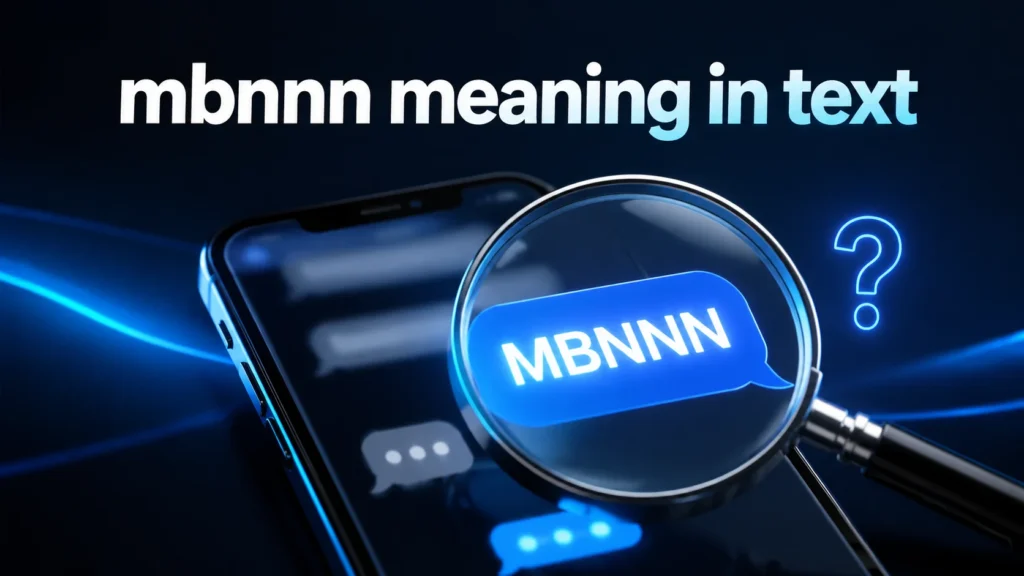
The mbnnn meaning in text is usually “must be nice,” with the extra letters adding emotion or emphasis. People often type it after seeing someone enjoy a holiday, receive a thoughtful gift, enter a happy relationship, or experience something desirable.
For example, if your friend posts a photo from a beautiful beach, you might reply, “mbnnn 😭.” In that situation, you are essentially saying, “Must be nice—I wish I were there too.”
However, this expression can carry several tones. It may sound genuinely happy, playfully jealous, quietly disappointed, or even sarcastic. The surrounding conversation, relationship between the speakers, punctuation, and emojis all help reveal the intended emotion.
Understanding those signals solves the main confusion: is the sender celebrating your happiness or criticizing you for showing off? Usually, the answer lies in how they write it and what happened before the message.
MBNNN Meaning in Text – Quick Meaning
MBNNN means “must be nice.” It is an extended version of MBN, a popular texting abbreviation.
The additional “n” letters do not introduce new words. Instead, they stretch the final sound to make the reaction feel more expressive, similar to writing “soooo nice” instead of “so nice.”
Depending on context, MBNNN can communicate:
- “You are so lucky.”
- “I wish I had that.”
- “That looks amazing.”
- “Good for you—although I am a little jealous.”
- “You have it easy, don’t you?”
- “Are you trying to show off?”
Here are a few quick examples:
“Your boyfriend planned the whole trip? Mbnnn 😭❤️”
“You get Friday off while we have to work? MBNNN.”
“A new phone and a new laptop in one week? mbnnn 😂”
The first example sounds affectionate and playfully jealous. The second may feel annoyed or sarcastic. Meanwhile, the third sounds surprised and humorous.
Origin and Background of MBNNN
Where Did MBNNN Come From?
MBNNN developed from MBN, an acronym for “must be nice.” The expression existed in spoken English long before people shortened it for texting.
Someone might traditionally respond to another person’s good news by saying, “Oh, that must be nice.” Depending on vocal tone, the statement could express sincere approval or subtle envy.
As texting became faster and more informal, users reduced “must be nice” to “MBN.” Online slang references also recognize MBN as an abbreviation that can show admiration, dissatisfaction, or envy.
Why Are Extra Letters Added?
Digital conversations lack facial expressions and vocal emphasis. Therefore, people stretch words and abbreviations to recreate spoken emotion.
“MBN” can look brief, neutral, or dismissive. In comparison, “mbnnn” feels more dramatic and conversational. The extended ending may represent a person drawing out the phrase:
“Must be niiiice.”
The number of additional letters has no fixed grammatical meaning. “MBNN,” “MBNNN,” and “MBNNNNN” generally express the same basic idea, although more letters often suggest greater emotional intensity.
Social Media Influence
Instagram, TikTok, Snapchat, and WhatsApp helped make expressive spellings common. Users regularly lengthen words such as “heyyy,” “noooo,” “cuteee,” and “okayyy” to create a specific mood.
MBNNN follows the same pattern. It often appears beneath posts about romantic surprises, expensive purchases, vacations, attractive lifestyles, and achievements.
Over time, its meaning has become more flexible. What once functioned mainly as a shortened phrase can now communicate admiration, longing, sarcasm, exclusion, or playful jealousy.
Real-Life Conversations Using MBNNN
WhatsApp Conversation: Playful Jealousy
Person A: My sister surprised me with concert tickets!
Person B: Mbnnn 😭 I need a sister like yours.
and,
Person A: Come with us next time!
Person B: I’m holding you to that 😂
Here, MBNNN means “You are lucky.” The crying emoji and follow-up joke keep the reaction warm rather than bitter.
Instagram DM: Romantic Admiration
Person A: Did you see the anniversary dinner my boyfriend planned?
Person B: Yes! The flowers were beautiful. MBNNN ❤️
Person A: I honestly wasn’t expecting any of it.
Person B: You deserve that kind of love.
This exchange shows sincere happiness mixed with lighthearted longing. The final supportive message removes any possibility of hostility.
TikTok Comments: Humorous Envy
Creator: My parents surprised me with a trip to Italy after graduation.
Commenter A: MBNNN, my parents gave me a lecture 😭
Commenter B: Congratulations! Have the best time.
Creator: Thank you! I still can’t believe it.
The commenter compares experiences for comedic effect. Although there is envy, the tone appears playful rather than insulting.
Text Message: Sarcastic Frustration
Person A: I’m leaving early again because my manager said I could.
Person B: Mbnnn. The rest of us are still covering your section.
Person A: I didn’t realize you were short-staffed.
Person B: We have been all week.
In this case, “mbnnn” is not a cheerful compliment. It expresses irritation because one person’s advantage creates extra work for someone else.
Emotional and Psychological Meaning of MBNNN
What Emotion Does It Express?
The emotional meaning of MBNNN sits somewhere between admiration and envy. A person sees something desirable and recognizes that another individual is enjoying it.
Healthy, playful jealousy often sounds like:
“Mbnnn 😭 invite me next time!”
Resentful jealousy may sound like:
“MBNNN. Some people get everything.”
The words are similar, yet the emotional impact is completely different.
Why Do People Use It?
Saying “I am jealous of you” can feel too serious or vulnerable. MBNNN offers a lighter way to admit, “I want what you have.”
It may also help someone participate in a happy moment without writing a long response. A single expressive abbreviation can acknowledge good news, show interest, and communicate longing at once.
Sometimes, however, people use it indirectly. Rather than openly saying, “I feel left out” or “That seems unfair,” they send “mbnnn” and expect the receiver to understand the hidden emotion.
A Relatable Scenario
Imagine that your closest friends go out without inviting you. Later, one of them sends a photo from the restaurant and says, “This place is amazing.”
You reply, “Mbnnn.”
On the surface, you are saying the restaurant looks nice. Emotionally, though, your message may mean, “I wish I had been invited.”
This is why context matters. MBNNN can reveal an unmet emotional need without stating it directly.
Usage in Different Contexts
On Social Media
People commonly post MBNNN under content featuring:
- Luxury holidays
- New cars or phones
- Romantic dates
- Surprise gifts
- Flexible work schedules
- Concerts and special events
- Academic or career success
- Close friendships
A comment such as “MBNNN 😍” generally shows admiration. By contrast, “mbnnn must be easy for some people” communicates criticism.
Between Friends
Friends often use the expression as playful teasing. If one friend sleeps late while everyone else attends an early class, another might write, “You woke up at noon? Mbnnn.”
Their friendship allows the phrase to sound humorous because both people understand the tone.
In Relationships
Within romantic conversations, MBNNN may reveal a desire for similar attention. Someone who sees another couple exchanging thoughtful gifts might tell their partner, “Look what he planned for her, mbnnn.”
Although it appears playful, the message may contain a real request: “I would appreciate this kind of effort too.”
A caring partner should respond to the underlying feeling instead of dismissing it as random slang.
At Work
MBNNN is rarely suitable for formal professional communication. It can appear in friendly coworker chats, but even there, caution is helpful.
For instance, replying “mbnnn” when a colleague receives a promotion may seem resentful. “Congratulations—you earned it” would communicate support more clearly.
Casual Versus Serious Tone
In a casual exchange, the expression sounds relaxed and relatable. Emojis such as 😂, 😭, ❤️, or 😍 often soften it.
During a serious disagreement, MBNNN can sound passive-aggressive. A period at the end—“mbnnn.”—may make it feel colder or more judgmental.
When Not to Use MBNNN
Avoid using MBNNN when clarity, sensitivity, or professionalism is important.
It may be inappropriate:
- In job applications or formal emails
- When congratulating someone on a serious achievement
- While speaking to a teacher, manager, or unfamiliar client
- When someone shares sensitive financial information
- During grief, illness, or personal hardship
- When the receiver may not understand online slang
- If you genuinely feel angry and need an honest conversation
- When it could minimize someone’s hard work
Suppose a friend earns a scholarship after years of effort. Replying only with “mbnnn” could imply that they were merely lucky. A warmer response would recognize the work behind the achievement.
Cultural sensitivity also matters. Not everyone interprets indirect sarcasm comfortably. Some people may read the words literally, while others may view them as an accusation.
Common Misunderstandings About MBNNN
It Does Not Usually Have a Different Full Form
The additional letters often confuse readers. Nevertheless, MBNNN is generally not a longer acronym containing extra words. It is simply an emotionally stretched form of MBN.
It Is Not Always a Compliment
“Must be nice” can sound positive, but its emotional direction depends on delivery. The sender may admire you, envy you, or criticize what they perceive as showing off.
It Does Not Always Indicate Serious Jealousy
Friends commonly use MBNNN without resentment. Playful envy means, “I wish I had that too,” not, “I want to take it away from you.”
Punctuation Changes the Tone
Compare these messages:
- “MBNNN 😍” — enthusiastic admiration
- “mbnnn lol” — playful teasing
- “Mbn.” — cold or dismissive
- “Must be nice…” — possibly sarcastic
- “MBNNN invite me!” — friendly excitement
Literal and Figurative Meanings Differ
Literally, “must be nice” acknowledges a pleasant experience. Figuratively, it may communicate, “You do not understand how fortunate you are.”
The correct interpretation depends on the wider conversation rather than the abbreviation alone.
MBNNN Compared With Similar Expressions
| Expression | Basic meaning | Typical tone | Example |
|---|---|---|---|
| MBNNN | Must be nice | Admiring, jealous, or sarcastic | “You’re in Paris? Mbnnn!” |
| MBN | Must be nice | Short and casual | “No work today? MBN.” |
| Lucky you | You are fortunate | Friendly or sarcastic | “You got the last ticket? Lucky you.” |
| Goals | I want something like that | Positive and admiring | “Your friendship is goals.” |
| I’m jealous | I wish I had that | Direct and honest | “That holiday looks great—I’m jealous.” |
| Good for you | I am pleased for you | Supportive or sarcastic | “You passed? Good for you!” |
| Can’t relate | My experience is different | Humorous or dismissive | “Eight hours of sleep? Can’t relate.” |
| Flex | A display of success or status | Teasing or critical | “That new-car post was a flex.” |
| Same | I share that feeling | Agreeable | “I need a vacation.” “Same.” |
| Unfortunately, no | The opposite experience applies | Dry humor | “You get weekends off? Unfortunately, no.” |
Key Insight
MBNNN is more emotionally flexible than “congratulations” or “lucky you.” Its meaning can shift from affectionate admiration to sharp sarcasm through nothing more than punctuation, emojis, and context.
Variations and Types of MBNNN
1. MBN
Meaning: Must be nice.
This is the standard and shortest form, usually used for a quick reaction.
2. MBNN
Meaning: Must be nice, with slight emphasis.
One added letter makes the expression appear more animated and informal.
3. MBNNN
Meaning: Must be really nice.
This popular stretched form often conveys playful jealousy or strong admiration.
4. MBNNNN
Meaning: That must be very nice.
Extra letters increase the dramatic or teasing quality of the message.
5. Mbnnn 😭
Meaning: I am playfully jealous.
The crying emoji usually represents exaggerated longing rather than genuine sadness.
6. Mbnnn 😍
Meaning: I love what you have or experienced.
Heart eyes make the response warmer and more clearly admiring.
7. MBN 😂
Meaning: Lucky you—that is funny.
The laughing emoji signals teasing and reduces the chance of a hostile interpretation.
8. Mbn.
Meaning: Must be nice, but I may be annoyed.
The period and short spelling can create a cold, restrained, or passive-aggressive tone.
9. “Must be nice…”
Meaning: You seem privileged or fortunate.
Writing the phrase in full with an ellipsis often makes the sarcasm more noticeable.
10. MBN, Invite Me Next Time
Meaning: That looks enjoyable, and I want to join.
The follow-up sentence turns possible jealousy into friendly interest.
How to Respond When Someone Uses MBNNN
Your best reply depends on whether the sender sounds amused, supportive, excluded, or upset.
Casual Replies
- “Honestly, it is!”
- “I got lucky this time.”
- “You need to try it too.”
- “I’m enjoying every second.”
- “Next time, you’re coming with me.”
Funny Replies
- “Let me enjoy my five minutes of happiness 😂”
- “I waited my whole life for this flex.”
- “Don’t worry, reality returns tomorrow.”
- “Manifesting the same for you.”
- “I’ll send you the application form 😭”
Mature Replies
- “I’m grateful because I know not everyone gets this opportunity.”
- “I understand why you feel that way.”
- “It looks effortless, but it took a lot of work.”
- “I hope something equally good comes your way.”
- “Did my message make you feel left out?”
Respectful Replies
- “Thank you—I really appreciate it.”
- “I feel very fortunate.”
- “Your support means a lot.”
- “I would love to include you next time.”
- “I hope I didn’t come across as insensitive.”
If the message feels passive-aggressive, avoid responding defensively. A calm question such as “Are you joking, or did something bother you?” can prevent unnecessary conflict.
Regional and Cultural Usage
Western Culture
In the United States, Canada, and the United Kingdom, “must be nice” often carries playful envy or sarcasm. MBNNN reflects that same flexibility in digital conversations.
Young users are especially likely to place it under lifestyle, relationship, and travel content.
Asian Culture
English-speaking social media users across South Asia and Southeast Asia may use MBNNN as borrowed internet slang. It often appears in conversations about education, travel, relationships, family freedom, or career opportunities.
Because indirect communication is common in many communities, the phrase may quietly express comparison or disappointment without open confrontation.
Middle Eastern Culture
Among English-speaking users in the Middle East, MBNNN can react to luxury experiences, travel, gifts, weddings, and social freedom. Still, interpretation varies according to English fluency, age, and familiarity with Western online slang.
When speaking across cultures, writing “That looks wonderful—you are lucky” is safer if the intended meaning must be completely clear.
Global Internet Usage
Online slang moves quickly across national borders. A person does not need to live in an English-speaking country to understand or use MBNNN.
Memes, short-form videos, gaming communities, and international friendships have turned the expression into a recognizable digital reaction.
Gen Z Versus Millennials
Gen Z users are more likely to stretch the abbreviation, combine it with emojis, or use it ironically. Millennials may prefer the simpler “MBN,” “must be nice,” or “lucky you.”
Older generations might interpret the phrase literally or view it as sarcasm. Therefore, spelling out your emotion is often better when communicating with someone unfamiliar with modern texting habits.
Is MBNNN Safe for Kids?
Yes, MBNNN is generally safe for children and teenagers. It does not inherently contain profanity, sexual language, or an offensive meaning.
However, children should understand that it may sound jealous or passive-aggressive. Teaching them to add a positive phrase—such as “mbnnn, I’m happy for you!”—can make their intention clearer.
Parents should also encourage direct communication. If a child feels excluded or treated unfairly, saying “I felt left out” is healthier than relying only on an ambiguous abbreviation.
Frequently Asked Questions
What does MBNNN mean in a text message?
MBNNN means “must be nice.” It usually expresses admiration, playful jealousy, longing, or sarcasm after someone shares a desirable experience.
What is the difference between MBN and MBNNN?
Both mean “must be nice.” MBN is the standard abbreviation, while MBNNN uses extra letters to add emotion, emphasis, or a drawn-out conversational sound.
Is MBNNN a compliment?
It can be a compliment, especially when paired with positive emojis or supportive words. In other situations, it may express envy, annoyance, or sarcasm.
What does MBNNN mean from a girl?
From a girl, MBNNN usually means “you are lucky” or “I wish I had that too.” It could also suggest playful jealousy, depending on the conversation.
What does MBNNN mean from a guy?
From a guy, the meaning remains “must be nice.” His tone may be friendly, teasing, envious, flirtatious, or sarcastic based on the context and emojis.
Is MBNNN rude?
MBNNN is not automatically rude. However, it may sound dismissive when written with a period, used after a serious achievement, or sent during an argument.
How should I reply to MBNNN?
You can reply with “I got lucky,” “Come with me next time,” or “I hope you get to experience it too.” If the sender seems upset, politely ask what they mean.
Conclusion
The mbnnn meaning in text is “must be nice,” but those three words can carry more emotion than they initially reveal. Sometimes, the sender is genuinely impressed. At other times, they are jokingly jealous, feeling excluded, or quietly criticizing someone’s privilege.
Look at the full conversation before deciding what the message means. Emojis, punctuation, follow-up words, and your relationship with the sender offer the strongest clues.
Used thoughtfully, MBNNN can be a funny and relatable way to say, “You are lucky, and I wish I could experience that too.” When emotions are serious, though, direct and honest words will always create better understanding.