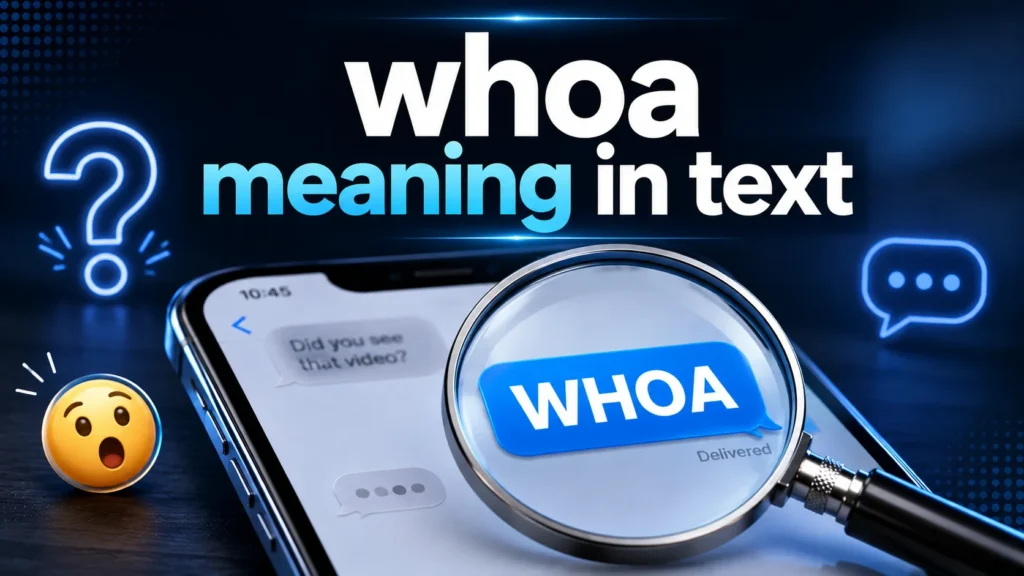
If you have seen someone type “whoa” in a text message, comment, or social media post, you may have wondered what they actually mean. Is it excitement? Surprise? Shock? Disbelief? The answer depends on the situation and the emotion behind the message.
The phrase “whoa meaning in text” is searched by many people because online conversations often remove facial expressions and body language. A simple word like “whoa” can carry different feelings that are difficult to understand without context.
In everyday digital communication, “whoa” is usually used as an emotional reaction. It can show amazement, surprise, admiration, confusion, or even concern. People often use it when something catches their attention or feels unexpected.
For example:
- Someone shares an unbelievable achievement → “Whoa, that’s amazing!”
- Someone reveals surprising news → “Whoa, I didn’t know that.”
- Someone sees an expensive purchase → “Whoa, that’s a lot of money.”
Understanding this expression helps you read online conversations more naturally and respond with the right emotion.
Whoa Meaning in Text – Quick Meaning
What Does “Whoa” Mean in Text Messages?
The word “whoa” is an expression used to show a strong reaction to something surprising, impressive, unexpected, or difficult to believe.
In texting, “whoa” can mean:
- “Wow!” – showing admiration or amazement
- “Wait a second!” – asking someone to slow down or pause
- “That’s surprising!” – reacting to unexpected information
- “I can’t believe that!” – expressing disbelief
The meaning depends heavily on the conversation and the relationship between the people communicating.
Simple Examples of “Whoa” in Text
Example 1:
“I just bought my first house!”
Reply:
“Whoa, congratulations!”
Meaning: The person is impressed and excited.
Example 2:
“I scored 100% on my final exam.”
Reply:
“Whoa, that’s incredible!”
Meaning: Showing admiration.
Example 3:
“The ticket costs $5,000.”
Reply:
“Whoa…”
Meaning: Expressing shock because the price is unexpectedly high.
Origin & Background of “Whoa”
Where Did the Word “Whoa” Come From?
The word “whoa” originally came from a command used to stop horses. Riders would say “whoa” to make a horse slow down or stop moving.
Over time, the expression moved from physical situations into everyday human conversations.
Today, people use “whoa” not only as a command but also as an emotional reaction.
For example:
- “Whoa, slow down!”
- “Whoa, that’s unbelievable!”
- “Whoa, I never expected that.”
The modern meaning developed because the word naturally expresses a sudden pause or reaction.
Cultural Influence and Internet Usage
The internet helped make “whoa” more popular in casual communication. Social media platforms, gaming communities, and online discussions often use short emotional expressions instead of full sentences.
On platforms like TikTok, Instagram, Reddit, and YouTube comments, people frequently write:
- “Whoa, this is beautiful.”
- “Whoa, that changed everything.”
- “Whoa, that was unexpected.”
The word became popular because it is quick, expressive, and easy to understand across different cultures.
How the Meaning Has Evolved
In older conversations, “whoa” mostly meant “stop” or “wait.”
In modern texting culture, it has become more emotional. It can represent:
- Surprise
- Excitement
- Respect
- Confusion
- Concern
- Amazement
The emotion behind “whoa” is often stronger than the word itself.
Real-Life Conversations Using “Whoa” in Text
WhatsApp Conversation Example
Ali:
I finally got my dream job today.
Sara:
Whoa! That’s huge. Congratulations 🎉
Ali:
Thanks, I still can’t believe it.
Meaning:
Sara uses “whoa” to show happiness and excitement about Ali’s success.
Instagram DM Example
Person A:
I traveled to five countries this year.
Person B:
Whoa, that’s impressive. How did you manage that?
Meaning:
The person is surprised and impressed.
TikTok Comment Example
Creator:
My old car restoration took two years.
Comment:
Whoa, the final result is amazing!
Meaning:
The commenter expresses admiration.
Text Message Example
Person A:
I spent $2,000 on a single jacket.
Person B:
Whoa, seriously?
Meaning:
The person is shocked and wants confirmation.
Emotional & Psychological Meaning of “Whoa”
What Emotion Does “Whoa” Express?
The emotional meaning of “whoa” depends on the situation. It is usually connected with moments when the brain experiences something unexpected.
People use it when they feel:
Surprise:
Something happens that they did not expect.
Excitement:
Something feels impressive or enjoyable.
Amazement:
Something seems extraordinary.
Concern:
Something feels too extreme or unusual.
Confusion:
They need time to understand what they heard.
Why Do People Use “Whoa” Instead of a Full Sentence?
Modern communication is fast. People often use short emotional words because they immediately show their reaction.
Typing:
“Whoa!”
can communicate:
“I am surprised, impressed, and trying to process what you just said.”
It creates a more natural emotional connection than a simple “okay” or “interesting.”
Personal-Style Scenario
Imagine a friend tells you they completed a marathon after months of training. Instead of writing a long message immediately, you might naturally respond:
“Whoa, you actually did it!”
The word carries excitement, respect, and genuine appreciation in just one expression.
Usage in Different Contexts
The meaning of “whoa” in text changes depending on where and how it is used. The same word can sound excited in one conversation and serious in another.
Whoa in Social Media
On social media platforms, people often use “whoa” as a quick emotional reaction.
It is commonly seen in:
- Instagram comments
- TikTok replies
- YouTube comments
- Facebook posts
- Online communities
Examples:
“Whoa, this view is incredible!”
Meaning: The person is impressed by the image or video.
“Whoa, this story took an unexpected turn.”
Meaning: The content surprised them.
Social media users prefer short expressions like “whoa” because they quickly communicate feelings without writing long explanations.
Whoa Between Friends and Relationships
Among friends, “whoa” usually feels casual and natural. It can show excitement, curiosity, or playful surprise.
Example:
Friend A:
I’m moving to another country next month.
Friend B:
Whoa, that’s a big change!
Here, “whoa” shows that the news feels important and unexpected.
In romantic conversations, the meaning depends on the tone.
Example:
Partner A:
I planned a surprise trip for us.
Partner B:
Whoa, really? That’s so sweet.
In this situation, it expresses happiness and excitement.
Whoa in Work and Professional Settings
“Whoa” is mostly informal, so it should be used carefully in professional communication.
A colleague might write:
“Whoa, those numbers are much higher than expected.”
This may be acceptable in a relaxed workplace chat.
However, in a formal email, it is better to use professional alternatives:
Instead of:
“Whoa, this report is amazing.”
Use:
“This report is very impressive.”
Instead of:
“Whoa, that’s a huge problem.”
Use:
“This appears to be a significant issue.”
Casual vs Serious Tone
The tone of “whoa” changes with punctuation and context.
Casual excitement:
“Whoa!! That’s awesome!”
Meaning: Strong happiness or excitement.
Surprise:
“Whoa, I didn’t expect that.”
Meaning: Something unexpected happened.
Serious reaction:
“Whoa… are you okay?”
Meaning: Concern or worry.
Negative surprise:
“Whoa, that’s expensive.”
Meaning: The person thinks something costs more than expected.
When NOT to Use “Whoa”
Although “whoa” is common and friendly, there are situations where it may not be the best choice.
Formal Communication
Avoid using “whoa” in:
- Job applications
- Business proposals
- Official emails
- Academic writing
- Professional reports
The expression sounds conversational and emotional rather than formal.
For example:
Not suitable:
“Whoa, your research findings are unbelievable.”
Better:
“Your research findings are highly impressive.”
Sensitive Situations
Using “whoa” during serious or emotional moments can sometimes appear careless.
Example:
Someone says:
“My family member is in the hospital.”
Replying:
“Whoa.”
may sound insensitive because the situation requires empathy.
A better response:
“I’m sorry to hear that. I hope everything gets better soon.”
Cultural Sensitivity
Different cultures interpret emotional expressions differently.
Some people may see “whoa” as friendly and energetic, while others may consider it too casual or exaggerated.
Knowing your audience helps avoid misunderstandings.
Common Misunderstandings About “Whoa”
Thinking “Whoa” Always Means Something Positive
Many people assume “whoa” always means excitement.
That is not true.
Example:
“Whoa, you paid $10,000 for that?”
This may express shock rather than admiration.
The speaker might be impressed, surprised, or even questioning the decision.
Confusing “Whoa” With “Wow”
Although they are similar, they have slightly different feelings.
Wow usually focuses on admiration or amazement.
Example:
“Wow, your artwork is beautiful.”
Whoa often includes a sense of surprise or sudden reaction.
Example:
“Whoa, I didn’t know you could paint like that.”
Misreading Short Replies
A person who texts:
“Whoa…”
might not be angry.
They may simply need time to process information.
The meaning depends on:
- Previous messages
- Relationship between people
- Punctuation
- Emojis used
Literal Meaning vs Emotional Meaning
The original meaning of “whoa” was connected with stopping or slowing down.
In modern texting, it usually represents an emotional pause.
It is less about physically stopping and more about saying:
“Wait, this is surprising.”
Comparison Table: Whoa vs Similar Expressions
| Expression | Meaning | Emotional Tone | Example |
|---|---|---|---|
| Whoa | Strong surprise or reaction | Surprised, impressed, shocked | “Whoa, that’s amazing!” |
| Wow | Amazement or admiration | Positive excitement | “Wow, you look great!” |
| OMG | Extreme surprise | Very emotional | “OMG, I can’t believe it!” |
| Wait | Asking someone to pause | Confused or needing clarification | “Wait, what happened?” |
| Cool | Approval or interest | Calm positivity | “Cool, that sounds fun.” |
| No way | Disbelief | Shock or excitement | “No way, really?” |
| Awesome | Strong approval | Happiness and admiration | “That’s awesome!” |
| Yikes | Negative surprise | Concern or discomfort | “Yikes, that’s risky.” |
Key Insight
“Whoa” is unique because it combines surprise with an emotional pause. Unlike simple approval words, it shows that something has caught your attention strongly enough that you need a moment to react.
Variations and Types of “Whoa” in Text
1. Whoa!
Meaning: Strong surprise or excitement.
Example:
“Whoa! That performance was incredible.”
2. Whoaa
Meaning: A more dramatic or emotional version.
People add extra letters to increase the feeling.
Example:
“Whoaa, that sunset looks unreal.”
3. Whoaaa!
Meaning: Extreme amazement.
Common in social media reactions.
Example:
“Whoaaa! This transformation is unbelievable.”
4. Whoa…
Meaning: Shock, confusion, or needing time to think.
Example:
“Whoa… I wasn’t expecting that.”
5. Whoa, Really?
Meaning: Surprise and wanting confirmation.
Example:
“Whoa, really? You met that celebrity?”
6. Whoa, Hold On
Meaning: Asking someone to slow down or explain.
Example:
“Whoa, hold on. What happened?”
7. Whoa Dude
Meaning: Casual surprise among friends.
Example:
“Whoa dude, that was crazy!”
8. Whoa There
Meaning: Asking someone to stop or calm down.
Example:
“Whoa there, don’t make a decision too quickly.”
9. Whoa Okay
Meaning: Accepting surprising information.
Example:
“Whoa okay, I didn’t see that coming.”
10. Whoa That’s Crazy
Meaning: Strong reaction to unbelievable information.
Example:
“Whoa, that’s crazy. How did that happen?”
How to Respond When Someone Uses “Whoa”
When someone writes “whoa” in text, the best response depends on the situation. Since “whoa” can show excitement, surprise, confusion, or concern, your reply should match the emotion behind it.
Casual Replies
For everyday conversations with friends, you can keep your response relaxed.
Examples:
Person A:
Whoa, that’s amazing!
Possible replies:
- “Haha, I know right?”
- “Thanks! I’m excited too.”
- “Crazy, isn’t it?”
- “I was surprised as well.”
These replies keep the conversation friendly and natural.
Funny Replies
Sometimes “whoa” is used in a playful way. A humorous response can make the conversation more enjoyable.
Examples:
Person A:
Whoa, you actually cooked something?
Funny replies:
- “Yes, please respect my chef skills 😂”
- “Miracles do happen.”
- “I deserve a cooking award now.”
- “Don’t be too shocked.”
These responses work well among close friends.
Mature Replies
When someone reacts seriously or with admiration, a thoughtful response works better.
Example:
Person A:
Whoa, you completed that project so quickly.
Mature replies:
- “Thank you, I put a lot of effort into it.”
- “I appreciate that. It was challenging but rewarding.”
- “Thanks, I learned a lot during the process.”
These replies show confidence without sounding arrogant.
Respectful Replies
If “whoa” comes from someone you do not know well, keep your reply polite.
Examples:
- “Thank you, I appreciate it.”
- “Yes, it was quite an experience.”
- “I’m glad you liked it.”
- “Thanks for your kind words.”
Regional & Cultural Usage of “Whoa”
The expression “whoa” is widely understood around the world, but the way people use it can vary depending on culture, language background, and generation.
Western Culture Usage
In countries such as the United States, Canada, the United Kingdom, and Australia, “whoa” is a common casual expression.
People use it to show:
- Surprise
- Excitement
- Admiration
- A need to pause
Examples:
“Whoa, that movie was incredible.”
“Whoa, slow down!”
It is especially common in informal conversations, entertainment, and online spaces.
Asian Culture Usage
In many Asian countries, English internet expressions are often mixed with local languages.
Young people may use “whoa” because they see it in:
- Movies
- TV shows
- Gaming communities
- Social media content
It often carries the meaning of:
- “Wow”
- “Amazing”
- “Really?”
For example:
“Whoa, your score is so high!”
The expression usually feels modern and informal.
Middle Eastern Culture Usage
In Middle Eastern online conversations, English slang words are frequently used alongside Arabic and other local languages.
“Whoa” is generally understood as an expression of surprise or admiration.
Example:
“Whoa, that place looks beautiful!”
Among younger internet users, it may appear in comments, gaming chats, and social media discussions.
Global Internet Usage
The internet has made “whoa” a global reaction word.
People use it across:
- Gaming platforms
- Video comments
- Social networks
- Messaging apps
Because the emotion behind it is universal, people from different languages can understand its purpose.
Generational Differences: Gen Z vs Millennials
Gen Z Usage
Gen Z often uses “whoa” in exaggerated or playful ways.
Examples:
- “Whoa, that’s actually insane.”
- “Whoa, this is unreal.”
They may combine it with emojis:
“Whoa 😳🔥”
Millennials Usage
Millennials often use “whoa” more traditionally.
Examples:
- “Whoa, that’s surprising.”
- “Whoa, I didn’t expect that.”
Both generations understand the word, but younger users may use it more dramatically online.
Is “Whoa” Safe for Kids?
Yes, “whoa” is generally safe for children to use. It is a normal English expression and does not contain offensive or inappropriate meaning.
Children may use it when reacting to:
- A surprising event
- A funny video
- An exciting achievement
- Something impressive
Examples:
“Whoa, that dinosaur is huge!”
“Whoa, that game is cool!”
Teaching Kids Proper Context
Parents and teachers can explain that words have different meanings depending on situations.
For example:
Appropriate:
“Whoa, your drawing is beautiful!”
Less appropriate:
“Whoa” as the only response when someone shares sad news.
Children should learn that emotional words should match the situation.
Online Safety Awareness
Although “whoa” itself is harmless, parents should still guide children about online conversations.
Children should understand:
- Who they are chatting with
- How to respond respectfully
- When a conversation feels uncomfortable
Frequently Asked Questions
What does whoa mean in texting?
“Whoa” in texting means a strong emotional reaction such as surprise, excitement, shock, or amazement. The exact meaning depends on the conversation context.
Is whoa the same as wow?
Not exactly. Both express surprise, but “wow” usually focuses more on admiration, while “whoa” often suggests a sudden reaction or need to pause.
Example:
“Wow, your artwork is beautiful.”
(Admiration)
“Whoa, I didn’t know you were an artist.”
(Surprise)
Does whoa mean something negative?
Not always. “Whoa” can be positive, negative, or neutral depending on the situation.
Positive:
“Whoa, that’s incredible!”
Negative:
“Whoa, that’s expensive.”
Neutral:
“Whoa, what happened?”
Why do people type whoa with extra letters?
People write forms like:
- Whoaa
- Whoaaa
- Whoaaaa
to increase emotional intensity.
Extra letters usually show stronger surprise or excitement.
What does “whoa…” with three dots mean?
“Whoa…” often suggests the person is processing information, shocked, confused, or unsure how to respond.
Example:
“I just won a million dollars.”
Reply:
“Whoa…”
Meaning: The person is amazed and needs a moment.
Can I use whoa in professional messages?
It depends on the workplace culture. It is acceptable in casual team chats but usually avoided in formal emails, reports, or business communication.
Professional alternatives include:
- Impressive
- Surprising
- Remarkable
- Unexpected
Is whoa considered slang?
“Whoa” is an informal expression rather than traditional slang. It is common in everyday speech, texting, and online communication.
Conclusion
The phrase “whoa meaning in text” is more than just a definition question. It reflects how people communicate emotions in the digital world.
A single word like “whoa” can express surprise, excitement, admiration, confusion, or even concern. Its meaning comes from the situation, the relationship between people, and the tone of the conversation.
Whether someone writes “Whoa!” after seeing an amazing achievement or “Whoa…” after hearing unexpected news, the expression shows that something has made them stop and react.
Using “whoa” naturally can make your messages feel more human and expressive. The key is understanding the emotion behind it and choosing the right moment to use it.