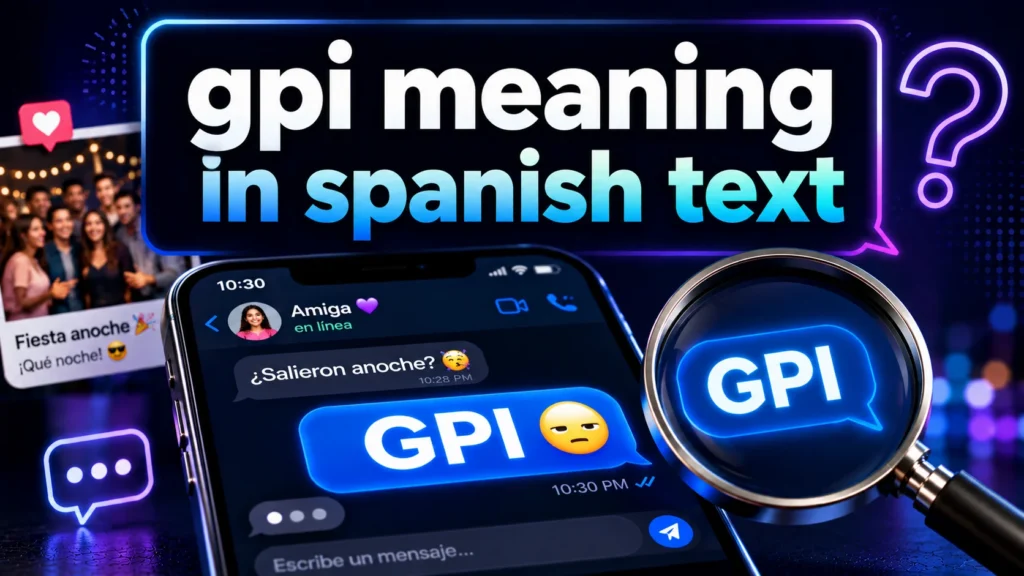
If you are chatting with a Spanish-speaking friend and suddenly see “GPI” after posting photos of a party, dinner, trip, or hangout, the message probably is not a genuine thank-you. What does GPI meaning in Spanish text?
The GPI meaning in Spanish text is “gracias por invitar,” which literally translates to “thanks for inviting” or “thanks for the invite.”
The interesting part is the tone.
In Spanish texting and social media, GPI is commonly used sarcastically when someone realizes they were not invited. It can communicate playful jealousy, mild disappointment, teasing, or even genuine feelings of exclusion. Mexican media sources describe the expression particularly in this sarcastic social-media sense.
For example, imagine your friends upload a picture from a restaurant without telling you about their plans.
You comment:
“GPI 😂”
You are basically saying:
“Thanks for inviting me… not!”
That combination of humor and hidden disappointment is what makes GPI so useful in casual Spanish communication.
GPI Meaning in Spanish Text – Quick Meaning
What Does GPI Mean in Spanish Text?
GPI = Gracias Por Invitar
In English, it means:
“Thanks for inviting me” or “Thanks for the invite.”
Online, though, people usually mean the opposite.
Someone saying GPI may actually be communicating:
- “Why didn’t you invite me?”
- “Thanks for leaving me out.”
- “Looks fun… shame nobody invited me.”
- “Next time, remember me.”
- “Wow, I guess my invitation got lost.”
- “I wanted to come too.”
Spanish-language sources consistently describe GPI as an informal electronic expression used especially when someone feels excluded from an activity.
For example:
“¿Fueron a comer sin mí? GPI 😂”
Meaning:
“You went to eat without me? Thanks for inviting me 😂”
Another example:
“Qué bonito viaje, gpi 😒”
Meaning:
“Nice trip, thanks for inviting me 😒”
And:
“Todos en la fiesta y yo en casa. GPI 💔”
Meaning:
“Everyone’s at the party and I’m home. Thanks for inviting me 💔”
The emoji often tells you whether the person is joking or genuinely bothered.
Origin & Background of GPI
Where Did GPI Come From?
GPI developed from Spanish-speaking internet culture, particularly informal texting and social-media communication.
Rather than typing the complete phrase “gracias por invitar,” users began reducing it to the first letters:
G = Gracias
P = Por
I = Invitar
The expression became especially recognizable in Mexican online communication. Even Spanish-language reference material describes GPI as being used in Mexico sarcastically to complain about not receiving an invitation to an event, gathering, or trip.
Is GPI an Official Spanish Abbreviation?
Not exactly.
The Real Academia Española has addressed GPI through its language consultation service. As reported by Mexican media, the RAE characterized forms like gpi as informal shortenings belonging to electronic communication rather than standardized abbreviations intended for formal Spanish.
That distinction matters.
GPI is perfectly understandable in a WhatsApp group or Instagram comment, but you would normally not use it in an academic essay, formal business letter, or professional Spanish email.
How Social Media Made GPI Popular
GPI works particularly well on social media because people constantly discover plans through photos and stories.
Someone opens Instagram and sees six friends eating tacos together.
“GPI.”
Someone uploads beach-trip photos.
“Ah bueno, GPI 😭.”
Someone posts a birthday celebration that you knew nothing about.
“GPI 😒.”
Platforms such as Facebook, Instagram, WhatsApp, and TikTok have all been associated with this usage.
Three letters can therefore communicate an entire emotional sentence.
Real-Life Conversations Using GPI
WhatsApp Conversation
Person A: Mira, fuimos por tacos anoche 😂
(Look, we went for tacos last night 😂)
Person B: ¿Todos fueron? GPI 😒
(Everyone went? Thanks for inviting me 😒)
Person A: Jajaja fue algo de último momento.
(Haha, it was a last-minute thing.)
Person B: La próxima sí me avisan 😂
(Next time you better tell me 😂)
Here, GPI contains mild disappointment, but the conversation remains friendly.
Instagram DM
Person A: Posts photos from a beach trip.
Person B: Wowwww, GPI 😭😂
and,
Person A: JAJAJA next time vienes con nosotros.
Person B: Eso dicen siempre 😭
In this example, GPI means something like, “Wow, thanks for inviting me,” with obvious playful sarcasm.
TikTok Comments
Creator: “POV: spontaneous road trip with the group 🚗😂”
Friend: GPI 🤡
Creator: Bro you said you were working 😭
Friend: Nobody asked me twice 😂
Here, GPI is being used as a humorous complaint about missing out.
Text Message
Person A: Fuimos al nuevo restaurante del centro.
(We went to the new restaurant downtown.)
Person B: GPI.
Person A: Perdón 😭 pensé que estabas ocupado.
(Sorry 😭 I thought you were busy.)
Person B: Sí estaba, pero se invita 😂
(I was, but you still invite me 😂)
A simple “GPI.” without a laughing emoji can sound slightly more serious. Tone depends heavily on the relationship.
Emotional & Psychological Meaning of GPI
GPI is interesting because its literal wording and emotional meaning are often opposites.
Literally, it expresses gratitude.
Emotionally, it can express exclusion.
The sender may really be thinking:
“I noticed you did this without me.”
That emotional message can range from harmless teasing to genuine hurt.
Why Do People Use GPI?
Writing “Why didn’t you invite me?” can sound confrontational.
Writing:
“GPI 😂”
makes the same point much more lightly.
Humor provides emotional protection. The person can reveal that they wanted to be included without directly admitting that being excluded hurt their feelings.
Consider a personal-style situation.
You open Instagram and notice three close friends having dinner together. Nobody mentioned the plan to you.
You do not want to start an argument, so instead of writing:
“Why was I excluded?”
you reply:
“GPI 🥲”
Your friends immediately understand the hidden message.
You wanted to be there.
That combination of humor, vulnerability, and social signaling explains much of GPI’s appeal.
Usage of GPI in Different Contexts
GPI on Social Media
Social media is one of the most natural places to use GPI.
Common situations include:
- Party photos
- Restaurant stories
- Vacations
- Concert videos
- Birthday celebrations
- Shopping trips
- Gaming sessions
- Group hangouts
For example:
“¿Noche de películas sin mí? GPI 😂”
means:
“Movie night without me? Thanks for inviting me 😂”
GPI Between Friends
Among close friends, GPI is usually playful.
Someone might write:
“GPI bro 😭”
without genuinely being angry.
Close relationships make sarcasm easier to interpret because everyone already understands the group’s humor.
GPI in Relationships
GPI can also appear between partners or people who are dating.
For example:
“You went for ice cream without me? GPI 😒😂”
The sender may be teasing while also communicating, “You should have asked me.”
In romantic relationships, the expression can therefore be both playful and emotionally meaningful.
GPI at Work
Use GPI carefully in professional situations.
A casual workplace chat might allow something like:
“Everyone got coffee without me? GPI 😂”
However, sending “GPI” after being excluded from an important meeting could seem passive-aggressive.
For serious workplace matters, direct communication is usually better.
Casual vs. Serious Tone
GPI works best when the situation is socially light.
If exclusion has genuinely caused conflict, replacing an honest conversation with sarcastic slang may make the misunderstanding worse.
When NOT to Use GPI
During Serious Conflicts
If you are genuinely angry about being excluded, “GPI” may hide the real problem.
Say what bothered you instead.
With Someone Who Does Not Understand Spanish Slang
An English learner or Spanish learner may interpret GPI as an unrelated acronym.
Use the full phrase if clarity matters.
In Formal Spanish
Avoid GPI in:
- Academic papers
- Job applications
- Formal emails
- Business proposals
- Official letters
- Professional reports
It belongs primarily to informal electronic communication.
When It Could Sound Passive-Aggressive
“GPI 😒” can sound much sharper than “GPI 😂.”
If your relationship is already tense, sarcasm may be interpreted as criticism.
When Someone Had a Valid Reason Not to Invite You
Context matters.
Commenting “GPI” on an intimate family event or private occasion can put unnecessary pressure on someone.
Not every social activity requires an invitation.
Common Misunderstandings About GPI
GPI Is a Genuine Thank-You
Sometimes it could be understood literally, but online usage is commonly ironic.
If someone writes GPI underneath photos from an event they did not attend, they are probably joking about not being invited.
GPI Means “Gracias Por Invitarme”
You may hear people explain it as “gracias por invitarme” because that naturally means “thanks for inviting me.”
However, the letters G-P-I correspond directly to “gracias por invitar.”
Both explanations communicate essentially the same idea in casual conversation.
GPI Is Used Throughout Spanish-Speaking Countries Equally
No.
GPI is particularly associated with Mexican internet culture and may be more familiar in some Spanish-speaking communities than others. Internet slang varies considerably by country and generation.
GPI Is Always Friendly
Not necessarily.
“GPI 😂” can be harmless teasing.
and,
“GPI 😒” can communicate annoyance.
“GPI…” may signal actual disappointment.
Punctuation and emojis matter.
GPI Meaning Comparison Table
| Expression | Meaning | Typical Tone | Example |
|---|---|---|---|
| GPI | Gracias por invitar | Sarcastic/playful | “¿Cena sin mí? GPI 😂” |
| NTP | No te preocupes | Reassuring | “NTP, todo bien.” |
| NTC | No te creas | Joking | “Ya no te hablo 😂 NTC.” |
| TQM | Te quiero mucho | Affectionate | “Buenas noches, TQM.” |
| XQ / PQ | Porque / por qué | Casual | “Xq no viniste?” |
| XFA | Por favor | Casual request | “Mándamelo xfa.” |
| GRAx / GRX | Gracias | Casual gratitude | “Grx por ayudar.” |
| FOMO | Fear of missing out | Feeling excluded | “Tengo FOMO viendo esto.” |
| “Thanks for the invite” | English equivalent | Often sarcastic | “Nice party, thanks for the invite.” |
Key Insight
GPI is more than a shortcut for “gracias por invitar.” Its real social meaning often comes from irony: the sender mentions an invitation precisely because they never received one.
Variations / Types of GPI
1. GPI
Meaning: Gracias por invitar.
The standard form used to jokingly complain about not being invited.
2. gpi
Meaning: Same as GPI.
Lowercase letters usually do not change the meaning.
3. GPI 😂
Meaning: Playful complaint.
The laughing emoji strongly suggests the sender is joking.
4. GPI 😒
Meaning: Annoyed sarcasm.
This version may indicate genuine frustration.
5. GPI 😭
Meaning: Dramatic disappointment.
Often used jokingly when someone feels they missed something fun.
6. GPI 💔
Meaning: Feeling left out.
The heart can make the message feel more emotionally serious.
7. “Ah bueno, GPI”
Meaning: “Oh okay, thanks for inviting me.”
This creates stronger sarcasm.
8. “GPI para la próxima”
Meaning: “Thanks for inviting me—remember me next time.”
It indirectly asks for a future invitation.
9. “Qué padre, GPI”
Meaning: “How cool, thanks for inviting me.”
This is particularly natural in Mexican-style casual speech.
10. “GPI, eh”
Meaning: A teasing reminder.
It can sound like: “Thanks for inviting me, huh?”
The precise emotional weight comes from the surrounding conversation.
How to Respond When Someone Uses GPI
Casual Replies
If someone comments GPI jokingly, you can answer:
- “JAJAJA la próxima 😂”
- “Perdón 😭”
- “Te aviso para la próxima.”
- “Fue de último minuto 😂”
- “Ya estás invitado para la siguiente.”
Funny Replies
For close friends:
- “Tu invitación se perdió 😂”
- “Pensé que estabas ocupado 😭”
- “Yo juraba que te habían dicho 😂”
- “La próxima tú organizas.”
- “No revisaste el correo 😂”
Mature Replies
If they appear genuinely hurt:
- “Perdón, no quería que te sintieras excluido.”
- “La próxima te aviso directamente.”
- “Fue algo improvisado, pero entiendo cómo se vio.”
- “No fue mi intención dejarte fuera.”
Respectful Replies
If you are unsure how serious they are:
- “¿Lo dices en serio o estás bromeando? 😅”
- “Perdón si te hizo sentir excluido.”
- “Claro, la próxima contamos contigo.”
The best response recognizes the emotion instead of automatically treating every GPI as a joke.
Regional & Cultural Usage of GPI
Mexican and Latin American Usage
GPI is particularly well documented in Mexican social-media culture, where it is used to sarcastically call out someone for not extending an invitation. Mexican outlets such as N+ and Milenio describe exactly this usage on WhatsApp, Facebook, Instagram, and TikTok.
Across Latin America, familiarity can vary considerably. A Spanish speaker may understand the phrase immediately without personally using the acronym.
Western Culture
English speakers have a very similar sarcastic expression:
“Thanks for the invite.”
Someone might see their friends at a party and comment:
“Wow, thanks for the invite 😂.”
GPI performs almost the same social function in Spanish.
Asian Culture
Spanish learners and multilingual users in Asian countries may encounter GPI through Latin American TikTok, Instagram, gaming communities, music fandoms, or Spanish-language friends.
It should not be assumed to be a universal Spanish abbreviation, especially for learners unfamiliar with Mexican slang.
Middle Eastern Culture
Multilingual social-media users may encounter GPI through Spanish-speaking online communities.
Its sarcasm can be difficult to recognize if someone translates only the literal words “thanks for inviting.”
Understanding the social context prevents that misunderstanding.
Global Internet Usage
Internet language travels quickly.
Spanish abbreviations can move beyond their original communities through memes, influencers, music, gaming, and international friend groups.
GPI is a good example of how a culturally specific expression can become understandable far beyond one platform.
Gen Z vs. Millennials
Both Gen Z and Millennials may understand GPI, particularly in Mexican digital culture.
Younger users often combine it with emojis, memes, and intentionally exaggerated reactions:
“GPI 😭💀”
Older users may be less familiar with the acronym even if they understand the full phrase “gracias por invitar.”
Age alone does not determine usage. Online community matters just as much.
Is GPI Safe for Kids?
Yes. GPI is generally safe for kids and teenagers.
The phrase itself contains no profanity, sexual meaning, or inherently inappropriate content.
It simply means “gracias por invitar.”
Parents should understand that a child writing “GPI 😭” may be joking about friends going somewhere without them.
Sometimes, though, repeated use around social activities could reflect genuine feelings of exclusion.
The slang itself is harmless; the emotional context may still be worth noticing.
FAQs About GPI Meaning in Spanish Text
What does GPI mean in Spanish texting?
GPI means “gracias por invitar,” which translates to “thanks for inviting.” It is commonly used sarcastically when someone was actually not invited.
What does GPI mean on WhatsApp?
On WhatsApp, GPI usually means “gracias por invitar.” Someone may send it after discovering friends made plans without including them.
What does GPI mean on Instagram?
On Instagram, GPI often appears under stories or photos showing parties, trips, meals, or gatherings. It jokingly means, “Thanks for inviting me even though you didn’t.”
What does GPI mean on TikTok?
GPI has the same basic meaning on TikTok: “gracias por invitar.” It may appear in comments when someone sees an activity they wish they had been invited to.
Is GPI sarcastic in Spanish?
Very often, yes. Its literal meaning expresses thanks, but its common internet use highlights the fact that the person was not invited.
Is GPI Mexican slang?
GPI is particularly associated with Mexican internet and social-media usage. Spanish speakers elsewhere may also recognize or use it, but its familiarity is not identical across every country.
What should I reply when someone says GPI?
If they are joking, reply playfully with something like “La próxima 😂” (“Next time”). If they seem genuinely disappointed, acknowledge it and let them know whether they will be included next time.
Conclusion
The GPI meaning in Spanish text is “gracias por invitar,” or “thanks for inviting.”
Yet the literal translation only tells half the story.
In everyday Spanish social-media culture, especially in Mexican online communication, GPI is often sarcastic. Someone uses it because they weren’t invited and want you to know they noticed.
“GPI 😂” may be harmless teasing.
and,
“GPI 😒” can communicate irritation.
“GPI 💔” may reveal that the person actually feels excluded.
That emotional flexibility is what makes the abbreviation so useful.
If you see GPI under a party picture, vacation story, restaurant post, or group hangout, think of it as the Spanish-language equivalent of saying:
“Wow, thanks for the invite!”
Once you understand the sarcasm behind those three letters, the message becomes much easier to read—and much easier to answer naturally.