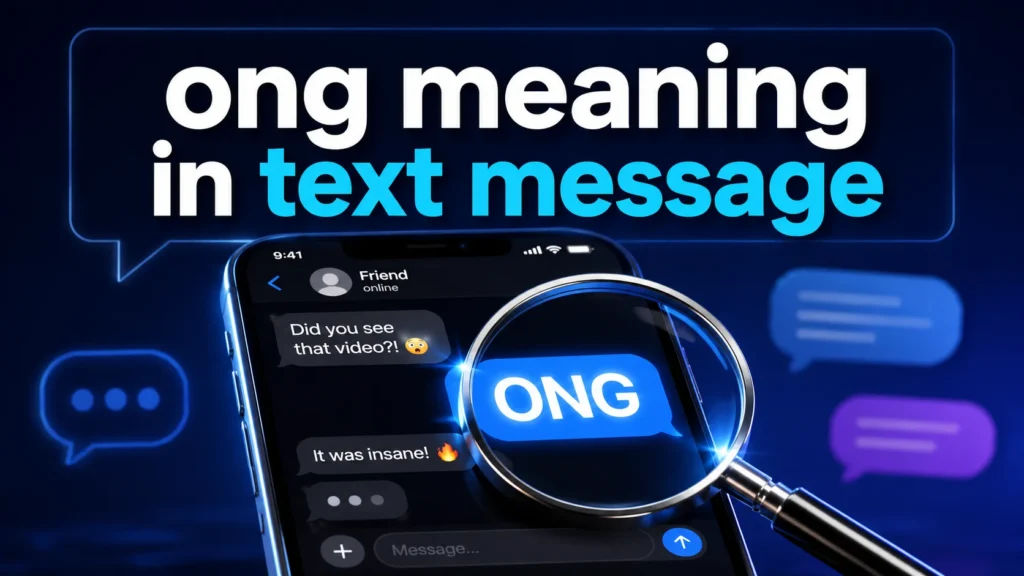
If someone suddenly replies with “ong” in a chat, it can look confusing—especially if you have never seen the abbreviation before. The ong meaning in text message is usually “on God,” a slang expression people use to show they are being completely serious, honest, or strongly agreeing with something.
In simple terms, “ong” can mean “I swear,” “for real,” “seriously,” or “that’s absolutely true.”
You will often see it in TikTok comments, Instagram DMs, Snapchat messages, gaming chats, and casual texts between friends. Depending on the tone, it can express agreement, disbelief, emphasis, or a promise that someone is telling the truth.
The confusing part is that “ong” does not always sound the same emotionally. Sometimes it feels serious. Other times it is playful, exaggerated, or even sarcastic.
Understanding the context helps you know what the sender actually means.
ONG Meaning in Text Message – Quick Meaning
The most common ong meaning in text message is:
ONG = “On God.”
It is used to strongly emphasize that something is true or that the speaker genuinely agrees.
People may use “ong” to mean:
- “I swear.”
- “I’m serious.”
- “That’s true.”
- “Exactly.”
- “For real.”
- “No lie.”
- “I completely agree.”
- “I promise.”
For example:
“That test was impossible ong.”
Here, “ong” emphasizes that the person genuinely found the test difficult.
“You’re coming tomorrow ong?”
Here, the sender may be asking for serious confirmation.
“Ong she’s so funny.”
In this example, “ong” means something close to “seriously” or “for real.”
Is ONG the Same as “On God”?
Yes. In most casual texting situations, “ONG” is simply the shortened form of “on God.”
The expression is used as a strong statement of sincerity.
However, because “on God” has religious wording, some people may avoid it or interpret it more seriously than others.
Origin & Background
The phrase “on God” existed in spoken English long before “ong” became common in online conversations.
It developed as a way of strengthening a statement. Saying something was “on God” communicated that the speaker was extremely serious about what they were saying.
As texting became shorter and faster, “on God” was reduced to the abbreviation ONG.
How ONG Became Popular Online
Internet culture naturally turns common phrases into abbreviations.
Expressions such as:
- “For real” → FR
- “I swear” → ISTG
- “No cap” → NC or simply “no cap”
- “On God” → ONG
became useful because they communicate emotion quickly.
ONG became especially recognizable in casual conversations among younger users.
It fits naturally into short reactions:
“ONG 😭”
and,
“Ong bro.”
“Ong that’s true.”
The abbreviation saves time while keeping the emotional intensity of the full phrase.
Social Media Impact
TikTok, Instagram, Snapchat, X, Discord, and gaming communities helped make “ong” more visible.
Short comments encourage short reactions, and ONG works perfectly when someone strongly relates to something.
For example, someone may post:
“School feels longer every Monday.”
A comment might say:
“ONG 😭”
That short response means:
“Seriously, that is so true.”
In these situations, ONG is less about making a literal oath and more about showing strong agreement.
Real-Life Conversations
Seeing ONG inside realistic conversations makes its meaning much easier to understand.
WhatsApp Conversation
Person A: That restaurant was actually so expensive.
and,
Person B: Ong 😭 I paid way too much for one meal.
Person A: Exactly. Never going there again.
Person B: Same.
Here, “ong” means “seriously” or “I completely agree.”
Instagram DM
Person A: Your new picture looks amazing.
Person B: Ong? 😭
Person A: Yes, you look so good.
Person B: Stoppp thank you 😂
In this conversation, “ong?” means something like “Seriously?” or “You really mean that?”
The person is asking for reassurance.
TikTok Comments
Person A: Summer goes by in two seconds but school lasts twelve years.
and,
Person B: ONG 💀
Person A: Literally feels like that.
Here, ONG means “That is so true.”
The skull emoji adds humor and exaggeration.
Text Message
Person A: I didn’t tell anyone what you told me.
and,
Person B: Ong?
Person A: Ong. I promise.
Person B: Okay, I trust you.
This example shows the more serious use of the slang.
The first “ong?” asks, “Are you seriously telling the truth?”
The reply confirms sincerity.
Emotional & Psychological Meaning
In, ong meaning in text message, ONG is not just an abbreviation. It often adds emotional force to a message.
Compare:
“That movie was good.”
with:
“That movie was good ong.”
The second sentence feels stronger.
The sender is not simply sharing an opinion. They are emphasizing it.
What Emotion Does ONG Express?
ONG can express several emotions depending on the message.
It can show:
- Strong agreement
- Honesty
- Surprise
- Frustration
- Excitement
- Reassurance
- Loyalty
- Seriousness
For example:
“Ong I’m proud of you.”
This sounds sincere and emotionally supportive.
“Ong this Wi-Fi is terrible.”
Here, the word emphasizes frustration.
“Ong you scared me 😭”
In this case, it adds emotional intensity to a playful reaction.
Why People Use ONG
Modern texting often relies on short expressions that communicate more emotion than their length suggests.
ONG works because it makes a sentence feel stronger without needing a long explanation.
Instead of writing:
“I genuinely agree with everything you just said.”
Someone can simply reply:
“Ong.”
That is efficient, expressive, and socially natural in casual conversations.
A Personal-Style Scenario
Imagine you tell your friend that you are nervous before an important interview.
They respond:
“Ong you’re ready for this. You’ve worked hard.”
The slang makes the encouragement feel informal and genuine.
It sounds like something a close friend would naturally say rather than a formal motivational statement.
Usage in Different Contexts
The ong meaning in text changes slightly depending on where it appears.
Social Media
On social media, ONG commonly means “so true,” “exactly,” or “for real.”
Example:
Post: “Nothing hurts more than waking up five minutes before your alarm.”
Comment: “ONG 😭”
The person strongly relates to the post.
Friends & Relationships
Between friends, ONG can show agreement or sincerity.
Examples:
“Ong you’re the funniest person I know.”
and,
“Ong I would never do that to you.”
“Ong that was embarrassing.”
In relationships, the phrase may also be used to reassure someone.
For example:
“I only want you ong.”
The meaning becomes more emotional because of the romantic context.
Still, the phrase itself is not automatically romantic.
Work / Professional Settings
ONG is normally too informal for professional communication.
You probably should not write:
“Ong the report is finished.”
in a formal email.
A better alternative would be:
“The report is complete.”
However, in a relaxed workplace group chat among close coworkers, slang may occasionally appear.
Professional context should guide the choice.
Casual vs Serious Tone
ONG can work in both playful and serious messages.
Casual:
“Ong that meme is me.”
Serious:
“Ong I didn’t tell anyone.”
The surrounding sentence determines the emotional weight.
When NOT to Use It
Even though ONG is common online, it does not fit every situation.
Formal Communication
Avoid ONG in:
- Job applications
- Business emails
- Academic essays
- Legal documents
- Official complaints
- Professional reports
Slang can make formal writing look careless or unclear.
Sensitive Religious Contexts
Because ONG comes from “on God,” some people may view the phrase more seriously due to religious beliefs.
Using it casually around someone who treats references to God with particular respect may feel uncomfortable or inappropriate.
If you are unsure, phrases such as “seriously,” “honestly,” or “I promise” are safer.
When You Do Not Mean It
Because ONG emphasizes sincerity, using it when you are lying or joking can damage trust.
For example:
“Ong I didn’t touch your phone.”
If the person later finds out you did, the statement may feel more dishonest because you emphasized it so strongly.
Professional Relationships
If you are messaging a teacher, manager, client, or someone you do not know well, avoid unnecessary slang.
Clear language is usually better.
Common Misunderstandings
ONG is simple once you know the slang, but several misunderstandings are common.
People Think It Means “OMG”
ONG and OMG are different.
ONG = On God
OMG = Oh My God
OMG usually expresses surprise.
ONG usually expresses seriousness or strong agreement.
For example:
“OMG you won!”
means:
“I’m surprised you won!”
While:
“ONG you deserved to win.”
means:
“I seriously believe you deserved it.”
People Think ONG Always Means a Promise
Not necessarily.
Sometimes it works like a promise:
“Ong I’ll come tomorrow.”
Other times, it simply means strong agreement:
“Ong that song is amazing.”
The context changes the meaning.
People Take It Too Literally
In many online conversations, ONG is used casually rather than as a formal religious oath.
A TikTok comment saying:
“ONG this is funny”
is usually just strong agreement.
However, individual attitudes toward the phrase differ.
Tone Confusion
ONG can also sound sarcastic.
For example:
“Ong you’re such a genius 🙄”
Depending on the situation, the sender may actually be criticizing the person.
The eye-roll emoji makes the sarcasm clearer.
ONG Compared With Similar Slang
| Slang | Meaning | Typical Use |
|---|---|---|
| ONG | On God | Strong agreement or sincerity |
| FR | For real | Agreement or seriousness |
| FRFR | For real, for real | Very strong agreement |
| ISTG | I swear to God | Strong frustration or sincerity |
| No cap | No lie | Telling the truth |
| Deadass | Seriously | Strong seriousness |
| Facts | That is true | Agreement |
| Bet | Okay / agreed | Confirmation |
| NGL | Not gonna lie | Honest opinion |
| Cap | Lie / false statement | Disagreement |
Key Insight
ONG is closest to expressions such as “for real,” “no cap,” and “I swear.” The main difference is that ONG comes directly from the phrase “on God,” which gives it a stronger sense of sincerity.
Variations / Types of ONG
There are several ways people use ONG in messages.
1. “Ong”
Meaning: “Seriously.”
This is the most common lowercase form used in everyday texting.
2. “ONG”
Meaning: Stronger emphasis.
Typing it in capital letters can make the reaction feel more intense.
Example:
“ONG THAT WAS CRAZY.”
3. “Ong?”
Meaning: “Seriously?” or “Do you promise?”
It is usually asking for confirmation.
4. “Ong bro”
Meaning: “Seriously, bro.”
Common between friends when strongly agreeing.
5. “Ong fr”
Meaning: “On God, for real.”
This doubles the emphasis.
Example:
“Ong fr that was the best episode.”
6. “Ong 😭”
Meaning: “Seriously, that is so true.”
The crying emoji usually adds humor, frustration, or strong relatability.
7. “Ong 💀”
Meaning: Strong agreement with something funny or ridiculous.
The skull emoji often suggests “I’m dead” from laughter.
8. “Ong no cap”
Meaning: “I’m completely serious and not lying.”
Both expressions emphasize truthfulness.
9. “Ong I swear”
Meaning: Very strong reassurance.
It may appear when someone desperately wants to be believed.
10. “Put that ong”
Meaning: “Seriously swear that it’s true.”
This can sound much more serious than casual ONG usage.
How to Respond When Someone Uses ONG
Your reply depends on whether the sender is agreeing, joking, or asking for reassurance.
Casual Replies
You can respond with:
- “Fr.”
- “Exactly.”
- “Facts.”
- “Literally.”
- “I know 😭”
- “No cap.”
Funny Replies
For playful conversations:
- “Finally someone understands 😂”
- “We’re living the same life.”
- “Ong ong 😭”
- “Say it louder.”
- “Facts were spoken.”
Mature Replies
If the message is serious:
- “I believe you.”
- “I understand.”
- “Thanks for being honest.”
- “I appreciate you telling me.”
- “Okay, that makes sense.”
Respectful Replies
When you want to stay clear and neutral:
- “Got it.”
- “Understood.”
- “I agree.”
- “Absolutely.”
- “That’s true.”
Regional & Cultural Usage
Slang travels quickly online, but not everyone interprets ONG in exactly the same way.
Western Culture
ONG is especially recognizable in informal online English in the United States and other English-speaking internet communities.
It is commonly associated with younger, slang-heavy communication.
Asian Culture
Many English-speaking social media users across Asian countries understand ONG through TikTok, Instagram, gaming, and global internet culture.
However, people who learned English mainly through formal education may be less familiar with it.
Middle Eastern Culture
ONG may be recognized by younger English-speaking users who interact with global social media.
Because it includes a reference to God, some users may also view the expression with greater religious seriousness.
That makes context and personal sensitivity important.
Global Internet Usage
Internet slang rarely stays in one country.
A phrase that becomes popular on TikTok or gaming platforms can spread worldwide within months.
As a result, ONG is increasingly understood as:
“Seriously.”
“Exactly.”
“I swear.”
rather than only as a literal religious statement.
Gen Z vs Millennials
Gen Z is more likely to use ONG naturally in quick reactions, comments, memes, and casual chats.
Millennials may understand it but might be more likely to use alternatives such as:
“Seriously.”
“Honestly.”
“Exactly.”
“For real.”
Generational differences are flexible, though. Online communities often matter more than age.
Is ONG Safe for Kids?
ONG is not generally considered explicit or sexually inappropriate slang.
However, parents should know that it means “on God,” which is essentially a strong expression of sincerity.
Some families may prefer children not to use religious language casually.
From a communication perspective, the phrase itself is not dangerous, but its appropriateness depends on family values, age, and context.
Kids and teenagers should also understand that repeatedly using strong statements such as “ong” to prove honesty can become meaningless if they use them for everything.
FAQs
What does ONG mean in a text message?
ONG usually means “on God.” People use it to show they are serious, telling the truth, or strongly agreeing with something.
What does ONG mean from a guy?
If a guy says ONG, he is usually emphasizing honesty, agreement, or seriousness. The phrase itself does not automatically mean romantic interest.
What does ONG mean from a girl?
When a girl uses ONG, it commonly means “seriously,” “I swear,” or “that is so true.” Context determines whether the message is friendly, emotional, or flirty.
Is ONG the same as “for real”?
They are very similar. Both can express sincerity or agreement, although ong meaning in text messagecomes from “on God” and may feel slightly stronger.
What does “ONG fr” mean?
“ONG fr” combines “on God” and “for real.” It means the person strongly agrees or wants to emphasize that they are completely serious.
What does “ONG?” mean in texting?
When someone sends “ONG?” with a question mark, they are usually asking, “Seriously?” “Do you swear?” or “Are you telling the truth?”
Is ONG rude?
Usually, no. ong meaning in text message is casual slang rather than an insult. However, some people may dislike the phrase because of its religious wording, especially when used casually.
Conclusion
The ong meaning in text message is usually “on God,” and people use it to express strong agreement, honesty, seriousness, or reassurance.
If someone replies:
“ONG 😭”
they probably mean:
“That is so true.”
If they ask:
“Ong?”
they may be asking:
“Are you serious?” or “Do you promise?”
And if they say:
“Ong I didn’t do it,”
they are strongly emphasizing that they want you to believe them.
Like most internet slang, ONG makes the most sense when you read the full conversation rather than treating the abbreviation as a fixed emotion.
Once you recognize its tone, it becomes easy to understand whether someone is joking, agreeing, reassuring you, or trying to prove they are being completely serious.