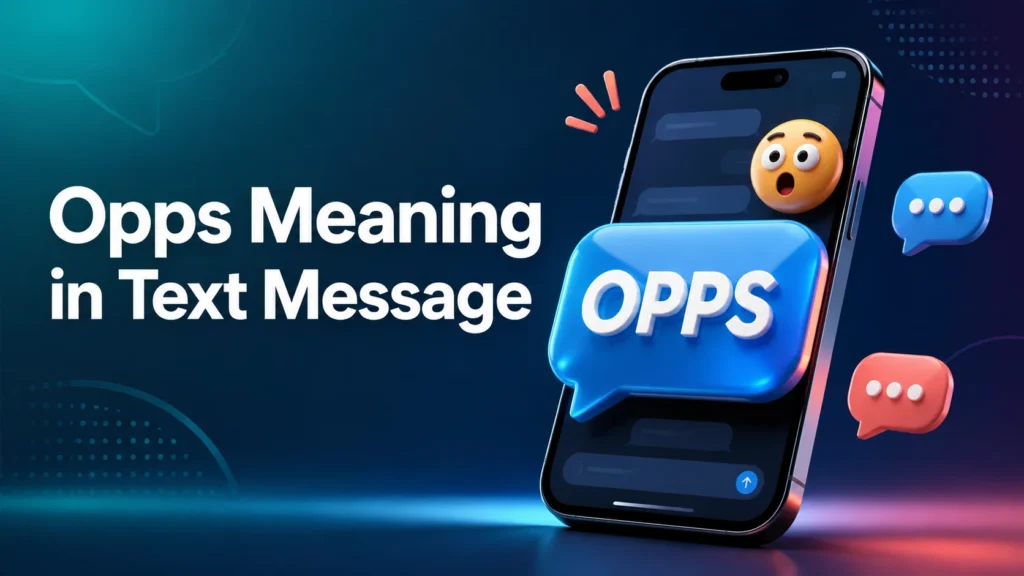
If someone writes “the opps are watching” or calls another person “an opp,” they are usually talking about a rival, enemy, or untrustworthy person. The word can sound playful in one conversation and genuinely serious in another.
That difference explains why people search for the opps meaning in text message conversations. Without context, it is difficult to know whether someone is joking about a competitive friend, describing an online hater, or referring to a real conflict.
“Opps” is also easily confused with “oops.” Although the two spellings look similar, their meanings are completely different. This guide explains the distinction, the cultural background of the slang, its emotional tone, and the safest ways to respond.
Opps Meaning in Text Message – Quick Meaning
In a text message, opps means opponents, opposition, rivals, or enemies. The singular form is “opp,” while “opps” refers to two or more people viewed as being on the opposing side.
According to Merriam-Webster’s slang definition, “opps” refers to someone’s opposition or opponents.
Common interpretations include:
- Enemies: People with whom someone has a serious conflict.
- Rivals: People competing against someone.
- Untrustworthy people: Those believed to be secretly working against someone.
- Online haters: Users who constantly criticize or provoke another person.
- Opposing groups: People associated with the other side of a dispute.
- Playful competitors: Friends joking about sports, games, or small disagreements.
Examples include:
“Don’t tell him our plans. He’s one of the opps.”
“We beat the opps in the final match.”
“My sister ate my snacks, so now she’s an opp.”
The first example sounds suspicious, the second is competitive, and the third is clearly humorous. Context controls the level of seriousness.
Origin and Background of Opps
Short for opposition or opponents
“Opp” developed as a shortened form of “opposition” or “opponent.” Its plural form, “opps,” refers to multiple rivals or people on an opposing side.
The slang became especially recognizable through hip-hop, drill music, and urban youth culture. Artists used it when discussing rivalry, distrust, neighborhood conflict, loyalty, and survival.
It is important not to assume that every person using “opps” is involved in criminal activity. Language often travels beyond its original or most visible cultural settings. Today, people use the term for gaming opponents, sports rivals, online critics, and even friends who commit harmless acts of “betrayal.”
Hip-hop and drill influence
Hip-hop helped introduce the term to a much wider audience. Drill music later gave “opps” a particularly intense meaning because many songs described real rivalries and dangerous conflicts.
Listeners adopted the vocabulary, sometimes without fully understanding its background. On social media, the word gradually became more flexible and humorous.
Someone might now call a friend an opp for taking the last slice of pizza. That use borrows the dramatic energy of the original slang while applying it to a harmless situation.
How social media changed the meaning
TikTok, Instagram, X, Snapchat, and gaming communities turned “opp” into a general label for anyone acting against a person.
Memes often exaggerate minor inconveniences:
“My alarm woke me up at 6 a.m. That clock is an opp.”
The alarm is obviously not a real enemy. Calling it an opp humorously transforms an ordinary frustration into a dramatic conflict.
As a result, the modern meaning exists on a spectrum. It can describe anything from friendly competition to serious hostility.
Real-Life Conversations Using Opps
WhatsApp conversation
Hamza: Are you inviting Ryan to the party?
Zain: Probably not. He shared my private messages last month.
Hamza: Fair enough. We don’t invite the opps.
Here, “the opps” refers to someone considered disloyal or untrustworthy. The tone is serious because a genuine breach of trust occurred.
Instagram DMs
Sofia: Why did you remove Chloe from your close friends?
Maya: She keeps showing my stories to people I blocked.
Sofia: That’s opp behavior for real.
In this exchange, “opp behavior” means acting like an enemy or secretly helping people on the other side of a conflict.
TikTok comments
Creator: When your best friend takes the last chicken nugget after saying she wasn’t hungry.
Commenter: She’s officially an opp 😭
The crying emoji and harmless situation make the meaning playful. The commenter is not describing a real enemy.
Text message between gamers
Leo: Same team tonight?
Arman: No, the game put me on the other side.
Leo: So you’re one of the opps now?
Arman: Only until the match ends 😂
In gaming, “opps” can simply mean the opposing team. No personal hostility is required.
Emotional and Psychological Meaning
Calling someone an opp creates a strong “us versus them” feeling. It places the person outside your trusted circle and suggests that their goals conflict with yours.
In a serious conversation, the word may express suspicion, betrayal, defensiveness, or anger. A person who says, “I found out who the real opp was,” may feel hurt after discovering that someone they trusted had acted against them.
In playful conversations, the emotional effect is theatrical rather than hostile. Friends use an exaggerated word for a minor offense because the contrast makes the message funny.
Imagine that a friend promises not to reveal your birthday surprise but accidentally hints at it in the group chat. You might message, “I trusted you, but you’re moving like an opp today.” If your friendship is warm and the mistake is minor, the message can sound teasing. During an existing argument, the same sentence may feel accusatory.
The word also reveals something about modern digital communication: people often use dramatic labels to express feelings quickly. Instead of explaining, “Your actions made me question your loyalty,” someone may simply write, “You’re an opp.”
That shorthand is emotionally powerful, but it can also remove important nuance.
Usage in Different Contexts
On social media
On TikTok and Instagram, “opp” frequently appears in jokes, memes, captions, and comment sections. Creators may use it for critics, fake friends, or anyone who disagrees with them.
Examples include:
- “The opps found my page.”
- “When your biggest opp watches every story.”
- “Why are the opps in my comments?”
- “My own Wi-Fi became an opp during the livestream.”
The first three could be serious or humorous. The Wi-Fi example is clearly personification for comic effect.
Between friends
Friends often use “opp” as playful criticism. Someone who changes the music, wins a game, exposes an embarrassing photo, or takes another person’s food may temporarily become “the opp.”
This style works best when everyone understands the joke. A newer friend may interpret the label more seriously.
In relationships
A romantic partner might call someone an opp when discussing an ex, a person who interferes in the relationship, or a friend who encourages conflict.
That usage can create unnecessary tension. Labeling people as enemies may intensify jealousy or turn a misunderstanding into a larger dispute. Clear language is healthier when trust is already fragile.
In gaming and sports
“Opps” can refer naturally to opposing players or teams:
“The opps have a strong defense.”
In this context, it may function like “opponents” without suggesting personal hatred. Players sometimes use it to create competitive energy before a match.
At work
Avoid calling coworkers, clients, or competing businesses “opps” in professional communication. The term sounds confrontational and can damage trust.
“Competitor,” “other team,” “opposing viewpoint,” or “challenger” usually communicates the idea more professionally.
Casual versus serious tone
The tone depends on three main clues:
- The subject of the conversation
- The relationship between the people
- The presence of playful emojis or exaggeration
A message about stolen snacks is probably a joke. A message involving threats, betrayal, or an ongoing dispute deserves a more careful interpretation.
When Not to Use Opps
Do not use “opps” during a serious conflict unless you genuinely understand its impact. Calling someone an enemy can close the door to calm conversation.
The word is also inappropriate in:
- Professional emails
- School essays and formal presentations
- Customer service conversations
- Legal or police-related discussions
- Workplace disagreements
- Sensitive family conflicts
- Messages to people unfamiliar with slang
Avoid using it casually around real violence. The term has serious associations in some communities, and a joke may sound insensitive to someone who has experienced neighborhood conflict or loss.
It is equally important not to imitate a cultural style simply to appear tough. Slang feels most natural when it matches the speaker, relationship, and situation.
If you mean “competitor,” say “competitor.” If you mean “someone hurt my feelings,” explain what happened. Specific words often prevent the emotional situation from becoming worse.
Common Misunderstandings
Opps does not mean oops
This is the most common confusion.
Opps means opponents, enemies, or rivals.
Oops is an exclamation used after a mistake or accident.
Compare these sentences:
“The opps found our account.”
“Oops, I sent that to the wrong account.”
The first is about rivals. The second acknowledges a mistake.
An opp is not always a dangerous enemy
Social media users often apply the label to harmless rivals, irritating objects, strict teachers, siblings, or friends. You should not immediately assume that the sender is discussing violence.
However, the term can be serious. Read the surrounding conversation before deciding.
Opps and cops are not the same
Some people believe “opps” specifically means police. Police officers may be described as opposition in certain lyrics or situations, but “opps” does not automatically mean cops.
The general meaning is opponents or enemies.
Opp does not always mean another person’s partner
“OPP” gained an older pop-culture meaning through Naughty by Nature’s 1991 song “O.P.P.,” where it referred to involvement with someone else’s romantic or sexual partner.
That interpretation is different from the current slang meaning of “opp” as an opponent. Modern context usually makes the intended definition clear.
Opps are not simply people who disagree
A disagreement alone does not necessarily make someone an opp. The word generally suggests rivalry, opposition, disloyalty, or perceived hostility.
Using it for everyone with a different opinion can make ordinary conversations unnecessarily aggressive.
Opps Compared With Similar Slang
| Expression | Meaning | Typical tone | Example |
|---|---|---|---|
| Opp | One opponent, rival, or enemy | Playful to serious | “I think he’s an opp.” |
| Opps | Multiple rivals or enemies | Playful to serious | “The opps are watching.” |
| Enemy | Someone actively hostile | Serious | “He became my enemy.” |
| Rival | A person competing with you | Neutral or competitive | “She’s my biggest rival.” |
| Hater | Someone who constantly criticizes | Casual or dismissive | “Ignore the haters.” |
| Fake friend | Someone pretending to be loyal | Hurt or suspicious | “She was a fake friend.” |
| Snake | A deceptive or disloyal person | Negative | “He acted like a snake.” |
| Traitor | Someone who betrays a person or group | Strong and serious | “They called him a traitor.” |
| Frenemy | A friend with hidden rivalry | Playful or suspicious | “We’re more like frenemies.” |
| Teammate | Someone on your side | Positive; opposite idea | “Trust your teammates.” |
| Ally | A supportive person or group | Positive; opposite idea | “She has always been an ally.” |
| Oops | Reaction to a mistake | Mild or humorous | “Oops, wrong chat.” |
Key Insight
“Opps” is stronger than “competitors” but more flexible than “enemies.” Its intensity depends on whether the speaker is discussing real disloyalty, friendly competition, or an exaggerated joke.
Variations and Types of Opps
Opp
The singular form describes one opponent or person considered disloyal.
Example: “He smiled at us, but I still think he’s an opp.”
Opps
The plural form refers to several rivals, enemies, or opposing people.
Example: “Don’t share your location with the opps.”
The opps
Adding “the” creates the sense of a known opposing group.
Example: “The opps keep checking our page.”
Big opp
A major rival or someone strongly associated with the opposing side.
Example: “They became big opps after that argument.”
Secret opp
Someone who pretends to be supportive while quietly working against you.
Example: “A secret opp will celebrate your failures.”
Internet opp
An online rival, critic, troll, or person involved in repeated digital arguments.
Example: “My internet opp commented again.”
School opp
A joking label for a rival student, strict teacher, or competing school group.
Example: “The quiz made our favorite teacher an opp today.”
Gaming opp
A player or team competing against you in a game.
Example: “The gaming opps are already in the lobby.”
Friendly opp
A friend who becomes a temporary rival during sports, games, or playful competition.
Example: “You’re my friend after the match, but right now you’re an opp.”
Opp behavior
Actions that appear disloyal, competitive, or suspicious.
Example: “Posting that embarrassing picture was opp behavior.”
How to Respond When Someone Says Opps
The right reply depends on whether the message is serious, playful, or unclear.
Casual replies
- “Who are the opps this time?”
- “I’m staying out of that drama.”
- “What did they do?”
- “Are you being serious?”
Funny replies
- “I have no opps, only confused fans.”
- “Even my alarm clock is an opp.”
- “Not me becoming the villain over one French fry.”
- “The opps can’t stop snack time.”
- “Plot twist: the opp was the Wi-Fi.”
Mature replies
- “Let’s not turn this into a bigger conflict.”
- “Do you mean a real threat or just a disagreement?”
- “Maybe talk to them before assuming the worst.”
- “What happened that made you stop trusting them?”
- “I understand you’re upset, but labeling them may not help.”
Respectful replies
- “I’m not comfortable calling anyone an enemy.”
- “I don’t know the full story, so I won’t take sides.”
- “Please explain what you mean by opps.”
- “If you feel unsafe, speak to someone you trust.”
- “Let’s focus on the behavior rather than insulting the person.”
If the message suggests a genuine threat, do not encourage confrontation. Prioritize safety, save relevant messages, and contact a trusted adult or appropriate local support if necessary.
Regional and Cultural Usage
Western culture
In the United States, “opps” is strongly connected with hip-hop, drill music, youth slang, and online culture. It may describe genuine enemies, opposing neighborhoods, social rivals, or harmless competitors.
The term has also spread throughout Canada and the United Kingdom, where local music scenes and social platforms have adapted it to their own styles.
Asian culture
Young people across Asia may encounter “opps” through American music, gaming, memes, and TikTok. It is often used more playfully for rivals or online opponents.
Because the term comes from a specific cultural setting, not every English speaker in Asia will recognize its emotional strength.
Middle Eastern culture
In Middle Eastern online communities, English slang often appears alongside Arabic, Urdu, Persian, or other languages. “Opps” may be used for rival gamers, opposing friend groups, critics, or people involved in online disagreements.
Local context remains important because users may adopt the word from music without using all of its original cultural associations.
Global internet usage
Online, “opp” has become a flexible symbol of opposition. A person, brand, sports team, difficult exam, broken phone, or bad internet connection can jokingly become an opp.
This global humorous use is less serious than the word’s meaning in conflict-based music or street contexts.
Gen Z versus Millennials
Gen Z commonly uses “opp” in memes, gaming chats, short videos, and exaggerated jokes. The term may be applied to almost anything that causes inconvenience.
Millennials are more likely to recognize “OPP” from 1990s hip-hop or interpret “opponent” literally. Once again, these are general patterns rather than fixed rules.
Is Opps Safe for Kids?
The word “opps” is not automatically a swear word, but its meaning deserves context. It can be harmless when children use it for opposing sports teams or jokingly call a sibling an opp.
The concern arises when the term supports bullying, threats, gang imitation, or an “everyone is against me” attitude. Adults should ask what the child means instead of reacting only to the word.
A useful conversation might explain that competitors are not necessarily enemies and disagreements do not require hostility. Teaching that distinction helps children use online language without copying its most aggressive implications.
Frequently Asked Questions
What does opps mean in a text message?
“Opps” usually means opponents, rivals, enemies, or people viewed as being against the sender. The tone can range from playful competition to serious conflict.
What does it mean when someone calls you an opp?
Being called an opp means the person sees you as a rival, enemy, untrustworthy individual, or someone on the opposing side. In a friendly setting, it may simply be a joke.
Is opps short for opposition?
Yes. “Opp” is commonly understood as a shortened form of “opposition” or “opponent,” while “opps” is the plural form.
What does opp mean on TikTok?
On TikTok, “opp” often means an enemy, rival, hater, fake friend, or person working against someone. It is also frequently used as humorous exaggeration.
What is the difference between opps and oops?
“Opps” refers to opponents or enemies. “Oops” is an exclamation used after making a mistake. One missing letter completely changes the meaning.
Can a friend be an opp?
A friend may jokingly be called an opp during a game or after a minor betrayal such as eating someone’s food. In a serious context, the label suggests distrust or disloyalty.
Is calling someone an opp disrespectful?
It can be. In a serious conversation, calling someone an opp may sound hostile or accusatory. Among close friends, it may be harmless teasing if everyone understands the tone.
Conclusion
The opps meaning in text message conversations is usually opponents, opposition, rivals, or enemies. Yet the word does not carry the same emotional weight in every situation.
A gamer may call the other team “the opps.” A friend may use it after someone steals a snack. Another person may use it to describe genuine betrayal or a serious threat. The message topic, relationship, and tone reveal which meaning applies.
Remember that “opps” and “oops” are not the same. Opps are people on the opposing side; “oops” is what someone says after making a mistake.
Use the slang carefully and avoid turning ordinary disagreements into enemy relationships. Understanding the word is useful, but understanding the emotion behind it is what helps you respond with confidence.