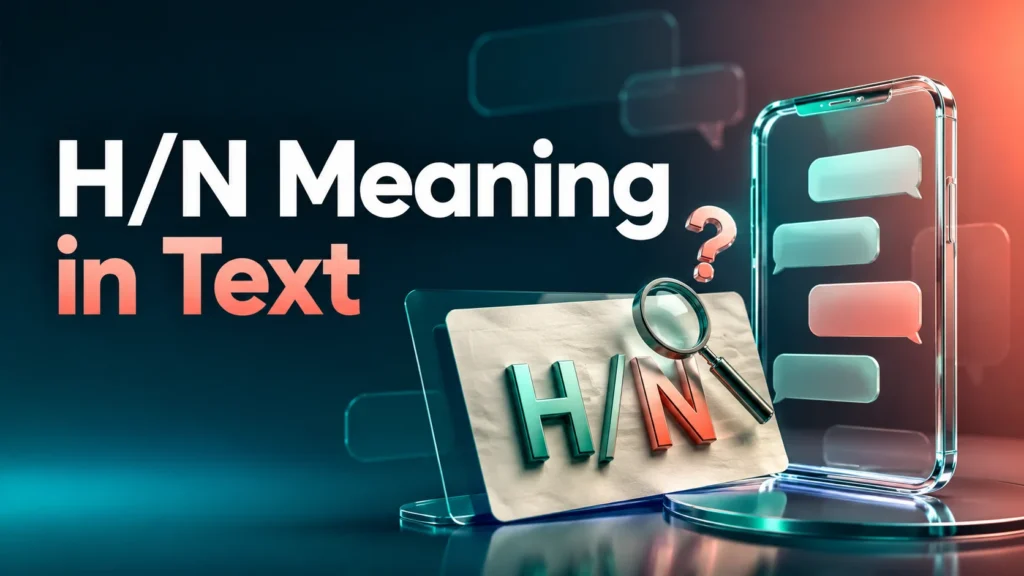
The H/N meaning in text is usually “his name” or “her name.” It acts as a customizable placeholder in fanfiction, reader-insert stories, TikTok POV videos, Instagram captions, and online roleplay.
When you see “H/N smiled at you,” replace H/N mentally with the name of the male or female person involved. That person could be a crush, partner, celebrity, fictional character, or someone created entirely in your imagination.
Confusion arises because HN without the slash can mean something different. In casual American texting, HN may stand for “hell no.” In South Asian conversations, lowercase “hn” can be a shortened spelling of haan, meaning “yes.”
The slash, sentence structure, and platform are therefore important. However, H/N inside a story normally represents a name; HN sent as a complete reply may express a strong refusal.
H/N Meaning in Text – Quick Meaning
H/N most commonly means his name or her name. Writers use it when they want readers to choose the identity of another character.
For example:
“H/N saved you a seat before class.”
Insert the name of the person you want to imagine.
“You smiled when H/N sent a good-morning message.”
H/N could represent a crush, partner, celebrity, or fictional character.
“Everyone noticed when H/N walked into the room.”
The writer keeps the character’s identity open so different readers can personalize the scene.
The quickest distinction is:
- H/N: His name or her name
- HN: Sometimes “hell no”
- hn: Sometimes haan, meaning yes
- HN in technology: Hacker News
- H/N in templates: A name to be inserted later
H/N is not controlled by one universal internet rule. If an author provides a glossary, their definition should take priority.
Origin and Background of H/N
Reader-insert fiction created the need
H/N belongs to a family of placeholders used in reader-insert fiction. These stories allow readers to imagine themselves or people they know inside a fictional scene.
The most recognizable placeholder is Y/N, meaning “your name.” Writers later adopted related forms, including:
- F/N: First name
- L/N: Last name
- E/C: Eye color
- H/C: Hair color
- S/O: Significant other
- H/N: His name or her name
These abbreviations let one story feel personal to thousands of readers without requiring the writer to create separate versions.
Fanfiction communities expanded its use
Reader-insert writing became especially visible through fandom spaces, story-sharing sites, blogs, and social-media communities. Romantic stories often asked readers to imagine meeting an actor, musician, fictional hero, or original character.
Y/N usually represented the reader. H/N could represent another customizable person:
“Y/N looked across the café and saw H/N waiting by the window.”
The reader inserts their own name for Y/N and another person’s name for H/N.
Not every writer uses H/N identically. Some use it specifically for “his name,” while others mean “her name” or simply “their name.” Pronouns and author notes normally resolve the uncertainty.
TikTok transformed it into visual storytelling
TikTok brought reader-insert language into short-form video. Creators began posting romantic, dramatic, and humorous POVs such as:
“POV: H/N realizes you remembered their birthday.”
The video gives viewers a ready-made emotional situation, while H/N allows each person to imagine a different character.
Instagram reels, YouTube Shorts, fandom edits, and Pinterest posts adopted similar formats. As a result, H/N now appears far beyond traditional fanfiction.
Real-Life Conversations Using H/N
WhatsApp conversation
Areeba: I started the story you sent me, but who is H/N?
Maham: It means “his name.” You’re supposed to insert your crush’s name.
Areeba: That changes the entire story!
Maham: Exactly. Now you understand why I sent it.
Here, H/N personalizes a romantic reader-insert story.
Instagram DMs
Ella: Your caption says, “H/N always remembers your coffee order.” Are those someone’s initials?
Chloe: No, it’s a placeholder for whoever the reader imagines.
Ella: I thought you were revealing a secret relationship.
Chloe: Nothing that exciting, unfortunately.
The conversation shows a common misunderstanding: H/N can look like hidden initials to someone unfamiliar with fandom language.
TikTok comments
Creator: “POV: H/N notices you went quiet and asks if you’re okay.”
Commenter 1: Why is H/N more emotionally available than everyone I know?
and,
Commenter 2: What does H/N stand for?
Commenter 1: His name or her name. Put in the name of whoever you’re imagining.
The placeholder helps every viewer personalize the same video.
Text-message conversation
Kai: Would you ever go back to your ex?
Jordan: HN 😭
Kai: That answer was immediate.
Jordan: I learned my lesson the first time.
In this example, HN means “hell no.” There is no slash, and it appears as a forceful answer to a yes-or-no question.
Emotional and Psychological Meaning of H/N
H/N gives readers more than a blank space. It gives them emotional control over the story.
A fixed name asks readers to observe someone else’s experience. A placeholder invites them to participate. They can insert a person connected to a real memory, private hope, celebrity interest, or imagined relationship.
People commonly use H/N for:
- A current crush
- A romantic partner
- A best friend
- A former partner
- A favorite celebrity
- A fictional character
- An original character
- An imagined future partner
Suppose a story says, “H/N remembered the small detail everyone else forgot.” The line may feel ordinary until you insert the name of someone important. Suddenly, it connects with your desire to be noticed, understood, or cared for.
That emotional personalization explains the popularity of reader-insert content. The writer supplies the situation, but the reader supplies its private meaning.
I once saw friends reading the same romantic scenario while inserting completely different names. One treated it as a joke about a celebrity crush; the other connected it to someone she genuinely missed. The words were identical, but the emotional experience was not.
Usage in Different Contexts
Social media
H/N appears in TikTok POVs, Instagram captions, Tumblr posts, fandom edits, quizzes, and short fictional scenarios.
Examples include:
- “H/N sends you this after an argument.”
- “Choose an outfit for your date with H/N.”
- “H/N remembers your favorite song.”
- “Your reaction when H/N compliments you.”
- “POV: H/N finally admits the truth.”
The surrounding content usually indicates whether H/N represents a male, female, or gender-neutral character.
Friends and relationships
Friends may use H/N to discuss a crush without stating the person’s real name:
“We all know H/N is why you attended that party.”
This usage combines privacy with playful teasing. The friends probably know the real identity, but they deliberately keep it hidden.
Couples may send each other reader-insert posts and jokingly replace H/N with the partner’s name. In that context, the abbreviation creates affection rather than secrecy.
Fanfiction and creative writing
H/N works best in second-person and interactive stories. It lets a broad audience customize the cast.
Still, too many placeholders can interrupt the reading experience:
“Y/N looked at H/N while F/N spoke to L/N.”
A story filled with abbreviations may feel more like a form than an emotional narrative. Skilled writers provide enough description and context to maintain natural flow.
Work and professional settings
H/N is not a standard professional placeholder. It may confuse colleagues, customers, and international readers.
Instead, use a descriptive placeholder such as:
- [Employee name]
- [Client name]
- [Manager’s name]
- [Participant name]
- [Recipient’s name]
HN can also have specialized meanings in technology, medicine, business, and organizational names. Professional documents should define unfamiliar abbreviations before using them.
Casual versus serious tone
H/N suits playful, fictional, and personalized content. It should not replace a real name when accuracy or responsibility matters.
A TikTok romance scenario can remain intentionally open. A school notice, medical record, workplace instruction, or emergency message must identify people clearly.
When Not to Use H/N
Avoid H/N when the recipient may not recognize reader-insert language. A placeholder is useful only when readers understand that they must replace it.
Do not use it in:
- Formal emails
- Legal documents
- Medical communication
- Academic essays
- Emergency messages
- Customer-service conversations
- Workplace instructions
- Official school notices
- Serious discussions about consent
- Public allegations involving real people
H/N can also cause problems when a writer never explains whether it means “his name” or “her name.” If pronouns do not provide a clue, include a brief glossary.
Cultural and linguistic differences deserve attention. A South Asian reader may interpret “hn” as haan, while an American reader could interpret HN as “hell no.” Someone in a technology discussion may assume it means Hacker News.
Write the full phrase whenever misunderstanding could affect someone’s feelings, safety, reputation, or responsibilities.
Common Misunderstandings About H/N
Believing it always means “hell no”
HN can mean “hell no,” but this interpretation is most likely when it appears without a slash as a direct answer.
“Are you working this weekend?”
“HN!”
That is a strong refusal.
“H/N waited for you after work.”
Here, H/N is clearly a name placeholder.
Confusing H/N with Y/N
Y/N means “your name.” H/N means “his name” or “her name.”
Consider this sentence:
“Y/N called H/N after school.”
Y/N represents the reader, while H/N represents another customizable person.
Treating it as hidden initials
The capital letters and slash can resemble someone’s initials. Yet H/N usually does not identify one specific person in reader-insert content.
Look for narrative language or other placeholders. If the post includes Y/N, E/C, or H/C, H/N almost certainly belongs to the same personalization system.
Assuming “his” or “her” without context
Some writers use H/N for “his name,” while others use it for “her name.” A growing number use it as a flexible or gender-neutral placeholder.
Check the character’s pronouns, description, title, tags, or author’s note.
Confusing H/N with HN
The slash may look unimportant, but it provides a strong contextual clue.
- “H/N hugged you” refers to a character.
- “HN, I’m not going” expresses rejection.
- “hn, aa raha hoon” may mean “yes, I’m coming” in Romanized South Asian texting.
H/N Compared with Similar Text Expressions
| Expression | Common meaning | Typical context | Example |
|---|---|---|---|
| H/N | His name or her name | Reader-insert stories | “H/N called you.” |
| HN | Hell no | Strong rejection | “Go back there? HN.” |
| Y/N | Your name | Fanfiction and POVs | “Y/N opened the letter.” |
| F/N | First name | Templates or stories | “Enter F/N here.” |
| L/N | Last name | Reader-insert fiction | “Mr. L/N entered.” |
| N/N | Nickname | Personalized stories | “H/N called you N/N.” |
| S/O | Significant other | Relationship discussions | “My S/O sent this.” |
| OC | Original character | Creative communities | “This is my OC.” |
| BF | Boyfriend | Casual texting | “My BF is coming.” |
| GF | Girlfriend | Casual texting | “Her GF called.” |
| HN | Hacker News | Technology discussions | “I saw it on HN.” |
| Name | A person’s identity | Clear everyday writing | “Enter the character’s name.” |
Key Insight
Sentence structure is the strongest clue. H/N occupying a character’s position normally represents a name, while HN functioning as a complete response usually means “hell no.”
Variations and Types of H/N
1. H/N as “his name”
This replaces the name of a male character.
Example: “H/N said he would meet you after class.”
2. H/N as “her name”
This replaces the name of a female character.
Example: “H/N left her jacket beside you.”
3. H/N as a gender-neutral placeholder
Some creators use H/N for a person of any gender.
Example: “H/N smiled when they saw your message.”
4. HN as “hell no”
This expresses immediate and forceful disagreement.
Example: “Would you date them again?” “HN.”
5. hn as haan
In Romanized South Asian conversations, “hn” may represent haan, meaning yes, yeah, or okay.
Example: “Are you free?” “Hn.”
6. HN as Hacker News
Technology communities use HN as an abbreviation for Hacker News.
Example: “That startup discussion is trending on HN.”
7. H/N as a hidden identity
A creator may use H/N to conceal a real person’s name.
Example: “H/N knows what happened, but I won’t identify them.”
8. H/N in romantic POVs
H/N commonly represents a crush, celebrity, partner, or fictional love interest.
Example: “H/N reaches for your hand during the movie.”
9. H/N in roleplay
Roleplayers may use it as a temporary character label until a name is chosen.
Example: “H/N enters the village looking for shelter.”
10. H/N in editable templates
Writers may use H/N in drafts that will later be personalized for a specific recipient.
Example: “Congratulations, H/N, on your achievement.”
How to Respond When Someone Uses H/N
Casual replies
- “Who should I imagine as H/N?”
- “Oh, so it means his or her name.”
- “I’m putting my crush’s name there.”
- “That makes the story much clearer.”
- “Which character did you choose?”
- “Is H/N supposed to be gender-neutral?”
Funny replies
- “H/N is raising my standards again.”
- “I inserted the wrong name and created chaos.”
- “Why is H/N more thoughtful than real people?”
- “H/N needs to stop making me delusional.”
- “My imaginary relationship is going wonderfully.”
- “Plot twist: H/N is the villain.”
Mature replies
When the meaning is unclear, ask directly:
- “Does H/N mean his name or her name here?”
- “Is this a placeholder or someone’s initials?”
- “How did the author define H/N?”
- “Do you mean H/N or HN?”
- “Could you write the name or phrase in full?”
Respectful replies
If HN means “hell no,” recognize the boundary:
- “Understood.”
- “That’s completely fair.”
- “I won’t pressure you.”
- “Thanks for being clear.”
- “We can choose another option.”
- “No problem—I respect your decision.”
A strong refusal should not become an invitation to argue.
Regional and Cultural Usage
Western culture
In Western fanfiction and TikTok communities, H/N generally represents “his name” or “her name.” HN without a slash is more likely to mean “hell no” in casual American messages.
People outside fandom culture may not recognize the placeholder immediately.
Asian culture
Asian fandom communities commonly use English reader-insert abbreviations alongside local-language content. The meaning of H/N generally remains connected to character personalization.
In Pakistan, India, and nearby South Asian communities, lowercase “hn” may represent haan. That creates a particularly sharp contrast: the same letters can communicate either strong refusal in American slang or casual agreement in South Asian texting.
Middle Eastern culture
Many Middle Eastern users recognize H/N through English-language fandoms, K-pop communities, anime content, and social-media POVs.
Outside those spaces, readers may interpret it as initials. Full wording is safer in multilingual groups.
Global internet culture
Global social media blends expressions from different languages and communities. A term created for personalized storytelling may appear beside regional abbreviations and unrelated professional acronyms.
Platform context provides a reliable clue. H/N in a romantic TikTok POV probably represents a name. HN after an unwanted suggestion probably expresses rejection.
Gen Z versus Millennials
Gen Z users frequently encounter placeholders through TikTok POVs and short video captions. Millennials may recognize the same system from Tumblr, Wattpad, blogs, and earlier fanfiction communities.
Users outside fandom spaces—regardless of age—may find H/N unfamiliar. Interests often predict understanding better than generation.
Is H/N Safe for Kids?
H/N itself is safe for children. It usually serves as a harmless placeholder and contains no offensive meaning.
The surrounding content determines whether a story or video is appropriate. Reader-insert material may involve innocent friendship, fantasy, romance, violence, or adult themes.
Parents and educators should examine the complete post rather than judging it from the abbreviation alone.
If HN means “hell no,” it contains a mild profanity when expanded. Children can use clearer alternatives such as “no,” “definitely not,” or “no, thank you.”
Frequently Asked Questions About H/N
What does H/N mean in a text message?
H/N usually means “his name” or “her name.” It replaces a character’s name in personalized stories, fanfiction, and social-media POVs.
What does H/N mean on TikTok?
On TikTok, H/N is normally a placeholder for the name of a crush, partner, celebrity, fictional character, or another person the viewer imagines.
Is H/N the same as Y/N?
No. H/N means his name or her name, while Y/N means your name. Writers may use both placeholders in the same story.
What does HN mean from a guy?
If a guy sends HN as a complete response to a suggestion, it probably means “hell no.” Inside a story, H/N is more likely to represent a character’s name.
What does HN mean from a girl?
The sender’s gender does not determine the meaning. HN may mean “hell no,” while H/N in fanfiction usually means his name or her name.
Can H/N mean “her name”?
Yes. Many writers use H/N to mean “her name.” Others use it for “his name,” so the character’s pronouns and author notes provide confirmation.
Why do writers use H/N?
Writers use H/N so readers can insert a personally meaningful name. This makes one fictional scenario feel customized for many different people.
Conclusion
The standard H/N meaning in text is “his name” or “her name.” It is most common in reader-insert fiction, TikTok POVs, Instagram captions, roleplay, and personalized online scenarios.
The abbreviation invites you to insert the name of a crush, partner, celebrity, friend, or fictional character. This small act can turn a general scene into something emotionally personal.
Formatting makes a difference. H/N inside a narrative normally represents a name. HN as a short answer can mean “hell no,” while lowercase “hn” may mean haan, or yes, in South Asian messages.
Read the entire sentence before choosing an interpretation. If the author provides no explanation and the context remains unclear, simply ask. Understanding the intended meaning is always better than building an emotional assumption around two letters and a slash.