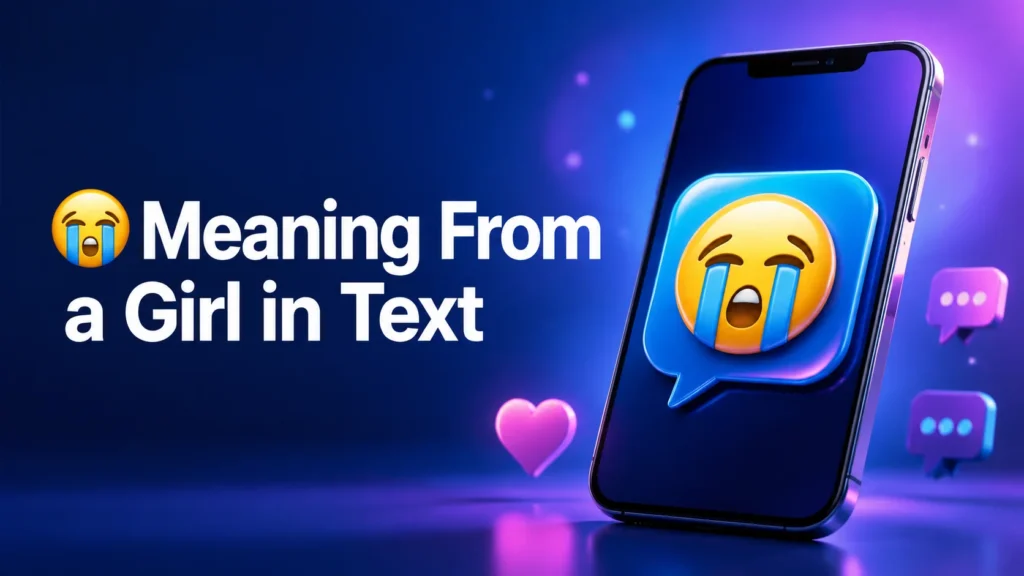
The 😭 meaning from a girl in text can be sadness, uncontrollable laughter, emotional overwhelm, embarrassment, happiness, affection, or playful drama. Although the emoji officially shows a loudly crying face, girls often use it when something is extremely funny or emotionally adorable.
For example, “My phone fell on my face 😭” is probably humorous frustration. “I miss you so much 😭” expresses genuine sadness or affection. Meanwhile, “Stop, you’re so cute 😭” usually means she feels overwhelmed by how sweet or attractive something is.
That emotional flexibility makes 😭 one of the easiest emojis to misunderstand. You cannot identify its meaning by looking at the tears alone.
Read the words before it, notice any other emojis, and consider your relationship with the sender. The emoji intensifies the emotion already present in the conversation rather than creating one fixed meaning.
😭 Meaning From a Girl in Text – Quick Explanation
When a girl sends 😭, she may mean:
- “I’m genuinely sad.”
- “That is extremely funny.”
- “I’m emotionally overwhelmed.”
- “That is painfully relatable.”
- “You are so sweet.”
- “This is too cute.”
- “I’m embarrassed.”
- “I’m disappointed.”
- “I miss you.”
- “I can’t believe this happened.”
- “Please stop teasing me.”
- “I’m being playfully dramatic.”
- “I’m proud and emotional.”
- “I’m laughing so hard I’m crying.”
Here are three quick examples:
“I failed my driving test again 😭”
She is likely disappointed or genuinely upset.
“Why did he run like that 😭”
More, She is probably laughing at something funny.
“You remembered my favorite song 😭❤️”
She feels touched, happy, or affectionately overwhelmed.
Does 😭 Mean She Is Actually Crying?
Not necessarily. The emoji frequently exaggerates emotion.
She might be physically crying, but she could also be laughing, pretending to cry for humor, or emphasizing that something feels adorable or relatable.
If the subject is serious, respond with care. If the message clearly contains a joke, treat the emoji as laughter.
Simple Definition
From a girl, 😭 means she is emotionally overwhelmed. The specific emotion may be sadness, laughter, love, embarrassment, joy, or frustration depending on context.
Origin and Background of 😭
The official name of 😭 is Loudly Crying Face. It depicts a yellow face with closed eyes, an open wailing mouth, and heavy streams of tears.
According to Emojipedia, it can communicate grief as well as intense feelings such as uncontrollable laughter, overwhelming joy, and pride.
The emoji has roots in Japanese mobile emoji sets and became widely available through Unicode 6.0 in 2010.
From Sadness to Every Intense Emotion
Its original visual design clearly suggests crying. Early users commonly sent it to express grief, heartbreak, or disappointment.
Internet culture gradually expanded its purpose. People began using it whenever an emotion felt too intense for ordinary words.
It could now mean:
- “This is so funny that I cannot breathe.”
- “This is so cute that I cannot handle it.”
- “I’m too embarrassed to continue.”
- “This moment made me emotional.”
- “I am dramatically suffering.”
The tears represent emotional overflow rather than sadness alone.
Gen Z and the Laughter Meaning
Many Gen Z users prefer 😭 over 😂 when reacting to humor. The loudly crying face can make laughter feel more dramatic, spontaneous, and emotionally expressive.
Compare:
“That video was funny 😂”
“Why would he do that 😭”
The second response often feels more conversational and current. It suggests that the situation was so ridiculous that the sender emotionally collapsed.
Social Media Influence
TikTok, Instagram, Snapchat, X, and group chats helped turn 😭 into a multipurpose reaction.
It is particularly common beneath:
- Relatable videos
- Awkward stories
- Cute animals
- Romantic edits
- Celebrity clips
- Personal confessions
- Fashion failures
- Friendship jokes
- Emotional reunions
- Nostalgic content
Its popularity comes from emotional flexibility. One face can communicate laughter, pain, affection, and embarrassment.
Real-Life Conversations Using 😭
These examples show how the 😭 meaning from a girl in text changes in different situations.
WhatsApp Conversation About Sadness
Girl: I didn’t get the scholarship 😭
Friend: I’m really sorry. I know how hard you worked.
Girl: I honestly thought I had a chance.
Here, the emoji expresses real disappointment. A joke would be inappropriate.
Instagram DM With Flirting
Guy: You looked beautiful in that blue dress.
Girl: Stoppp 😭❤️
Guy: I’m only telling the truth.
Her response probably means she feels flattered, shy, and emotionally overwhelmed. The heart adds affection, while “stoppp” is likely playful rather than a serious request to stop.
TikTok Comments
Creator: Me opening the fridge five times and expecting new food to appear.
Girl: Why is this literally me 😭
She is not sad. The emoji means the video is painfully relatable and funny.
Snapchat Conversation
Guy: I accidentally sent that snap to my teacher.
Girl: NO WAY 😭😭😭
The repeated crying faces express intense laughter, shock, and second-hand embarrassment.
Relationship Conversation
Girl: I miss how we used to talk 😭
Partner: I miss that too. Can we call tonight?
The emoji communicates sadness, longing, and emotional vulnerability.
Cute Animal Video
Girl: Look at his tiny paws 😭
Friend: He’s adorable.
Here, 😭 means “This is too cute for me to handle.”
Emotional and Psychological Meaning
The crying emoji allows a girl to express strong feelings without writing a long explanation. It can make vulnerability feel safer because the image adds softness and informality.
Genuine Sadness
In serious conversations, 😭 may express heartbreak, grief, disappointment, loneliness, or emotional pain.
Examples include:
“My best friend is moving away 😭”
“I really thought the interview went well 😭”
“I miss my grandmother today 😭”
These messages deserve empathy rather than an automatic humorous reply.
Uncontrollable Laughter
In playful conversations, 😭 often performs the same job as “I’m crying,” “I can’t,” or “I’m dead.”
“You really wore your shirt backward all day 😭”
She is laughing at the situation, not experiencing sadness.
Affectionate Overwhelm
Girls commonly use 😭 when a compliment, gift, gesture, or message feels unexpectedly sweet:
“You saved that photo of us? 😭❤️”
The emoji shows that the gesture touched her emotionally. It may communicate friendship, family affection, or romantic interest.
Embarrassment
😭 can also mean, “Please let me disappear.”
“I waved back, but he was waving at the person behind me 😭”
The girl is expressing humorous embarrassment rather than deep distress.
Playful Drama
Some messages use the emoji to exaggerate a minor inconvenience:
“They forgot the extra sauce 😭”
She may be disappointed, but the dramatic emoji turns the complaint into humor.
A Personal-Style Scenario
Imagine sending a girl a photograph from the first day you met. She replies, “You still have this? 😭”
The message could mean she is touched by the memory, embarrassed by her old appearance, or laughing at how different you both looked.
A good response would acknowledge the shared memory:
“Of course. That day still means a lot to me.”
This allows her next reply to clarify whether the emotion is nostalgic, romantic, or humorous.
Usage in Different Contexts
The surrounding conversation is the strongest clue to what a girl means by 😭.
Social Media
On TikTok and Instagram, 😭 frequently means laughter, relatability, cuteness, or second-hand embarrassment.
Examples include:
“The way he looked at the camera 😭”
“I need this dress immediately 😭”
“They’re so cute together 😭❤️”
In public comments, the emoji is often exaggerated and should not automatically be read as genuine crying.
Friendship
Girls may use 😭 with friends to react dramatically:
“You went without me? 😭”
This could be a playful complaint. If she genuinely feels excluded, however, the same message may express hurt.
Her later responses and the situation determine the tone.
Dating and Relationships
In romantic conversations, 😭 can show that she feels:
- Flattered
- Shy
- Loved
- Emotionally touched
- Afraid of losing someone
- Hurt
- Nostalgic
- Frustrated
- Overwhelmed by attraction
Example:
“Why are you so sweet to me 😭❤️”
This is generally positive and affectionate.
By contrast:
“You promised you wouldn’t do that again 😭”
This communicates pain and should be taken seriously.
Flirting
😭 is not automatically a flirting emoji, but it can support a flirty message:
Guy: “You’re cute when you get nervous.”
Girl: “Leave me alone 😭”
If the conversation is playful and she continues responding warmly, “leave me alone” probably means she is embarrassed by the compliment.
If she clearly asks you to stop, withdraws from the conversation, or sounds uncomfortable, respect the boundary. An emoji does not cancel a direct refusal.
Family Conversations
A girl may use 😭 with family to express affection, gratitude, or nostalgia:
“Mom found my childhood drawings 😭”
The emoji may combine embarrassment, warmth, and sentimental emotion.
Professional or School Settings
The emoji is usually too casual for formal emails, reports, applications, or serious academic communication.
It may be acceptable in a friendly class group chat:
“We have another test tomorrow 😭”
It should not replace a clear explanation when requesting support from a teacher or manager.
When Not to Misread 😭 and Common Mistakes
The biggest mistake is assuming the emoji always represents one emotion.
Treating Genuine Sadness as a Joke
If a girl sends:
“My parents are separating 😭”
do not respond with laughter simply because younger people sometimes use the emoji humorously.
The serious subject makes sadness the obvious interpretation.
Assuming Laughter Means Mockery
When she writes “You’re so stupid 😭” after a harmless joke, she may be laughing affectionately rather than attacking your intelligence.
Your existing communication style matters.
Assuming It Proves Romantic Interest
A girl may write “You’re so sweet 😭” because she appreciates your kindness. That does not automatically mean she wants a relationship.
Look for consistent romantic signs rather than building a conclusion around one emoji.
Ignoring Direct Boundaries
If she says “Stop messaging me 😭,” do not assume the crying face makes the request playful. Ask once if clarification is truly needed, then respect the words.
Direct language carries more weight than an emoji.
Overthinking Repeated Emojis
One 😭 and five 😭 emojis usually differ in intensity, not fundamental meaning.
“That was funny 😭”
“THAT WAS FUNNY 😭😭😭😭”
The second response shows a stronger reaction.
Confusing 😭 With 😢
😭 shows loud, overwhelming emotion. 😢 usually feels quieter, gentler, or more sincerely sad.
Someone disappointed by a small issue might choose 😢, while someone emotionally overwhelmed may choose 😭.
😭 Compared With Similar Emojis
| Emoji | Common meaning | Typical tone | Key difference |
|---|---|---|---|
| 😭 | Overwhelming emotion, sadness, laughter | Intense and dramatic | Works for both pain and humor |
| 😢 | Sadness or disappointment | Quiet and sincere | Less exaggerated |
| 😂 | Laughing with tears | Clearly humorous | More directly means laughter |
| 🤣 | Extremely strong laughter | Loud and playful | Rarely interpreted as sadness |
| 🥲 | Smiling through pain | Bittersweet | Combines happiness and sadness |
| 🥺 | Pleading, tenderness, vulnerability | Soft and cute | Requests sympathy or affection |
| 😔 | Disappointment or reflection | Serious and quiet | Less emotionally explosive |
| 💀 | “I’m dead” from laughter or shock | Dramatic and humorous | Common Gen Z laughter reaction |
| 😩 | Exhaustion, frustration, desire | Overwhelmed | Usually lacks literal sadness |
| 🥹 | Holding back tears | Grateful or touched | More controlled emotion |
| ❤️ | Love and affection | Warm or romantic | Communicates affection directly |
| 🙃 | Awkwardness or hidden frustration | Ironic | Masks discomfort with a smile |
Key Insight
😭 is more versatile than most emotional emojis. It represents feelings that have become too intense for a calm reaction, whether the person is heartbroken, delighted, embarrassed, or laughing uncontrollably.
Variations and Emoji Combinations
The emojis surrounding 😭 often clarify what a girl means.
1. 😭
One loudly crying face expresses emotional intensity. Context determines whether it is sadness or laughter.
2. 😭😭😭
Repeated crying emojis amplify the reaction. In funny conversations, they usually mean intense laughter.
3. 😭❤️
This combination represents affectionate overwhelm, love, gratitude, or emotional closeness.
4. 😭😂
These two emojis clearly indicate laughter. The sender finds something extremely funny.
5. 😭💀
This means “I’m dying from laughter” or “This is unbelievably embarrassing.” It is common in Gen Z communication.
6. 😭🥺
This pairing expresses softness, vulnerability, sadness, or an emotional request.
7. 😭✨
The combination may show emotional admiration, beauty, pride, or dramatic excitement.
8. 😭🙏
This can mean desperate hope, intense gratitude, pleading, or a prayerful response.
9. 😭🫶
The heart-hands emoji adds love, support, or deep appreciation.
10. 😭😍
This pairing means someone or something is extremely attractive, beautiful, or adorable.
11. 😭😩
Together, these emojis express exhaustion, frustration, or being emotionally unable to cope.
12. 😭🤦♀️
This combination shows embarrassment, disbelief, or frustration about a foolish mistake.
How to Respond When a Girl Sends 😭
Match your response to the subject rather than the emoji alone.
If She Is Sad
- “I’m really sorry. Are you okay?”
- “Do you want to talk about it?”
- “I’m here for you.”
- “That sounds painful.”
- “Would you like me to call?”
- “You don’t have to deal with this alone.”
More, If She Is Laughing
- “I knew you’d find that funny.”
- “I’m still laughing too.”
- “It was the facial expression for me.”
- “Please, it wasn’t that funny.”
- “I’ll never recover from this.”
- “You’re making it worse 😭”
If She Is Flattered
- “I’m only telling the truth.”
- “You deserve the compliment.”
- “I like making you smile.”
- “Your reaction is adorable.”
- “Should I stop, or do you secretly like it?”
- “There’s more where that came from.”
Keep flirting respectful and respond to her comfort level.
If She Is Embarrassed
- “Don’t worry, it happens to everyone.”
- “I promise it wasn’t that bad.”
- “Your secret is safe with me.”
- “We’ll laugh about it tomorrow.”
- “Honestly, that makes you more relatable.”
If the Meaning Is Unclear
- “Wait, are you laughing or crying?”
- “Is that a happy 😭 or a sad 😭?”
- “Are you okay?”
- “I can’t tell whether this is funny or serious.”
- “Tell me what happened.”
Asking kindly is better than guessing incorrectly.
Regional, Cultural and Generational Usage
Western Culture
In Western texting, 😭 can represent both genuine sadness and intense laughter. Younger users rely heavily on context, while older users may interpret it literally.
It is common in casual conversations about relationships, humor, awkward moments, and emotional media.
Asian Digital Culture
Emotionally expressive emojis are widely used across Asian messaging platforms, but habits differ by country and language.
Some users employ repeated crying faces for dramatic disappointment, cuteness, pleading, or humor. Local stickers and text-based expressions may communicate similar emotions.
Middle Eastern and South Asian Culture
Girls in Middle Eastern and South Asian online communities commonly use 😭 for laughter, sadness, exam stress, family situations, romantic content, and playful complaints.
A message such as “There’s another assignment due tomorrow 😭” is normally dramatic frustration rather than serious distress.
Global Internet Usage
TikTok and meme culture have made the laughter meaning recognizable internationally. Even users who speak different languages can understand 😭 as a reaction to an absurd video.
Still, cultural familiarity varies. Clear wording helps when speaking with someone from a different generation or digital background.
Gen Z Versus Millennials
Gen Z often uses 😭 where previous generations might use 😂:
“Why did you say it like that 😭”
Millennials are more likely to use 😂 or 🤣 for laughter and reserve 😭 for strong sadness, although many understand both uses.
Older adults may interpret 😭 as genuine distress unless the humor is obvious.
Is 😭 Safe for Kids?
Yes, 😭 is generally safe for children. It represents strong emotion and contains no inherently adult meaning.
Children may use it to express:
- Sadness
- Disappointment
- Laughter
- Missing someone
- School stress
- Embarrassment
- Excitement
- Feeling overwhelmed
Parents should avoid assuming every 😭 signals a crisis, but they should not dismiss it either. A simple question works well:
“Is this a funny cry or a sad cry?”
If the child mentions bullying, hopelessness, fear, self-harm, or feeling unsafe, take the words seriously and provide immediate support. The surrounding message matters more than the emoji.
Frequently Asked Questions About 😭 Meaning From a Girl
What does 😭 mean when a girl sends it?
It means she feels emotionally overwhelmed. She may be sad, laughing hard, embarrassed, touched, frustrated, or reacting to something adorable.
Does 😭 from a girl mean she likes you?
It can show that your message touched or flattered her, especially in a warm conversation. However, the emoji alone does not prove romantic interest.
What does “stop 😭” mean from a girl?
In a playful conversation, it often means “You’re making me laugh” or “You’re making me shy.” If she expresses genuine discomfort, respect the request literally.
What does 😭 mean after a compliment?
She is probably flattered, shy, or emotionally overwhelmed. Combinations such as 😭❤️, 😭🥺, or 😭🫶 make a positive reaction more likely.
Why do girls use 😭 when laughing?
The emoji exaggerates the feeling of laughing so hard that tears appear. Many younger users find it more expressive and natural than 😂.
What does 😭😭😭 mean from a girl?
Repeated crying faces intensify the emotion. They may represent extreme laughter, deep sadness, excitement, cuteness, or dramatic frustration.
How can I know if she is sad or laughing?
Read the sentence and subject. Bad news usually signals sadness, while jokes, awkward stories, and playful comments usually signal laughter. Ask her directly if the context remains unclear.
Conclusion
The 😭 meaning from a girl in text is not limited to sadness. It can represent uncontrollable laughter, affectionate overwhelm, embarrassment, frustration, joy, longing, or playful drama.
The surrounding words reveal the emotion. “I miss you 😭” expresses longing, “You’re so sweet 😭❤️” shows affection, and “Why did he fall like that 😭” communicates laughter.
Do not assume the emoji proves romantic interest, and never ignore serious words because younger users sometimes send 😭 jokingly. Context, relationship history, and her communication pattern matter far more than the tears on the screen.
When you are unsure, ask whether she is okay or whether she is laughing. That small moment of emotional attention can prevent confusion—and show her that you care about what she actually feels.