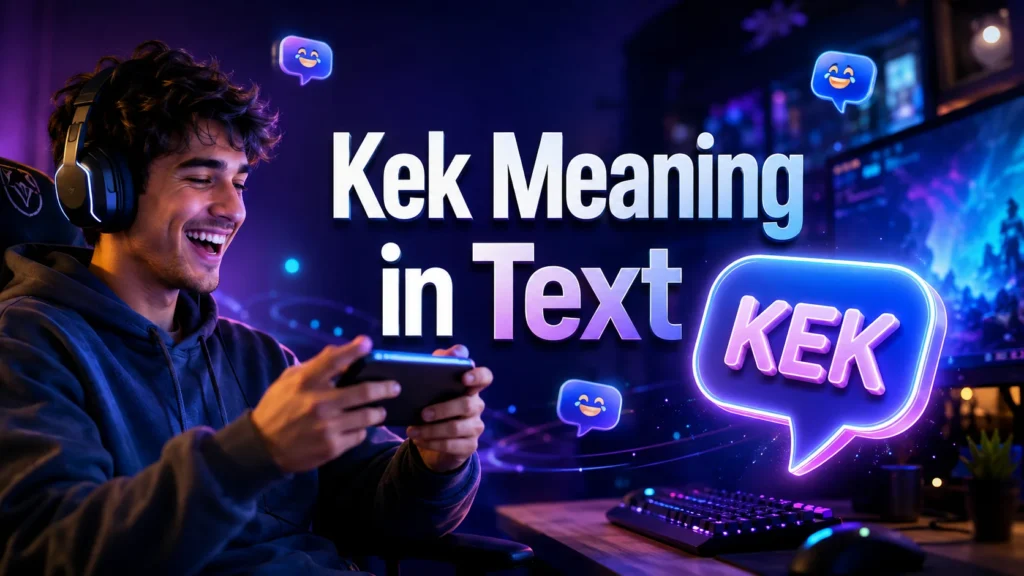
The most common kek meaning in text is “LOL,” “haha,” or laughter. People use it to react to something funny, ridiculous, awkward, or unexpectedly entertaining.
If someone replies “kek” after you share a gaming mistake, they are probably laughing at the situation. The word may sound strange outside internet culture because it is not a standard English expression.
Kek became popular through online gaming, particularly communities connected to StarCraft and World of Warcraft. It later spread across forums, livestream chats, Discord servers, memes, and social media.
However, its tone is not always friendly. Depending on the community, “kek” may communicate genuine amusement, sarcastic laughter, playful mockery, or an intentionally old-school internet style. Context helps you decide whether the sender is laughing with you or at you.
Kek Meaning in Text – Quick Meaning
In most casual online conversations, kek means “LOL” or “haha.” It is a short written reaction to something amusing.
Common interpretations include:
- “That’s funny.”
- “LOL.”
- “I’m laughing.”
- “What a ridiculous situation.”
- “That was an embarrassing mistake.”
- “I can’t believe that happened.”
- Sarcastic or mocking laughter
- A reference to older gaming culture
Here are a few examples:
“I entered the wrong gaming lobby again.”
“Kek.”
This means the sender finds the mistake funny.
“He celebrated before crossing the finish line and lost. Kek.”
The word expresses laughter mixed with mockery.
“Kek, that joke was actually good.”
Here, it works like “Haha” at the beginning of a message.
The safest quick translation is “LOL,” but the emotional tone may range from warm amusement to sarcastic teasing.
Origin and Background of Kek
Korean internet laughter
One influence behind “kek” comes from Korean online communication. Korean users commonly represent laughter with the character ㅋ, based on a “k” sound associated with laughing.
Repeated characters such as ㅋㅋㅋ function much like “hahaha” or “LOL.” In Romanized form, Korean laughter may appear as “keke” or “kekeke.”
This style became familiar to international gamers through South Korean gaming culture, especially during the rise of competitive StarCraft.
The World of Warcraft connection
Another major source of kek’s popularity is World of Warcraft. The game historically prevented players from opposing factions from communicating normally.
When a Horde player typed “LOL,” Alliance players could see it transformed through the game’s fictional language system. The result became famously associated with “KEK.”
Players began using “kek” intentionally as a gaming version of “LOL.” The word then escaped the game and became part of wider internet vocabulary.
Meme culture and later associations
As “kek” spread through forums and imageboards, it developed several additional cultural associations. It appeared alongside reaction images, Pepe the Frog memes, parody religions, and the fictional idea of “Kekistan.”
Some online political communities also adopted these memes. As a result, “kek” may occasionally appear in edgy or politically charged content.
Still, the word itself does not automatically express a political belief or hateful message. In many gaming chats, it remains nothing more than laughter. The account, conversation, images, and surrounding language determine whether a deeper reference exists.
Real-Life Conversations Using Kek
WhatsApp conversation between gamer friends
Person A: I spent twenty minutes looking for my character’s sword.
Person B: Where was it?
and,
Person A: Equipped the entire time.
Person B: Kek, you need more sleep.
Here, “kek” means “LOL.” The friend is teasing but does not appear hostile.
Instagram DM about an embarrassing post
Person A: I accidentally liked his photo from 2019.
Person B: Kek. There’s no recovering from that.
Person A: I immediately closed the app like that would help.
Person B: He probably already got the notification.
In this exchange, kek reacts to an awkward but relatable social media mistake.
TikTok comment section
Creator: Watch me confidently explain the wrong answer for two full minutes.
Commenter A: Kek, the confidence made it ten times funnier.
Creator: Confidence without knowledge is my special talent.
The commenter uses kek as amused approval of the creator’s self-deprecating humor.
Discord gaming conversation
Player A: Easy win. They can’t stop us.
Player B: You said that last round too.
Game notification: Player A has been eliminated.
Player B: KEK.
Capitalized “KEK” emphasizes the comic timing and adds a slightly mocking tone.
Emotional and Psychological Meaning of Kek
Kek often represents detached or knowing amusement. Compared with “hahaha,” it can feel shorter, drier, and more internet-aware.
Someone may use it to communicate:
- Genuine laughter
- Friendly teasing
- Sarcasm
- Mockery
- Shared gaming nostalgia
- Amusement at failure
- Ironic approval
- Emotional distance
“Kek” is rarely as warm as “That genuinely made me laugh.” Its brevity gives it a deadpan quality. That is precisely why many gamers find it funny.
It can also signal group identity. People familiar with older gaming communities recognize the term immediately, while outsiders may not understand it. Using kek can quietly communicate, “I know this part of internet culture too.”
Imagine losing an online match because your teammate accidentally presses the wrong button. If they write, “I just activated the worst ability possible,” replying “kek” treats the failure as shared comedy. Yet if the teammate is genuinely upset, the same reply may feel dismissive.
The psychology behind the word depends on emotional timing. Among relaxed friends, it strengthens connection through humor. During embarrassment or conflict, it may increase discomfort by making the recipient feel mocked.
Usage in Different Contexts
Social media
Kek appears in comments under funny clips, gaming highlights, memes, and public mistakes. It commonly replaces “LOL” when the user wants a more niche or ironic reaction.
Examples include:
- “Kek, he really thought that would work.”
- “The ending took me out. KEK.”
- “Old-school meme, but still funny. Kek.”
- “Kek, this comment section is chaos.”
It is less common in mainstream lifestyle content than in gaming and meme-focused communities.
Friends and relationships
Friends who share online humor may use kek as casual laughter. It is especially natural when both people understand gaming references.
In romantic relationships, the word has no special affectionate meaning. It may appear during teasing, but it does not communicate attraction by itself.
If someone responds “kek” to a vulnerable message, the reply could seem insensitive. The sender may have misunderstood the seriousness, or they may be mocking the situation.
Gaming communities
Gaming is the most natural home for kek. Players use it after:
- An embarrassing defeat
- An unexpected victory
- A technical failure
- A badly timed move
- A funny voice-chat moment
- An overconfident opponent losing
- An absurd in-game glitch
The expression can be friendly between teammates or deliberately provocative between rivals.
Livestream and Discord chats
In livestream chats, people may post “KEK,” “KEKW,” or related emotes when something funny happens. Rapid chat culture encourages short reactions that other viewers can repeat.
Discord users may type kek in lowercase for dry laughter or capitals for a louder reaction.
Professional settings
Kek is unsuitable for most professional communication. Many coworkers will not recognize it, and its sarcastic tone may appear immature.
Use “That was funny,” “I see the humor,” or a simple laughing emoji in relaxed workplace chats. Avoid kek in formal emails, reports, client messages, and customer-service conversations.
Casual versus serious tone
“Kek 😂” clearly looks playful. “Kek.” may feel dry or mocking because the period creates emotional finality.
Compare:
- “I wore two different shoes today.” — “Kek 😂”
- “I failed the exam I studied for.” — “Kek.”
The first response fits the harmless mistake. The second is insensitive because the situation may involve real disappointment.
When Not to Use Kek
Avoid kek when laughter may hurt, confuse, or disrespect another person.
It is inappropriate in:
- Conversations about grief
- Serious mental health discussions
- Responses to personal trauma
- Formal workplace communication
- Academic writing
- Customer-service messages
- Apologies
- Discussions involving discrimination
- Messages to people unfamiliar with gaming slang
- Moments when someone is genuinely embarrassed
Kek can also be risky when used alongside politically extreme imagery or hateful language. Although the term alone usually means laughter, some internet subcultures have attached additional associations to it.
If you do not understand the surrounding meme, do not repeat it casually. Checking the context helps you avoid sharing a message you did not intend.
Be mindful of tone during competition. Repeatedly sending “kek” after defeating another player may be interpreted as taunting. Friendly humor stops being friendly when it is designed to humiliate someone.
Common Misunderstandings About Kek
Thinking kek is a typing error
People unfamiliar with gaming slang may assume the sender meant “LOL” or accidentally typed random letters. In many cases, kek is intentional.
Assuming it always comes from one source
Kek’s popularity is connected to both Korean-style written laughter and gaming culture, especially World of Warcraft. Its history cannot be reduced neatly to one community.
Believing it means “okay”
Kek does not normally mean “okay.” It is primarily a laughter reaction, although its short appearance can resemble other casual acknowledgements.
Assuming it is friendly laughter
Kek may be affectionate, sarcastic, or mocking. The subject and relationship reveal whether the laughter feels supportive.
Treating it as automatically offensive
The word has appeared in controversial meme communities, but ordinary use is not automatically hateful or political. Context is necessary before making that judgment.
Confusing kek with KEKW
KEKW is a livestream emote associated with intense laughter. It is related to kek culture but is not exactly the same expression.
Thinking capitalization creates a new meaning
“Kek” and “KEK” both indicate laughter. Capitals usually add emphasis, making the reaction feel louder or more dramatic.
Kek Compared With Similar Internet Slang
| Expression | Common meaning | Typical tone | Example |
|---|---|---|---|
| Kek | LOL or ironic laughter | Dry, gaming-based, or mocking | “You fell again, kek.” |
| LOL | Laughing out loud | General and casual | “LOL, that was funny.” |
| Haha | Natural written laughter | Friendly and warm | “Haha, I’ve done that too.” |
| LMAO | Laughing very hard | Strong and informal | “LMAO, the ending!” |
| ROFL | Rolling on the floor laughing | Exaggerated and old-school | “ROFL, I can’t breathe.” |
| ㅋㅋㅋ | Korean written laughter | Casual and playful | “That clip was funny ㅋㅋㅋ.” |
| Jajaja | Spanish written laughter | Friendly and natural | “Jajaja, no way!” |
| Hehe | Quiet or mischievous laughter | Playful | “I already knew, hehe.” |
| 💀 | “I’m dead” from laughter | Dramatic Gen Z humor | “That reply 💀” |
| KEKW | Strong livestream laughter | Meme-heavy and expressive | “He missed again KEKW.” |
Key Insight
Kek differs from ordinary “haha” because it carries a stronger gaming and internet-culture identity. It often sounds ironic or deadpan, even when the sender is genuinely amused.
Popular Variations and Types of Kek
“Kek”
The standard form communicates laughter. It may sound casual, dry, or slightly sarcastic.
“KEK”
Capital letters intensify the reaction. It can resemble a loud “LOL.”
“Kekeke”
This longer form represents continuing laughter. It is associated with Korean-style written laughter and may sound playful or mischievous.
“Kek lol”
Combining both terms emphasizes amusement. It may also be intentionally repetitive for comic effect.
“Top kek”
“Top kek” means something is extremely funny, ridiculous, or worthy of high-level laughter. It is deeply connected to meme culture.
“Mega kek”
This exaggerated variation means very strong laughter. It usually appears in gaming or deliberately silly conversations.
“Kekw”
KEKW is a popular reaction associated with livestream culture. People use it when something is extremely funny or when a situation fails dramatically.
“KekW”
Some communities write the expression with a capital W. The practical meaning remains strong laughter.
“Kekl”
This variation appears in certain livestream communities as another laughter reaction. Its exact visual or emotional tone may depend on the platform’s emote.
“Kekistan”
Kekistan is a fictional meme-based place created within online subcultures. It can appear as parody, political satire, or edgy internet identity, so context requires additional care.
“Praise Kek”
This phrase refers to an ironic meme mythology built around “Kek.” It is usually humorous or satirical but may also appear in politically charged communities.
How to Respond When Someone Says Kek
Your response should match whether the sender is laughing with you, teasing you, or mocking you.
Casual replies
For friendly laughter, try:
- “LOL, I know.”
- “It was pretty funny.”
- “I couldn’t believe it either.”
- “That timing was perfect.”
- “You had to be there.”
Funny replies
When you want to continue the joke, use:
- “Kek indeed.”
- “My dignity has left the chat.”
- “Laugh now; your turn is coming.”
- “A legendary failure.”
- “That never happened, understood?”
Mature replies
If the joke involves a genuine mistake, you could say:
- “I can laugh about it now.”
- “It was embarrassing, but I learned from it.”
- “I understand why it looked funny.”
- “Let’s move on.”
- “I’d rather not joke about that.”
Respectful replies
If you do not understand the term or feel mocked, respond clearly:
- “What does kek mean here?”
- “Are you laughing with me or at me?”
- “I know it may seem funny, but I’m actually upset.”
- “Please don’t make fun of that.”
- “I’d appreciate a more respectful response.”
A calm question often exposes whether the sender intended harmless humor or deliberate disrespect.
Regional and Cultural Usage
Western culture
Kek is most recognizable in Western gaming, streaming, forum, and meme communities. It is less common in ordinary face-to-face conversation.
Users familiar with World of Warcraft, Twitch-style chat, or older internet forums are more likely to understand it immediately.
East Asian influence
The word’s resemblance to “keke” or “kekeke” connects it with Korean digital laughter. South Korea’s influence on competitive gaming helped international audiences encounter this laughter style.
However, Korean users more commonly type ㅋㅋㅋ when communicating in Korean.
Asian internet culture
Across Asian gaming communities, users may recognize kek through international games, Discord servers, or livestream platforms. Its exact popularity varies by language and community.
Middle Eastern culture
Kek may appear among gamers and meme followers, but many general social media users will not recognize it. “LOL” and laughing emojis are clearer for broader audiences.
Global internet usage
Kek now acts as a niche global laughter term. Its meaning travels across languages because gaming communities share vocabulary regardless of location.
The term still carries different cultural layers, from Korean laughter to fantasy games and modern memes.
Gen Z versus Millennials
Millennials who played early online games may associate kek with World of Warcraft or older forums. Gen Z users may know it through streaming emotes, Discord, memes, or intentionally retro internet humor.
People outside gaming communities may have never encountered it, regardless of age.
Is Kek Safe for Kids?
Kek usually means laughter and does not contain profanity, sexual content, or an inherently harmful message. In that basic sense, it is safe for children.
Still, parents should consider the surrounding community. The term sometimes appears in spaces containing aggressive jokes, political memes, bullying, or inappropriate material.
Children should understand that laughing at another player’s harmless mistake can be fun between friends, but repeated mocking may become cyberbullying.
They should also avoid copying unfamiliar memes without knowing what those memes represent. The word “kek” itself is generally harmless; context determines whether the larger message is appropriate.
Frequently Asked Questions
What does kek mean in a text message?
Kek normally means “LOL,” “haha,” or laughter. It is especially common in gaming, streaming, Discord, and meme-based conversations.
Is kek an insult?
Kek is not automatically an insult. It can become insulting when someone uses it to mock another person’s failure, pain, or embarrassment.
What does kek mean in gaming?
In gaming, kek represents laughter. It became strongly associated with World of Warcraft, where cross-faction language conversion famously connected “LOL” with “KEK.”
What does kek mean on Discord?
On Discord, kek usually means amused, ironic, or mocking laughter. The server’s culture and surrounding messages determine its exact tone.
What is the difference between kek and LOL?
Both mean laughter. LOL is widely understood, while kek has stronger connections to gaming, memes, and old-school internet culture.
What does “top kek” mean?
“Top kek” means something is exceptionally funny or ridiculously amusing. It is an exaggerated meme expression similar to “top-tier comedy.”
Is kek a bad word?
No, kek is not inherently a bad word. However, it has been used in some controversial online subcultures, so surrounding symbols and language should be considered.
Conclusion
The most common kek meaning in text is simple: “LOL,” “haha,” or “That’s funny.” It developed through Korean-style online laughter and gaming culture before spreading into forums, livestream chats, Discord servers, and memes.
A friendly “kek 😂” usually expresses shared amusement. A dry “kek” after someone experiences a painful failure may sound mocking. Meanwhile, expressions such as “top kek” and “KEKW” intensify the laughter or connect it more strongly to meme culture.
Kek is easy to understand once you examine the situation. Pay attention to the community, relationship, and emotional context, and you will know whether the sender is sharing a laugh, teasing playfully, or trying to provoke a reaction.