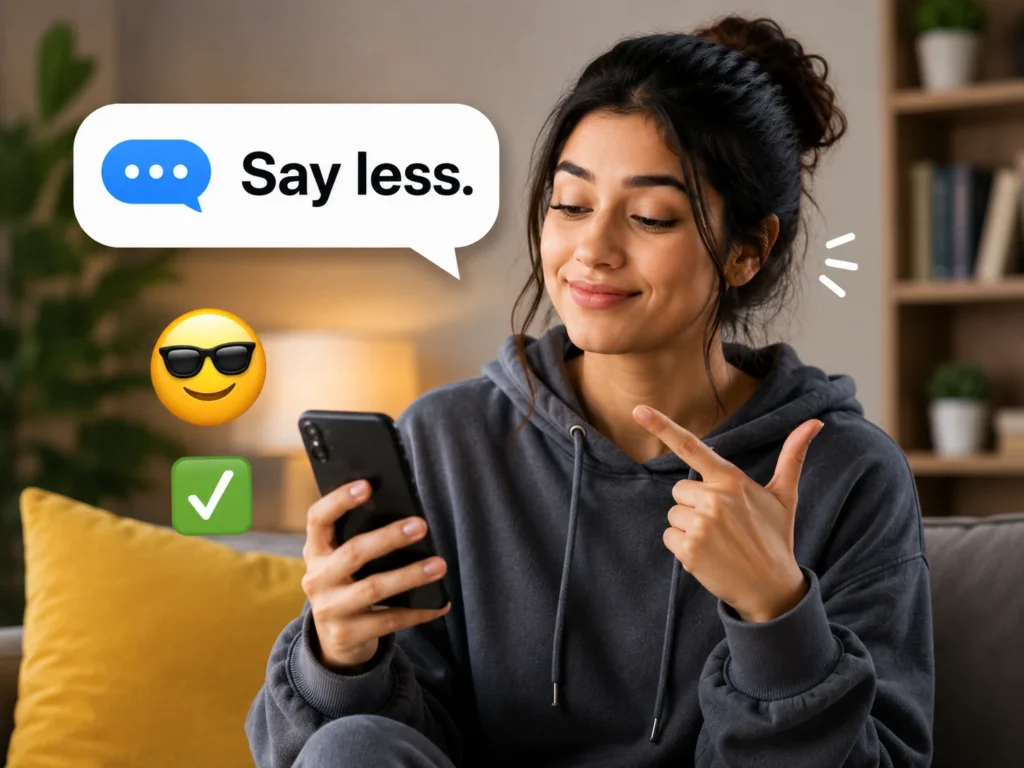
“Say less” in text usually means “I understand,” “you don’t need to explain,” or “I’m already interested and on board.” It can also mean “consider it done” when someone is agreeing to a request or plan.
What Does “Say Less” Mean When Someone Texts It to You?
When someone texts “say less,” they usually mean:
- “I get what you mean.”
- “You don’t have to explain any further.”
- “I’m in.”
- “Count me in.”
- “Consider it done.”
- “I already understand.”
It is an informal slang expression, not an acronym or abbreviation.
The phrase often signals quick agreement or enthusiasm. For example:
A: Pizza tonight?
B: Say less.
Here, B means “Absolutely. I’m in.”
The expression can also respond to information rather than an invitation:
A: The test got moved to Friday.
B: Say less.
In that context, it can mean “Got it” or “I understand.”
Is “Say Less” an Acronym or Slang?
“Say less” is a slang expression/idiom, not an acronym.
It does not stand for separate words, and there is no hidden full form.
The literal phrase means “speak less,” but its modern informal meaning is usually closer to “I understand; you can stop explaining.”
It can also communicate enthusiasm when someone makes an appealing suggestion.
Say Less Meaning in Texting
In texting, “say less” often works as a complete reply.
For example:
A: I found tickets for Saturday.
B: Say less.
The reply communicates agreement without requiring a longer explanation.
You can also place it after another phrase:
“Say less, I’m coming.”
or:
“Say less 😂 I’ll handle it.”
Lowercase and uppercase usually have the same basic meaning:
- say less — casual
- Say less — normal sentence capitalization
- SAY LESS — stronger emphasis
Say Less Meaning on Instagram, Snapchat, and WhatsApp
“Say less” can appear naturally in DMs and messaging apps, including Instagram, Snapchat, and WhatsApp.
Instagram DM
A: I found that jacket you’ve been looking for.
B: Say less 😭
This means the sender is immediately interested.
Snapchat
A: We’re getting food after school.
B: Say less.
This means:
“I’m coming.”
A: I’ll pick you up at 8.
B: Say less.
Here, the response means:
“Got it.”
The expression does not have a different fundamental meaning on each platform. The surrounding conversation determines the exact nuance.
The Two Main Meanings of “Say Less”
1. “I Understand”
Someone can use “say less” when they already understand the situation.
A: Bring your ID because they’ll check everyone at the door.
B: Say less.
B means:
“Understood.”
2. “I’m In”
Someone can also use it to show immediate enthusiasm.
A: We’re ordering burgers.
B: Say less.
B means:
“I’m definitely in.”
This second use is especially common when someone makes an appealing suggestion.
Tone and Context Variations
Funny
A: I’m ordering fries, a burger, and dessert.
B: Say less.
A: You weren’t even hungry five minutes ago.
B: I found my appetite.
Here, “say less” humorously shows enthusiasm for food.
Sarcastic
A: I have another three-hour lecture for you.
B: Say less 😭
A: You’re excited?
B: Absolutely not.
The phrase is sarcastic because the speaker clearly does not want the situation.
Playful
A: I know a place with amazing ice cream.
B: Say less 👀
A: Want to go tonight?
B: Obviously.
Here, it means “I’m interested” with a playful tone.
Serious
A: I’ll send you the documents tonight.
B: Say less.
A: You don’t need anything else?
B: No, I understand.
Here, the expression simply means “understood.”
Real Text Examples of “Say Less”
1. Friends
A: We’re going to the mall after lunch.
B: Say less.
A: You coming?
B: Obviously.
2. Food
A: There’s a new burger place downtown.
B: Say less 😭
A: Want to try it?
B: I’m already ready.
3. Party
A: The party starts at 9.
B: Say less.
A: I’ll send you the address.
B: Perfect.
4. Siblings
A: Mom said we can order pizza tonight.
B: Say less.
A: What toppings?
B: Everything.
5. Partner
A: I booked our favorite restaurant for Friday.
B: Say less ❤️
A: So you’re happy?
B: Very.
6. Coworkers
A: I’ll cover your shift tomorrow.
B: Say less.
A: Just return the favor next week.
B: Deal.
7. Instagram DM
A: You said you wanted those shoes, right?
B: Yeah.
A: They’re back in stock.
B: Say less 😭
8. Group Chat
A: Free coffee at my place tonight.
B: Say less.
C: I’m coming too.
D: Same.
9. Stranger or Acquaintance
A: I can send you the link if you want.
B: Say less.
A: I’ll send it now.
B: Thanks.
10. Friend Making Plans
A: Movie at 8?
B: Say less.
A: I’ll buy the tickets.
B: Perfect.
11. Study Partner
A: I made notes for tomorrow’s exam.
B: Say less.
A: Want me to send them?
B: Please 😂
12. Teasing
A: I know exactly how to embarrass you.
B: Say less.
A: That wasn’t an invitation.
B: Too late.
How “Say Less” Works Grammatically
“Say less” looks like a command because it literally tells someone to speak less. In modern slang, however, it often works as a fixed conversational expression.
As a Standalone Reply
“Say less.”
This is extremely common in texting.
Before Another Sentence
“Say less, I’ll be there.”
Here, it introduces agreement before the speaker gives additional information.
Can It Replace a Full Sentence?
Yes.
Instead of:
“I understand what you’re saying, and you don’t need to explain anything else.”
someone can simply write:
“Say less.”
That compression is one reason the expression works so well in casual texting.
Does “Say Less” Mean “Be Quiet”?
Not usually in modern slang.
The literal interpretation is:
“Talk less.”
But when someone says “say less” in casual conversation, they generally mean:
“I understand.”
or:
“I’m already interested.”
Context is important.
If someone is annoyed and says:
“Say less.”
they could genuinely be telling another person to stop talking.
But:
“You found tickets? Say less!”
clearly communicates excitement.
Is “Say Less” Rude?
Usually, no.
Among friends, “say less” can sound enthusiastic and natural.
However, the expression can sound dismissive if used in the wrong context. For example, if someone is explaining an important emotional issue and you respond only with “say less,” they might interpret it as impatience.
For serious conversations, a clearer response such as “I understand” may be better.
Say Less vs. “Got It”
These expressions overlap but have slightly different tones.
| Term | Meaning | Usage Context | Tone | Popularity | Confusion Risk |
|---|---|---|---|---|---|
| Say less | I understand / I’m in | Casual texting | Slang, confident | High | Low |
| Got it | I understand | General texting | Neutral | Very high | Very low |
| I’m in | I agree to participate | Plans/invitations | Direct | High | Low |
| Bet | Okay / agreed | Casual slang | Confident | High | Medium |
| For sure | Definitely | Agreement | Friendly | High | Low |
| Say no more | I understand; no further explanation needed | Casual conversation | Informal | Medium | Low |
“Say no more” is particularly close to “say less.” Both can communicate that additional explanation is unnecessary.
Say Less vs. “Say No More”
These expressions are often interchangeable.
“You want pizza? Say less.”
and:
“You want pizza? Say no more.”
both communicate enthusiasm or agreement.
“Say no more” can sometimes sound slightly more literal or dramatic, while “say less” has a distinctly modern casual-slang feel.
Say Less vs. “Bet”
Bet often means “okay,” “agreed,” or “deal.”
For example:
A: I’ll pick you up at 7.
B: Bet.
“Say less” can communicate the same agreement:
B: Say less.
But “say less” often emphasizes immediate enthusiasm or understanding, whereas “bet” can simply acknowledge a plan.
Who Uses “Say Less”?
“Say less” is common in informal English, particularly among younger speakers and online communities. It appears in texting, DMs, memes, music culture, and everyday casual conversation.
Gen Z vs. Millennials
Gen Z users may use “say less” frequently as a quick response to invitations, recommendations, or exciting information.
Millennials also use the expression, particularly in online and casual communication, although individual preferences vary.
Age alone cannot tell you whether someone uses the phrase. Personal texting habits and social circles matter more.
Regional Usage
The expression is strongly associated with contemporary American English and has spread through internet culture and popular media to other English-speaking communities.
Its use outside the United States varies, so it is better to interpret the specific conversation rather than assume everyone uses it identically.
Origin and Internet Culture
“Say less” is based on the ordinary English idea that someone does not need to say anything more because the listener already understands or agrees.
The modern slang use became especially visible through contemporary American internet, music, and social-media culture. It does not depend on TikTok alone, and there is no reliable basis for claiming that TikTok invented the phrase.
The expression also connects with a broader tradition of conversational shortcuts in English. Instead of responding with a complete sentence such as:
“I understand your proposal and I agree to participate.”
a speaker can simply say:
“Say less.”
The shorter response communicates the same idea more efficiently in a casual setting.
AAVE and Cultural Context
“Say less” appears in contemporary African American English and broader internet slang, but it has also spread well beyond any single community.
It is best to avoid claiming that every modern slang expression has one simple origin or belongs exclusively to one group. Expressions can move between speech communities through music, entertainment, social media, and everyday interaction.
Safety and Appropriateness
“Say less” does not contain profanity and is not inherently offensive.
It is generally safe for:
- Friends
- Family
- Casual DMs
- Group chats
- Informal conversations
It may be inappropriate or overly casual when communicating with:
- A boss
- A client
- A teacher
- A formal institution
Instead of:
“Say less.”
a professional reply would usually be:
“Understood.”
or:
“Absolutely, I can do that.”
Real-World Observation
What makes “say less” durable in texting is its efficiency. The phrase can communicate understanding, enthusiasm, and agreement without forcing the sender to spell out a longer response. A person who receives “say less” after making an invitation usually knows they have a yes before the conversation even continues. The surrounding context determines whether that “yes” sounds enthusiastic, playful, sarcastic, or simply practical.
How to Reply to “Say Less”
Funny Reply
“I knew you’d say yes 😂”
Serious Reply
“Perfect. I’ll send you the details.”
Flirty Reply
“I like how quickly you agreed 👀”
Neutral/Unbothered Reply
“Cool, sounds good.”
The best response depends on what the sender meant. If they used “say less” to accept an invitation, continue with the plan. If they used it to show understanding, there may be nothing else you need to explain.
FAQ: Say Less Meaning in Text
What does “say less” mean in texting?
“Say less” usually means “I understand,” “you don’t need to explain,” or “I’m interested.” It is an informal slang expression. The exact meaning depends on what came immediately before it.
Is “say less” a compliment?
Not by itself. It is usually a response showing agreement, understanding, or enthusiasm. Whether it feels positive depends on the situation and tone.
Is “say less” rude?
Usually not among friends or in casual conversations. However, it can sound dismissive if someone is sharing something serious and you respond without acknowledging their feelings.
What does “say less” mean from a guy?
It generally means he understands, agrees, or is interested in what you suggested. It does not have a special romantic meaning simply because a guy sent it.
What does “say less” mean from a girl?
The meaning is generally the same: agreement, understanding, or enthusiasm. If the surrounding conversation is flirtatious, it can carry a playful or romantic tone, but the phrase itself is not inherently flirty.
What’s the difference between “say less” and “say no more”?
Both can mean that additional explanation is unnecessary. Both can also express enthusiasm or agreement. “Say less” tends to feel especially concise and modern in casual texting.
Can I use “say less” at work?
You can, but it is better reserved for very informal workplace relationships. In professional emails or messages to clients and managers, “Understood,” “Absolutely,” or “Sounds good” is safer.
Does “say less” mean “be quiet”?
Sometimes literally, but usually not in slang. In casual texting, it more often means “I already understand” or “I’m in.” The context tells you which interpretation makes sense.
PAA Questions About “Say Less”
What does “say less” mean in slang?
It means “I understand,” “don’t explain further,” or “I’m already interested.” It is commonly used as a quick expression of agreement.
What does “say less” mean from a girl in text?
It usually means she understands or agrees with what you said. If you were making an invitation or suggestion, it can mean she is interested in joining.
What does “say less” mean from a guy in text?
It usually communicates agreement, understanding, or enthusiasm. The phrase itself does not automatically indicate flirting.
What does “say less” mean on Instagram?
On Instagram, especially in DMs, “say less” usually means “I’m in,” “I understand,” or “you don’t need to say anything else.”
What does “say less” mean after an invitation?
It usually means “Yes, I’m interested” or “Count me in.” For example, if you invite someone to dinner and they reply “say less,” they are generally accepting enthusiastically.
Conclusion
“Say less” in text means “I understand,” “you don’t need to explain further,” or “I’m in.” It is informal slang that often communicates quick agreement or enthusiasm.
Usage Tips
- Use “say less” with friends and in casual DMs.
- Use it when you already understand or enthusiastically agree.
- Add context if the conversation could be misunderstood.
- Use “Understood” or “Absolutely” in formal communication.
Common Mistakes
- Don’t assume it literally means “stop talking.”
- Don’t automatically interpret it as flirting.
- Don’t use it as a response to a serious issue without acknowledging the person’s feelings.
- Don’t assume everyone uses the phrase in exactly the same way.
When to use: Casual texts, group chats, DMs, invitations, plans, and enthusiastic agreement.
When to avoid: Formal emails, professional conversations, academic communication, or serious situations where clarity matters more than slang.