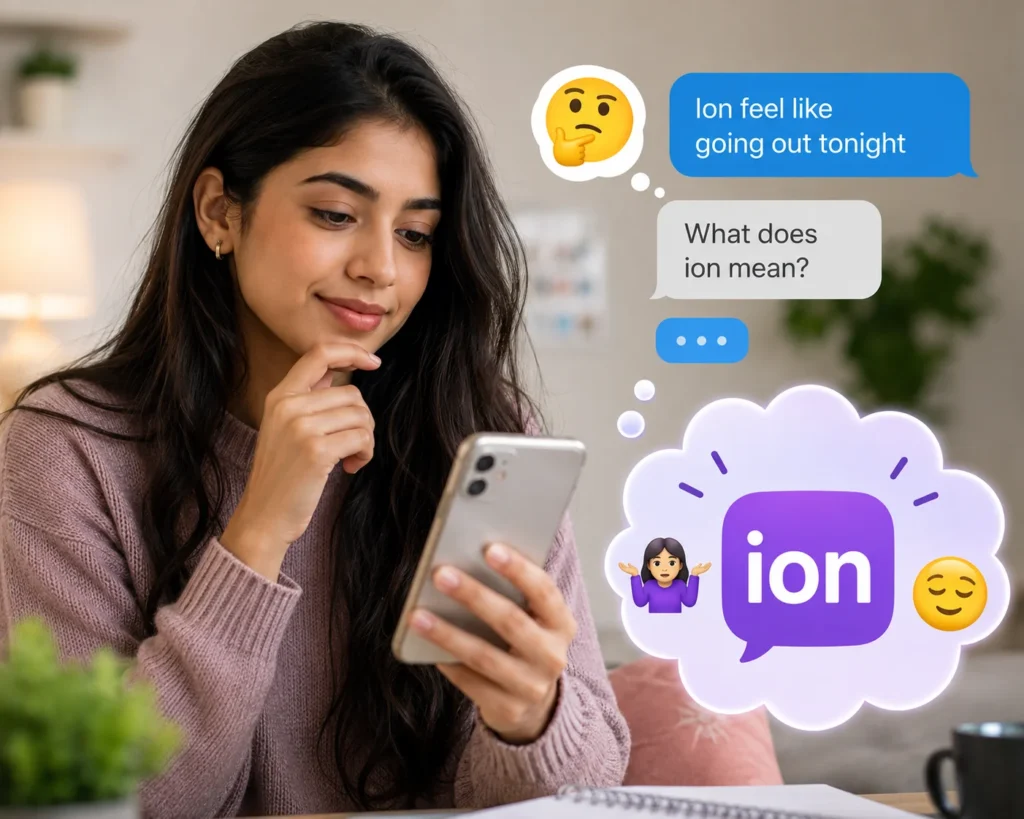
“ION” in an iPhone text message usually means “I don’t,” especially in casual texting. It is a shortened slang form of “I don’t,” often used in phrases like “ion know” (“I don’t know”) or “ion wanna go” (“I don’t want to go”). The exact tone depends on the sentence and the relationship between the people texting.
What Does ION Mean in a Text Message on iPhone?
The most common ION meaning in text message on iPhone is “I don’t.”
People use ion as a casual phonetic spelling of “I don’t.” The pronunciation can sound compressed in fast speech, and texting turns that sound into a short written form.
For example:
- “ion know” = “I don’t know”
- “ion want it” = “I don’t want it”
- “ion like that” = “I don’t like that”
- “ion care” = “I don’t care”
- “ion wanna go” = “I don’t want to go”
So if someone sends you:
“ion know tbh”
they most likely mean:
“I don’t know, to be honest.”
ION isn’t an iPhone-specific abbreviation. You can encounter it in SMS, iMessage, WhatsApp, Instagram DMs, Snapchat, Discord, and other informal online conversations.
Is ION an Acronym, Abbreviation, or Slang Word?
In texting, ION is best understood as a slang spelling or phonetic abbreviation of “I don’t.”
It isn’t normally an acronym in which each letter represents a separate word.
The transformation is essentially:
I don’t → ion
The apostrophe disappears, and the words are compressed into a short form.
This makes ION different from abbreviations such as IDK, where each letter represents a word:
IDK = I Don’t Know
With ION:
ION = I don’t
The following word usually completes the thought.
Why Does ION Look Like a Technical Term?
The spelling can be confusing because ion is also a real scientific word. In chemistry and physics, an ion is an electrically charged atom or molecule.
But if someone texts:
“ion know what happened”
they aren’t talking about chemistry.
They’re saying:
“I don’t know what happened.”
Context tells you which meaning applies.
The Most Common Ways People Use ION
ION Know
One of the most recognizable uses is:
“ion know”
This means:
“I don’t know.”
You might see:
“ion know what you want me to say 😭”
The sender is simply saying:
“I don’t know what you want me to say.”
ION Wanna
Another common construction is:
“ion wanna”
This means:
“I don’t want to.”
For example:
“ion wanna argue rn”
means:
“I don’t want to argue right now.”
ION Care
“ion care”
usually means:
“I don’t care.”
Depending on context, this can sound casual, dismissive, annoyed, or defensive.
ION Think
“ion think so”
means:
“I don’t think so.”
The slang doesn’t fundamentally change the meaning. It mainly makes the message sound more casual.
ION Want
“ion want that”
means:
“I don’t want that.”
Again, the word following ION provides the rest of the sentence.
ION on iMessage and SMS
If you receive ION through iMessage or regular SMS, the meaning is usually the same.
For example:
“ion feel like going out”
means:
“I don’t feel like going out.”
iPhone itself doesn’t assign ION a special meaning. It’s simply something the sender typed.
Does iPhone Auto-Correct ION?
Depending on the keyboard, language settings, and personal dictionary, your iPhone may try to correct unfamiliar slang. Some users deliberately keep slang such as ion because they use it frequently.
If someone types ION consistently, that can simply reflect their personal texting style.
ION on Instagram, Snapchat, and Discord
ION also appears in informal DMs and chats.
“ion even remember 😂”
= “I don’t even remember.”
Snapchat
“ion wanna snap rn”
= “I don’t want to Snapchat right now.”
Discord
“ion think that’s gonna work”
= “I don’t think that’s going to work.”
The platform doesn’t fundamentally change the meaning.
Does Capitalization Matter?
Usually, no.
These forms generally communicate the same thing:
- ion
- ION
- Ion
However, lowercase ion tends to look more natural in casual texting.
For example:
“ion know”
feels like ordinary informal slang.
Whereas:
“ION KNOW”
may look more emphatic, frustrated, or dramatic.
The capitalization changes the presentation, not the underlying meaning.
Tone and Context Variations
ION doesn’t have one fixed emotional tone. The rest of the message determines how it comes across.
Funny Tone
A: Are you really going to eat the whole cake?
B: ion know 😂
A: That’s not an answer.
B: It might be.
Here, ION helps keep the conversation playful.
Sarcastic Tone
A: You definitely didn’t take my charger?
B: ion know maybe it walked away.
A: Seriously?
B: 😂
Here, the message is sarcastic because the sender is joking about the situation.
Playful Tone
A: You coming with us tonight?
B: ion wanna gooo 😭
A: Come onnn.
B: Fine, I’ll come.
The slang makes the refusal sound casual and playful.
Serious Tone
A: Do you still trust him?
B: ion know anymore.
A: What happened?
B: Too much stuff has happened lately.
Here, ION expresses genuine uncertainty.
Real iPhone Text Examples
1. Friends
A: You coming to the party?
B: ion know yet.
A: Let me know by 8.
B: Bet.
ION means “I don’t.”
2. Romantic Partner
A: Are you mad at me?
B: ion know how I feel rn.
A: Do you want some space?
B: Yeah, for a little while.
Here, the slang appears in a serious conversation.
3. Siblings
A: Did you take my hoodie?
B: ion have it.
A: Then why is it on your chair?
B: Oh 😂 I forgot.
Here, ION means “I don’t.”
4. Coworker
A: Do you know when the meeting starts?
B: ion think anyone told me.
A: It’s at 3.
B: Thanks.
This is informal coworker texting.
5. Parent and Child
A: Did you finish your homework?
B: ion wanna do it tonight.
A: You still need to finish it.
B: I know 😭
Here, ION means “I don’t.”
6. Instagram DM
A: You still like that restaurant?
B: ion even remember it 😂
A: We went last month!
B: Ohhh right.
7. Snapchat
A: Wanna go out?
B: ion feel like leaving the house.
A: Fair enough.
B: Maybe tomorrow.
8. Group Chat
A: Who knows what we’re supposed to bring?
B: ion know 😭
C: Same.
A: I’ll check the message.
Here, ION is short for “I don’t.”
9. Argument
A: Why didn’t you tell me?
B: ion know what you wanted me to do.
A: You could’ve asked.
B: You’re right.
10. Flirty Conversation
A: You miss me?
B: ion wanna admit it 😂
A: So that’s a yes?
B: Maybe.
Here, ION contributes to a playful, teasing tone.
11. Making Plans
A: Pizza or burgers?
B: ion care, you choose.
A: Pizza it is.
B: Works for me.
12. Casual Conversation
A: Did you watch the new episode?
B: ion have time yet.
A: Don’t let anyone spoil it.
B: Too late 😭
How ION Works Grammatically
ION normally appears at the beginning of a clause where “I don’t” would naturally appear.
For example:
I don’t know.
becomes:
ion know.
Or:
I don’t want that.
becomes:
ion want that.
The structure usually remains recognizable.
Common Sentence Patterns
ION + verb
- ion know
- ion care
- ion want
- ion think
- ion remember
And, ION + adverb + verb
- ion even know
- ion really care
- ion actually remember
ION + wanna + verb
- ion wanna go
- ion wanna talk
- ion wanna argue
Can ION Stand Alone?
It usually doesn’t.
A message such as:
“ion”
by itself is incomplete and may confuse the recipient.
The sender normally follows it with a verb or another part of the sentence:
“ion know”
“ion want to”
“ion think so”
“ion care”
This is one reason you should read the entire message rather than trying to interpret ION independently.
How to Reply to ION
Your response depends on what the person is saying.
Funny Reply
If they text:
“ion know 😂”
you could reply:
“How do you NOT know? 😭”
Serious Reply
If they say:
“ion know what to do anymore.”
you could respond:
“Take your time. We can figure it out together.”
Flirty Reply
If someone says:
“ion wanna admit I miss you.”
you might say:
“You don’t have to admit it. I already know 😉”
Neutral Reply
If someone says:
“ion know yet.”
you can simply answer:
“Okay, let me know when you decide.”
ION vs Similar Texting Terms
| Term | Meaning | Usage Context | Tone | Popularity | Confusion Risk |
|---|---|---|---|---|---|
| ION | I don’t | Casual texts and DMs | Very informal | High | Medium |
| IDK | I don’t know | Texting and online chat | Informal | Very high | Low |
| IDC | I don’t care | Casual texting | Informal | High | Low |
| IDRC | I don’t really care | Casual texting | Informal | Medium | Medium |
| IONK | I don’t know | Very informal slang | Casual | Lower | High |
| I do | Opposite of “I don’t” | Standard English | Neutral | Very high | Low |
The most important comparison is ION vs IDK.
ION vs IDK
Both can appear when someone doesn’t know something, but they aren’t technically identical.
ION means:
I don’t
IDK means:
I don’t know
For example:
“ion know”
and:
“idk”
both communicate uncertainty.
But ION normally needs something after it, while IDK can stand alone.
For example:
A: Are you coming?
B: IDK.
This is complete.
But:
A: Are you coming?
B: ion…
sounds unfinished.
Who Uses ION?
ION appears mainly in informal digital communication. Its use varies by individual, age, community, and online environment.
Gen Z
Younger internet users may encounter ION frequently in casual conversations, especially alongside other informal spellings such as:
- ion
- finna
- tryna
- wanna
- gon
- y’all
However, not every Gen Z texter uses these forms.
Millennials
Some Millennials also recognize and use ION, particularly in informal online communities and conversations. Others may prefer more established abbreviations such as IDK.
The difference isn’t absolute. Personal texting style matters more than age alone.
Regional and Cultural Usage
ION is associated with informal English-language internet and texting culture and is particularly visible in forms of online communication influenced by African American English (AAVE).
It’s important not to treat this as simply a random spelling mistake. In many contexts, forms such as ion reflect pronunciation and language patterns that exist in spoken varieties of English, including AAVE.
At the same time, internet users outside those communities may adopt the spelling through social media and online communication.
Using a slang form doesn’t automatically mean the writer belongs to the culture from which a form has spread. Context and cultural awareness matter.
Where Did ION Come From?
ION is not a newly invented iPhone abbreviation.
The form is connected to the way “I don’t” can sound in rapid, casual speech, particularly in varieties of English where the phrase becomes compressed.
Internet and texting culture then made it easy to represent that pronunciation in writing.
This is different from claiming that ION originated on TikTok. The form predates today’s short-video culture and should be understood in the broader history of informal digital communication and spoken-language representation.
Social media helped spread and normalize many informal spellings, but that doesn’t make modern platforms the original source.
Is ION Rude or Offensive?
ION itself is not profanity.
However, some sentences containing it can sound dismissive.
For example:
“ion care.”
can sound blunt or rude depending on the situation.
Compare:
“I don’t really care about that.”
with:
“ion care.”
The second sounds more casual and potentially more dismissive.
Is ION Appropriate at Work?
It depends on the relationship, but it is generally best to avoid ION in formal workplace communication.
Don’t use it in:
- Formal emails
- Job applications
- Reports
- Academic assignments
- Messages to a professor
- Formal customer communication
- Professional documents
A casual coworker group chat may have different standards, but standard English is safer in professional situations.
Instead of:
“ion know when the meeting starts”
write:
“I don’t know when the meeting starts.”
Real-World Observation
ION is a good example of how texting often captures the way people actually speak rather than the way formal English is written. A phrase such as “I don’t know” can become “ion know” because the speaker’s pronunciation compresses the words in casual speech. Once that spelling becomes familiar within an online community, readers can understand it instantly without seeing the original phrase. That’s what makes ION more than a random typo: in the right context, it functions as a recognizable marker of informal speech and texting style.
Frequently Asked Questions
What does ION mean in a text message on iPhone?
ION usually means “I don’t.” It is an informal slang spelling commonly used in phrases such as “ion know” or “ion wanna go.” Your iPhone doesn’t give it a special definition; it is simply a form the sender typed.
Does ION mean “I don’t know”?
Sometimes people interpret ION as “I don’t know,” but technically ION means “I don’t.” The next word completes the phrase. Therefore, “ion know” means “I don’t know.”
Is ION the same as IDK?
No, although they can communicate similar ideas. IDK directly means “I don’t know,” while ION means “I don’t” and normally requires another word. “IDK” can stand alone much more naturally.
Is ION an iPhone abbreviation?
No. ION isn’t an abbreviation created by Apple or an iPhone feature. It is informal internet and texting slang that can appear on iPhone, Android, and other devices.
What does ION mean from a girl?
ION doesn’t have a special meaning when a girl uses it. It generally means “I don’t.” The tone depends on the rest of her message—for example, “ion know” expresses uncertainty, while “ion care” can sound dismissive.
What does ION mean from a guy?
The meaning is generally the same when a guy uses ION. It usually represents “I don’t.” Don’t assign a romantic or gender-specific meaning to it without considering the complete conversation.
Is it rude to text ION?
ION itself isn’t rude, but it can make a message sound very casual or blunt. For example, “ion care” may sound dismissive depending on the context. With close friends, it may be completely normal.
What’s the difference between texting ION and saying “I don’t” out loud?
ION is a written representation of a shortened or compressed pronunciation of “I don’t.” When speaking formally, most people would use the standard phrase “I don’t.” In casual speech, pronunciation can become compressed, which helps explain why ION works naturally in informal texting.
PAA Questions About ION
What does ION mean on Snapchat?
ION usually means “I don’t” on Snapchat. For example, “ion know” means “I don’t know.” It is informal slang rather than a Snapchat-specific abbreviation.
What does ION mean on Instagram?
ION normally means “I don’t” in an Instagram DM. A message such as “ion wanna go” means “I don’t want to go.” The platform doesn’t change the basic meaning.
What does ION mean in texting from a girl?
It usually means “I don’t.” The meaning comes from the complete sentence, not the sender’s gender. For example, “ion think so” means “I don’t think so.”
What does ION mean in texting from a guy?
It generally means “I don’t.” A guy might write “ion know,” “ion care,” or “ion want that.” The surrounding words determine the exact message.
Why do people type ION instead of I don’t?
People use ION because it’s short, casual, and can reflect the way the phrase sounds in fast speech. It also fits the informal style of online conversations. It isn’t meant to follow formal spelling rules.
Conclusion
The ION meaning in text message on iPhone is usually “I don’t.” It is an informal slang spelling, not an Apple-specific abbreviation.
The easiest way to understand it is to look at the word after ION:
- ion know = I don’t know
- ion want = I don’t want
- ion care = I don’t care
- ion think = I don’t think
- ion remember = I don’t remember
- ion wanna go = I don’t want to go
Usage Tips
- Read ION together with the next word.
- Remember that it usually means “I don’t,” not automatically “I don’t know.”
- Expect it mainly in informal texts and DMs.
- Consider the sender’s language style and cultural context.
Common Mistakes
- Assuming ION is an iPhone-specific abbreviation.
- Treating ION as exactly the same as IDK.
- Assuming it always means “I don’t know.”
- Interpreting it without reading the rest of the sentence.
When to Use ION
ION fits casual conversations with friends, family, partners, and online contacts who already use informal slang.
When to Avoid ION
Avoid it in academic writing, formal emails, professional documents, and other situations where standard English is expected.
In short: ION = “I don’t.” When you see it in an iPhone text, read the words that follow it to understand the complete meaning.