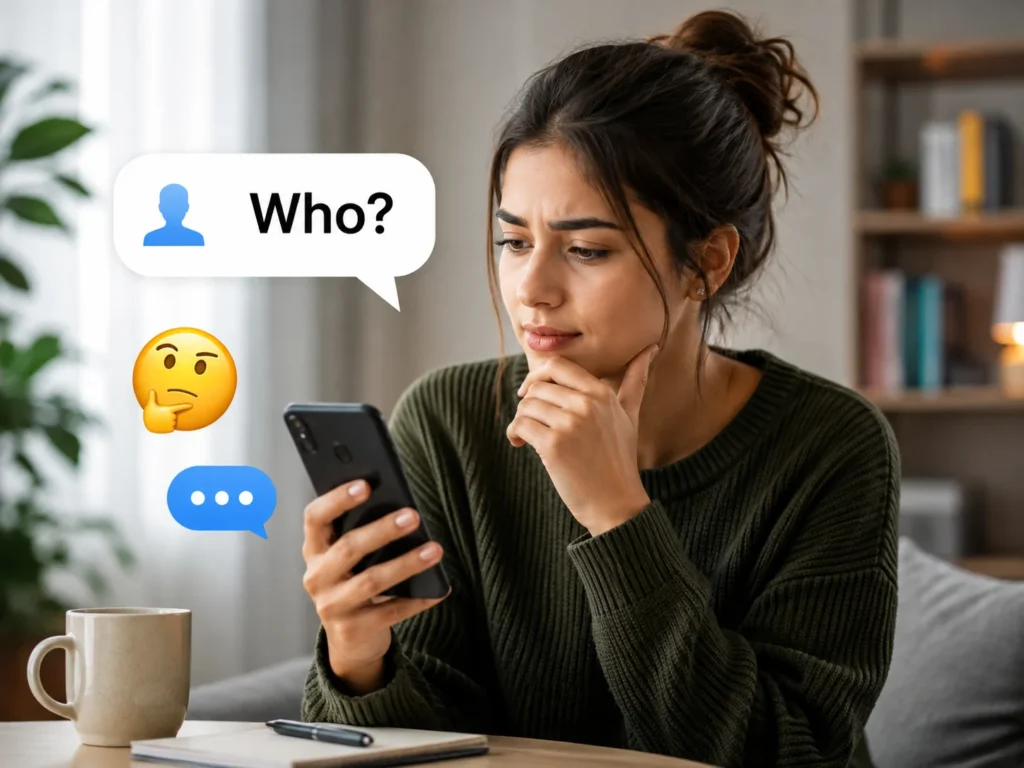
If someone texts “who?”, they usually mean “which person?” or “who are you talking about?” It can also show confusion, curiosity, surprise, or suspicion depending on the conversation. In health-related contexts, WHO can mean the World Health Organization.
What Does “Who” Mean in Text?
The most common meaning of “who” in text is exactly the same as its normal English meaning: the sender wants to know the identity of a person or people. Cambridge defines who as a question word used to ask which person or what someone’s name is.
For example:
A: Someone called you earlier.
B: Who?
Here, “who?” means “Who called me?”
Likewise:
A: I’m meeting someone tonight.
B: Who?
The second person wants to know which person the first person means.
Unlike common texting abbreviations such as wyd, brb, or idk, who is not normally a texting abbreviation. It is an ordinary English pronoun/question word that people naturally use in messages.
However, the exact tone can change dramatically depending on punctuation, capitalization, and context.
Is “Who” an Acronym, Abbreviation, or Slang Word?
In ordinary texting, who is a pronoun, not an acronym or abbreviation. It asks about a person or group of people.
WHO, written in capital letters, can also be an abbreviation for the World Health Organization. Merriam-Webster lists this as a separate meaning of the capitalized abbreviation.
For example:
“WHO released new health guidance.”
Here, WHO means the World Health Organization.
But:
“You told WHO?”
does not automatically mean the World Health Organization. The capital letters may simply emphasize the question.
What Does “Who?” Mean When Someone Texts It to You?
A standalone “Who?” usually means the sender wants you to identify someone you just mentioned.
It can represent several practical questions:
- Who is that?
- Who are you talking about?
- Who sent it?
- Who called?
- Who are you with?
- Who did that?
For example:
A: I was talking to Sarah yesterday.
B: Who?
A: Sarah from our old class.
The short reply saves the sender from typing a complete question.
“Who?” Can Also Show Surprise
Sometimes the sender already understands that you’re referring to a person but wants clarification because the person is unexpected.
A: Jake is getting married.
B: Wait, who?!
Here, “who?!” can communicate surprise as well as a request for information.
“Who?” Can Sound Suspicious
Context can make a simple question sound more serious.
A: Someone was asking about you.
B: Who?
The sender may simply be curious, but they could also be concerned about who has been asking about them.
The word itself doesn’t automatically mean jealousy, anger, or suspicion. You need to consider the conversation around it.
“Who,” “WHO,” and “who?” — Does Capitalization Change the Meaning?
Texting gives people several ways to write the same word, and these versions can create different impressions.
| Version | Common impression |
|---|---|
| who | Casual, relaxed |
| Who? | Neutral question |
| WHO? | Emphasis, surprise, disbelief |
| Who?! | Strong surprise or confusion |
| WHO?! | Very strong emphasis or shock |
| who?? | Confusion or urgency |
However, capitalization isn’t a universal code. Some people type everything in lowercase, while others capitalize normally.
For example, someone who always texts “who” in lowercase may not be expressing a special tone at all.
Compare:
“who told you?”
with:
“WHO TOLD YOU?!”
The second version clearly places much more emphasis on the question.
How “Who” Is Used on Different Messaging Platforms
SMS, iMessage, and WhatsApp
In actual texting, who is extremely straightforward. People use it to ask about someone’s identity, especially when another person has just been mentioned.
Examples include:
- “Who called?”
- “Who are you with?”
- “Who told you?”
- “Who is coming?”
- “Who?”
It doesn’t need special slang formatting to work.
Instagram, Snapchat, and Discord DMs
The same basic meaning appears in private messages and DMs.
A person might send:
“who?”
after you mention someone they don’t recognize.
In Discord or gaming chats, “who?” may refer to a player, teammate, username, or person involved in an event.
TikTok and X
The word who also appears in comments and other public online communication, but those uses aren’t necessarily texting-specific. Expressions such as “who asked?” have a distinct sarcastic online use and should not be confused with a simple private “who?”.
Tone and Context Variations
Funny
A friend may use “who?” jokingly when pretending not to recognize someone.
A: You know I’m basically famous now.
B: Famous?
A: Yeah, three people liked my post.
B: Who?
Here, “who?” is playful rather than a genuine request for someone’s identity.
Sarcastic
“Who?” can sometimes be used sarcastically to act as though the person mentioned isn’t important.
A: Did you hear that Mark got promoted?
B: Who?
A: Mark. You literally work with him.
B: Ohhh, that Mark.
The joke comes from pretending not to know someone.
Playful
A partner or close friend might use “who?” to tease someone.
A: I met a really cute person today.
B: Oh really? Who?
A: Why, are you jealous?
B: Maybe. Just answer.
The surrounding conversation creates the playful tone.
Serious
In a serious situation, “who?” may ask for important information.
A: Someone gave your number to a stranger.
B: Who?
A: I don’t know yet. I’m trying to find out.
B: Please tell me when you know.
Here, the question is direct and concerned rather than casual.
Real Chat Examples
Example 1: Friends
A: I saw your brother at the mall.
B: Which brother?
A: Ali.
B: Ohh, you should’ve said Ali 😂
Example 2: Partner
A: I’m going out with someone tonight.
B: Who?
A: My cousin, relax 😂
B: You could’ve started with that.
More, Example 3: Coworkers
A: Who’s covering the afternoon meeting?
B: I think James.
A: Okay, thanks.
Example 4: Siblings
A: Mom said someone left the door open.
B: Who?
A: She doesn’t know.
B: Definitely wasn’t me.
Moreover, Example 5: Parent
A: Your teacher called earlier.
B: Who?
A: Ms. Khan.
B: Oh, okay. I’ll call her back.
Example 6: Unknown number
A: Hey, are you free tomorrow?
B: Hi, who is this?
A: It’s Hamza from college.
B: Oh hey! Sorry, I didn’t have your number saved.
So, Example 7: Friend gossip
A: Someone told me what happened.
B: Who told you?
A: I promised I wouldn’t say.
B: Seriously? 😭
Example 8: Group chat
A: Who’s coming tonight?
B: I’m in.
A: Same.
B: Anyone else?
And, Example 9: Surprise
A: You invited Taylor too?
B: Yeah.
A: Wait, WHO invited Taylor?
B: I did. Why?
Example 10: Casual DM
A: Hey, do you know this person?
B: Who?
A: The account I just sent you.
B: Nope, never seen them.
More, Example 11: Teasing
A: Guess who I bumped into today.
B: Who?
A: Your favorite person.
B: Don’t tell me it’s David 😂
Example 12: Serious situation
A: Someone has been asking where you live.
B: Who?
A: I don’t know. That’s why I’m telling you.
B: Okay, thanks for letting me know.
Grammar and Language Role
Who is primarily an interrogative pronoun. It normally refers to a person or people. Dictionaries also recognize its use as a relative pronoun when introducing information about someone.
Where Does “Who” Appear in a Text?
It can appear:
- At the beginning of a question: “Who called?”
- In the middle of a sentence: “Do you know who she is?”
- Alone: “Who?”
- As part of a phrase: “Who is this?”
- In an informal shortened question: “Who you with?”
A standalone “Who?” can function as a complete reply because the missing information is understood from the previous message.
Formal vs. Informal Use
Who works in both formal and informal English.
However, a one-word “Who?” may sound abrupt in professional communication. With a boss, teacher, customer, or unfamiliar person, a fuller question is often better:
- “Who are you referring to?”
- “Could you tell me who contacted you?”
- “May I ask who this is?”
- “Sorry, who do you mean?”
How to Reply to “Who?”
Your best response depends on why the person asked.
Funny Reply
“The one and only 😂”
Use this when you already know the person is joking.
Serious Reply
“It was Sarah from the office. She wanted to speak with you.”
This gives clear information without creating confusion.
Flirty Reply
If the conversation is already romantic:
“The person who’s been waiting for your reply 😉”
Only use a flirty answer when the relationship makes that tone appropriate.
Neutral or Unbothered Reply
“James from college.”
This is probably the safest everyday response.
Related Terms People Often Confuse With “Who”
| Term | Meaning | Usage Context | Tone | Popularity | Confusion Risk |
|---|---|---|---|---|---|
| who | Which person? | Everyday texting | Neutral | Very high | Low |
| who’s | Who is / who has | Questions and statements | Neutral | Very high | Medium |
| whose | Belonging to whom | Ownership | Neutral | High | High |
| whom | Formal object form of who | Formal English | Formal | Low in texting | Medium |
| who dis | Who is this? | Informal texts/DMs | Casual/playful | Moderate | Medium |
| what | Which thing/information? | General questions | Neutral | Very high | Low |
| nobody | No person | Opposite-type response | Neutral/dismissive | High | Low |
The most important distinction is between who’s and whose. Who’s is normally short for who is or who has, while whose asks about possession.
For example:
“Who’s coming?”
means “Who is coming?”
But:
“Whose phone is this?”
asks who owns the phone.
Who Uses “Who” in Texting?
Because who is a standard English word rather than specialized slang, it isn’t restricted to one age group or internet community. Teenagers, Gen Z, Millennials, older adults, and English speakers worldwide all use it.
Gen Z vs. Millennials
The basic meaning doesn’t change between generations. Differences are more likely to appear in formatting and tone.
A younger texter might write:
“who 😭”
or:
“WHO??”
A Millennial might simply write:
“Who?”
These are tendencies rather than strict rules. Individual texting habits vary much more than a simple age-based rule suggests.
Regional Usage
Who is standard English in the United States, United Kingdom, and other English-speaking regions. Its core meaning doesn’t change by region.
Some informal expressions, such as “who dis?”, may vary in frequency and style, but the ordinary question word who remains widely understood.
Origin and Internet Culture
Unlike modern internet slang, who did not originate with social media, TikTok, or texting culture. It is a very old English question word. Merriam-Webster traces the word to Old English and records its first known use before the 12th century.
Texting simply gave people another place to use it.
The digital environment also created shorter conversational forms such as “who?”, “who u?”, and playful expressions such as “who dis?”. These forms reduce typing while relying heavily on context.
The separate capitalized abbreviation WHO has a modern institutional meaning: the World Health Organization.
Is “Who” Rude or Offensive in a Text?
No, “who” is not inherently rude or offensive. It is a normal English question word.
However, sending only “Who?” can sometimes feel blunt because text messages don’t include vocal tone or facial expression.
Compare:
“Who?”
with:
“Oh, who do you mean?”
The second sounds softer.
If someone sends “WHO?!”, the capitalization and punctuation can make the message seem shocked, angry, or suspicious. Still, you should consider the person’s normal texting style before assuming they are upset.
There is also nothing inherently profane or sexually explicit about who.
Real-World Observation
What makes “who?” interesting in texting is how much meaning can fit into one ordinary word. The literal meaning stays simple—asking about a person—but the surrounding conversation determines whether the message feels curious, surprised, suspicious, playful, or annoyed. A single punctuation mark can make the difference between a calm question and an emphatic reaction. That’s why people often search “who meaning in text” even though they already know the dictionary definition: they’re usually trying to understand the tone of a particular message.
FAQ: Who Meaning in Text
What does “who” mean in texting?
In most texts, “who” means “which person?” or asks for someone’s identity. If someone sends only “who?” after you mention a person, they probably want you to identify that person. The exact tone depends on the conversation.
Is “who” a texting abbreviation?
No. Ordinary who is a standard English question word, not a texting abbreviation. However, WHO in capital letters can be an abbreviation for the World Health Organization when the context involves health or international health matters.
Is it rude to reply with just “who?” in a text?
Not necessarily. A standalone “who?” is grammatically normal and often just means the sender wants clarification. However, it can sound abrupt in a sensitive or professional conversation, so “Who do you mean?” may sound friendlier.
What’s the difference between texting “who?” and saying it out loud?
The literal meaning is usually the same, but spoken language includes your voice and facial expression. In text, punctuation and capitalization have to carry more of the tone. As a result, “WHO?!” can look much more intense than a calm spoken “Who?”
Does “who” mean the same thing in a group chat vs. a 1-on-1 text?
The basic meaning stays the same, but the context can change. In a group chat, “who?” may ask which member someone is talking about or who is joining an event. In a private text, it more often asks for the identity of a person mentioned or someone who contacted the sender.
What does “WHO” mean in a health-related text?
In a health, disease, vaccination, or public-health discussion, WHO can mean the World Health Organization. It is an abbreviation rather than the ordinary question word who.
What does “who dis?” mean in texting?
“Who dis?” is an intentionally informal version of “Who is this?” It can be a genuine question when someone doesn’t recognize a number, or a playful response between friends. The tone depends on the relationship.
What does “who asked?” mean in texting?
“Who asked?” is different from a simple “who?” It commonly works as a dismissive or sarcastic response suggesting that nobody requested the person’s opinion. Because of that, it can sound rude when used seriously.
PAA Questions
What does “who” mean in text from a girl?
Usually, “who?” from a girl simply means she wants to know which person you’re talking about. Her tone depends on the context. If you’re discussing another girl, for example, it could be simple curiosity, concern, or playful jealousy, but the word alone doesn’t prove any particular emotion.
What does “who” mean in text from a guy?
Usually, it means the same thing: “which person?” or “who are you referring to?” A guy might also use “who?” to show surprise or ask about someone’s identity. Context matters more than gender.
What does “WHO?” mean in a text?
Capitalized “WHO?” commonly adds emphasis. It may communicate surprise, disbelief, urgency, or suspicion. In a health-related context, however, WHO can refer to the World Health Organization.
What does “who?” mean from an unknown number?
It usually means the person doesn’t recognize the sender or wants to know your identity. A polite version is “Hi, may I ask who this is?” In casual texting, “Who’s this?” is also common.
Conclusion
The who meaning in text is usually simple: which person, what person, or who are you referring to? Unlike many texting abbreviations, who is an ordinary English question word. Its tone can shift with context, punctuation, and capitalization.
Remember these tips:
- “Who?” usually asks you to identify a person.
- “WHO?!” can show surprise, disbelief, or strong emphasis.
- “who” in lowercase is often simply casual texting.
- WHO in a health-related context may mean the World Health Organization.
Common mistakes include:
- Assuming every WHO means the World Health Organization.
- Assuming “who?” is automatically rude or jealous.
- Confusing who, who’s, and whose.
- Judging someone’s emotion from capitalization alone.
Use “who?” freely in casual conversations when you need clarification. In professional or sensitive texts, a fuller question such as “Who do you mean?” or “May I ask who this is?” usually sounds more considerate.