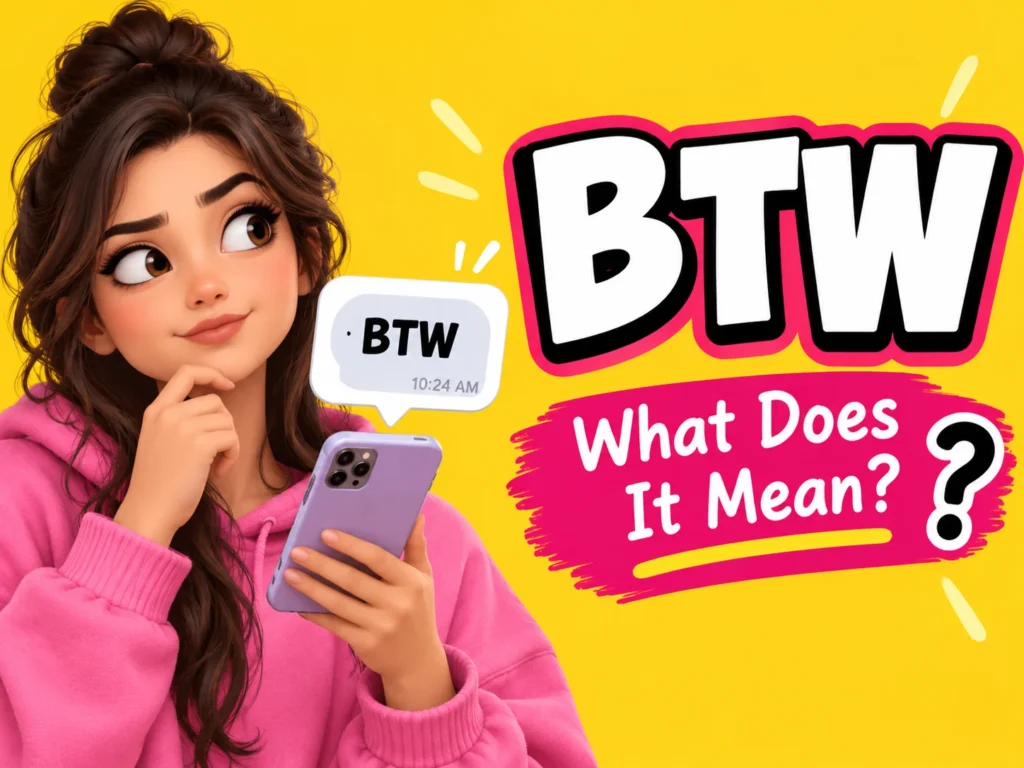
“BTW” stands for “by the way.” It’s used to add a side note, extra piece of information, or a slight change of topic without formally interrupting the flow of a conversation — the same way you’d casually toss in “oh, by the way” while talking out loud. It’s one of the most stable and universally understood texting abbreviations, used the same way across WhatsApp, iMessage, Instagram, Snapchat, and pretty much every messaging platform.
“I finished the report. BTW, did you see the email from Sarah?”
Where “BTW” Comes From
“By the way” has been used in spoken English for centuries as a way to introduce something related but slightly off the main topic — essentially “incidentally” or “in passing.” When early internet chat rooms, forums, and SMS messaging took off in the 1990s, character limits and slow typing made abbreviating common phrases a habit. “BTW” joined early staples like “LOL” and “BRB” as one of the first widely adopted pieces of internet shorthand.
Unlike a lot of newer slang, “BTW” never really drifted from its original meaning. It’s stayed remarkably consistent for decades — which is part of why it’s understood across nearly every age group today.
How “BTW” Is Actually Used
“BTW” almost always does one of two jobs in a message:
1. Adding a Side Note
The most common use — tacking on extra information that doesn’t need its own message.
“Running 10 minutes late. BTW, I grabbed your coffee order too.”
2. Shifting the Topic Slightly
Used to pivot the conversation without an abrupt subject change.
“That movie was so good. BTW, are you free this weekend?”
In both cases, “BTW” softens the transition — it signals “here’s something related, no need to react strongly, just noting it.”
Does “BTW” Ever Mean Something Else?
Almost always, no — but there’s one niche exception worth knowing: in some workplace chat contexts, people occasionally use “BTW” to mean “back to work,” typically as a quick sign-off after a break in conversation. This usage is far less common than “by the way” and usually only makes sense if the context is clearly about returning to a task.
“Anyway, lunch was fun. BTW — talk later!”
If “BTW” shows up at the start of a sentence introducing new information, it’s “by the way.” If it shows up at the end of a message wrapping things up in a work context, it might mean “back to work.” When in doubt, “by the way” is the safe assumption.
Is “BTW” Rude?
Generally, no — “BTW” is considered neutral and casual. It doesn’t carry attitude on its own. But like any short abbreviation, tone comes from context rather than the word itself:
- Feels natural: Used mid-conversation to add a related thought
- Can feel abrupt: Dropped right before or after a sensitive topic, where it can make an important point feel like an afterthought
- Fine casually, risky formally: Comfortable in texts, DMs, and casual work chat (Slack, Teams); better spelled out as “by the way” in formal emails or client-facing writing
“BTW” From a Girl or a Guy — Does It Change Anything?
Searches like “btw meaning from a girl” or “from a guy” are common, but the honest answer is: the word itself doesn’t carry a different meaning based on gender. “BTW” functions the same way regardless of who sends it. What actually shapes how it lands is:
- What it’s introducing (casual info vs. something more personal)
- The tone of the conversation leading up to it
- Whether it’s paired with emoji, punctuation, or more text
- The existing relationship between the two people
A “BTW, miss you 🥹” reads warm from anyone. A flat “BTW.” reads clipped from anyone. The sender’s gender isn’t what determines the tone — the surrounding message is.
READ MORE: “TSTS” From a Girl — What It Actually Means in Texting
“BTW” vs. Similar Abbreviations
| Term | Meaning | Typical Tone |
|---|---|---|
| BTW | By the way | Casual, adds a side note |
| FYI | For your information | Slightly more formal, informative |
| TBH | To be honest | Personal opinion or honest take |
| ICYMI | In case you missed it | Recapping something already shared |
| AFAIK | As far as I know | Hedged, uncertain information |
“BTW” is the most casual and conversational of this group — it’s built for smoothly adding a thought, not for delivering formal information or hedging an opinion.
When to Use “BTW” (and When to Spell It Out)
Good times to use “BTW”:
- Texting friends or family
- Casual DMs on social media
- Informal workplace chat with colleagues you know well
Better to spell out “by the way”:
- Formal emails
- Messages to clients or people unfamiliar with texting shorthand
- Any context where clarity matters more than speed
FAQ
What does “BTW” mean in text? It stands for “by the way” and is used to add a related side note or slightly shift topic in a casual, non-disruptive way.
Is “BTW” the same in every messaging app? Yes — its meaning is consistent across WhatsApp, iMessage, Instagram, Snapchat, Slack, and virtually every other platform.
Is “BTW” rude to use? No, it’s generally neutral. It can occasionally feel abrupt if it introduces a sensitive topic too casually, but the word itself carries no negative connotation.
Does “BTW” mean anything besides “by the way”? Rarely, it’s used in some workplace chats to mean “back to work,” but this is a minor, context-dependent exception. “By the way” is the meaning in the vast majority of cases.
Does “BTW” mean something different from a girl or a guy? No — the meaning doesn’t change based on who sends it. Tone comes from the surrounding conversation, not the sender’s gender.
Is it okay to use “BTW” in professional emails? It’s better to spell out “by the way” in formal or client-facing writing. “BTW” is fine in casual internal chat with colleagues you know well.