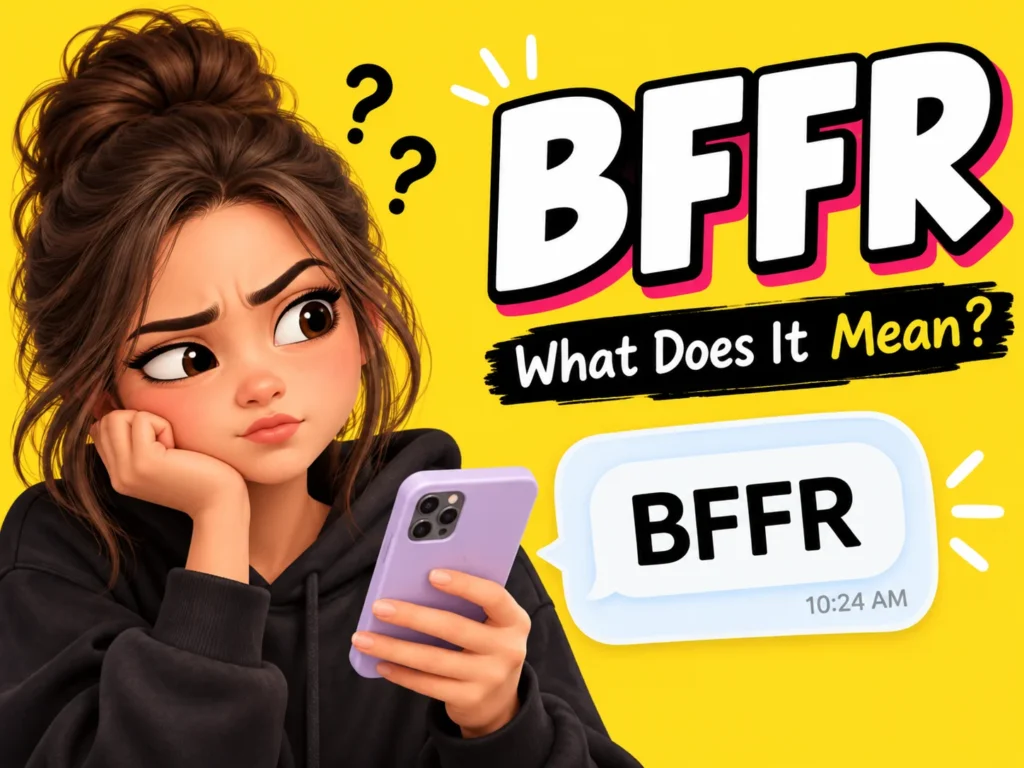
If someone texts you “BFFR,” they usually mean “be f*ing for real”** or, less explicitly, “be freaking for real.” It tells someone to stop joking, exaggerating, or pretending and be serious. In a text, BFFR can sound funny, sarcastic, annoyed, or genuinely serious depending on the conversation.
What Does BFFR Mean in Text?
BFFR is an abbreviation used in texting and online conversations. Its most common expansion is “be fucking for real,” although people sometimes interpret or soften it as “be freaking for real.”
In simple terms, it means:
“Seriously?”
“Are you for real?”
“Come on, be serious.”
For example:
A: I think I can finish this 20-page assignment in an hour.
B: BFFR 😭
Here, BFFR means something like “Come on, be serious. You know that’s not realistic.”
The abbreviation works especially well because it can communicate disbelief without requiring a long response.
Is BFFR an Acronym or Abbreviation?
BFFR is generally treated as an initialism/abbreviation formed from the first letters of the words in “be fucking for real.”
Because the original phrase contains profanity, some people use “be freaking for real” as a cleaner interpretation.
Where Do People Use BFFR?
You may encounter BFFR in:
- SMS and iMessage: Friends may use it to react to an unbelievable statement.
- WhatsApp: It can appear in casual one-on-one conversations and group chats.
- Instagram DMs: People often use it when reacting to a friend’s story or message.
- Snapchat: It can express playful disbelief or annoyance.
- Discord: It may appear in casual conversations between friends or gaming communities.
The lowercase form “bffr” is also common. Lowercase usually feels more casual, while “BFFR” can add emphasis.
What Does BFFR Mean From a Girl or Guy?
The meaning doesn’t fundamentally change based on who sends it.
If a girl texts “bffr,” she could be teasing you, questioning something you said, or telling you that she doesn’t believe you.
If a guy sends “BFFR,” he may likewise be joking, skeptical, or genuinely frustrated.
The surrounding messages matter more than the sender’s gender.
Example:
A: I definitely didn’t eat the last slice.
B: BFFR 😭
The sender probably doesn’t believe you.
READ MORE: What Does CS Mean in a Text? Full Guide to This Texting Slang
BFFR Tone Variations
Funny
A: I’m going to wake up at 5 AM every day now.
B: BFFR 😂
A: Tomorrow is different.
B: You said that yesterday.
Here, BFFR is playful rather than hostile.
Sarcastic
A: I only spent $200 at the mall.
B: BFFR.
A: What? That’s not that much.
B: Your bank account would disagree.
The abbreviation highlights disbelief.
Playful
A: You really think you can beat me at Mario Kart?
B: BFFR 😭
A: Watch me.
B: I’m waiting.
The exchange uses BFFR as friendly trash talk.
Serious
A: You told me you’d be honest with me.
B: I was.
A: BFFR. You know that’s not what happened.
B: Okay. You’re right.
Here, the abbreviation sounds much more confrontational.
10 Real Text Examples Using BFFR
1. Between Friends
A: I forgot we had a test today.
B: BFFR 😭
A: I’m serious.
B: You literally reminded me last night.
2. Between Partners
A: I’m not jealous.
B: BFFR 😂
A: Okay, maybe a little.
B: I knew it.
3. Sibling Conversation
A: Mom likes me more.
B: BFFR.
A: She does!
B: She asked me to help her first.
4. Coworkers
A: You think we’ll finish this report in ten minutes?
B: BFFR.
A: Fine, twenty minutes?
B: Try two hours.
5. Group Chat
A: I’m deleting every social media app tonight.
B: BFFR 😂
A: I’m serious this time.
C: See you on Instagram tomorrow.
6. Friend Making an Excuse
A: My phone died, that’s why I didn’t reply.
B: BFFR 😭
A: What?
B: You were online.
7. Family Text
A: I’m not hungry.
B: BFFR. You just asked what’s for dinner.
A: That doesn’t count.
8. Flirty Conversation
A: You don’t miss me.
B: BFFR.
A: So you do?
B: Obviously.
9. Stranger or Casual Contact
A: This phone is definitely brand new.
B: BFFR, the box is falling apart.
A: Okay, maybe it’s not new.
B: That’s what I thought.
10. Friendly Argument
A: I never said that.
B: BFFR.
A: When did I say it?
B: Scroll up.
How BFFR Works Grammatically
BFFR isn’t a traditional part of speech like a noun or adjective. It represents an entire informal phrase: “be [expletive] for real.”
It usually appears:
- As a standalone response: “BFFR.”
- At the beginning of a reply: “BFFR, you knew this was coming.”
- With emojis: “BFFR 😭”
- In lowercase: “bffr”
- In uppercase for emphasis: “BFFR!”
So, It can function almost like a complete sentence in a text conversation.
Does Capitalization Change the Meaning?
Usually, no.
“BFFR” and “bffr” generally have the same basic meaning. However, capitalization can affect tone.
- bffr → casual, relaxed
- BFFR → stronger emphasis
- BFFR! → potentially more forceful or annoyed
Context remains the biggest factor.
How to Reply to BFFR
Your response should match the tone of the person who sent it.
Funny Reply
“Okay okay, you got me 😂”
Serious Reply
“I am being serious. Let me explain.”
Flirty Reply
“You know I’m right, don’t act like that 😏”
Neutral Reply
“I’m serious, actually.”
If someone uses BFFR aggressively, you don’t need to match their attitude. A calm response can prevent a casual disagreement from becoming an argument.
BFFR vs Similar Texting Terms
| Term | Meaning | Usage Context | Tone | Popularity | Confusion Risk |
|---|---|---|---|---|---|
| BFFR | Be f***ing for real | Disbelief, calling someone out | Sarcastic/strong | High | Medium |
| FR | For real | Agreement or emphasis | Casual | High | Low |
| FRFR | For real, for real | Strong agreement | Casual | High | Low |
| BFF | Best friends forever | Friendship | Friendly | High | High |
| IDK | I don’t know | Uncertainty | Neutral | High | Low |
| GTFO | Get the f*** out | Shock, dismissal, joking | Strong | High | Medium |
One particularly important distinction is BFFR vs BFF. Despite sharing the letters “BFF,” they have completely different meanings. BFF means “best friends forever,” while BFFR is a reaction telling someone to be serious.
Who Uses BFFR?
BFFR is primarily associated with informal digital communication. It can appear among younger users, but you shouldn’t assume that every person using it belongs to one particular generation.
Gen Z vs. Millennials
Younger texters may use BFFR as a short, expressive reaction, often adding emojis such as 😭 or 😂. Millennials who use the abbreviation may use it similarly, especially in casual social-media conversations.
The difference often comes down to personal texting style rather than a strict age boundary.
Regional Usage
BFFR is recognizable in English-language internet and texting culture, particularly in casual online communication. Its exact frequency can vary by community, age group, and platform.
It’s best understood as informal internet slang, not standard formal English.
Origin and Internet Culture
BFFR belongs to the broader tradition of shortening phrases for fast digital communication. The phrase itself is built from ordinary English words, while the initialism makes the reaction quicker to type.
Its modern online use has also benefited from social-media culture, where short expressions can work as standalone reactions.
Unlike older abbreviations such as LOL or BRB, BFFR is more confrontational. The key idea isn’t simply surprise; it often challenges another person’s statement by asking them to acknowledge reality.
That distinction explains why “BFFR” can be humorous between close friends but sound rude in a sensitive conversation.
Is BFFR Rude or Offensive?
It can be.
The original expansion contains profanity, so BFFR is not appropriate for every audience. Even when someone understands the phrase as “be freaking for real,” the expression can still sound dismissive.
Avoid it in:
- Formal emails
- School assignments
- Messages to teachers
- Professional communication
- Sensitive conversations with someone you don’t know well
With close friends, however, BFFR may be completely normal and playful.
A Real-World Observation About BFFR
One interesting feature of BFFR is how easily it replaces an entire reaction. Instead of typing “Come on, there’s no way you actually believe that,” someone can send three or four letters and let the context do the rest. Adding 😭, 😂, or a follow-up message can make the same abbreviation feel teasing rather than genuinely angry. That flexibility helps explain why BFFR works so naturally in fast-moving text conversations.
Frequently Asked Questions
What does BFFR mean in text?
BFFR most commonly means “be f*ing for real.”** It is used when someone wants another person to be serious, stop exaggerating, or acknowledge that something is obviously untrue or unrealistic. Depending on the context, it can be playful, sarcastic, or annoyed.
Is BFFR rude to say in a text?
It can be rude because the original phrase contains profanity and can sound confrontational. Close friends may use it jokingly without taking offense. With a boss, teacher, customer, or someone you barely know, a softer phrase such as “Are you serious?” is safer.
Is BFFR a bad word?
BFFR itself is an abbreviation, but its most common expansion contains profanity. Some people use “be freaking for real” as a cleaner version. Whether it is considered offensive depends on the audience and context.
What’s the difference between texting BFFR and saying it out loud?
In text, BFFR can be softened or intensified by punctuation, capitalization, and emojis. Someone might type “bffr 😂” while joking with a friend. Spoken aloud, the full phrase tends to sound more direct, so tone of voice becomes much more important.
Does BFFR mean the same thing in a group chat?
Generally, yes. In a group chat, BFFR can respond to something one person said while inviting everyone else to react. The audience can make it feel more humorous, especially when several people already understand the context.
Can BFFR be flirty?
Yes, depending on the conversation. Someone might use it playfully when the other person denies having feelings or attraction. However, BFFR isn’t inherently romantic, so the surrounding messages determine whether the exchange is actually flirtatious.
What is the difference between BFFR and FRFR?
FRFR means “for real, for real” and usually emphasizes agreement or sincerity. BFFR challenges someone to be realistic or serious. In simple terms, FRFR often means “I really mean it,” while BFFR often means “Seriously, be realistic.”
Is BFFR appropriate for work?
Usually, it’s better to avoid it in formal workplace communication. Even among coworkers, the profanity and confrontational tone may be misunderstood. A phrase such as “Are you serious?” or “Can we be realistic about this?” is more professional.
Conclusion
BFFR means “be f*ing for real”** in most texting contexts. People use it to express disbelief, challenge an unrealistic statement, or tell someone to stop joking and get serious.
Quick usage tips
- Use BFFR with people who understand casual internet slang.
- Use lowercase bffr for a relaxed tone.
- Add emojis when you want the message to feel playful.
- Remember that the original phrase contains profanity.
Common mistakes
- Don’t confuse BFFR with BFF.
- Don’t assume BFFR is always angry.
- Don’t use it automatically in professional conversations.
- Don’t judge its tone without reading the surrounding messages.
Use BFFR when you’re having a casual conversation and want to express strong disbelief or playful skepticism.
Avoid BFFR when you need to sound respectful, formal, or especially sensitive.
PAA Questions
What does BFFR stand for?
BFFR most commonly stands for “be f***ing for real.” It is an informal texting abbreviation used to express disbelief or tell someone to be serious.
What does BFFR mean from a girl?
It usually means the same thing regardless of gender: “be for real” or “are you serious?” Her tone and the surrounding conversation determine whether she’s joking, teasing, or annoyed.
What does BFFR mean from a guy?
A guy using BFFR is usually expressing disbelief or challenging something you said. It may be playful among friends or more serious during an argument.
What does BFFR mean on Snapchat?
On Snapchat, BFFR generally carries the same meaning as it does in texts and DMs. It can be used as a quick reaction to something surprising, unrealistic, or funny.
1 thought on “What Do BFFR Mean in Text? Gen Z Dictionary”