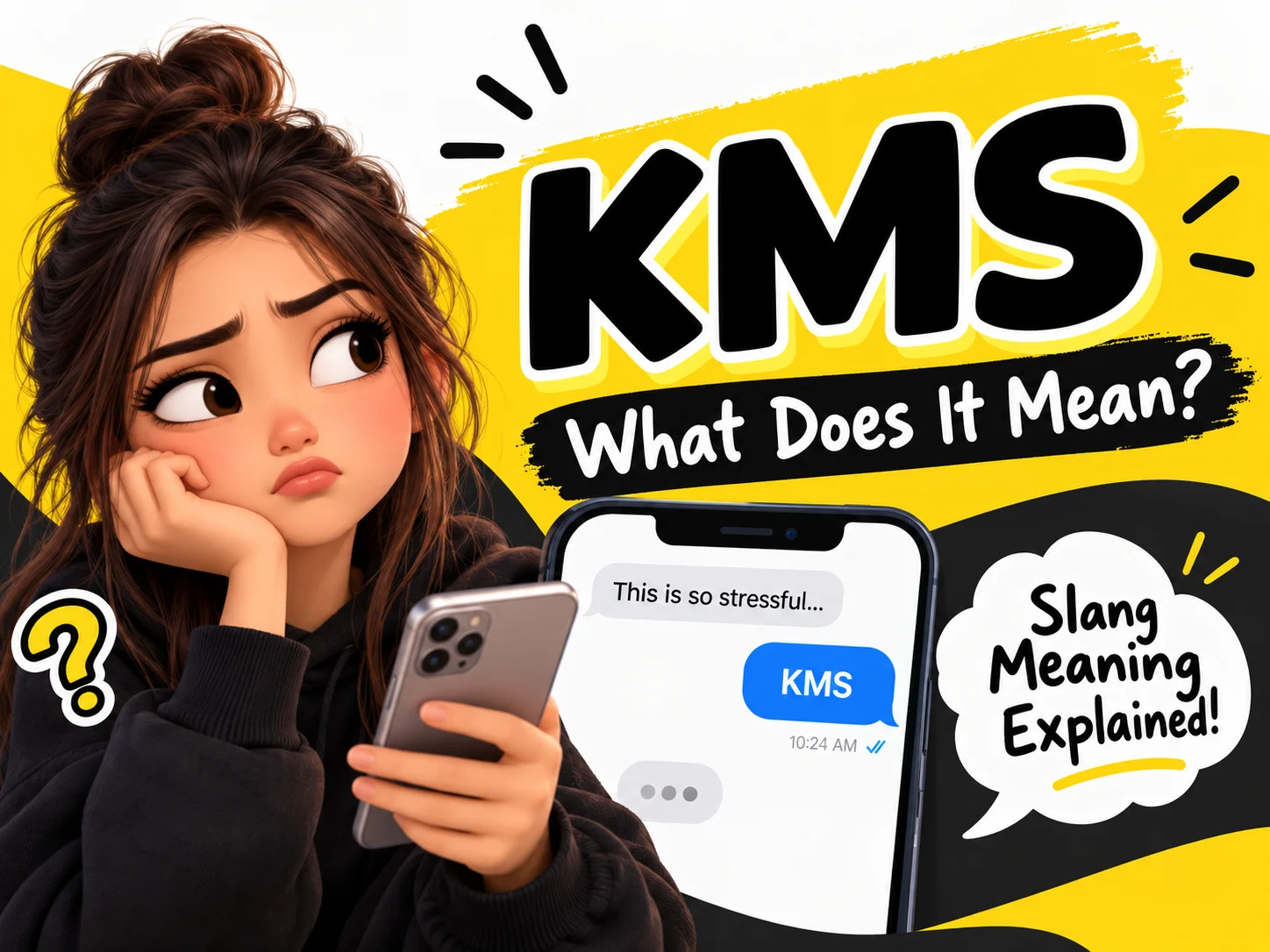

KMS usually means “kill myself” in texting and online slang. People use it to express frustration, embarrassment, annoyance, or emotional distress. However, the meaning depends on context. When someone texts you “kms,” it can be a dark joke, an exaggerated reaction, or a genuine expression of suicidal thoughts that deserves care and attention.
What does KMS mean when someone texts it to you? It generally means “kill myself,” but you should consider the conversation, the person’s tone, and whether they might be expressing real emotional pain before deciding how to respond.
READ MORE: Chomo Meaning: What Does Chomo Mean in Text?
KMS Meaning in Text at a Glance
| Term | Meaning |
|---|---|
| KMS | Kill myself |
| Type | Initialism / internet slang |
| Common use | Texting, DMs, online conversations |
| Tone | Frustrated, joking, embarrassed, distressed, or serious |
| Formality | Informal |
| Safety | Can refer to genuine suicidal thoughts |
KMS isn’t a polite or professional expression. Although some people use it casually, the phrase involves self-harm and shouldn’t automatically be dismissed as a joke.
What Does KMS Stand For?
KMS is an initialism formed from the first letters of “kill myself.” In everyday text conversations, it often appears as an emotional reaction rather than a literal statement of intent.
For example:
“I just sent the wrong screenshot to my boss kms.”
Here, the person may be expressing embarrassment or panic. They might not mean that they actually intend to hurt themselves.
However, context matters. If someone says they want to die, describes a plan, or expresses hopelessness alongside KMS, take the message seriously and respond with concern rather than assuming they’re joking.
Is KMS an Acronym or Abbreviation?
KMS is commonly described as an initialism because people typically pronounce the individual letters, “K-M-S,” rather than saying it as one word. In informal online discussions, people may also call it slang or an abbreviation.
The expression can appear in lowercase (kms), uppercase (KMS), or mixed forms. Capitalization alone doesn’t establish whether someone is joking or experiencing a crisis.
Why Do People Use KMS in Text Messages?
People use KMS for different reasons, and the surrounding conversation helps clarify the intended meaning.
1. Frustration
Someone might use KMS after a disappointing experience.
Example:
“I studied for three hours and the test covered nothing I revised. kms.”
This may express frustration, but you shouldn’t assume that every use is harmless.
2. Embarrassment
A person might type KMS after making an awkward mistake.
Example:
“I called my teacher mom in front of everyone kms 😭”
The phrase emphasizes embarrassment and may function as exaggerated internet humor.
3. Dark Humor
Some users include KMS in jokes, memes, or casual conversations. The phrase can become a shorthand reaction to something that feels painfully awkward or ridiculous.
Even when someone uses it humorously, the wording can be upsetting to others. Pay attention to the relationship and the setting.
4. Genuine Emotional Distress
KMS can also communicate real suicidal thoughts. If the message appears alongside statements about wanting to die, feeling trapped, or having a plan, treat it as potentially serious.
You don’t need to diagnose the person’s feelings. Instead, check in directly and encourage immediate support when necessary.
KMS Meaning Across Texting Platforms
KMS can appear in different types of online conversations, including:
- SMS and iMessage: Friends may use it as a reaction to embarrassment, frustration, or an unpleasant situation.
- WhatsApp: It can appear in personal chats and group conversations, particularly among people who already share an informal communication style.
- Instagram and Snapchat DMs: Users may type KMS while reacting to awkward moments or personal experiences.
- Discord: The term can occur in casual gaming and community conversations, where context determines whether it’s a joke or a serious message.
The meaning doesn’t automatically change from one platform to another. The same lowercase “kms” can have very different implications depending on the person and the conversation.
KMS Tone Variations With Realistic Text Conversations
Funny or Embarrassed Tone
A person may use KMS to exaggerate how embarrassed they feel.
Example 1:
A: Did you really send that voice note to the family group?
B: I DID 😭
A: Your uncle replied with a thumbs-up.
B: kms this is so embarrassing.
The exchange uses dark humor as an exaggerated reaction. It doesn’t establish whether the person has suicidal intent.
Sarcastic Tone
KMS may appear in a sarcastic response to an inconvenient situation.
Example 2:
A: The internet stopped working right before your presentation.
B: Of course it did.
A: Want me to call the provider?
B: kms, this timing is unbelievable.
A supportive reply can acknowledge the frustration without repeating the self-harm phrase.
Playful Tone
Some friends use exaggerated language when teasing each other or discussing minor mistakes.
Example 3:
A: I accidentally ordered spicy noodles again.
B: You said you were done with spicy food.
A: I trusted the picture on the menu 😭
B: kms 😂
Even if the conversation seems playful, the phrase itself concerns self-harm. Don’t assume that everyone will interpret it comfortably.
Serious Tone
When KMS appears in a message about emotional pain, the response should shift from humor to concern.
Example 4:
A: I can’t deal with everything anymore.
B: I’m sorry you’re feeling this way. Are you safe right now?
A: I don’t know. I just want everything to stop.
B: I’m here with you. Can we call someone you trust and get you some support?
In this situation, focus on the person’s safety and immediate needs.
10 Realistic KMS Text Examples
These examples show how the term can appear in different relationships. They are illustrative conversations, not evidence of the speakers’ actual intentions.
1. Between Friends
A: I just waved back at someone who wasn’t waving at me.
B: PLEASE 😭
A: I want to disappear.
B: You’re fine 😂 but seriously, you okay?
2. Between Partners
A: I forgot our dinner reservation.
B: I’m disappointed, honestly.
A: I’m sorry. I’ll fix it.
B: Let’s talk when you get home.
3. Between Siblings
A: Mom found the snacks I hid.
B: How did she find them?
A: She literally moved the one cushion.
B: That’s tragic 😭
4. Between Classmates
A: Did you finish the assignment?
B: Almost. The references are taking forever.
A: Same. Let’s check the requirements together.
B: Please, I need help.
5. Between Coworkers
A: I accidentally attached the old file.
B: Did you catch it before sending?
A: No.
B: Send a correction quickly. I’ll help check the new version.
6. Between a Parent and Child
A: I had a terrible day at school.
B: I’m sorry. Do you want to talk about it?
A: Not right now.
B: That’s okay. I’m here whenever you’re ready.
7. Between Online Friends
A: I lost my game progress.
B: After all those hours?
A: Yes 😭
B: That hurts. Want to start again together?
8. Between Strangers
A: Sorry, I think you sent this to the wrong number.
B: Oh, I’m so sorry!
A: No worries. Hope you find the person you meant to message.
9. In a Group Chat
A: Who changed the meeting time?
B: I did. Is the new time a problem?
A: I have another class then.
B: Let’s find a time that works for everyone.
10. During a Difficult Conversation
A: I’ve been feeling really overwhelmed lately.
B: I’m sorry you’re going through that.
A: Sometimes I think about killing myself.
B: Thank you for telling me. Are you in immediate danger? Let’s find someone who can support you right now.
The final example uses direct language because a serious disclosure requires clarity rather than guessing or joking.
Grammar and Language Role of KMS
KMS functions as informal internet slang rather than a conventional English sentence.
| Feature | Explanation |
|---|---|
| Part of speech | Initialism used as an emotional expression |
| Sentence position | Often appears at the end of a message |
| Stand-alone use | Can appear alone as a reaction |
| Mid-sentence use | May be inserted after describing a frustrating event |
| Capitalization | Lowercase is common; uppercase can add emphasis |
| Formality | Informal and unsuitable for professional communication |
Can KMS Be Used as a Full Reply?
Yes, people may send kms on its own. However, the receiver cannot reliably know whether the person is joking, expressing distress, or seeking help from that message alone.
If someone sends only KMS and the context feels concerning, a direct check-in is more appropriate than laughing it off.
How to Reply When Someone Texts KMS
Your response should match the situation.
Funny but gentle reply
“That sounds like a painfully embarrassing moment 😭 You okay though?”
Serious reply
“Hey, are you serious? Are you safe right now? I’m here to listen.”
Neutral reply
“What happened? Tell me what went wrong.”
When the message sounds urgent
“I’m concerned about you. Are you thinking about hurting yourself right now? Let’s get you some immediate support.”
If someone says they’re in immediate danger, encourage them to contact local emergency services or a trusted person who can stay with them. In Pakistan, you can contact local emergency services for urgent assistance.
KMS vs. Related Texting Terms
| Term | Meaning | Usage Context | Tone | Popularity | Confusion Risk |
|---|---|---|---|---|---|
| KMS | Kill myself | Emotional reaction or distress | Dark, frustrated, serious | Common online slang | High |
| KYS | Kill yourself | Insult or harmful phrase | Hostile or joking | Internet slang | High |
| LOL | Laughing out loud | Humor or reaction | Lighthearted | Very common | Low |
| OMG | Oh my God | Surprise or shock | Emotional | Very common | Low |
| SMH | Shaking my head | Disapproval or disbelief | Frustrated | Common slang | Medium |
| IDK | I don’t know | Uncertainty | Neutral | Very common | Low |
Popularity labels in this table are broad usage descriptions, not measured search-volume rankings.
Who Uses KMS?
KMS appears in informal online communication among different age groups. Its use depends on individual habits, peer groups, and online communities.
Gen Z and Millennials
Both Gen Z and Millennials may encounter KMS in texting and online slang. You shouldn’t infer someone’s age from their use of the term.
Younger users may encounter it in fast-moving group chats, while Millennials may see it in messaging, social media, or gaming communities. These are possible contexts, not fixed age-based rules.
Regional Usage
The phrase “kill myself” is English-language slang that can be understood across many online communities. However, the exact frequency and social meaning may differ between individuals and regions. There isn’t enough evidence here to claim a specific regional preference or usage rate.
Origin and Internet Culture
KMS is derived from the phrase “kill myself” and belongs to a broader group of internet shorthand expressions. Its precise first use and original platform cannot be established reliably from the information available here, so it’s better not to assign it a specific invention date or platform origin.
The phrase reflects a wider online habit of shortening expressions to communicate quickly. However, its connection to suicide means it carries more weight than neutral shorthand such as LOL or IDK.
Is KMS Rude or Offensive?
KMS is not profanity in the traditional sense, but it refers to suicide and can be disturbing or inappropriate in many settings.
- With close friends: Consider the context and whether everyone is comfortable with dark humor.
- At school: Avoid using it casually, especially in messages to teachers or classmates you don’t know well.
- At work: Don’t use it in professional messages, emails, or workplace group chats.
- With someone in distress: Treat it as a possible sign that they need support.
A person’s safety matters more than whether their wording initially appears humorous.
Frequently Asked Questions About KMS Meaning in Text
1. Is it rude to reply with just KMS in a text?
Yes, sending KMS can be upsetting or inappropriate, particularly when the recipient doesn’t know your sense of humor. The phrase references suicide, so a casual response can be misunderstood. If you’re frustrated, consider using a clearer alternative such as “I’m so done with this” or “This is really frustrating.”
2. What’s the difference between texting KMS and saying it out loud?
The meaning depends on context in both spoken and written communication. Text messages don’t always show facial expressions, tone of voice, or immediate emotional cues. As a result, KMS may be harder to interpret accurately in text, especially when someone sends it without additional explanation.
3. Does KMS mean the same thing in a group chat and a 1-on-1 text?
The underlying phrase is generally the same, but the social context can differ. In a group chat, someone may use it as a reaction to an event, while a private message may contain more personal emotional information. Neither setting guarantees that the phrase is a joke or a serious disclosure.
4. Is KMS a bad word?
KMS isn’t usually classified as profanity, but it refers to self-harm and suicide. That makes it sensitive language, even when someone uses it casually. Whether it’s appropriate depends on the audience, situation, and purpose of the message.
5. What does KMS mean from a friend?
From a friend, KMS might express embarrassment, frustration, dark humor, or genuine distress. You can’t determine the exact meaning from the abbreviation alone. If the message seems unusual for your friend or sounds serious, ask how they’re doing and whether they’re safe.
6. What does KMS mean on Snapchat or WhatsApp?
On Snapchat and WhatsApp, KMS generally refers to “kill myself.” The platform doesn’t create a separate standard definition. Interpret the expression using the surrounding messages, the relationship, and the person’s emotional context.
7. How should I respond if someone uses KMS seriously?
Take the statement seriously and ask directly whether they’re thinking about hurting themselves or are in immediate danger. Listen without judgment, encourage them to contact a trusted person or qualified professional, and seek emergency assistance if there’s an immediate risk. You don’t have to manage a crisis alone.
8. Is KMS appropriate for school or work?
KMS is generally unsuitable for formal school or workplace communication because it references suicide and may be misunderstood. Use clear, respectful language to express frustration or ask for help. If someone uses KMS in a serious context, prioritize their safety rather than workplace etiquette.
Real-World Observation: Why KMS Can Be Difficult to Interpret
One notable feature of KMS is that the same three letters can sit at the end of a joking message or a genuine disclosure of suicidal thoughts. Unlike neutral texting shorthand, KMS can require an emotional context check before you respond. The most responsible approach is to recognize that a humorous-looking message doesn’t rule out distress, especially when the person communicates a change in mood or describes feeling unsafe.
Conclusion: What Does KMS Mean in Text?
KMS commonly stands for “kill myself” in texting and online slang. People may use it to express frustration, embarrassment, dark humor, or genuine emotional distress. Because the phrase references suicide, it’s important to avoid automatically treating it as a joke.
Usage Tips
- Check the context before interpreting the message.
- Use less sensitive alternatives when expressing everyday frustration.
- Ask directly if a person appears to be in distress.
- Avoid using KMS in professional or formal conversations.
Common Mistakes
- Assuming KMS always means someone is joking.
- Treating a serious message as harmless slang.
- Using the phrase with people who may find it upsetting.
- Ignoring signs of immediate danger.
When to use or avoid it: KMS is informal and sensitive. Understanding the phrase helps you interpret messages more carefully, but choosing clearer language is often a better option.