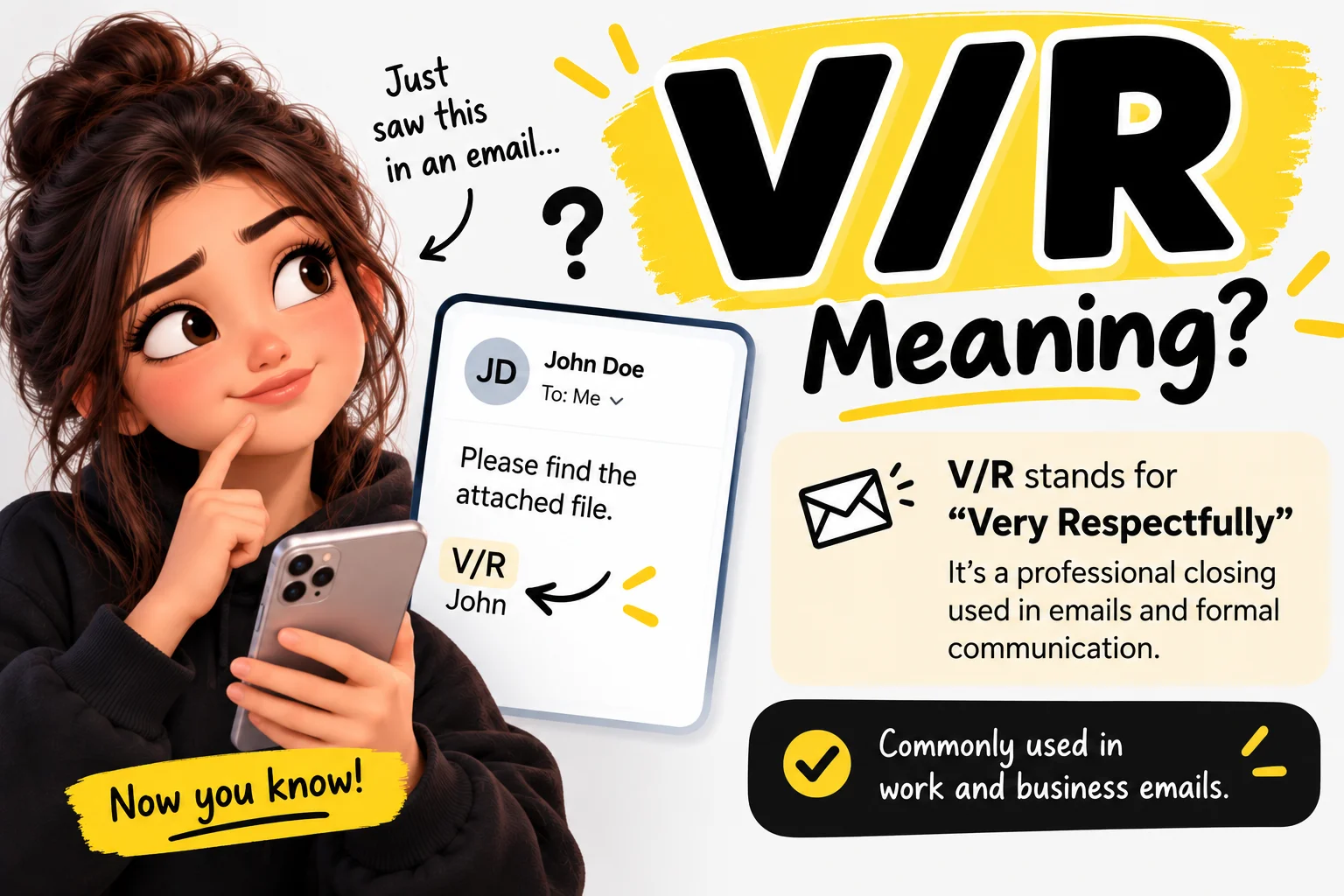

V/R usually means “Very Respectfully” in professional emails and messages, especially as a complimentary closing. However, the meaning can change depending on context. In texting, online conversations, and military communication, V/R may refer to different expressions. Understanding the context helps you determine what someone means when they send or sign a message with V/R.
What Does V/R Mean in Text?
The most recognized formal meaning of V/R is “Very Respectfully.” People use it as a sign-off in emails, letters, and official correspondence.
For example:
Thank you for your assistance.
V/R,
Alex
In this example, V/R works like “Respectfully” or “Best regards,” but its exact level of formality depends on the organization and communication style.
Is V/R an Acronym or Abbreviation?
V/R is an abbreviation or initialism for “Very Respectfully.” It is not normally used as a casual reaction like LOL or OMG. Instead, it commonly appears at the end of a message.
The slash is an important part of the conventional form: V/R. You may also encounter variations in capitalization and punctuation.
READ MORE: KMS Meaning in Text — What Does KMS Mean?
V/R Meaning in Email and Military Communication
V/R is particularly associated with U.S. military and government correspondence. It functions as a respectful closing, similar to “Sincerely” or “Best regards” in civilian emails.
Example of a Professional Email
Subject: Report Submission
Good morning, Captain,
The requested report is attached for your review. Please let me know if you need any additional information.
The abbreviation appears before the sender’s name, rather than replacing the name itself.
V/R vs. R/
Some military correspondence conventions distinguish V/r (“Very respectfully”) from R/ (“Respectfully”). The appropriate closing may depend on the recipient’s rank and the applicable organization’s correspondence guidance. Follow the relevant official style manual rather than assuming one universal rule applies everywhere.
V/R vs. VR: What’s the Difference?
The slash can help distinguish two different meanings.
| Term | Meaning | Context |
|---|---|---|
| V/R | Very Respectfully | Formal email closing |
| VR | Virtual Reality | Technology and gaming |
| VR | Other specialized meanings | Depends on the subject |
For example:
- “I bought a new VR headset.” → Virtual Reality.
- “V/R, Sarah.” → Very Respectfully.
Important: Context matters more than capitalization alone. The version without a slash does not always have one fixed meaning.
Tone and Language Variations
Because V/R is mainly a formal sign-off, its tone is different from casual texting slang.
Formal
Thank you for your time and consideration.
V/r, Jordan
Professional but Friendly
I appreciate your help with this request.
V/r, Alex
Casual Texting
A: Are you free for a quick call?
B: Yes, give me five minutes.
A: Perfect, thanks!
B: No problem.
A formal closing such as V/R would feel unusual in this everyday exchange.
Humorous Use
A: Can you send me the notes?
B: Of course.
A: V/R, Your Favorite Classmate.
B: Why does this sound like an official government letter? 😂
Here, the phrase is used playfully to imitate formal correspondence.
How to Use V/R Correctly
- Choose the appropriate context: V/R fits formal correspondence better than casual conversations.
- Place it before your name: It functions as a closing, not as a greeting.
- Follow organizational guidelines: Military and government agencies may have specific correspondence conventions.
- Use familiar alternatives when appropriate: “Best regards” or “Kind regards” may be clearer in a civilian workplace.
Frequently Asked Questions
1. What does V/R mean in a text message?
V/R most commonly means “Very Respectfully,” particularly when it appears as a sign-off. In a casual text, it may seem unusually formal or could be used humorously. Context determines whether the sender is using it seriously.
2. What does V/R mean at the end of an email?
It means “Very Respectfully” and serves as a complimentary closing. The writer places it before their name, much like “Sincerely” or “Best regards.” It is especially associated with military and government correspondence.
3. Is V/R formal or informal?
V/R is generally formal. It is most suitable when the communication follows military, government, or similar professional conventions. For ordinary personal messages, a simpler closing usually sounds more natural.
4. Can civilians use V/R?
Civilians can encounter or use V/R, but its appropriateness depends on the audience and organizational culture. If the recipient isn’t familiar with the convention, “Best regards” may communicate the same courtesy more clearly. Match the sign-off to the setting.
5. What is the difference between V/R and VR?
V/R generally means “Very Respectfully” when used as a professional closing. VR commonly means “Virtual Reality” in technology and gaming. The slash and the surrounding message help distinguish the meanings.
6. Does V/R mean the same thing on WhatsApp and email?
The abbreviation retains its usual meaning when used as a formal sign-off, regardless of the messaging tool. However, V/R is much more typical in formal correspondence than ordinary WhatsApp conversations. Don’t assume it has a new slang meaning just because it appears in a chat.
7. Should I use V/R in a business email?
Use it if your organization’s conventions or the recipient’s communication style make it appropriate. Otherwise, “Kind regards” or “Best regards” is often a more familiar choice. When in doubt, follow your workplace’s established style.
Conclusion
V/R means “Very Respectfully,” most commonly as a formal email closing. It appears frequently in military and government correspondence, while casual texting generally uses more familiar expressions.
Key Takeaways
- V/R stands for Very Respectfully.
- It usually appears at the end of a formal message.
- Military and government communication commonly use the abbreviation.
- VR without the slash may mean Virtual Reality.
- Always consider the context before interpreting an abbreviation.
When to Use or Avoid V/R
Use V/R when it fits the communication style of your organization or recipient. Avoid using it casually with friends unless you’re intentionally making a formal or humorous reference.