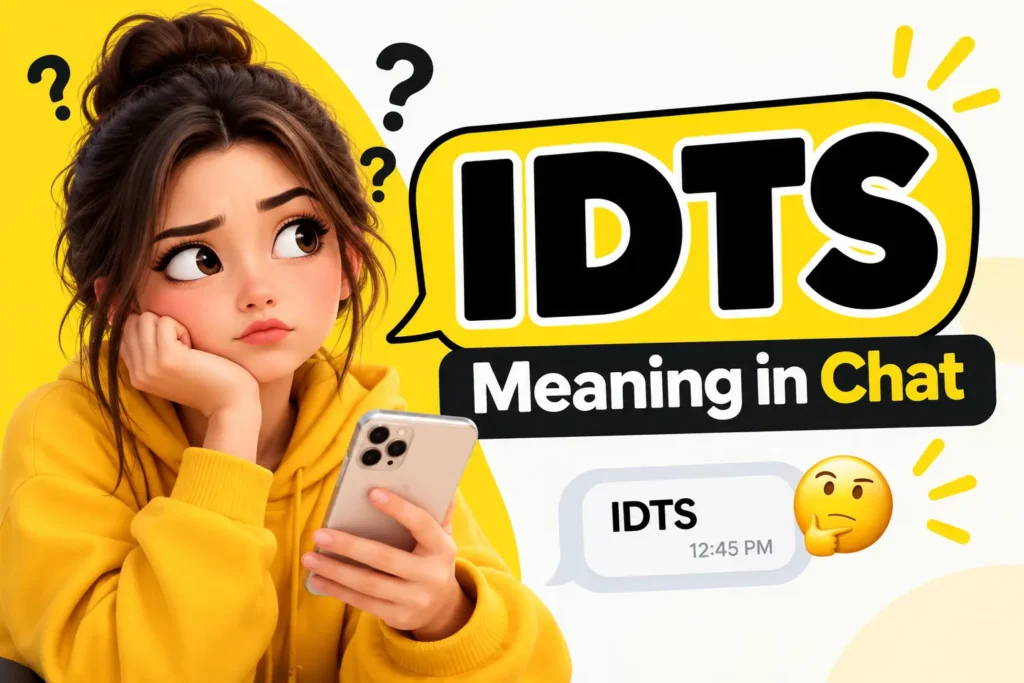
When someone texts you IDTS, it usually means “I Don’t Think So.” People use this abbreviation in text messages and online chats to express doubt, disagree politely, or say that something probably will not happen. For example, if your friend asks, “Do you think we’ll win the match?” you might reply, “IDTS.”
What Does IDTS Stand For in Texting?
IDTS stands for I Don’t Think So. It is an abbreviation formed from the first letters of the words in the phrase.
People commonly use IDTS when they want to give a quick answer without typing a complete sentence. Depending on the conversation, it can communicate uncertainty, disagreement, or a negative opinion.
For example:
A: Are you coming to the party tonight?
B: IDTS, I have too much work.
A: Oh, maybe next time.
B: Yeah, hopefully!
Here, IDTS means the person probably will not attend the party.
READ MORE: BIFL Meaning: What Does BIFL Stand For?
How Is IDTS Used in Text Messages?
IDTS appears in everyday digital conversations, including SMS, iMessage, WhatsApp, Instagram DMs, Snapchat chats, and Discord messages.
Its meaning usually stays the same across these platforms. The surrounding conversation helps you understand whether the sender is uncertain, disagreeing, or simply giving a negative answer.
1. Expressing Doubt
Someone may use IDTS when they are not confident that something is true.
A: Do you think Sara has finished her assignment?
B: IDTS. She was still working on it yesterday.
A: I’ll ask her later.
B: Good idea.
2. Disagreeing With Someone
IDTS can also express disagreement without sounding too direct.
A: This movie is definitely the best one ever.
B: IDTS, the ending was disappointing.
A: Really? I liked it.
B: The beginning was good, though.
3. Giving a Quick Negative Answer
People sometimes use IDTS as a short response when they believe something is unlikely.
A: Will the teacher cancel tomorrow’s class?
B: IDTS.
A: Guess I’ll prepare for it, then.
B: Same here.
IDTS Meaning in Different Tones
The abbreviation itself does not automatically communicate a particular emotion. The sender’s wording, punctuation, and relationship with you can change how it feels.
Funny Tone
A: Do you think I’ll become a millionaire tomorrow?
B: IDTS 😂
A: Let me dream!
B: Fine, just remember me when you’re rich.
Sarcastic Tone
A: You really think I’ll finish this project in ten minutes?
B: IDTS, unless you’ve discovered a time machine.
A: Very supportive of you.
B: Just being realistic!
Playful Tone
A: Do you think I can beat you at this game?
B: IDTS 😏
A: Challenge accepted.
B: Don’t blame me when you lose!
Serious Tone
A: Do you think the meeting will be postponed?
B: IDTS. The manager confirmed the schedule.
A: Okay, I’ll be there on time.
B: That’s probably best.
10 Realistic IDTS Chat Examples
Here are different ways people may use IDTS in everyday conversations.
Example 1: Between Friends
A: Is Ahmed joining us for lunch?
B: IDTS, he said he was busy.
A: Let’s ask someone else.
B: Sure, I’ll message Bilal.
Example 2: Between Partners
A: Do you think I’m still upset with you?
B: IDTS, but I want to make sure we’re okay.
A: We are. Don’t worry.
B: Good, I just wanted to check.
Example 3: Between Siblings
A: Do you think Mom will let us order pizza?
B: IDTS. We already had takeout yesterday.
A: We can still ask her.
B: Go ahead, but don’t expect much!
Example 4: Between Coworkers
A: Will the client approve the proposal today?
B: IDTS. They requested more changes this morning.
A: I’ll prepare the revised version.
B: Great, that should help.
Example 5: Parent and Child
A: Dad, do you think I can stay up late tonight?
B: IDTS. You have school tomorrow.
A: Just another thirty minutes?
B: Finish your homework first, and we’ll discuss it.
Example 6: Planning an Outing
A: Do you think it will rain during our picnic?
B: IDTS, but check the forecast before we leave.
A: I’ll bring an umbrella anyway.
B: That’s a sensible plan.
Example 7: A Flirty Conversation
A: Do you think I look cute in this picture?
B: IDTS 😏 You look amazing.
A: That doesn’t even make sense!
B: I meant, “I don’t think so” because you look better than cute.
This example uses IDTS as a playful setup. Without the follow-up explanation, the abbreviation would normally sound negative.
Example 8: Making Study Plans
A: Do you think the exam will be easy?
B: IDTS. The last practice paper was difficult.
A: Then we’d better study together.
B: Agreed. Let’s start this evening.
Example 9: A Group of Friends
A: Is everyone coming to the birthday dinner?
B: IDTS. Two people haven’t replied yet.
A: I’ll check with them.
B: Perfect, then we can confirm the booking.
Example 10: Talking to Someone New
A: Do you think this shop is still open?
B: IDTS. The lights are off.
A: Let’s try the one across the street.
B: Sure, that one might still be open.
How Should You Reply to IDTS?
Your response depends on what the other person means and what you want to communicate.
- Funny reply: “You never know 😂”
- Serious reply: “Okay, what makes you think that?”
- Flirty reply: “Oh really? Maybe I can change your mind 😉”
- Neutral reply: “Alright, we’ll see.”
- Clarifying reply: “So, is that a no?”
If the sender’s answer seems unclear, ask a follow-up question rather than assuming they are being rude.
Is IDTS Rude or Disrespectful?
No, IDTS is not inherently rude or offensive. It is an informal abbreviation for a common English phrase.
However, replying with only “IDTS” can sometimes sound blunt, especially when someone is sharing something important or asking for reassurance. Adding an explanation can make your message feel more considerate.
For example, “IDTS, because the weather looks bad” sounds more helpful than simply saying “IDTS” when someone asks whether an outdoor event will happen.
In professional conversations, it is usually better to write “I don’t think so” or explain your reasoning instead of relying on abbreviations.
IDTS vs. Similar Texting Abbreviations
| Term | Meaning | Usage Context | Tone | Popularity | Confusion Risk |
|---|---|---|---|---|---|
| IDTS | I don’t think so | Doubt or disagreement | Neutral | Common informal shorthand | Low |
| IDK | I don’t know | Lack of knowledge | Neutral | Common | Medium |
| IMO | In my opinion | Sharing an opinion | Neutral | Common | Low |
| TBH | To be honest | Giving an honest opinion | Direct | Common | Low |
| IDC | I don’t care | Indifference | Can sound blunt | Common | Medium |
| IKR | I know, right? | Agreement | Friendly | Common | Medium |
The most important distinction is that IDTS expresses a negative expectation or opinion, while IDK means the person does not know the answer.
Who Uses IDTS?
IDTS is informal digital shorthand that people may use in personal text messages and online chats. It is not exclusive to one age group.
Gen Z and Millennials
Both Gen Z and Millennials may use IDTS to keep conversations short. Individual habits vary: some people prefer abbreviations, while others write complete sentences even in casual messages.
Regional Usage
IDTS is understandable to English-speaking users familiar with texting abbreviations. However, its frequency can vary by community and individual preference. There is no need to assume that every person in the United States, United Kingdom, or elsewhere uses it regularly.
Capitalization and Variations
You may see IDTS, idts, or Idts. These usually have the same meaning. Lowercase “idts” often feels casual, while uppercase “IDTS” can appear more emphatic depending on the context.
Where Did IDTS Come From?
IDTS follows the broader pattern of English texting abbreviations that shorten common phrases into their initial letters. Such shorthand makes quick digital communication easier.
There is no sufficiently established evidence here to assign IDTS a specific inventor, exact creation date, or single originating platform. It is best understood as an abbreviation used in informal online communication rather than a term with a verified, single-source origin.
Frequently Asked Questions About IDTS
1. What does IDTS mean in chat?
IDTS usually means “I Don’t Think So.” People use it to express doubt, disagreement, or the belief that something is unlikely. The exact interpretation depends on the question and the surrounding messages.
2. What does IDTS mean from a girl or a guy?
The basic meaning remains “I Don’t Think So,” regardless of who sends it. A girl or guy might use it to answer a question, disagree, or express uncertainty. The abbreviation alone does not establish romantic interest or reveal someone’s feelings.
3. Is it rude to reply with just IDTS in a text?
Not necessarily. A short IDTS can be a normal, quick answer between friends. However, it may sound dismissive if the conversation is serious or emotional, so adding a reason can help avoid misunderstandings.
4. What’s the difference between texting IDTS and saying it out loud?
In a text, IDTS replaces the spoken phrase “I don’t think so.” In conversation, your voice and facial expression help communicate whether you are joking, uncertain, or serious. Text messages lack those cues, so emojis and additional words can help clarify your tone.
5. Does IDTS mean the same thing in a group chat and a private text?
Yes, the usual meaning is the same in both settings. In a private conversation, it often answers one person’s direct question. In a group chat, it may express an opinion about plans or a suggestion, and other members may respond with different views.
6. Is IDTS the same as IDK?
No. IDTS means “I Don’t Think So,” while IDK means “I Don’t Know.” IDTS usually communicates a negative expectation or opinion; IDK indicates that the sender lacks the answer or is unsure.
7. Can I use IDTS in a work message?
You can use it in a casual conversation with a colleague if you both communicate informally. For a manager, client, or formal workplace discussion, a complete phrase such as “I don’t think so, because…” is generally clearer and more professional.
8. What should I reply when someone texts IDTS?
You can reply with “Okay,” “Why do you think so?” or “We’ll see.” If the conversation is playful, you might use a lighthearted response. Choose your reply based on whether you need clarification, want to continue the discussion, or simply accept the answer.
Conclusion: Understanding IDTS in Text Messages
IDTS means “I Don’t Think So” in most casual texting situations. It is a quick way to express doubt, disagree with an idea, or suggest that something probably will not happen.
Tips for using IDTS:
- Use it in casual conversations with friends and people you know.
- Add a short explanation when your answer could be misunderstood.
- Use punctuation or an emoji when you want to make your tone clearer.
- Choose complete sentences for formal or sensitive discussions.
Common mistakes to avoid:
- Confusing IDTS with IDK.
- Assuming IDTS always means a firm “no.”
- Treating the abbreviation as automatically rude.
- Assuming it signals romantic interest without other context.
Use IDTS when a quick, informal answer fits the conversation. When clarity matters more than speed, writing out “I don’t think so” is the safer choice.