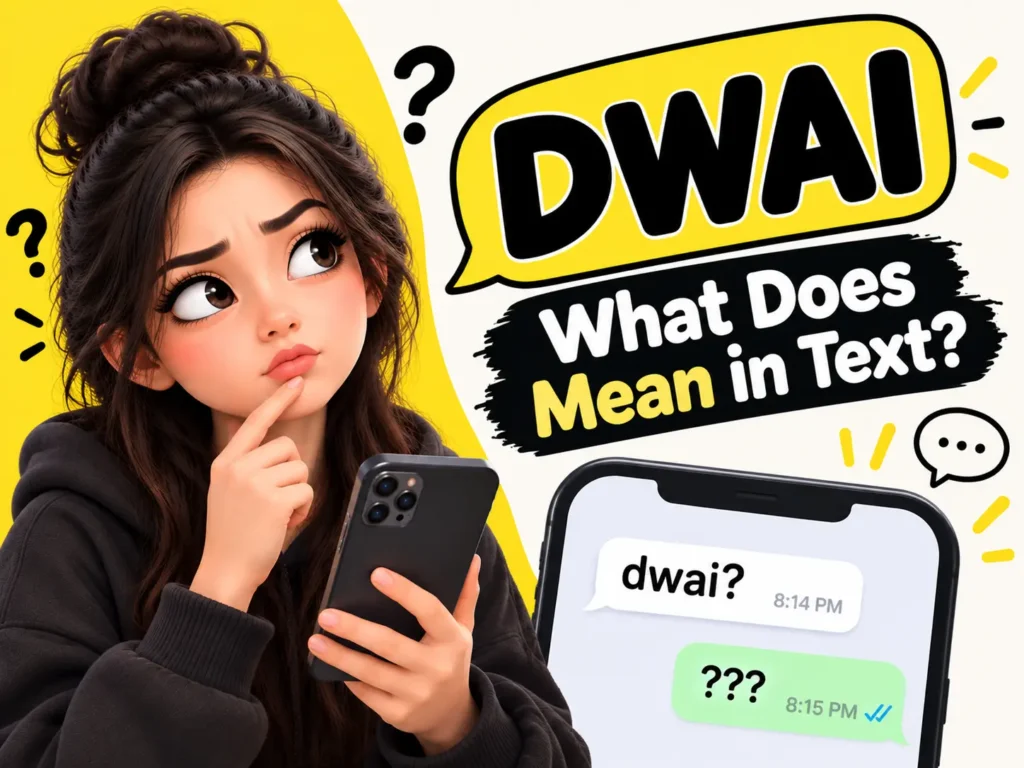
DWAI usually means “Don’t Worry About It” in text messages. People use it to reassure someone, dismiss a small concern, or let them know that something is not a problem. When someone texts you “DWAI,” they are generally saying, “It’s okay,” “Don’t stress about it,” or “You don’t need to apologize.”
What Does DWAI Mean in Text?
DWAI is an informal texting abbreviation for “Don’t Worry About It.” It combines the first letters of the phrase into a short response that is easy to type in casual conversations.
For example:
A: Sorry I forgot to send you the notes yesterday.
B: DWAI, I’ll get them today.
Here, DWAI reassures the other person that the mistake is not a big deal.
The abbreviation is less familiar than common expressions such as DW (“Don’t Worry”) and NP (“No Problem”). Therefore, not everyone will recognize it immediately. If someone sends you DWAI, the surrounding conversation can help you understand what they mean.
READ MORE: HKSJH Meaning in Text: What Does HKSJH Mean?
How Is DWAI Used in Text Messages?
DWAI can communicate reassurance in several everyday situations.
1. When Someone Apologizes
People may use DWAI to let someone know they are not upset about a mistake.
Example:
A: Sorry I replied so late.
B: DWAI, I know you’ve been busy.
2. When Someone Says Thank You
DWAI can also suggest that a favor was no trouble, although “You’re welcome” or “No problem” may sound more natural in some conversations.
Example:
A: Thanks for helping me with my assignment.
B: DWAI, happy to help.
3. When Plans Change
Friends may use DWAI when someone needs to cancel or reschedule plans.
Example:
A: I’m sorry, but I can’t make it tonight.
B: DWAI, we can meet another day.
4. When Someone Feels Embarrassed
DWAI may reassure someone who is worried about an awkward moment.
Example:
A: I can’t believe I called the teacher by the wrong name 😭
B: DWAI, everyone makes mistakes.
DWAI Meaning on Different Platforms
DWAI can appear in informal digital conversations, but its exact frequency and popularity across platforms are not firmly established.
- SMS and iMessage: It may be used as a quick reassurance after an apology.
- WhatsApp: It can appear in casual conversations with friends or family.
- Instagram DMs: Someone might use it when responding to a concern or mistake.
- Snapchat: It may be used in informal exchanges between friends.
- Discord: It can work as a casual response in private messages or group conversations.
The intended phrase remains “Don’t Worry About It” when the abbreviation is used in this sense. However, if the context is unclear, ask the sender to clarify.
Real Text Conversations Using DWAI
Here are realistic examples of how DWAI might appear in everyday messaging.
Conversation 1: Between Friends
A: Sorry I forgot your birthday yesterday.
B: DWAI, we can celebrate this weekend.
A: I owe you a proper treat.
B: Definitely 😂
Conversation 2: Between Partners
A: Sorry, I fell asleep before replying.
B: DWAI ❤️ You must have been tired.
A: I really was.
B: Get some rest tonight too.
Conversation 3: Between Siblings
A: I accidentally used your charger.
B: DWAI, just put it back when you’re done.
A: Thanks!
B: No worries.
Conversation 4: At Work
A: Sorry for sending the document a little late.
B: DWAI, I’ve received it now.
A: Let me know if you need anything else.
B: Will do, thanks.
Conversation 5: Making Plans
A: I might not be able to come today.
B: DWAI, we can reschedule.
A: Thanks for understanding.
B: Of course!
Conversation 6: A Funny Exchange
A: Sorry I ate the last slice of pizza.
B: DWAI.
A: You’re not mad?
B: I’m only ordering a bigger pizza next time 😂
Conversation 7: Between Parent and Child
A: Mom, I spilled some water on the floor.
B: DWAI, just get a cloth and clean it up.
A: Okay, sorry!
B: It’s fine. Just be careful.
Conversation 8: An Online Friend
A: Sorry, I left the game without saying goodbye.
B: DWAI, my internet disconnected too.
A: We should play again tomorrow.
B: Sounds good!
DWAI Tone Variations
Although DWAI generally communicates reassurance, the surrounding message can change its tone.
| Tone | Example | Meaning |
|---|---|---|
| Friendly | “DWAI, happy to help!” | Warm reassurance |
| Funny | “DWAI 😂 just buy me fries next time.” | Playful acceptance |
| Serious | “DWAI. Take the time you need.” | Understanding |
| Sarcastic | “DWAI, it’s only the fifth time 🙄” | Possible frustration or teasing |
DWAI does not automatically mean that someone is angry, sarcastic, or romantically interested. Tone depends on the relationship and conversation.
Grammar and Correct Usage of DWAI
DWAI is an informal initialism formed from the words “Don’t Worry About It.” It functions as a short conversational response rather than a conventional word.
It can appear in different positions:
- As a standalone reply: “DWAI!”
- At the beginning of a sentence: “DWAI, I understand.”
- With an emoji: “DWAI 😊”
- In lowercase: “dwai, it’s all good.”
Capitalization usually does not change the intended meaning. Lowercase typing often feels casual, while uppercase letters may simply reflect the sender’s typing preference.
Because DWAI is informal and less widely recognized than some other abbreviations, spelling out the phrase can help avoid confusion.
How to Reply When Someone Texts DWAI
Your reply depends on the situation.
- Friendly: “Thanks for understanding!”
- Casual: “Appreciate it.”
- Funny: “You’re a lifesaver 😂”
- Warm: “That’s really kind of you.”
- Neutral: “Okay, thank you!”
If someone uses DWAI after you apologize, a simple thank-you is often enough. You do not need to keep apologizing if they have reassured you that the situation is fine.
DWAI Compared With Similar Text Abbreviations
| Term | Meaning | Usage context | Tone |
|---|---|---|---|
| DWAI | Don’t Worry About It | Reassuring someone | Relaxed |
| DW | Don’t Worry | Offering reassurance | Supportive |
| NP | No Problem | Responding to thanks or apologies | Casual |
| NBD | No Big Deal | Minimizing an issue | Relaxed |
| YW | You’re Welcome | Replying to thanks | Polite |
| NVM | Never Mind | Withdrawing or dismissing a request | Context-dependent |
| IDK | I Don’t Know | Expressing uncertainty | Neutral |
DWAI and DW are especially similar. Both can reassure someone, but DWAI explicitly adds “about it,” making the intended phrase more specific.
Who Uses DWAI?
DWAI may be used by people who prefer shortened expressions in informal digital conversations. It can appear in messages between friends, relatives, classmates, or colleagues who communicate casually.
However, there is not enough reliable evidence to establish a precise age group, regional popularity ranking, or platform where DWAI is most common. It should not be described as exclusively Gen Z slang or as a term belonging to a particular country.
If the recipient is unfamiliar with the abbreviation, writing “Don’t worry about it” in full is clearer.
Is DWAI Rude or Offensive?
No. When DWAI means “Don’t Worry About It,” it is generally harmless and reassuring. It is not profanity or an inherently offensive expression.
Still, context matters. A short reply might sound dismissive if someone is discussing a serious problem. In an emotional conversation, adding a supportive sentence may communicate more care.
For professional messages, consider using “No problem,” “That’s okay,” or “Please don’t worry about it” instead. These expressions are more immediately recognizable and can sound more polished.
Frequently Asked Questions About DWAI
What does DWAI stand for in texting?
DWAI usually stands for “Don’t Worry About It.” It is an informal abbreviation used to reassure someone that a mistake or inconvenience is not a problem. Its exact meaning should still be checked against the context if the message is unclear.
What does DWAI mean from a girl?
If a girl texts DWAI after you apologize, she is likely telling you not to worry about the situation. She may be accepting your apology or reassuring you that she is not upset. The abbreviation alone does not indicate romantic interest.
What does DWAI mean from a guy?
A guy may use DWAI to tell you that a mistake, delay, or inconvenience is not a concern. For example, he might send it when you apologize for cancelling plans. It generally communicates reassurance rather than a specific romantic message.
Is DWAI the same as DW?
They are similar but not identical. DW stands for “Don’t Worry,” while DWAI stands for “Don’t Worry About It.” Both can express reassurance, and the intended difference is often small in casual conversations.
Is DWAI rude in a text?
Usually, no. DWAI is generally a friendly or neutral expression. However, if someone uses it during a serious conversation without acknowledging your feelings, it may come across as dismissive. The surrounding words and relationship matter.
Can I use DWAI in a professional message?
You can use it in a casual workplace chat if the recipient understands the abbreviation. For formal emails, client communication, or messages to a manager, writing “Don’t worry about it” or “No problem” is clearer and more professional.
What is the difference between DWAI and NP?
DWAI means “Don’t Worry About It,” while NP means “No Problem.” Both can reassure someone after an apology or when responding to thanks. DWAI directly tells the person not to worry, while NP emphasizes that the situation is not troublesome.
Conclusion
DWAI usually means “Don’t Worry About It” in texting. People use it to reassure others, accept apologies, and make small mistakes or inconveniences feel less serious.
Remember these tips:
- Use DWAI in casual conversations when the meaning is clear.
- Respond with a simple thank-you when someone reassures you.
- Consider the tone before interpreting a short message.
- Write the full phrase in formal or sensitive conversations.
The main point is that DWAI is an informal way to tell someone that everything is okay. If you are unsure what a sender means, asking for clarification is always better than guessing.