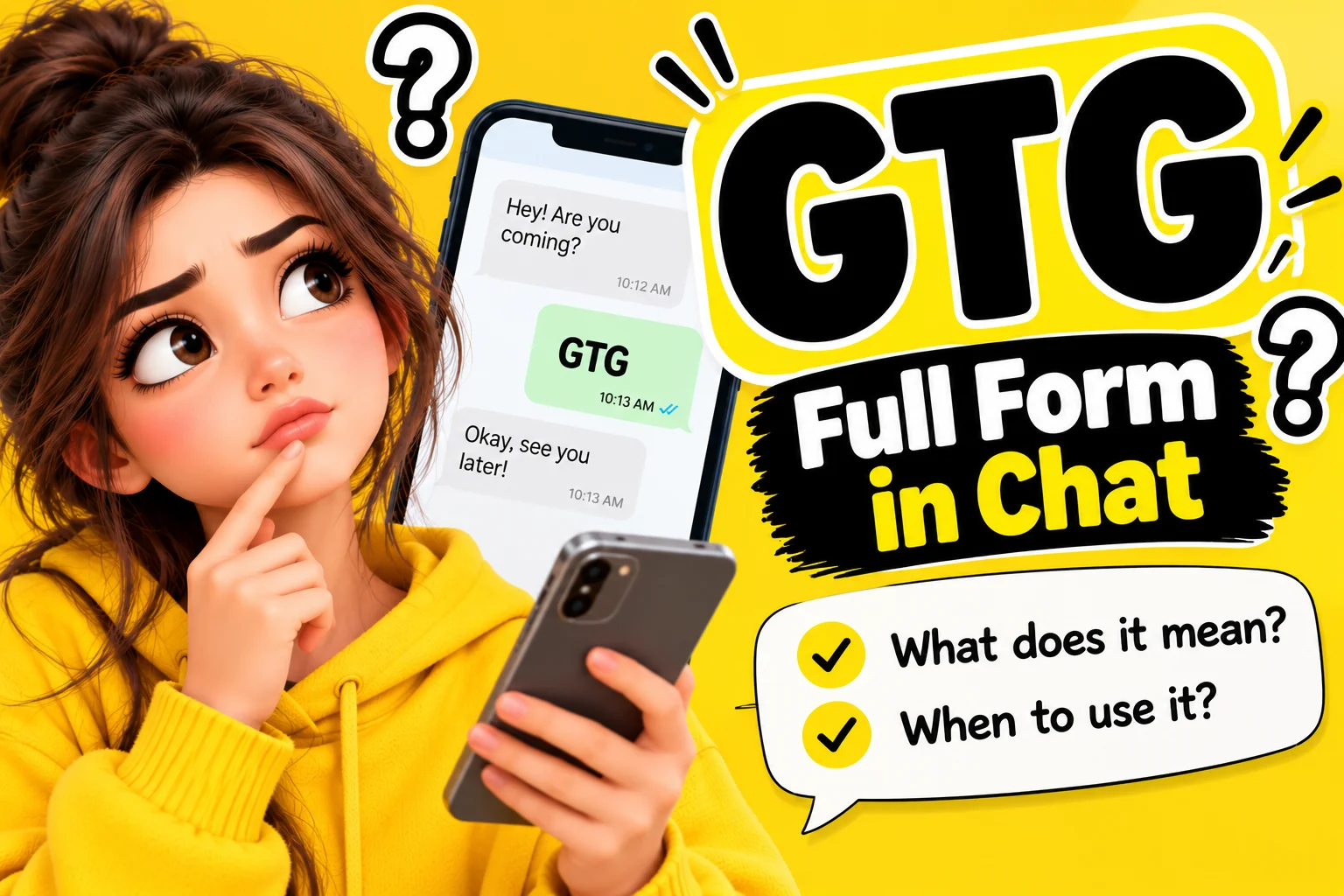

GTG in chat usually means “Got to Go.” When someone sends “GTG” in a text, they are telling you they need to leave the conversation or go somewhere. It is a casual abbreviation commonly used in texting, instant messages, and online chats.
If you have received a message like “GTG, talk later!”, the meaning is simple: the person has to leave for now.
What Does GTG Mean in Chat?
The most common GTG full form in chat is “Got to Go.” It tells the other person that the conversation needs to end, at least temporarily.
For example:
A: Are you free to talk?
B: For a few minutes.
A: Okay, tell me what happened.
B: GTG, my dad needs me.
Here, “GTG” means “Got to go.”
GTG does not usually communicate anger or dislike. In most conversations, it simply indicates that the person has another task, appointment, responsibility, or reason to leave.
Is GTG an Acronym or Abbreviation?
GTG is generally described as a texting abbreviation. It is formed from the initial letters of “got to go.”
You may see it written in several ways:
- GTG
- gtg
- Gtg
- GTG!
- gtg, ttyl
The meaning generally stays the same. Capitalization can change the visual tone, but it does not create a completely different definition.
READ MORE: What Does G6 Mean in Text?
What Does “GTG” Mean When Someone Texts It to You?
When someone texts you “GTG,” they are usually saying that they need to leave or stop chatting.
The exact reason depends on the surrounding conversation.
They might be:
- Going somewhere
- Starting work or class
- Responding to a family member
- Getting ready for an appointment
- Becoming busy with another task
- Ending the conversation for the moment
For example:
“GTG, my bus is here.”
means the person needs to leave because their bus has arrived.
Meanwhile:
“GTG, talk tomorrow.”
means they are ending the conversation but expect to talk again later.
How GTG Is Used in Text Messages
GTG works naturally at the beginning or end of a text message.
At the beginning
“GTG, I’ll call you later.”
Here, GTG immediately tells the recipient that the sender has to leave.
At the end
“Okay, I have to get ready now. GTG!”
In this case, the abbreviation reinforces the reason for ending the conversation.
As a standalone reply
Someone can also simply send:
“GTG”
This can function as a complete response when the context already makes the meaning clear.
For example:
A: Want to keep playing?
B: GTG.
The second person is saying they need to leave.
GTG on Different Messaging Platforms
GTG is primarily a casual texting and chat abbreviation, so it can appear wherever people have informal conversations.
SMS and iMessage
GTG can be used in ordinary phone texting:
“GTG, dinner is ready.”
WhatsApp users may use GTG when ending a conversation:
“GTG now. I’ll message you later.”
Instagram and Snapchat DMs
GTG can also appear in direct messages when someone wants to leave the conversation:
“GTG 😭 I have homework.”
Discord
In casual Discord conversations, GTG can indicate that someone is leaving the chat or stepping away:
“GTG guys, catch you later.”
The abbreviation does not require a particular platform. Its meaning comes from the phrase “Got to Go.”
GTG Tone: What Does It Sound Like?
The tone of GTG depends heavily on the surrounding message.
Funny
A person might use GTG dramatically as a joke.
A: Did you really eat the whole pizza?
B: Maybe.
A: There were eight slices!
B: GTG, I suddenly remembered I have somewhere to be 😂
Sarcastic
GTG can also appear in a playful sarcastic exchange.
A: You said you were going to help me clean.
B: I was going to.
A: Then why are you putting on your shoes?
B: GTG. Important business. 😭
Playful
Friends may use it casually without any serious meaning.
A: Movie starts in ten minutes.
B: I know!
A: Then hurry up.
B: GTG, grabbing snacks 😂
Serious
In a serious conversation, GTG can simply indicate that the person has to stop texting.
A: We should finish discussing this later.
B: I agree.
A: I need to leave for work now.
B: GTG too. We’ll talk tonight.
10 Real Text Examples Using GTG
1. Between friends
A: Are you coming downstairs?
B: Give me two minutes.
A: Hurry!
B: GTG, my ride is here.
2. Between siblings
A: Can you help me with this?
B: Sure, what do you need?
A: Can you check my laptop?
B: GTG right now. I’ll help later.
3. With a partner
A: Are you still awake?
B: Yeah, barely.
A: Want to talk for a few minutes?
B: I wish I could, but GTG. I have an early morning.
4. With a coworker
A: Did you finish the document?
B: Almost.
A: Send it when you’re done.
B: GTG for my meeting, but I’ll send it afterward.
5. With a parent
A: Did you get home?
B: Yes.
A: Okay, call me when you’re free.
B: GTG, Mom. Talk later.
6. In a group chat
A: Anyone still playing?
B: I am.
A: Same.
C: GTG everyone. Good game!
7. With a classmate
A: Did you understand today’s assignment?
B: Mostly.
A: Can we compare answers later?
B: Sure, GTG now. I have class.
8. With a friend online
A: You joining the game?
B: Not tonight.
A: Everything okay?
B: Yeah, just GTG. I have some work to finish.
9. A quick conversation
A: Want to keep chatting?
B: Definitely.
A: Then why are you leaving?
B: GTG! I’ll text you tomorrow.
10. A casual DM
A: Did you see the new episode?
B: Not yet. No spoilers!
A: Fine 😂
B: GTG, I’m actually going to watch it now.
Grammar and Language: How Do You Use GTG?
GTG functions as a texting abbreviation rather than a conventional part of speech.
It can appear:
- At the beginning of a message
- At the end of a message
- In the middle of a sentence
- As a complete standalone reply
For example:
“GTG, talk later.”
or:
“I’m GTG now.”
The first construction is more natural because the abbreviation usually introduces the idea that the sender needs to leave.
GTG vs. “Got to Go”
There is no major difference in meaning.
“Got to go” is the complete phrase.
“GTG” is the shortened texting version.
The abbreviation feels faster and more casual.
GTG vs. Similar Texting Abbreviations
| Term | Meaning | Usage Context | Tone | Popularity | Confusion Risk |
|---|---|---|---|---|---|
| GTG | Got to Go | Leaving a conversation | Casual | Common | Low |
| BRB | Be Right Back | Temporarily leaving | Casual | Common | Low |
| TTYL | Talk to You Later | Ending a conversation | Friendly | Common | Low |
| AFK | Away From Keyboard | Temporarily unavailable | Casual/gaming | Common online | Medium |
| G2G | Got to Go | Leaving or ending chat | Casual | Common variant | Low |
| STAY | Remain/continue | Opposite idea | Context-dependent | Ordinary word | Medium |
One particularly close variation is G2G, which uses the number “2” to represent “to.” Therefore, GTG and G2G can communicate essentially the same message in casual chat.
GTG vs. BRB: What’s the Difference?
GTG means “Got to Go,” while BRB means “Be Right Back.”
The distinction is important.
If someone says:
“GTG, talk later.”
they are generally ending the conversation.
If they say:
“BRB, getting some water.”
they normally expect to return shortly.
So GTG usually signals leaving, while BRB usually signals temporary absence.
Who Uses GTG?
GTG is associated with informal digital communication rather than formal writing.
People may use it in:
- One-on-one text messages
- Group chats
- Messaging apps
- Social-media DMs
- Gaming chats
- Informal online conversations
There is no need to assume that only one age group uses GTG. People familiar with texting abbreviations may understand and use it, although individual texting habits vary.
Younger texters may prefer lowercase “gtg,” while uppercase “GTG” can make the abbreviation more visually prominent.
Where Did GTG Come From?
GTG belongs to the broader tradition of internet and mobile-text shorthand. People have long shortened common phrases to make typing faster and messages more compact.
Unlike newer slang terms that emerge from a specific viral meme or social-media trend, GTG is straightforward functional shorthand. It compresses the familiar phrase “got to go” into three letters.
Its usefulness explains why it remains easy to understand: the abbreviation directly preserves the first letters of the words.
Is GTG Rude?
GTG is not inherently rude.
However, sending only “GTG” can sometimes feel abrupt depending on the relationship and conversation.
Compare:
“GTG.”
with:
“GTG, sorry! I have to run. Talk to you later 😊”
The second version feels warmer because it provides context and signals that the person is not deliberately ignoring the conversation.
If you are speaking with a teacher, manager, client, or another person in a formal setting, writing “I have to go now” is usually clearer and more appropriate than relying on texting shorthand.
How to Reply to GTG
Your response can depend on your relationship with the person.
Funny reply
“Fine 😂 Go save the world. Talk later.”
Serious reply
“Okay. We can continue this conversation later.”
Flirty reply
“GTG already? I was just getting to the good part 😏”
Neutral reply
“Okay, talk later!”
A simple “Okay, talk later” is usually enough if you are unsure how to respond.
Is GTG Appropriate at School or Work?
GTG is generally appropriate for casual personal texting, but it may not be suitable for every professional situation.
With close friends, it is completely normal:
“GTG, see you tomorrow.”
With a teacher or manager, a complete phrase is usually more professional:
“I need to leave now. I’ll respond later.”
The same principle applies to formal emails, applications, academic work, and business communication. Standard language is clearer in those settings.
Real-World Observation: Why GTG Still Works
What makes GTG interesting is how little explanation it needs. In a fast conversation, three letters can immediately signal that the other person is stepping away. It also leaves room for the sender to add a reason—“GTG, class is starting”—or a future connection—“GTG, talk later.” Unlike many slang terms whose meanings depend heavily on internet culture, GTG remains useful because it solves a practical communication problem: ending a conversation quickly without typing the full phrase.
Frequently Asked Questions About GTG
What is the full form of GTG in chat?
The most common full form of GTG is “Got to Go.” It is a casual texting abbreviation used when someone needs to leave a conversation or go somewhere. You may see it in SMS, WhatsApp messages, DMs, gaming chats, and other informal conversations.
What does GTG mean when someone texts it to you?
When someone texts GTG, they usually mean they need to leave or stop chatting. They may be going somewhere, becoming busy, starting work, or simply ending the conversation. The exact reason usually comes from the surrounding message.
Is GTG rude to send in a text?
GTG itself is not rude. However, sending only “GTG” can sound abrupt in some situations, especially during a serious conversation. Adding “sorry,” a reason, or “talk later” can make the message feel friendlier.
What is the difference between GTG and BRB?
GTG means “Got to Go,” while BRB means “Be Right Back.” GTG usually signals that the person is leaving the conversation. BRB normally suggests that the person expects to return shortly.
What is the difference between GTG and G2G?
GTG and G2G can both mean “Got to Go.” G2G uses the number 2 as a shorthand representation of “to.” Both are informal texting expressions.
Does GTG mean the same thing in a group chat?
Generally, yes. In a group chat, GTG usually means that the person is leaving the conversation or becoming unavailable. For example, “GTG everyone, see you tomorrow” clearly signals that the sender is stepping away.
Can GTG be used in a professional text?
It can be understood, but it is usually better to use complete wording in professional communication. Instead of “GTG,” you could write “I need to leave now” or “I have to go, but I’ll follow up later.”
What’s the difference between texting GTG and saying “got to go” out loud?
The meaning is essentially the same. GTG is simply a shortened written form designed for quick digital communication. When speaking, people normally say the complete phrase rather than pronouncing the letters G-T-G.
Conclusion: GTG Meaning in Text
The GTG full form in chat is “Got to Go.” It is a simple, informal abbreviation used when someone needs to leave a conversation or become unavailable.
Remember these points:
- GTG = Got to Go
- It is mainly used in casual digital communication.
- G2G is a closely related variation.
- BRB means something different because it suggests returning soon.
- GTG can stand alone or appear with a reason and goodbye.
- Use complete wording instead of GTG in formal or professional communication.
Common mistakes to avoid
- Don’t assume GTG means the person is angry.
- Don’t confuse GTG with BRB.
- Don’t treat every short GTG message as a rejection or insult.
- Avoid using texting abbreviations in formal academic or business writing.
When to use GTG
Use GTG when you are chatting casually with friends, family, gaming partners, or people who are comfortable with texting shorthand.
Avoid it when you need a formal, professional, or especially sensitive message.
In short, if someone texts “GTG,” they usually mean they have to go.