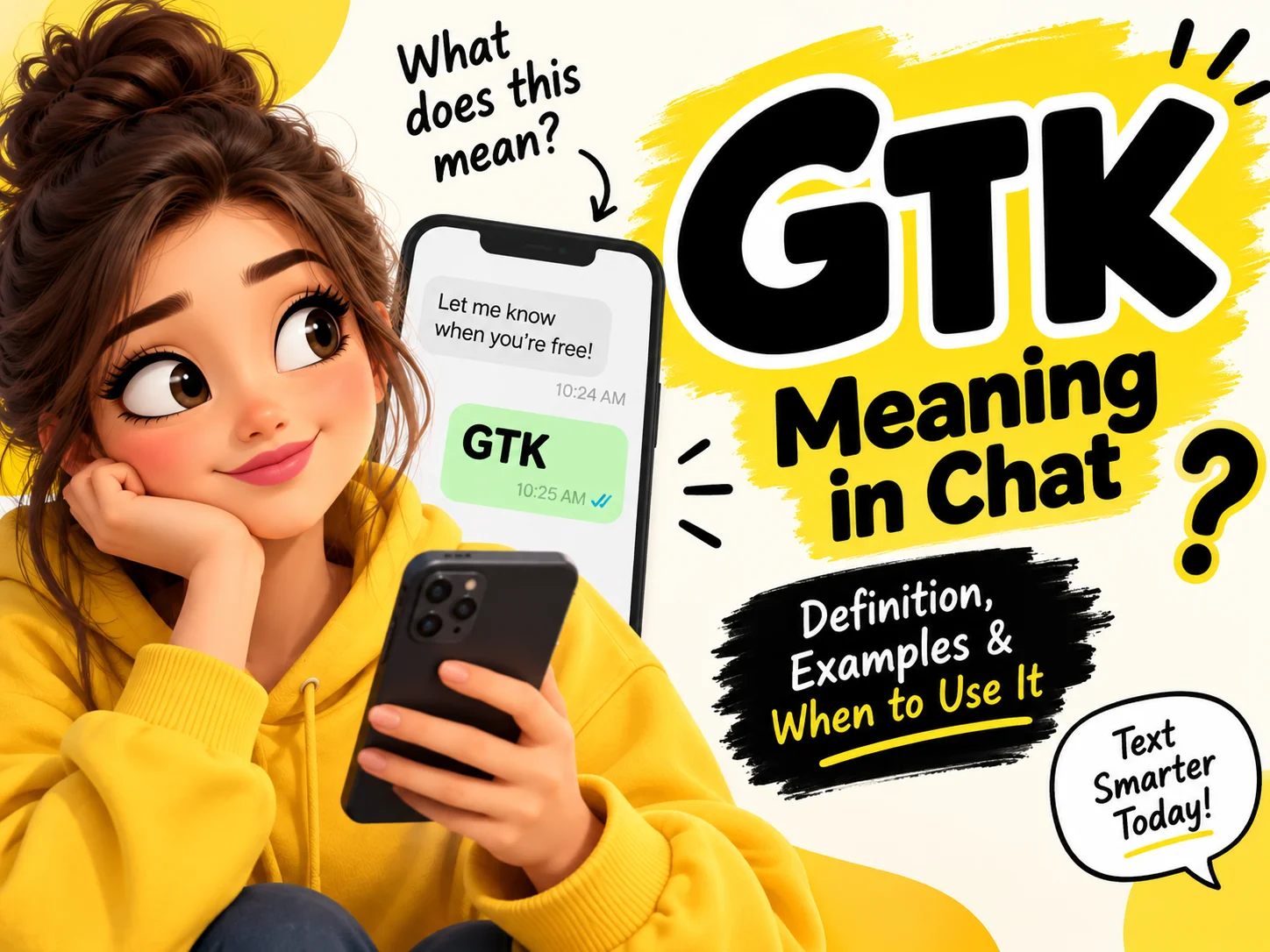

GTK usually means “Good to Know” in chat and text messages. People use it to acknowledge helpful information, show that they understand something, or respond positively to an update. When someone texts “GTK, thanks!” they mean “Good to know, thanks!”
The abbreviation is common in informal digital communication, including texting and online conversations. However, its tone depends on the situation. This guide explains GTK meaning in chat, real text examples, tone variations, how to reply, and when to use it.
What Does GTK Mean in Chat?
GTK stands for “Good to Know.” It is an informal abbreviation that people use when someone shares information, provides an update, or explains something useful.
For example:
A: The store closes at 8 PM today.
B: GTK, thanks!
Here, GTK acknowledges the information without requiring a long response.
Is GTK an Acronym or Abbreviation?
GTK is commonly treated as an initialism or abbreviation for “Good to Know.” People usually read the letters individually rather than pronouncing them as a regular word.
It is different from a slang term that expresses an emotion or reaction. Instead, GTK primarily communicates acknowledgment.
GTK Full Form
| Short Form | Full Form | Meaning |
|---|---|---|
| GTK | Good to Know | Useful or helpful information |
| GTK, thanks | Good to Know, thanks | Acknowledges information appreciatively |
| Oh, GTK | Oh, good to know | Shows that the sender has learned something |
The exact tone can range from neutral to friendly.
READ MORE: What’s “WTV” Mean in Text? Tone & How to Use It Naturally
How GTK Works in Different Texting Situations
1. GTK as a Simple Acknowledgment
Someone may use GTK when they receive information they didn’t know before.
Example:
A: The assignment deadline is Friday.
B: GTK! I thought it was Thursday.
The sender acknowledges the correction and shows that the information is useful.
2. GTK as a Polite Response
GTK can make a short reply sound appreciative when paired with “thanks.”
A: I uploaded the revised document.
B: GTK, thanks for letting me know.
This response is casual but polite.
3. GTK in Work or Study Chats
The abbreviation may appear in informal workplace or class group messages. However, not everyone recognizes abbreviations immediately, so “Good to know” is a clearer choice when communicating with unfamiliar audiences.
Example:
A: The meeting has moved to Room 4.
B: GTK. I’ll be there at 10.
GTK Tone Variations With Real Text Conversations
The same abbreviation can feel different depending on the surrounding message.
Funny Tone
A person may use GTK in a playful response when someone shares a surprising fact.
A: Apparently, coffee isn’t a food group.
B: GTK 😂
A: You seriously didn’t know?
B: I was living by different rules.
Sarcastic Tone
GTK itself isn’t sarcastic, but the surrounding words can create sarcasm.
A: You need to submit the form before the deadline.
B: GTK, would’ve been helpful to know yesterday.
A: Sorry, I thought everyone had seen the update.
B: All good, I’ll handle it.
The sarcasm comes from the complaint, not from the abbreviation alone.
Playful Tone
Friends may use GTK as part of a lighthearted conversation.
A: Your favorite restaurant has a new menu.
B: GTK 👀
A: I knew you’d want to hear that.
B: When are we going?
Serious Tone
GTK can also appear in a practical conversation where someone needs useful information.
A: The appointment has been moved to Monday.
B: GTK. I’ll update my calendar.
A: Let me know if the new time works.
B: It does. Thanks.
10 Real Chat Examples Using GTK
These examples show how GTK might appear in everyday texting and messaging.
Example 1: Friends
A: The movie starts at 7:30, not 8.
B: GTK, I’ll leave earlier.
A: Don’t be late this time 😂
B: No promises.
Example 2: Partners
A: I have a busy day tomorrow, so I might reply late.
B: GTK, thanks for telling me.
A: I didn’t want you to think I was ignoring you.
B: I understand ❤️
Example 3: Coworkers
A: The client meeting is now online.
B: GTK. I’ll join through the meeting link.
A: Great, see you there.
B: See you.
Example 4: Siblings
A: Mom said dinner will be ready at 9.
B: GTK, I’m still outside.
A: Don’t forget to come home.
B: I’m on my way.
Example 5: Classmates
A: The professor extended the deadline until Monday.
B: GTK! I needed extra time.
A: Same. I was stressing over it.
B: At least we can finish properly now.
Example 6: Group Chat
A: The event location has changed to the community hall.
B: GTK, I’ll share it with everyone.
A: Thanks!
B: No problem.
Example 7: Family
A: Your appointment is at 11 AM tomorrow.
B: GTK, I’ll set an alarm.
A: Please arrive a little early.
B: Okay, I will.
Example 8: Casual Acquaintance
A: The café is closed on Sundays.
B: Oh, GTK. I’ll go Saturday instead.
A: Good idea.
B: Thanks for the heads-up.
Example 9: Online Friend
A: That game has a new update today.
B: GTK 👀 I’ll check it out.
A: Let me know what you think.
B: Definitely.
Example 10: Short Reply
A: Your package should arrive tomorrow.
B: GTK, appreciate the update.
A: You’re welcome.
B: Thanks again.
Grammar and Language Role of GTK
GTK doesn’t function like a standard grammatical word. It acts as a short response or conversational phrase.
| Feature | Explanation |
|---|---|
| Part of speech | Abbreviated conversational phrase |
| Sentence position | Often stands alone at the beginning of a response |
| Stand-alone use | Yes, particularly as an acknowledgment |
| Register | Informal |
| Capitalization | GTK, gtk, or G.T.K. may appear, depending on typing style |
| Embedded use | Can appear with additional words, such as “GTK, thanks.” |
Can GTK Stand Alone?
Yes. Someone might reply with just “GTK” after receiving information. However, a short response can sometimes feel abrupt, especially in a sensitive conversation.
Compare:
- “GTK.” — Brief acknowledgment.
- “GTK, thanks!” — More appreciative.
- “Good to know. I appreciate it.” — Clearer and more conversational.
How to Reply to GTK in Chat
Your reply depends on the context and the tone you want to maintain.
Choose a reply style
FriendlyFunnySeriousNeutral
Friendly reply
“You’re welcome! Just wanted to keep you updated 😊”
If Someone Says “GTK, Thanks”
You can respond with:
- “You’re welcome!”
- “No problem.”
- “Glad to help.”
- “Anytime!”
You don’t need to send a lengthy response when the conversation has naturally ended.
GTK vs. Related Chat Abbreviations
| Term | Meaning | Usage Context | Tone | Popularity | Confusion Risk |
|---|---|---|---|---|---|
| GTK | Good to Know | Acknowledging information | Neutral/friendly | Common in informal chat | Low |
| FYI | For Your Information | Sharing information | Informative | Common | Low |
| BTW | By the Way | Adding a side note | Casual | Common | Low |
| TIL | Today I Learned | Sharing something newly learned | Casual | Common online | Medium |
| TY | Thank You | Expressing thanks | Friendly | Common | Low |
| IDK | I Don’t Know | Expressing uncertainty | Casual | Common | Low |
These abbreviations have different functions. GTK acknowledges information, while FYI introduces information and IDK communicates uncertainty.
Who Uses GTK in Chat?
GTK can be used by people who communicate in informal English-language text conversations. However, there is no reliable basis here for claiming that one age group or region uses it more frequently than another.
Gen Z vs. Millennials
Both groups may recognize or use chat abbreviations. Individual texting preferences vary, and the choice between “GTK,” “good to know,” and “thanks for the update” depends on the person and setting.
SMS, WhatsApp, and DMs
GTK may appear in text messages, WhatsApp conversations, and social media direct messages. It is most natural in situations where someone shares useful information and the recipient wants to acknowledge it.
It isn’t necessary to assume that a specific platform created the abbreviation or that its usage is limited to one generation.
Origin and Internet Culture
GTK is formed from the initial letters of Good To Know. This kind of abbreviation follows a straightforward pattern in informal digital communication: speakers shorten familiar phrases to make quick written replies.
A specific first-use date or verified platform of origin shouldn’t be assumed without historical evidence. GTK’s meaning is relatively transparent because each letter corresponds to a word in the phrase.
Unlike some slang terms, GTK doesn’t require a special meme or cultural reference to understand its ordinary use.
Is GTK Rude or Offensive?
GTK is generally neutral and not offensive. It doesn’t contain profanity or inherently insulting language.
However, a one-word response can feel distant if someone shares personal or emotional information. For example, replying “GTK” to a friend discussing a difficult experience may sound less supportive than a more thoughtful response.
School and Workplace Appropriateness
GTK is acceptable in some informal group chats, but professional communication often benefits from clearer language.
- Informal: “GTK, thanks!”
- Professional: “Good to know. Thank you for the update.”
When communicating with a teacher, manager, or client, consider using the complete phrase if you aren’t sure the abbreviation will be understood.
Real-World Observation: Why GTK Works in Texting
GTK is useful because it performs a small but important conversational task: it confirms that information has reached the other person. Rather than repeating the entire message, the sender can acknowledge it with three letters. The phrase is especially practical when someone shares a schedule change, instruction, recommendation, or helpful fact. Its meaning is usually clear from the message that comes before it, making context more important than elaborate wording.
Frequently Asked Questions About GTK Meaning in Chat
1. What does GTK mean in chat?
GTK usually means “Good to Know.” People use it to acknowledge information or show that something they’ve learned is useful. For example, “GTK, thanks!” means “Good to know, thanks!” The abbreviation is generally informal and context-dependent.
2. Is GTK rude in a text message?
GTK isn’t inherently rude. However, a short reply can feel abrupt if the conversation involves something personal or serious. Adding “thanks,” “I appreciate it,” or another supportive phrase can make your intention clearer.
3. What is the full form of GTK?
The full form of GTK in ordinary chat usage is Good to Know. It is an abbreviation made from the first letters of the phrase. The meaning is usually an acknowledgment of information.
4. Can I use GTK in a professional message?
You can use GTK in informal professional chats when the people involved understand the abbreviation. For emails, formal requests, or communication with unfamiliar recipients, “Good to know” is clearer. The best choice depends on your workplace’s communication style.
5. What is the difference between GTK and FYI?
GTK means “Good to Know,” while FYI means “For Your Information.” GTK usually responds to information that someone has shared, whereas FYI introduces information for another person’s awareness. They may appear in the same conversation but serve different purposes.
6. Does GTK mean thank you?
GTK doesn’t literally mean “thank you.” It means “Good to Know,” although someone may add “thanks” to express appreciation. For example, “GTK, thanks!” communicates both acknowledgment and gratitude.
7. Can GTK be used in a group chat?
Yes, GTK can be used in a group chat when someone shares an update or useful detail. The abbreviation doesn’t change its core meaning in a group conversation. Still, using the full phrase may help if some members aren’t familiar with it.
8. What’s the difference between texting GTK and saying good to know aloud?
The meaning is the same, but GTK is a written abbreviation. In spoken conversation, people generally say “Good to know” rather than pronounce the individual letters. Written abbreviations often reflect the convenience of typing rather than a change in meaning.
Conclusion: GTK Meaning in Chat
GTK means “Good to Know.” It is an informal abbreviation used to acknowledge information, respond to updates, and show that something is useful.
Tips for Using GTK
- Use GTK in casual text conversations.
- Add “thanks” when you want to express appreciation.
- Consider your audience before using abbreviations.
- Use “Good to know” in formal communication when clarity matters.
Common Mistakes to Avoid
- Assuming GTK means “thank you.”
- Treating it as a universal response to emotional situations.
- Using unexplained abbreviations in formal messages.
- Assuming that a short reply always indicates disinterest or rudeness.
When to Use or Avoid GTK
Use GTK when someone shares helpful information and you want to acknowledge it quickly. Avoid relying on it alone when the conversation requires empathy, detailed feedback, or a formal response.