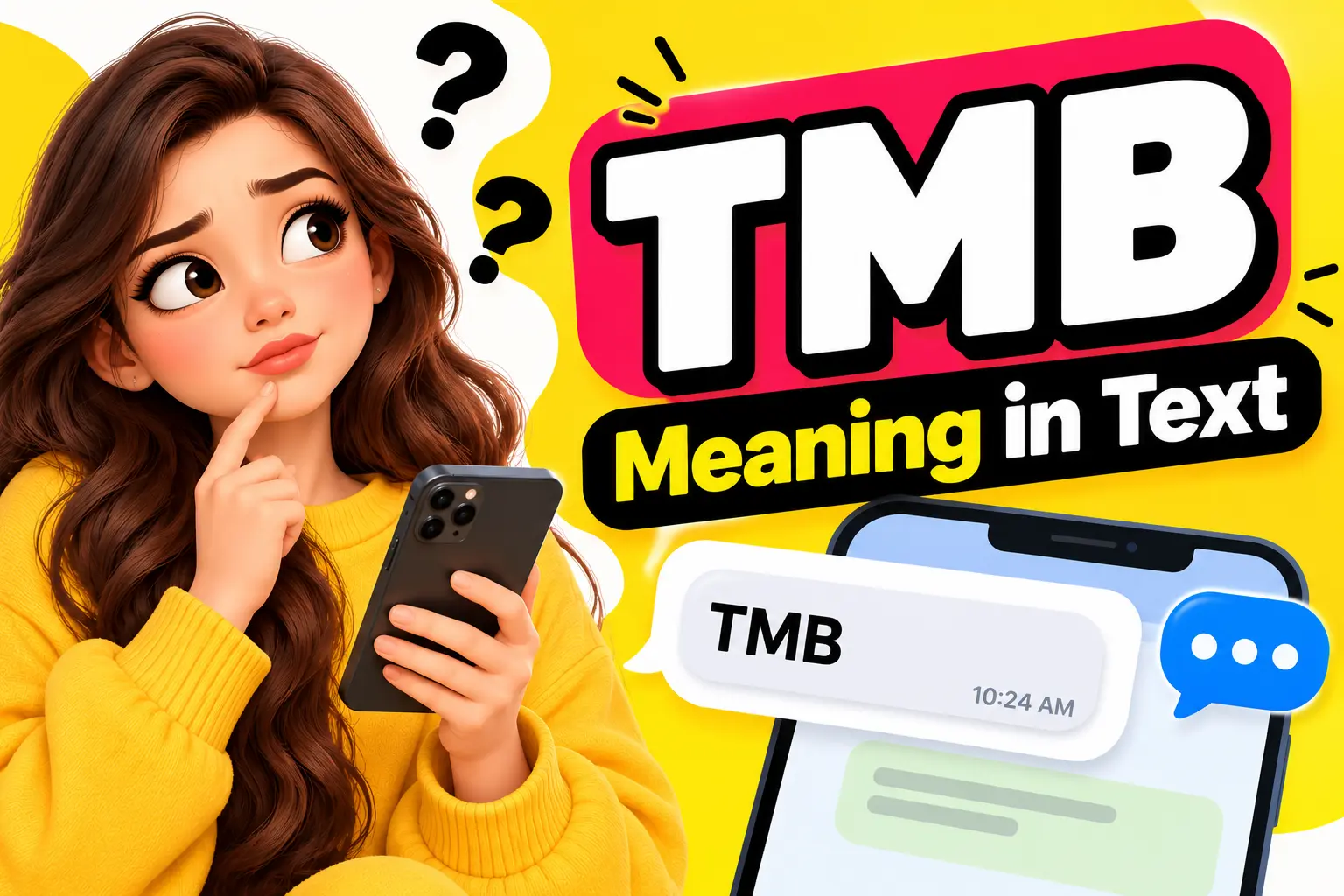

If someone texts you “TMB,” it usually means “Text Me Back.” This common texting abbreviation asks you to reply to a message. People use it in everyday conversations with friends, family members, partners, and other contacts when they want to continue a conversation or receive an answer.
However, TMB can have other meanings in specific contexts, including “Tag Me Back” on social media. Understanding the surrounding message helps you identify the intended meaning and choose an appropriate reply.
What Does TMB Mean in Text?
TMB stands for Text Me Back. It is an informal abbreviation that people use to ask someone to send a reply by text.
The abbreviation breaks down into three letters:
- T = Text
- M = Me
- B = Back
For example, someone might write, “TMB when you get home.” This means they want you to send them a message after you arrive home.
TMB does not automatically mean that someone expects an immediate response. The sender might simply want to continue the conversation later. Words such as “now,” “ASAP,” or “when you can” help communicate how quickly they expect a reply.
READ MORE: ITR Meaning in Text: What Does ITR Stand For?
Other Possible Meanings of TMB
Although “Text Me Back” is a common interpretation in personal messages, the abbreviation can mean different things depending on the situation.
- Text Me Back: Asking someone to reply to a message.
- Tag Me Back: Asking someone to tag you in return on social media.
- Tweet Me Back: Asking for a response on Twitter, now known as X, particularly in a social-media context.
- Take Me Back: Expressing a wish to return to a previous time, place, or relationship.
These alternatives are context-dependent and should not be treated as equally common in ordinary texting. In a private conversation, “Text Me Back” is generally the most useful interpretation to consider first. https://www.allacronyms.com/TMB/Text_me_back
How Is TMB Used in Text Messages?
People use TMB when they want a response without typing a complete sentence. It can appear at the end of a message, after a question, or as a short follow-up when a conversation pauses.
Here are some common examples:
- “TMB when you’re free.”
- “I have something important to tell you. TMB!”
- “I’m leaving for work. TMB later.”
- “Did you see my message? TMB.”
- “Let me know what you decide and TMB.”
The tone depends on the wording and the relationship between the people. For instance, “TMB whenever you have time” sounds considerate, while “TMB NOW!” can sound demanding.
TMB on SMS, iMessage, and WhatsApp
In ordinary text messages, TMB is a convenient way to ask someone to respond. It works in SMS, iMessage, and WhatsApp conversations when both people understand the abbreviation.
Example:
A: I’m going to the market now.
B: Okay, TMB when you get back.
A: Sure, I’ll message you.
B: Great!
Here, the sender wants to continue chatting after the other person returns.
TMB in Instagram, Snapchat, and Discord DMs
TMB can also appear in private messages on Instagram, Snapchat, and Discord. The basic meaning remains the same when the sender wants a response.
Example:
A: I sent you the pictures.
B: I haven’t checked them yet.
A: No problem, TMB after you look.
B: Okay, I’ll let you know.
On social media, the context matters because TMB might refer to tagging someone back rather than replying to a private message.
Four TMB Tone Variations With Realistic Conversations
The abbreviation does not have one fixed emotional tone. The sender’s words, punctuation, and relationship with the recipient can change how it sounds.
1. Funny TMB
A friend can use TMB playfully when waiting for a reply.
A: I sent you the funniest video.
B: Wait, I’m watching it now.
A: TMB with your review 😂
B: Five stars. Send me another one!
2. Sarcastic TMB
When someone has ignored several messages, TMB can sound sarcastic.
A: Did you see my three messages?
B: Yes, sorry. I got busy.
A: Amazing. TMB before next year, please.
B: Okay, okay! I’m replying now.
3. Playful TMB
Friends or romantic partners might use it to keep a lighthearted conversation going.
A: I’m going to sleep now.
B: Already? We just started talking.
A: TMB tomorrow, sleepyhead ❤️
B: Fine, but you have to message first.
4. Serious TMB
Someone might use TMB when they need an important answer.
A: Did you confirm the meeting time?
B: Not yet. I’m waiting for the manager.
A: Please TMB as soon as you know.
B: Of course. I’ll update you immediately.
10 Realistic TMB Text Conversations
The following examples show how TMB can appear in different relationships and everyday situations.
Example 1: Between Friends
A: Are we still meeting this evening?
B: Yes, I just need to finish my work.
A: Okay, TMB when you’re ready.
B: Will do!
Example 2: Between Partners
A: I miss talking to you.
B: I’m busy for a little while, love.
A: No worries. TMB when you’re free.
B: I will ❤️
Example 3: Between Siblings
A: Did Mom say what time we’re leaving?
B: I think around six.
A: Check with her and TMB.
B: Okay, I’ll ask her.
Example 4: Between a Parent and Child
A: Have you reached your academy?
B: Not yet, I’m on the way.
A: TMB when you arrive safely.
B: Okay, I’ll message you.
Example 5: Between Coworkers
A: Can you confirm whether the report is ready?
B: I’m checking the final figures.
A: Thanks. TMB when you finish.
B: I’ll send you an update shortly.
Example 6: Between Classmates
A: Did you understand today’s assignment?
B: Most of it, but I’m confused about question four.
A: I’ll check my notes. TMB in a few minutes.
B: Thanks, that would help.
Example 7: When Someone Is Busy
A: Can I ask you something?
B: I’m driving at the moment.
A: No problem. TMB when you stop.
B: Sure, I’ll message you then.
Example 8: A Flirty Conversation
A: You disappeared yesterday!
B: Sorry, I fell asleep early.
A: You owe me a proper conversation. TMB tonight 😉
B: Deal. I’ll make time for you.
Example 9: A Family Plan
A: Are you coming to dinner on Sunday?
B: I need to check my schedule first.
A: Okay, TMB once you know.
B: I’ll confirm tomorrow.
Example 10: An Unfamiliar Contact
A: Hello, I sent you the details yesterday.
B: Thanks, I haven’t had time to read them.
A: Please TMB after you’ve reviewed everything.
B: Certainly. I’ll get back to you.
How to Reply to TMB in a Text
Your response depends on whether you can reply immediately and how well you know the sender.
- Funny reply: “I’m here! No need to send a search party 😂”
- Serious reply: “I’ll review the details and get back to you shortly.”
- Flirty reply: “Only if you promise to keep the conversation interesting 😉”
- Neutral reply: “Sure, I’ll message you later.”
- If you’re busy: “I’m occupied right now, but I’ll reply when I’m free.”
- If you need clarification: “Do you mean you want me to text you back?”
You do not need to answer with another abbreviation. A simple, clear sentence is perfectly fine.
Grammar and Language Role of TMB
TMB is an informal abbreviation or initialism, not a standard English word. People generally understand it by recognizing the words represented by its letters.
It often appears at the end of a sentence, such as “Let me know the time and TMB.” It can also stand alone as a brief request, although the recipient needs enough context to understand what they should respond to.
People may write it as “TMB,” “tmb,” or “Tmb.” Capitalization usually does not change its meaning, although all capitals can sometimes make the message feel more forceful.
TMB is suitable for casual conversations, but it is usually better to write “Please reply when you can” in formal workplace communication.
TMB vs. Other Common Texting Abbreviations
| Term | Meaning | Usage Context | Tone | Popularity | Confusion Risk |
|---|---|---|---|---|---|
| TMB | Text Me Back | Requesting a reply | Casual | Context-dependent | Medium |
| TTYL | Talk To You Later | Ending a conversation | Friendly | Widely recognized | Low |
| BRB | Be Right Back | Temporarily leaving a chat | Casual | Widely recognized | Low |
| LMK | Let Me Know | Requesting information | Neutral | Widely recognized | Low |
| HMU | Hit Me Up | Asking someone to contact you | Casual | Widely recognized | Medium |
| GTG | Got To Go | Leaving a conversation | Casual | Widely recognized | Low |
The main difference is that TMB specifically asks someone to respond, while TTYL indicates that the conversation will continue later. LMK asks someone to provide information, and HMU invites them to initiate contact.
Who Uses TMB?
TMB is an informal expression that can be understood by people who regularly use texting abbreviations. It is not limited to one age group, although individual familiarity varies.
Gen Z and Millennials
Some younger texters use lowercase abbreviations and short replies as part of their everyday messaging style. Millennials may also use TMB, especially when communicating casually with friends, family, and colleagues.
However, there is no reliable basis for claiming that one generation uses TMB more than the other in every setting. Personal habits, social circles, and communication preferences all matter.
Regional Usage
TMB can be understood in English-language online conversations across different regions, but its familiarity is not guaranteed everywhere. The intended meaning should be inferred from the surrounding message rather than assumptions about someone’s location.
Origin and Internet Culture
TMB is a straightforward initialism formed from the phrase “Text Me Back.” Its structure reflects a broader habit of shortening common expressions in digital communication.
However, the precise first use and origin date of TMB are not established by the sources consulted for this article. It would therefore be misleading to attribute it to a particular year, platform, or viral trend without stronger evidence.
Its practical appeal is easy to understand: three letters can communicate a request that would otherwise require several words. Unlike expressions that depend on a particular meme, TMB remains understandable whenever someone wants a reply.
Is TMB Rude or Inappropriate?
TMB is not inherently rude, offensive, or profane. In most casual conversations, it simply asks someone to send a reply.
Still, context can make it sound impatient. Sending repeated messages such as “TMB,” “TMB??,” and “TMB NOW!” may make the recipient feel pressured.
For school, university, or professional communication, use a more polite alternative when appropriate. For example, “Could you please respond when you have a chance?” sounds more professional than a standalone abbreviation.
There are no special cultural sensitivities associated with the ordinary meaning of “Text Me Back,” but the sender should respect the recipient’s time and availability.
Frequently Asked Questions About TMB Meaning
1. What does TMB mean in text?
TMB usually means “Text Me Back.” It is an informal way to ask someone to respond to a message. The sender may want an answer immediately or simply want to continue the conversation later.
2. What is the full form of TMB?
The most common texting expansion is “Text Me Back.” The letters represent the first letters of the three words. Other interpretations are possible when the conversation involves a different meaning, such as tagging someone on social media.
3. Is it rude to reply with just TMB in a text?
Not necessarily, because friends and familiar contacts may understand it as a simple request. However, sending TMB without context can sound abrupt, especially to someone you do not know well. Adding “when you have time” makes the request more considerate.
4. What’s the difference between texting TMB and saying it out loud?
In written messages, TMB functions as a shortcut for “Text Me Back.” If spoken aloud, someone would usually say the complete phrase or pronounce the letters individually. The abbreviation is generally more natural in informal digital communication than in formal spoken conversation.
5. Does TMB mean the same thing in a group chat and a private message?
It can mean “Text Me Back” in both settings, but the intended recipient may differ. In a private message, the request usually concerns one person’s reply. In a group chat, the sender might want a response from one person or several participants, so the surrounding messages help clarify the request.
6. What does TMB mean on Snapchat or Instagram?
In private messages, TMB can mean “Text Me Back,” just as it does in ordinary texting. In a social-media context involving tags, it may instead mean “Tag Me Back.” Check whether the conversation is about replying to a message or tagging someone in content.
7. What is the difference between TMB and LMK?
TMB usually asks someone to send a response, while LMK means “Let Me Know.” For example, “TMB when you’re free” requests a message, whereas “LMK if you’re coming” asks for specific information. Both are informal, but they emphasize slightly different actions.
8. Can TMB have a romantic meaning?
TMB does not automatically indicate romantic interest. A partner or crush may use it to keep a conversation going, but friends and relatives can use it too. Interpret the message alongside the relationship and the rest of the conversation rather than assuming it is flirtatious.
Conclusion: Understanding TMB in Text
TMB most commonly means “Text Me Back.” It is a short, informal abbreviation used when someone wants a response or hopes to continue a conversation. Depending on context, it can sound friendly, playful, serious, or impatient.
Tips for Using TMB
- Use TMB with friends or people who understand texting abbreviations.
- Add “when you’re free” to make the request more polite.
- Check the context before interpreting TMB as “Text Me Back.”
- Use complete sentences in formal or professional messages.
Common Mistakes to Avoid
- Assuming TMB always means the same thing in every context.
- Treating every TMB message as urgent.
- Assuming the abbreviation automatically signals romantic interest.
- Using repeated demands for a reply when the recipient may be busy.
Use TMB when you want to keep a casual conversation moving. Avoid it in formal messages where clarity and professional language matter more than brevity.