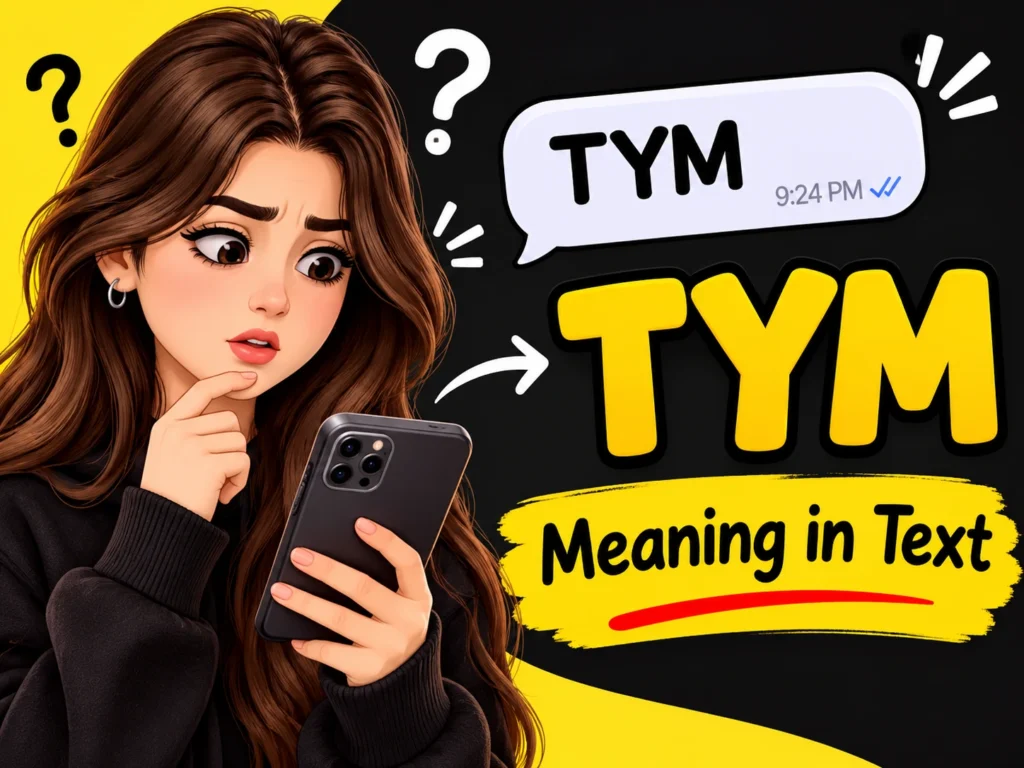
TYM most commonly means “Take Your Time” in text messages and online chats. It tells someone they do not need to hurry and can respond or finish something whenever they are ready. Depending on the conversation, the abbreviation may also be used with other intended meanings, so the surrounding message matters.
If someone texts you “TYM,” they are usually asking you not to rush. It is a short, informal expression often used between friends, family members, partners, and people communicating online.
READ MORE: Womp Meaning in Text: What Does Womp Mean?
What Does TYM Stand For in Text?
The primary texting expansion of TYM is Take Your Time.
It is an abbreviation formed from the first letters of the three words:
- T – Take
- Y – Your
- M – Time
People use it when someone apologizes for being late, needs extra time to complete a task, or cannot reply immediately.
For example:
A: Sorry, I’m still getting ready.
B: TYM, no rush!
In this exchange, the sender is reassuring the other person that there is no deadline or pressure to respond quickly.
Is TYM an Acronym or an Abbreviation?
TYM is an initialism-style abbreviation because each letter represents a word in the phrase “Take Your Time.” People generally pronounce the full phrase rather than saying the individual letters.
It is not a formal English word. Instead, it works as convenient texting shorthand.
The Other Meaning: TYM as Thank You Much
Another documented meaning of TYM is “Thank You Much.” It is a casual way of expressing appreciation when someone helps you, shares something, or does you a favor.
For example:
A: I sent you the assignment notes.
B: TYM! I really needed those.
This meaning is listed in online texting dictionaries, although it is less standardized than familiar expressions such as TY (Thank You) and TYSM (Thank You So Much). What Does TYM Mean?+2
Important distinction: TYM should not automatically be expanded as “Take Your Time.” The more established abbreviation for that phrase is TYT. Some people may use TYM informally or make a typing mistake, but the two abbreviations are not interchangeable. Slang.net+1
TYM Meaning on WhatsApp, SMS, and Social Media
The meaning depends on the message around it rather than the platform alone.
1. SMS and iMessage
In regular text messages, TYM can communicate appreciation. Someone might send it after receiving a favor or useful information.
Example:
A: I booked your appointment for tomorrow.
B: TYM, that’s really helpful!
2. WhatsApp
WhatsApp conversations often include short replies between friends, relatives, and colleagues. TYM may appear as a quick expression of thanks.
Example:
A: I’ve shared the documents on WhatsApp.
B: TYM. I’ll check them tonight.
3. Instagram and Snapchat DMs
In private messages, TYM can be used when someone shares pictures, provides information, or helps with a request.
Example:
A: Here’s the photo you wanted.
B: TYM 😊
4. Discord
In Discord chats, users may use TYM to acknowledge help from another member, such as receiving a game tip or useful information.
Example:
A: Here’s the location of the hidden item.
B: TYM, found it!
There is no reliable evidence establishing that TYM belongs exclusively to a particular social platform. It is better understood as informal messaging shorthand.
Different Tones of TYM in Conversations
Although TYM is short, the surrounding words and punctuation can make the message sound different.
Funny Tone
A: I sent you 20 pictures.
B: You sent the entire gallery 😂
A: At least one is good!
B: TYM, photographer of the year!
Sarcastic Tone
A: I finally remembered to send the file.
B: Only three days late.
A: Better late than never.
B: TYM, what excellent timing!
Playful Tone
A: I saved you the last piece of cake.
B: Seriously? That’s so sweet!
A: Don’t eat it before I arrive.
B: TYM! I’ll guard it 😂
Serious Tone
A: I’ve reviewed your documents and corrected the errors.
B: That saves me a lot of time.
A: Happy to help.
B: TYM. I appreciate your effort.
10 Realistic TYM Text Conversations
Here are different situations showing how TYM can work in everyday messages.
1. Between friends
A: I shared the notes with you.
B: Just received them.
A: Hope they help.
B: TYM, you’re a lifesaver!
2. Between partners
A: I ordered your favorite coffee.
B: You remembered!
A: Of course I did.
B: TYM ❤️
3. Between coworkers
A: I’ve emailed the updated spreadsheet.
B: I can see it now.
A: Let me know if anything is missing.
B: TYM, I’ll review it.
4. Between siblings
A: Mom asked me to bring your charger.
B: Finally! I’ve been looking everywhere.
A: It’s in your room.
B: TYM 😂
5. Between a parent and child
A: I packed your lunch.
B: Okay, I’m leaving now.
A: Don’t forget your water bottle.
B: TYM, Mom!
6. Between classmates
A: I found the lecture slides.
B: Can you send them?
A: Already sent.
B: TYM!
7. Between online acquaintances
A: Here’s the link to the resource.
B: It opened perfectly.
A: Glad it worked.
B: TYM for sharing.
8. Between a customer and service provider
A: Your revised document is ready.
B: I received it. Thank you.
A: You’re welcome.
B: TYM for the quick delivery.
9. Between cousins
A: I picked up your parcel.
B: Really? Thanks!
A: I’ll bring it tomorrow.
B: TYM, that’s great.
10. Between gaming friends
A: I dropped some extra equipment for you.
B: I needed that!
A: Take it before the match starts.
B: TYM, let’s win this!
Grammar and Language Role of TYM
TYM is an informal abbreviation rather than a conventional English word.
- Part of speech: It functions as a conversational expression of gratitude.
- Sentence position: Usually appears at the beginning or end of a short reply.
- Standalone use: Yes. Someone can reply with just “TYM.”
- Capitalization: Both TYM and tym are understandable. Capital letters do not change the intended meaning.
- Mid-sentence use: It can appear before or after another phrase, such as “TYM for helping me.”
- Formality: Informal. Writing the complete phrase is preferable in professional communication.
How to Reply When Someone Sends TYM
If someone uses TYM to thank you, you can respond naturally without making the conversation complicated.
| Reply style | Example text response |
|---|---|
| Funny | “Anything for you 😂” |
| Serious | “You’re very welcome.” |
| Flirty | “Anything to make you smile ❤️” |
| Neutral | “No problem!” |
| Friendly | “Happy to help!” |
The best response depends on your relationship with the sender.
TYM and Similar Texting Abbreviations
Some abbreviations look similar to TYM or communicate related ideas. Understanding their differences helps prevent confusion.
| Term | Meaning | Usage Context | Tone | Popularity | Confusion Risk |
|---|---|---|---|---|---|
| TYM | Thank You Much | Expressing gratitude | Friendly | Limited | Medium |
| TY | Thank You | General appreciation | Neutral | High | Low |
| TYSM | Thank You So Much | Strong appreciation | Warm | High | Low |
| TYVM | Thank You Very Much | Expressing thanks | Polite | High | Low |
| TYT | Take Your Time | Showing patience | Reassuring | Recognized | High |
| ASAP | As Soon As Possible | Requesting urgency | Direct | High | Opposite intent to TYT |
Notice the difference between TYM and TYT. TYM expresses appreciation, while TYT tells someone they do not need to hurry.
Who Uses TYM?
TYM belongs to informal digital communication, but there is insufficient reliable demographic research to establish a particular age group or region as its main user base.
Gen Z and Millennials
Both generations use shortened expressions in digital conversations. However, there is no verified evidence that either generation uses TYM more frequently than the other.
Gen Z may favor short, casual replies, while Millennials also use familiar texting abbreviations. Individual habits matter more than broad age-based assumptions.
Regional Usage
- United States: TYM may appear in informal English-language messages.
- United Kingdom: English speakers may understand it through context, although its popularity is not established.
- Global: International messaging can expose people to the abbreviation, but its frequency varies.
Platforms
TYM can appear in SMS, iMessage, WhatsApp, Instagram DMs, Snapchat, and Discord. There is no reliable platform-specific usage ranking.
Origin and Internet Culture
There is no sufficiently verified historical record identifying the exact person, date, or platform where TYM first appeared.
The expression “Thank You Much” is a shortened conversational form of appreciation. TYM follows the broader practice of using initial letters to reduce typing in digital communication.
Text messaging and online chat encouraged shorthand because people wanted to communicate quickly. However, it would be inaccurate to claim that TYM originated on a particular social media platform or became popular through a specific viral trend.
It is also important not to confuse TYM with TYT. The latter is a recognized abbreviation for “Take Your Time,” while TYM is documented as “Thank You Much.” What Does TYM Mean?+2
Is TYM Rude or Appropriate?
TYM is not a profanity or an offensive expression. When used to mean “Thank You Much,” it generally communicates appreciation.
However, its suitability depends on the situation.
- With friends: Perfectly acceptable in casual messages.
- With family: Fine for everyday conversations.
- With classmates: Suitable for informal communication.
- At work: Acceptable in relaxed team chats, depending on workplace culture.
- With teachers or clients: Writing “Thank you very much” is more professional.
There are no particular cultural sensitivity concerns associated with its ordinary gratitude meaning.
Real-World Observation: Why TYM Can Be Confusing
One interesting feature of TYM is that it can be mistaken for TYT, especially when someone encounters the abbreviation without context. Both expressions begin with the same two letters, but their purposes are different. A person receiving help might use TYM to say thanks, while someone waiting for a reply might use TYT to communicate patience. This small difference matters because one expresses gratitude and the other communicates timing. Reading the complete conversation is therefore more useful than guessing from three letters alone.
Frequently Asked Questions About TYM
1. What is the full form of TYM in text messages?
TYM commonly stands for “Thank You Much” in texting dictionaries. It is an informal expression used to appreciate someone’s help or kindness. For example, you might reply “TYM” after someone shares important information. Its intended meaning should always be checked against the conversation.
2. Does TYM mean Take Your Time?
TYM is sometimes interpreted as “Take Your Time,” but the better-established abbreviation for that phrase is TYT. TYM is documented as “Thank You Much.” If someone uses TYM while discussing a delay, they may have intended TYT, so context is important.
3. Is TYM rude to reply with just the abbreviation?
No, TYM is not inherently rude. It can be a quick way to acknowledge someone’s help. However, some people may find the shortened expression less warm than a complete thank-you message. In professional conversations, spelling out your appreciation is usually better.
4. What’s the difference between texting TYM and saying it aloud?
TYM is primarily written shorthand rather than a commonly spoken expression. When speaking, people generally say “Thank you” or “Thank you very much.” Reading the letters aloud may confuse someone who is unfamiliar with the abbreviation.
5. Does TYM mean the same thing in a group chat and a private message?
Its basic meaning does not automatically change between group and private conversations. In both situations, it can express appreciation. However, the surrounding discussion may clarify whether the sender means “Thank You Much” or has used it as an informal substitute for another expression.
6. Can I use TYM in a professional message?
You can use it in an informal workplace chat if your colleagues regularly communicate using abbreviations. However, it is not the best choice for formal emails, business proposals, or communication with unfamiliar clients. “Thank you very much” sounds clearer and more professional.
7. Is TYM the same as TYSM?
No. TYM means “Thank You Much,” while TYSM stands for “Thank You So Much.” Both express gratitude, but TYSM explicitly adds “so” to emphasize appreciation. They are related expressions, not identical abbreviations.
8. Is TYM still used in modern texting?
TYM appears in online abbreviation dictionaries, but reliable usage statistics are unavailable. It is less standardized than familiar expressions such as TY, TYSM, and TYVM. You may encounter it in informal messages, but you should not assume everyone recognizes it.
PAA-Style Questions
- What does TYM stand for on WhatsApp? It can mean “Thank You Much” in an informal WhatsApp conversation.
- What does TYM mean from a girl? It generally expresses appreciation; the sender’s gender does not change the abbreviation’s basic meaning.
- What does TYM mean from a guy? It can similarly mean “Thank You Much” when responding to help or a favor.
- Is TYM an acronym? It is an initialism-style abbreviation formed from the first letters of three words.
Conclusion
TYM is an informal texting abbreviation that commonly stands for Thank You Much. People may use it to acknowledge a favor, appreciate shared information, or thank someone for helping them.
Remember these simple tips:
Usage tips:
- Use TYM in casual text conversations.
- Check the surrounding message before interpreting it.
- Use TYSM when you mean “Thank You So Much.”
- Write the complete expression in formal communication.
Common mistakes:
- Confusing TYM with TYT.
- Assuming TYM always means Take Your Time.
- Using it in formal business emails.
- Treating every texting abbreviation as universally understood.
Use TYM when a short, friendly expression of gratitude fits the conversation. Avoid it when clarity and professional language matter more than typing speed.



1 thought on “TYM Full Form in Text – What Does TYM Mean?”