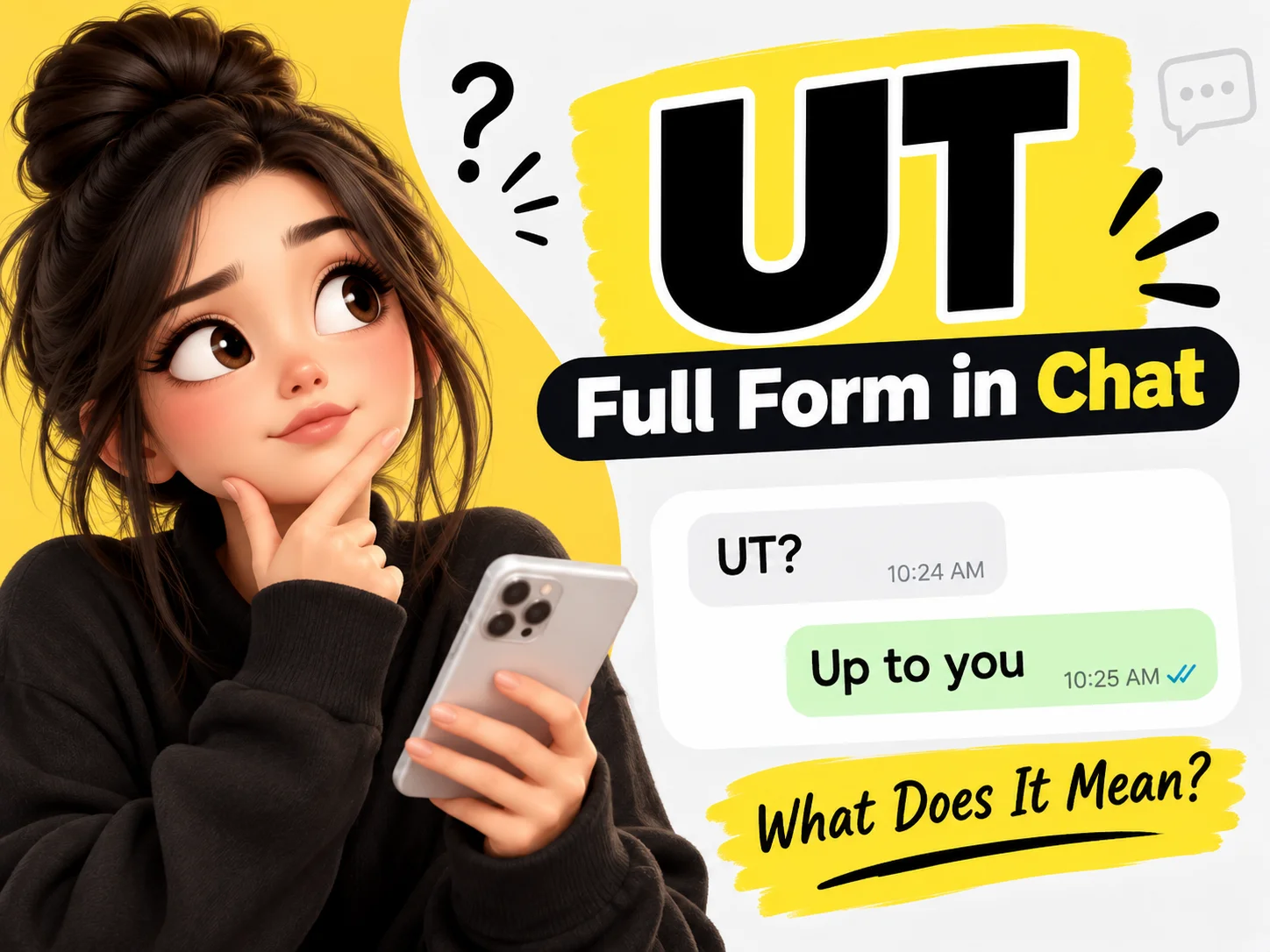

UT in chat most commonly means “You Too.” When someone texts “UT,” they’re usually returning the same wish, feeling, or greeting you just sent. For example, if you say “Have a great day!” and they reply “UT,” they mean “You too!”
However, UT can have other meanings depending on the conversation, so context matters.
What Does UT Mean in Chat?
In everyday texting, UT = “You Too.” It works as a quick response when someone says something that you can return to them.
For example:
A: Have a nice weekend!
B: UT 😊
Here, “UT” simply means “You too.”
UT is an abbreviation, not really an acronym. People shorten “you too” because it takes less time to type, especially in casual conversations.
Is UT the Same as “U2”?
Yes, U2 can also mean “you too” in texting. However, “UT” is less common than writing “you too” in full, and usage can vary between people and chat groups.
UT Meaning in Different Chat Situations
The meaning of UT depends heavily on what came before it.
After a Greeting
A: Good morning!
B: UT! Hope you have a good one.
Here, UT means “you too.”
After a Wish
A: Enjoy your vacation!
B: Thanks, UT when you get yours!
Again, it means “you too.”
After a Compliment or Positive Message
A: You’re really kind.
B: UT ❤️
In this context, the sender may mean “you too,” returning the compliment.
When the Meaning Is Unclear
UT isn’t always automatically “you too.” In some conversations, it can refer to something else, such as University of Texas, Utah, or another abbreviation known to the people chatting.
That’s why the surrounding messages matter.
How People Use UT in Text Messages
UT can appear in several forms:
- UT — uppercase
- ut — lowercase
- u too — more explicit texting shorthand
- you too — standard and clearest form
Unlike some slang terms, capitalization usually doesn’t change the basic meaning of UT. Lowercase “ut” simply looks more casual.
It can appear at the beginning or end of a message and can sometimes stand alone as a complete reply.
UT Tone Variations in Texting
The same abbreviation can feel different depending on the conversation.
Funny
A: Don’t forget to survive Monday 😂
B: UT 😭
A: I’m already struggling.
B: Same. We need another weekend.
Sarcastic
A: Hope your meeting is super exciting.
B: UT 🙃
A: That bad?
B: You have no idea.
Playful
A: Have fun tonight!
B: UT 😉
A: Oh, I definitely will.
B: That’s what I wanted to hear.
Serious
A: I hope everything works out for you.
B: UT.
A: Thank you. I really appreciate that.
B: Of course.
Real Chat Examples of UT
1. Friends
A: Have a good night!
B: UT!
A: Thanks 😊
B: Anytime.
2. Partners
A: Sleep well ❤️
B: UT ❤️
A: Goodnight.
B: Goodnight.
3. Coworkers
A: Enjoy the holiday!
B: UT, see you Monday.
A: Sounds good.
B: Take care!
4. Siblings
A: Good luck with your exam.
B: UT 😂
A: Mine isn’t until next week.
B: Oh right, my bad.
5. Parent and Child
A: Have a safe trip.
B: Thanks, UT!
A: Text me when you arrive.
B: I will.
6. Casual Friend
A: Hope you have an amazing birthday!
B: Thanks! UT when yours comes around.
A: Deal!
B: 🎉
7. Classmate
A: Good luck on the presentation!
B: UT!
A: I’m nervous.
B: You’ll do great.
8. Stranger or Casual Contact
A: Have a great evening.
B: UT.
A: Thanks.
B: No problem.
9. Group Chat
A: Everyone have a good weekend!
B: UT!
A: Same here 🙌
B: See you Monday.
10. Playful Conversation
A: Don’t work too hard today.
B: UT 😂
A: I’ll try.
B: No promises here either.
Grammar and Language Role of UT
UT functions as a short conversational response rather than a traditional part of speech.
It can replace the complete phrase “you too” and often appears as a standalone reply.
For example:
“Have a great day!”
“UT!”
It is highly informal and works best in texts, DMs, and casual online conversations. It isn’t appropriate for formal emails, academic writing, or professional documents.
How Should You Reply to UT?
Your response depends on what the other person meant.
Funny Reply
“Trying my best 😂”
Serious Reply
“Thanks, I appreciate it.”
Flirty Reply
“Only if you think about me too 😉”
Neutral Reply
“Thanks!”
If someone simply sends “UT” after your good wish, you usually don’t need to continue the conversation. It may simply be their way of returning your message.
READ MORE: What Does STG Mean? Complete Texting & Slang Guide
UT vs. Similar Texting Terms
| Term | Meaning | Usage Context | Tone | Popularity | Confusion Risk |
|---|---|---|---|---|---|
| UT | You Too | Casual texting | Casual | Moderate/Low | Medium |
| U2 | You Too | Texting and online chat | Casual | Moderate | Medium |
| TY | Thank You | Replies to wishes or favors | Casual | High | Low |
| YW | You’re Welcome | Response to thanks | Casual | Moderate | Low |
| NP | No Problem | Casual replies | Friendly | High | Low |
| U | You | General texting shorthand | Casual | High | Low |
One important distinction is that TY means “thank you,” while UT generally returns the sentiment: “you too.”
Who Uses UT in Chat?
UT is most likely to appear in informal digital communication, particularly when someone wants to respond quickly.
You may see it in:
- SMS and iMessage
- WhatsApp chats
- Instagram DMs
- Snapchat messages
- Discord conversations
- Group chats
Younger texters may use several shorthand forms interchangeably, while many Millennials are more likely to type “you too” in full, especially when they want the message to feel warmer or clearer.
There isn’t a reliable basis for assigning UT to one specific age group or region. Its meaning is straightforward enough that context matters more than geography.
Where Did UT Come From?
UT follows the broader tradition of text-message abbreviation, where people shorten common phrases to make casual communication faster and more compact.
Unlike slang that originated from a particular meme or social-media trend, UT doesn’t have a well-established single creator or viral origin. Its use fits naturally into the larger history of internet and mobile texting shorthand.
The phrase “you too” itself is much older than texting. Digital communication simply made shortened forms such as UT and U2 useful in quick conversations.
Is UT Rude or Offensive?
No. UT is not inherently rude or offensive.
However, replying with only “UT” can sometimes feel brief or impersonal, especially when someone sends you a thoughtful or emotional message.
Compare:
“UT.”
with:
“Thank you! You too 😊”
The second response feels warmer, even though both communicate essentially the same idea.
Is UT Appropriate at Work?
It depends on the relationship.
With a close coworker in an informal chat, “UT” may be perfectly understandable. With a manager, client, professor, or professional contact, writing “You too, thank you!” is safer and more polished.
Real-World Observation
What makes UT interesting is how little work it does in a conversation. It usually doesn’t introduce a new idea; instead, it mirrors what the other person just said. That makes it a useful example of how texting shorthand often functions as a social shortcut rather than simply a faster way to write. A two-letter response can acknowledge a greeting, return a good wish, or reciprocate a compliment without adding unnecessary words.
Frequently Asked Questions
What is the UT full form in chat?
The most common texting meaning of UT is “you too.” People use it to return a wish, greeting, or sentiment. For example, “Have a great day!” followed by “UT” means “You too!”
Is UT an acronym or abbreviation?
UT is best described as an abbreviation or texting shorthand for “you too.” It isn’t normally treated as a formal acronym. The exact interpretation still depends on the surrounding conversation.
Is it rude to reply with just UT in a text?
Not usually. A standalone “UT” is generally casual and friendly when someone has just wished you something. However, it can feel a little dry in an emotional or formal conversation.
What’s the difference between texting UT and saying “you too” out loud?
The meaning is basically the same. UT is simply a shortened written form, while “you too” is the natural spoken phrase. In texting, UT can make a response feel quicker and more casual.
Does UT mean the same thing in a group chat and a 1-on-1 text?
Usually, yes, if the surrounding message is a greeting or good wish. In a group chat, the sender may use UT to return a message to everyone or to one particular person. Context determines exactly who they are responding to.
Can UT have another meaning?
Yes. UT can represent other things in different contexts, including names, places, institutions, or technical terms. If the conversation isn’t about greetings or wishes, don’t automatically assume that UT means “you too.”
Is UT used on WhatsApp and Instagram?
It can be used in informal WhatsApp and Instagram conversations, although people often simply type “you too.” The abbreviation is not limited to one platform. Its meaning comes primarily from the surrounding text.
Should I use UT when texting my teacher or boss?
It’s better to write “You too, thank you” in a professional conversation. UT is casual shorthand and may look overly abbreviated in workplace or academic communication. When in doubt, use the full phrase.
Conclusion
UT most commonly means “you too” in chat and text messages. It’s a short, informal abbreviation used to return a greeting, wish, compliment, or similar sentiment.
Quick Usage Tips
- Use UT in casual texts and DMs.
- Use “you too” when you want to sound warmer or clearer.
- Check the context because UT can have other meanings.
- Avoid heavy texting abbreviations in formal communication.
Common Mistakes
- Assuming UT always means “you too.”
- Using it in formal emails or academic messages.
- Thinking capitalization creates a completely different meaning.
- Treating UT as a universal slang term on every platform.
Use UT when the conversation is casual and the meaning is obvious. Avoid it when the recipient may not understand the abbreviation or when a more polished response would be appropriate.