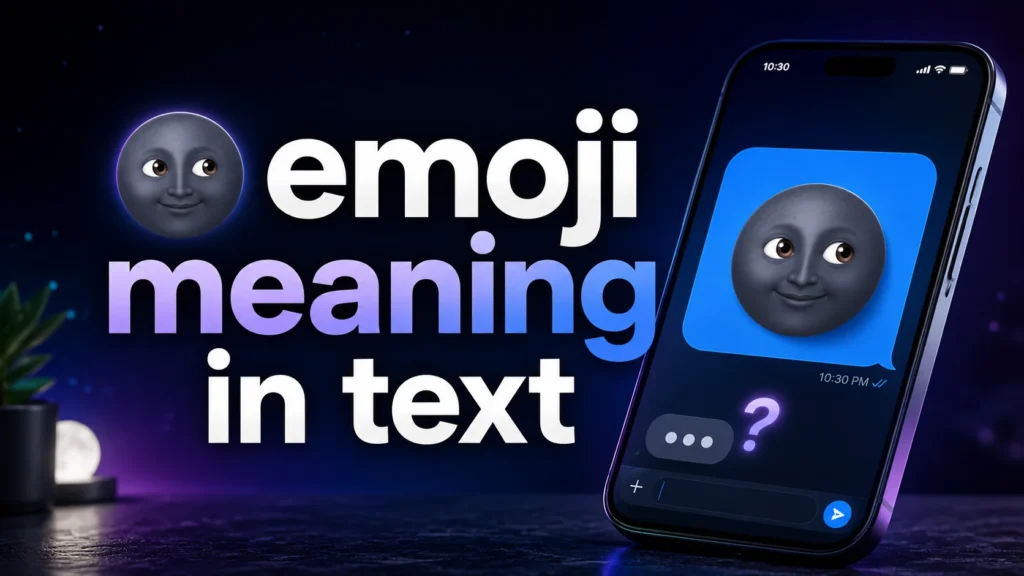
The 🌚 emoji meaning in text is usually more playful than it first appears. Although its official appearance is a dark moon with a face, people rarely use it simply to talk about the moon.
In texting, 🌚 often suggests mischief, awkwardness, hidden intentions, flirting, sarcasm, or “I know what you mean” energy. It can make an innocent sentence suddenly feel suspicious or cheeky.
For example, there is a big difference between:
“Come over later.”
and:
“Come over later 🌚”
The second message may sound flirty, suggestive, or intentionally mysterious.
That is why people often search for the meaning of 🌚 after receiving it from a crush, friend, boyfriend, girlfriend, or someone they have just started talking to.
The emoji does not have one fixed emotional meaning. Its interpretation depends heavily on the words around it, the relationship between the people, and the overall tone of the conversation.
🌚 Emoji Meaning in Text – Quick Meaning
The 🌚 emoji meaning in text commonly includes:
- Mischievous behavior
- Flirting
- Hidden intentions
- Suggestive humor
- Sarcasm
- Awkwardness
- Suspicion
- Secret knowledge
- Playful teasing
- “You know what I mean”
In simple terms, 🌚 can communicate:
“Hmm, interesting…”
“I know what you’re thinking.”
“That sounded a little suspicious.”
“I have something mischievous in mind.”
“You know exactly what I mean.”
For example:
“So you two were alone all night? 🌚”
The emoji suggests teasing or suspicion.
“Maybe you should come see me 🌚”
Here, 🌚 can add a flirty or suggestive tone.
“I didn’t say anything 🌚”
This often implies the person definitely knows more than they are admitting.
What Does 🌚 Literally Represent?
Visually, 🌚 represents a new moon with a face.
The new moon is the lunar phase when the moon appears dark from Earth. In emoji communication, however, people have given the face a completely different personality.
Its sideways-looking expression feels secretive, knowing, and slightly mischievous.
That visual personality is what created most of its modern texting meanings.
Origin & Background
The 🌚 emoji was originally designed as a moon-related symbol rather than a slang expression.
It represents the new moon as a human-like face, which is why it is commonly called the New Moon Face emoji.
Over time, internet users noticed that its unusual facial expression looked less like an astronomy symbol and more like someone quietly watching, judging, or hiding a secret.
That changed how people used it.
How Its Meaning Evolved
Emoji meanings often evolve beyond their official descriptions.
A symbol may begin with a literal purpose but develop emotional meanings because people repeatedly use it in certain situations.
🌚 is a perfect example.
At first glance, it is simply a moon.
In casual texting, it can behave more like a person giving you a suspicious side-eye.
Someone might write:
“You said you weren’t talking to him anymore 🌚”
The moon is not describing nighttime.
It is silently saying:
“Really?”
“I know something.”
“Explain yourself.”
That extra layer of meaning helped the emoji become popular in humorous and flirty conversations.
Cultural Influence
Many cultures have long connected the moon with mystery, secrecy, nighttime, romance, and hidden emotions.
Those associations naturally fit the way 🌚 is used online.
Darkness can suggest something hidden.
Nighttime can suggest romance or private conversations.
The facial expression adds humor and suspicion.
Together, those ideas make 🌚 ideal for messages with unspoken meaning.
Social Media Impact
TikTok, Instagram, X, Snapchat, WhatsApp, and meme culture helped transform 🌚 into an expressive reaction emoji.
It often appears after comments that are deliberately questionable, flirty, or dramatic.
For example:
“She said they’re just friends 🌚”
The sender may not directly accuse anyone of anything.
The emoji does the emotional work.
It tells readers:
“I don’t completely believe that.”
This ability to communicate an entire attitude with one symbol explains why 🌚 remains popular in informal digital communication.
Real-Life Conversations
Understanding 🌚 emoji meaning in text becomes easier when you see how it works in realistic conversations.
WhatsApp Conversation
Person A: So who were you talking to until 2 AM?
and,
Person B: Nobody important 😂
Person A: Nobody important? 🌚
Person B: Okay maybe someone.
Person A: I knew it.
Here, 🌚 communicates suspicion and playful curiosity.
Person A does not need to say, “I don’t believe you.”
The emoji already implies it.
Instagram DM
Person A: Your pictures from last night were nice.
Person B: Which one did you like? 😂
Person A: You already know which one 🌚
Person B: Oh really? 😭
Person A: Really.
In this conversation, 🌚 adds obvious flirtation.
Without the emoji, “You already know which one” could sound neutral.
With 🌚, the message feels teasing and suggestive.
TikTok Comments
Person A: POV: Your “study partner” comes over but nobody studies.
and,
Person B: 🌚🌚🌚
Person A: Y’all know exactly what I mean 😂
Here, the emoji represents a knowing reaction.
The commenter understands the hidden joke without needing to explain it.
Text Message
Person A: Are you coming to the party tonight?
Person B: Maybe.
and,
Person A: He’s going to be there 🌚
Person B: Okay suddenly I’m interested 😂
Here, 🌚 means:
“I know you like him.”
The emoji exposes an unspoken connection between the two people.
Emotional & Psychological Meaning
🌚 is interesting because it often communicates what someone does not want to say directly.
Instead of making an explicit statement, the sender leaves room for interpretation.
That makes it perfect for teasing, flirting, suspicion, and indirect communication.
What Emotion Does 🌚 Express?
Depending on context, it may express:
- Curiosity
- Mischief
- Attraction
- Suspicion
- Embarrassment
- Playfulness
- Sarcasm
- Secret amusement
- Awkward awareness
Consider:
“I saw you two together 🌚”
The sender may be teasing.
They might also be suspicious.
If there is already romantic tension between the people being discussed, the message becomes even more suggestive.
Why People Use It
People often use 🌚 when writing the full thought would feel too direct.
Imagine someone wants to flirt but does not want to openly say:
“I think you should come over because I like you.”
They might instead write:
“You could always come over 🌚”
The emoji creates plausible ambiguity.
If the other person responds positively, the flirting can continue.
If they do not, the sender can pretend it was just a joke.
This makes 🌚 especially useful in conversations where people are testing emotional boundaries.
It Creates an Inside-Joke Feeling
Another psychological effect of 🌚 is that it can create the impression that both people understand something without saying it aloud.
For example:
“You remember what happened last Friday 🌚”
This message suggests shared history.
The receiver immediately knows there is more behind the sentence.
That subtle communication can make conversations feel more personal.
A Personal-Style Scenario
Imagine your friend has been secretly interested in someone for weeks.
One evening, they tell you:
“He randomly asked if I was free this weekend.”
You reply:
“Randomly? 🌚”
The emoji communicates several thoughts at once:
“You know that wasn’t random.”
“I think he likes you.”
“I’m watching this situation.”
It keeps the conversation playful while still showing that you understand the emotional subtext.
Usage in Different Contexts
The meaning of 🌚 depends strongly on the situation.
Social Media
On social media, 🌚 commonly appears in:
- Memes
- Flirty comments
- Relationship jokes
- Suspicious observations
- Double-meaning captions
- Inside jokes
Someone may comment:
“You’re looking different lately 🌚”
Depending on the relationship, that could mean admiration, curiosity, or playful flirtation.
On TikTok, 🌚 often signals that a comment has a hidden or slightly inappropriate interpretation.
Friends & Relationships
Between friends, 🌚 is commonly used for teasing.
Example:
“You smiled when she texted you 🌚”
The sender is playfully exposing their friend’s feelings.
Between romantic partners, it can become more flirtatious.
Example:
“Missing you tonight 🌚”
The emoji may imply more than ordinary emotional affection.
It can create intimate or suggestive energy without using explicit language.
From a Crush
If your crush sends 🌚, context matters a lot.
A message like:
“You looked good today 🌚”
is probably more flirtatious than:
“Why were you late today 🌚”
The first suggests attraction.
The second may simply be playful suspicion.
Do not interpret the emoji alone as proof of romantic interest.
Look at the full conversation pattern.
Work / Professional Settings
🌚 is generally not suitable for formal workplace communication.
For example:
“Can you send that report tonight? 🌚”
could sound strange or passive-aggressive.
The emoji carries too much informal emotional ambiguity for professional messages.
Among close coworkers in a private group chat, however, it may appear jokingly.
Example:
“Someone took the last coffee again 🌚”
That can communicate humorous suspicion.
Casual vs Serious Tone
🌚 works best in casual conversations.
In serious discussions, it can make the sender seem dismissive or unserious.
For example:
“We need to talk about what happened yesterday 🌚”
may feel unnecessarily threatening, sarcastic, or awkward.
If the topic is important, direct language is usually better.
When NOT to Use It
🌚 can be funny and expressive, but its ambiguous tone can create problems.
Formal Communication
Avoid using it in:
- Job applications
- Professional emails
- Academic messages
- Customer complaints
- Legal discussions
- Official announcements
Its hidden, playful tone does not fit professional communication.
Serious Emotional Conversations
If someone is upset, grieving, anxious, or discussing an important problem, 🌚 may feel insensitive.
For example:
“I haven’t been feeling okay lately.”
Replying only:
“🌚”
would probably be inappropriate.
A supportive message would be much better.
When Flirting Is Unwanted
Because 🌚 can sound suggestive, avoid using it with someone who may not be comfortable with flirtation.
For example:
“You should come to my room later 🌚”
can easily be interpreted as sexual or romantic.
If that is not your intention, choose a clearer emoji or no emoji at all.
Cultural Sensitivity
Some people simply interpret emojis differently.
What feels funny to one person may feel creepy to another.
If you are messaging someone you do not know well, avoid relying heavily on ambiguous emojis.
In Arguments
Using 🌚 during conflict can feel passive-aggressive.
Example:
“So now you’re telling the truth? 🌚”
Even if you intend humor, the other person may see it as mocking or disrespectful.
During serious disagreements, direct communication is usually safer.
Common Misunderstandings
🌚 is frequently misunderstood because it has several unofficial meanings.
“It Always Means Something Sexual”
No.
🌚 can be suggestive, but it is not automatically sexual.
For example:
“You ate the last slice of pizza 🌚”
is clearly playful suspicion, not flirting.
Context determines whether the emoji feels suggestive.
“It Means the Sender Is Angry”
Usually not.
The dark face can visually look unsettling, but it is generally used for humor, teasing, irony, or suspicion rather than genuine anger.
“It Means Nighttime”
Sometimes it can literally represent the moon or night.
For example:
“Beautiful sky tonight 🌚”
could be literal.
However, in most casual chats, its emotional meaning is more common than its astronomical meaning.
“It Always Means Flirting”
Again, not necessarily.
Between friends, 🌚 may simply mean:
“I caught you.”
“I know what’s going on.”
“That’s suspicious.”
Flirtation depends on the words and relationship.
Literal vs Figurative Meaning
The literal meaning is a new moon with a face.
The figurative texting meaning can be:
“Mischievous.”
“Suspicious.”
“Flirty.”
“Interesting…”
“You know what I mean.”
Recognizing this difference is essential when reading modern emoji language.
🌚 Compared With Similar Emojis and Expressions
| Emoji/Expression | Common Meaning | Typical Tone |
|---|---|---|
| 🌚 | Mischief, suspicion, flirting | Secretive, playful |
| 🌝 | Happiness, awkward humor | Friendly, goofy |
| 😏 | Flirting, confidence, suggestion | Clearly flirty |
| 👀 | Curiosity, attention, suspicion | Interested |
| 🤨 | Doubt or disbelief | Questioning |
| 😈 | Mischief or naughty intentions | Bold, provocative |
| 🙃 | Awkwardness or irony | Passive, humorous |
| 😶🌫️ | Confusion or hiding | Mysterious |
| “Hmm…” | Suspicion or thoughtfulness | Neutral to teasing |
| “I see you” | Calling someone out | Playful or suspicious |
Key Insight
🌚 is especially useful when someone wants to imply something without saying it directly. Compared with 😏, it is usually more humorous and mysterious, while 😏 tends to communicate flirtation more openly.
Variations / Types of 🌚 Meaning
The New Moon Face emoji can carry several distinct meanings depending on the conversation.
1. 🌚 Mischievous Meaning
Meaning: “I know something.”
Used when someone is acting playful or secretly amused.
Example:
“I might have told her you like her 🌚”
2. 🌚 Flirty Meaning
Meaning: “I’m suggesting something.”
Often appears in romantic or teasing messages.
Example:
“You could come see me tonight 🌚”
3. 🌚 Suspicious Meaning
Meaning: “That sounds questionable.”
Used when the sender does not fully believe something.
Example:
“You were ‘just studying’ together? 🌚”
4. 🌚 Secret Meaning
Meaning: “We both know what I’m talking about.”
Often appears in conversations involving an inside joke.
Example:
“Remember that hotel story? 🌚”
5. 🌚 Sarcastic Meaning
Meaning: “Sure… if you say so.”
It can gently mock someone’s explanation.
Example:
“You definitely weren’t jealous 🌚”
6. 🌚 Awkward Meaning
Meaning: “Well, this is uncomfortable.”
It can appear after an embarrassing statement.
Example:
“I accidentally liked his picture from 2019 🌚”
7. 🌚 Teasing Meaning
Meaning: “I’m calling you out.”
Friends often use it when they notice something funny.
Example:
“You’ve checked your phone five times since she texted 🌚”
8. 🌚 Suggestive Meaning
Meaning: “There may be another meaning here.”
Some messages become more suggestive simply because 🌚 is added.
Example:
“I’m home alone tonight 🌚”
9. 🌚 Judgmental Meaning
Meaning: “I’m watching you.”
This is usually humorous rather than genuinely judgmental.
Example:
“Third takeaway this week? 🌚”
10. 🌚 Dark Humor Meaning
Meaning: “This is wrong, but I laughed.”
The emoji sometimes appears after mildly dark, awkward, or questionable jokes.
Its use still depends on the sensitivity of the topic.
How to Respond When Someone Uses It
Your reply should match the mood of the conversation.
Casual Replies
You can respond with:
- “What? 😂”
- “Don’t look at me like that.”
- “You know nothing 😭”
- “Why that emoji? 😂”
- “I already know what you’re thinking.”
Funny Replies
If someone sends 🌚 mischievously:
- “That moon knows too much.”
- “Delete that face immediately 😂”
- “Why are you exposing me?”
- “Not the 🌚 again.”
- “Mind your business 😭”
Flirty Replies
If the conversation is mutually flirty:
- “Oh really? 😏”
- “What are you implying? 👀”
- “Interesting choice of emoji.”
- “I see what you’re doing 🌚”
- “Maybe I do know what you mean.”
Mature Replies
If you are unsure what they mean:
- “What do you mean by that?”
- “Are you joking or being serious?”
- “I’m not sure how to read that.”
- “Explain yourself 😂”
Direct clarification can prevent unnecessary overthinking.
Respectful Replies
If the message feels too suggestive:
- “Let’s keep it friendly.”
- “I don’t think we’re thinking the same thing.”
- “I’d rather be clear about what you mean.”
You do not need to match someone’s tone if it makes you uncomfortable.
Regional & Cultural Usage
Emoji culture is global, but interpretations can still vary by region and generation.
Western Culture
In Western online communities, 🌚 is commonly associated with sarcasm, cheekiness, flirting, and suspicious humor.
People often use it after sentences with double meanings.
Its tone can feel similar to giving someone a knowing look in real life.
Asian Culture
Across many Asian online communities, 🌚 may appear in memes, teasing conversations, fandom discussions, and informal chats.
Younger social media users who follow global internet culture usually understand its mischievous meaning easily.
However, interpretations vary widely across languages and countries.
Middle Eastern Culture
In Middle Eastern digital conversations, 🌚 can also appear as a teasing or suspicious reaction, particularly among younger social media users.
It may be used when someone wants to hint at romance, gossip, or hidden meaning without stating it directly.
As always, personal and cultural boundaries around flirting should be respected.
Global Internet Usage
Globally, 🌚 has become a kind of digital suspicious face.
It often replaces expressions such as:
“Hmm…”
“I see.”
“Interesting.”
“Really now?”
“You know what you’re doing.”
Because these emotions are universal, the emoji works across many online communities even when users speak different languages.
Gen Z vs Millennials
Gen Z often uses 🌚 more ironically.
A Gen Z user might say:
“I definitely made responsible decisions last night 🌚”
The emoji reveals that the sentence is probably not entirely serious.
Millennials may use it more directly for teasing, flirtation, or suspicious humor.
These are broad patterns rather than strict generational rules.
Individual communication style matters more.
Is 🌚 Safe for Kids?
The 🌚 emoji itself is safe for kids.
It is simply a cartoon-like new moon face and contains no explicit imagery.
However, parents should understand that teenagers and adults sometimes use 🌚 in flirtatious or suggestive conversations.
Its meaning therefore depends on the surrounding message.
For example:
“You ate all the cookies 🌚”
is completely innocent.
But:
“Come over when everyone is asleep 🌚”
can have a more suggestive meaning.
The emoji itself is not inappropriate; the context determines whether the conversation is age-appropriate.
FAQs
What does 🌚 mean in texting?
🌚 usually represents mischief, suspicion, teasing, hidden intentions, or flirtation. It often suggests that the sender knows or implies something they are not saying directly.
What does 🌚 mean from a guy?
From a guy, 🌚 can mean playful teasing, suspicion, or flirting. If it follows a compliment or invitation, it may have a more suggestive or romantic tone.
What does 🌚 mean from a girl?
From a girl, 🌚 may express teasing, hidden meaning, curiosity, or flirtation. The surrounding words are more important than the sender’s gender.
Is 🌚 a flirting emoji?
Yes, 🌚 can be used for flirting, especially when added to compliments, invitations, or sentences with double meanings. However, it is also commonly used jokingly between friends.
What does 🌚 mean after a sentence?
When 🌚 appears at the end of a sentence, it usually adds a secretive, suspicious, sarcastic, or suggestive tone.
For example, “You’re looking good today 🌚” may sound more flirtatious than the same sentence without the emoji.
What is the difference between 🌚 and 😏?
🌚 feels more mysterious, humorous, and indirect, while 😏 usually expresses flirting, confidence, or suggestiveness more openly.
Does 🌚 have a dirty meaning?
Sometimes, but not always. 🌚 can add sexual or suggestive undertones to certain messages, but it is also frequently used for innocent teasing, sarcasm, and suspicious humor.
Conclusion
The 🌚 emoji meaning in text usually revolves around mischief, teasing, suspicion, hidden intentions, sarcasm, and sometimes flirtation.
Think of it as the digital version of giving someone a knowing look.
If someone writes:
“You said you don’t like him 🌚”
the emoji probably means:
“I don’t believe you.”
If they say:
“You should come over later 🌚”
the tone may be more flirtatious or suggestive.
And if they simply reply:
“🌚”
they may be silently telling you:
“I know exactly what’s going on.”
The most important rule is to avoid interpreting 🌚 in isolation. Read the words around it, consider your relationship with the sender, and pay attention to the conversation’s emotional tone.
Once you understand that hidden layer, the mysterious little moon becomes much easier to read confidently.