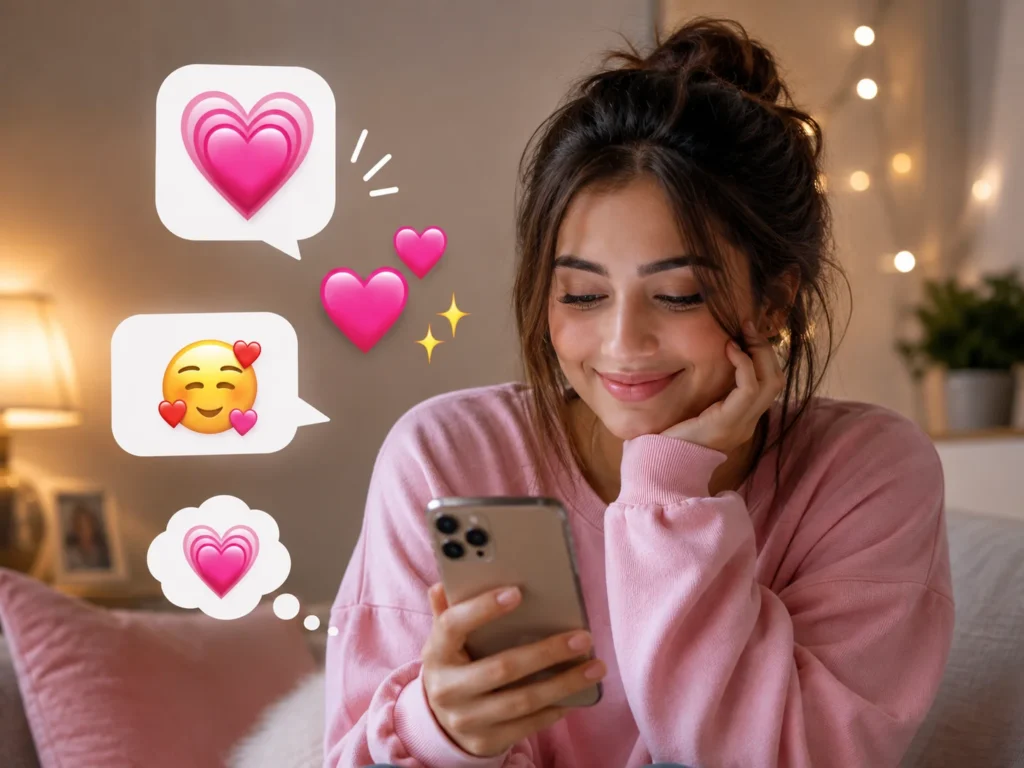
The 💗 pink heart emoji usually means affection, warmth, care, or growing romantic feelings in text. When someone sends it to you, the meaning can range from friendly sweetness to flirting, depending on your relationship and the surrounding messages.
What Does 💗 Mean When Someone Texts It to You?
💗 is the Growing Heart emoji. It shows a pink heart surrounded by smaller hearts, creating the impression that affection or love is growing.
In texting, it commonly communicates:
- Affection
- Caring
- Sweetness
- Appreciation
- Emotional warmth
- Romantic interest
- Support
- Excitement about someone or something
Unlike an abbreviation such as “LOL,” 💗 communicates emotion visually. The same emoji can therefore mean different things depending on who sends it.
For example:
“Thank you so much 💗”
could simply mean “I really appreciate you.”
But:
“I miss you 💗”
from a romantic partner can communicate much stronger affection.
💗 Emoji Meaning in Texting
The official name of 💗 is Growing Heart. Unicode describes it as a heart with smaller hearts around it, giving it a visual sense of growing affection.
It is not an acronym, abbreviation, or slang word. It is an emoji.
People often use it at the end of a sentence:
“Goodnight 💗”
They can also use it by itself:
“💗”
When sent alone, the emoji relies heavily on the previous conversation to communicate its meaning.
💗 Meaning From a Girl
If a girl sends you 💗, it usually indicates warmth, affection, appreciation, or emotional friendliness. It does not automatically mean she is romantically interested in you.
Context makes the difference.
For example:
“Aww thank you 💗”
is often simply sweet and appreciative.
But:
“Wish you were here with me 💗”
is more likely to carry a romantic or intimate tone.
If she regularly combines 💗 with affectionate language, compliments, or romantic conversation, it may indicate stronger feelings.
💗 Meaning From a Guy
When a guy sends 💗, the interpretation also depends on the relationship.
A friend might use it to express appreciation:
“Thanks for helping me 💗”
A romantic partner might use it as an affectionate sign:
“Goodnight, love 💗”
Someone who normally never uses heart emojis may give the emoji more significance than someone who sends hearts constantly.
💗 Meaning From Your Crush
If your crush sends 💗, it can feel like a romantic signal, but the emoji alone cannot confirm their feelings.
Look at the larger pattern:
- Do they initiate conversations?
- Do they regularly compliment you?
- Do they use affectionate language?
- Do they make plans to see you?
- Do they send 💗 specifically in romantic conversations?
- Do they use the emoji with everyone?
The combination of behavior and language provides much stronger evidence than one emoji.
💗 vs ❤️: What’s the Difference?
The pink and red hearts can overlap, but they often create different impressions.
| Emoji | Common Text Meaning | Typical Tone |
|---|---|---|
| 💗 | Growing affection, sweetness, warmth | Cute, affectionate |
| ❤️ | Love, strong affection, support | Direct, intense |
| 🩷 | Pink love, affection, sweetness | Soft, cute |
| 💕 | Mutual affection, love, closeness | Playful, romantic |
| 💓 | Beating heart, excitement | Emotional, romantic |
| 💖 | Sparkling affection, excitement | Cute, enthusiastic |
| 💘 | Romantic attraction | Flirty, romantic |
| 💝 | Love presented as a gift | Romantic, affectionate |
These are general conventions rather than strict rules. People often choose hearts based on personal texting habits.
Tone and Context Variations
Friendly 💗
A: Thanks for sending me those notes.
B: Of course!
A: You seriously saved me today.
B: Anytime 💗
Here, 💗 expresses appreciation and friendship rather than romance.
Romantic 💗
A: I wish you were here tonight.
B: Me too.
A: Hopefully soon.
B: Definitely 💗
In this context, the emoji reinforces romantic affection.
Playful 💗
A: You really think you can beat me at this game?
B: Easily.
A: That’s a lot of confidence.
B: I know 😌💗
The emoji adds a cute, teasing quality.
Supportive 💗
A: Today’s been really difficult.
B: I’m sorry you’re dealing with that.
A: I just needed someone to listen.
B: I’m here for you 💗
Here, the heart communicates emotional support.
Real Text Examples of 💗
1. Friends
A: I got home safely.
B: Good!
A: Thanks for checking on me.
B: Always 💗
2. Romantic Partners
A: Did you get home?
B: Just arrived.
A: Good. Get some rest.
B: I will, love you 💗
3. Crush
A: Your presentation was really good today.
B: You actually listened? 😂
A: Of course I did.
B: That’s sweet 💗
4. Siblings
A: Mom said you’re coming over tomorrow.
B: Yep!
A: Bring dessert.
B: Obviously 💗
5. Parent and Child
A: Thanks for checking on me.
B: Always, sweetheart.
A: Love you.
B: Love you too 💗
6. Coworkers
A: I sent you the updated file.
B: Got it, thank you!
A: No problem.
B: Appreciate you 💗
In some workplaces, however, a heart emoji may feel too personal depending on the culture.
7. Instagram DM
A: Your new haircut looks so good!
B: Thank you 😭
A: Seriously, it suits you.
B: You’re so sweet 💗
8. Apology
A: I’m sorry about yesterday.
B: It’s okay.
A: I really didn’t mean to upset you.
B: I know 💗
9. Long-Distance Relationship
A: Counting down until I see you.
B: Same here.
A: It feels like forever.
B: We’ll get through it 💗
10. Supportive Friend
A: I finally finished my exam.
B: How did it go?
A: Better than I expected.
B: I’m proud of you 💗
Can 💗 Mean “I Love You”?
It can, but not always.
💗 can communicate love or romantic affection, particularly when it appears alongside phrases such as:
“I love you 💗”
or:
“Miss you so much 💗”
However, the emoji itself does not necessarily translate directly to “I love you.”
Someone may send 💗 to a close friend, family member, or even as a general expression of kindness.
Does 💗 Mean Flirting?
Sometimes.
The emoji can contribute to a flirty message, especially when combined with compliments or romantic language.
For example:
“You looked really good today 💗”
has a more affectionate tone than:
“You looked really good today.”
But 💗 is not automatically a flirting emoji. Someone’s normal texting style matters.
Does 💗 Mean Friendship?
Absolutely.
Friends may use 💗 to express:
- “I appreciate you.”
- “You’re sweet.”
- “Love you, bestie.”
- “I’m here for you.”
- “Thank you.”
This is why interpreting an isolated heart emoji as romantic interest can lead to misunderstandings.
What Does a Single 💗 Mean?
A single 💗 can be surprisingly ambiguous.
For example:
A: I miss you.
B: 💗
That response probably communicates affection, but it does not tell you exactly how the sender feels.
Compare that with:
A: Thanks for helping me today.
B: 💗
This is more likely appreciation.
The previous message gives the emoji its context.
What Does 💗 Mean After “Thank You”?
When someone writes:
“Thank you 💗”
the heart usually adds warmth and appreciation.
It can mean:
“Thank you, I really appreciate you.”
It does not necessarily mean:
“I am romantically attracted to you.”
The relationship determines how strongly you should interpret it.
What Does 💗 Mean at the End of “Goodnight”?
A message such as:
“Goodnight 💗”
sounds affectionate.
Between romantic partners, it may simply be a loving goodnight.
Between close friends, it may be a sweet way of ending the conversation.
If the sender has already been flirting with you, 💗 can reinforce that tone.
💗 vs 🩷
The two emojis are similar but not identical.
💗 is officially the Growing Heart and visually suggests expanding affection.
🩷 is the Pink Heart and generally represents love, affection, sweetness, and warmth.
In everyday texting, people may use them interchangeably.
The difference often comes down to personal preference rather than a fixed hidden message.
How to Reply to 💗
Your reply should match the relationship and tone.
Sweet Reply
“Aww 💗”
Friendly Reply
“You’re the sweetest!”
Romantic Reply
“Love you too 💗”
Flirty Reply
“That heart supposed to mean something? 👀💗”
Neutral Reply
“Thank you! 😊”
If you’re unsure whether the sender is flirting, a warm but neutral response is safest.
Is 💗 Rude or Offensive?
No. 💗 is generally a positive and affectionate emoji.
It is not profanity, a slur, or an offensive symbol.
However, using it in a professional situation can sometimes feel overly personal.
For example:
“Thanks for the report 💗”
might feel unusual when sent to a manager or formal client.
A simple 👍 or “Thank you!” may be more appropriate in a professional setting.
Who Uses the 💗 Emoji?
💗 appears widely across messaging and social-media conversations. There is no reliable rule saying that only a particular generation, gender, or country uses it.
People may use it differently based on:
- Age
- Relationship
- Personality
- Online community
- Individual emoji habits
- Conversation topic
Younger users may combine it with other expressive emojis, while older users may use it more straightforwardly as a heart of affection. These are tendencies rather than universal rules.
Origin and Internet Culture
💗 was introduced as part of the Unicode emoji system and is officially named Growing Heart. Its design communicates a heart that appears to be expanding, which naturally connects it with growing affection or emotional warmth.
Unlike some slang expressions, 💗 did not originate as a TikTok phrase or texting abbreviation. It belongs to the broader development of standardized digital emoji characters.
Its meaning has remained relatively stable because the visual metaphor is easy to understand: a heart surrounded by smaller hearts suggests affection that is increasing or overflowing.
What Makes 💗 Different From Other Heart Emojis?
The most interesting feature of 💗 is its visual softness.
❤️ can feel direct and traditional.
💗 often feels:
- Softer
- Cuter
- More playful
- More youthful
- More emotionally warm
That does not mean 💗 is always less romantic than ❤️. In some conversations, it can actually make a romantic message feel more gentle and personal.
Common Mistakes When Interpreting 💗
Mistake 1: Assuming It Always Means Romance
A friend can send 💗 without having romantic feelings.
Mistake 2: Ignoring the Message Before It
“Thank you 💗” and “I miss you 💗” communicate different levels of affection.
Mistake 3: Assuming Everyone Uses Emojis the Same Way
Some people put hearts in almost every message. Others rarely use them.
Mistake 4: Treating One Emoji as Proof of Someone’s Feelings
An emoji is a communication cue, not definitive evidence of romantic interest.
FAQ: 💗 Meaning in Text
What does 💗 mean in a text message?
💗 usually expresses affection, warmth, care, appreciation, or sweetness. It can be romantic, friendly, or supportive depending on the conversation. The surrounding words and relationship are important when interpreting it.
What does 💗 mean from a girl?
A girl may use 💗 to show affection, appreciation, friendship, or romantic interest. It does not automatically mean she likes you romantically. Look at how she communicates with you overall.
What does 💗 mean from a guy?
A guy may use 💗 to express affection, appreciation, support, friendship, or romantic feelings. The emoji has no separate male-specific meaning. His usual texting style provides important context.
Is 💗 a flirty emoji?
It can be flirty, but it is not exclusively a flirting emoji. A message such as “You look amazing 💗” may sound flirtatious, while “Thanks for helping me 💗” may simply express appreciation.
Is 💗 more romantic than ❤️?
Not necessarily. ❤️ often communicates direct or strong love, while 💗 can feel softer, cuter, and more playful. Either emoji can be romantic depending on the conversation.
What does a single 💗 mean in text?
A standalone 💗 usually communicates affection or a warm emotional response to something that was previously said. Its exact meaning depends on the preceding message. It can represent appreciation, friendship, support, or romance.
Is it rude to reply with just 💗?
Generally, no. A standalone 💗 is normally a positive response, especially in casual conversations. However, in a serious conversation, replying only with an emoji might feel too brief or dismissive.
What’s the difference between texting 💗 and saying it out loud?
💗 is a visual emotional cue, while spoken communication depends on words and tone of voice. When someone texts 💗, they may be adding warmth that would otherwise be conveyed through vocal tone. There is no exact spoken word that always corresponds to the emoji.
PAA Questions About 💗
What does 💗 mean from a girl to a guy?
It can mean affection, appreciation, friendliness, or romantic interest. The emoji alone cannot establish which one.
What does 💗 mean from a guy to a girl?
It may express warmth, affection, support, or romantic interest. Consider the rest of the conversation rather than interpreting the emoji by itself.
Does 💗 mean love?
It can represent love or affection, but it does not always mean romantic love. Friends and family members can also use it.
What does 💗 mean on Instagram?
On Instagram, 💗 generally carries the same affectionate meaning it has in text messages. People may use it in DMs, reactions, Stories, or other social interactions.
What does 💗 mean from your crush?
It may indicate that your crush feels affection or is being friendly, but it is not definitive proof of romantic interest. Look for consistent patterns in their communication.
Conclusion
The 💗 emoji means affection, warmth, care, or growing love in most text conversations. It can be romantic, but it can also be completely friendly.
Remember these key points:
- 💗 = Growing Heart
- It commonly expresses affection and warmth.
- It can be romantic or platonic.
- A single 💗 needs context.
- 💗 after a compliment or romantic message may feel flirtier.
- “Thank you 💗” is usually appreciation rather than a declaration of love.
- Do not assume romantic feelings from the emoji alone.
When to Use 💗
Use 💗 when you want to communicate:
- Affection
- Appreciation
- Support
- Sweetness
- Romantic warmth
- Friendly care
When to Avoid 💗
Avoid it when a professional or formal tone matters, particularly if the recipient might interpret the heart as overly personal.