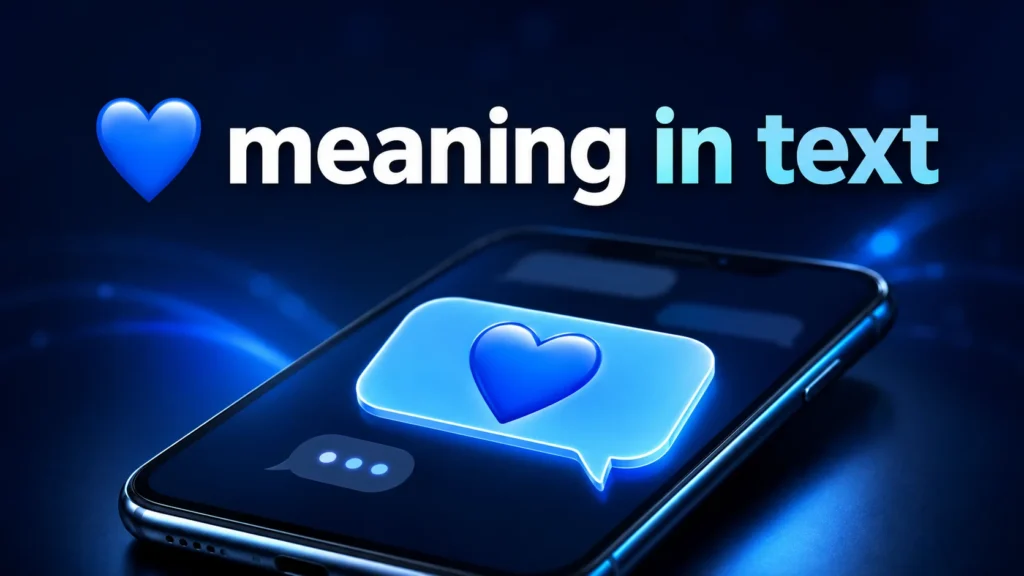
The 💙 meaning in text is usually connected with trust, loyalty, peace, friendship, and calm affection. Unlike the classic red heart, the blue heart often communicates care without making the message feel intensely romantic.
However, its meaning can change depending on who sends it, what they write with it, and the relationship between both people. A blue heart from a close friend may show emotional support, while the same emoji from a romantic partner can represent stable and loyal love.
People often search for the meaning of 💙 because hearts are emotionally powerful but surprisingly unclear. Does it mean friendship? Is someone hiding romantic feelings? Are they trying to create distance?
This guide explains the emotional, social, and cultural meanings behind the blue heart emoji so you can understand it—and respond to it—with confidence.
💙 Meaning in Text – Quick Meaning
The 💙 meaning in text is typically “I care about you,” “I trust you,” or “I support you.” It expresses a calm emotional connection rather than fiery romance.
Depending on the conversation, 💙 may represent:
- Trust and loyalty
- Close friendship
- Peaceful or steady love
- Emotional support
- Appreciation and respect
- A connection with the color blue
- Support for a team, organization, or cause
- Platonic affection without romantic pressure
For example:
“Thank you for always listening to me 💙”
Here, the emoji shows genuine appreciation and emotional trust.
“You’ve got this! I believe in you 💙”
In this message, the blue heart communicates encouragement and support.
“Goodnight, take care 💙”
This may suggest gentle affection. Still, it is not automatically a romantic confession.
Does 💙 Mean Love?
Yes, 💙 can mean love, but it usually represents peaceful, loyal, or emotionally secure love. It may feel less passionate than ❤️ and less flirtatious than 💕.
The relationship between the sender and receiver provides the strongest clue.
Origin and Background of the Blue Heart Emoji
The blue heart became part of Unicode 6.0 in 2010 and later appeared across popular smartphones and social platforms. As emoji communication grew, people began assigning emotional personalities to different heart colors.
The traditional red heart already represented romance, passion, and deep love. Therefore, users needed other colors to express feelings that were affectionate but not necessarily romantic. The blue heart naturally developed associations with trust, calmness, stability, and friendship.
The Psychology of Blue
Blue commonly represents peace, reliability, confidence, and emotional security. Businesses frequently use it in branding because it can create a sense of professionalism and trust.
These associations also influence the 💙 meaning in text messages. When someone chooses a blue heart, they may want their affection to feel sincere, supportive, and emotionally safe.
Cultural and Social Media Influence
Social media expanded the emoji’s meaning. Sports fans began using it for teams with blue uniforms. Music fandoms adopted colored hearts to represent particular artists, while awareness campaigns connected blue with specific causes.
On TikTok, Instagram, WhatsApp, Snapchat, and X, 💙 may also serve an aesthetic purpose. Someone might use it simply because it matches a photograph, outfit, profile theme, or favorite color.
As a result, its meaning now ranges from personal affection to public identity and online community support.
Real-Life Conversations Using 💙
The message surrounding an emoji usually reveals more than the symbol alone. These conversations show how the blue heart works in realistic situations.
WhatsApp Conversation Between Friends
Person A: I’m sorry you had such a difficult day. Do you want to talk?
Person B: Maybe later. I’m still trying to process everything.
Person A: No pressure. I’m here whenever you need me 💙
Person B: Thank you. That actually means a lot.
In this conversation, 💙 offers emotional safety. The sender cares without demanding an immediate response.
Instagram DM After a Compliment
Person A: Your new artwork is beautiful. You’ve improved so much!
Person B: That’s so kind of you 💙 I was nervous about posting it.
Person A: You shouldn’t be. It looks amazing.
Here, the blue heart expresses gratitude and friendly warmth. It does not necessarily suggest romantic interest.
TikTok Comment Between Fans
Person A: This song helped me through one of the hardest months of my life.
Person B: Same here. Sending you love and strength 💙
Person A: Thank you. I hope things are better for you now too.
In this example, 💙 represents empathy and community support between people who may not know each other personally.
Text Message Between Partners
Person A: I know we’ve both been busy, but I appreciate how patient you’ve been.
Person B: We’re a team. I’m always with you 💙
Person A: I love you. We’ll get through this together.
In a relationship, the blue heart can symbolize secure and committed love. It feels dependable rather than dramatic or intensely flirtatious.
Emotional and Psychological Meaning of 💙
Emotionally, 💙 often communicates steadiness. It can feel like a quiet form of reassurance: “I care about you, and you can trust me.”
People use it when a red heart seems too romantic or intense. They may want to offer affection while respecting emotional boundaries. Therefore, the blue heart is especially useful in friendships, supportive conversations, and developing relationships.
Psychologically, choosing 💙 can reveal a desire to appear calm, loyal, or emotionally controlled. Some people find it easier to send an emoji than to explain vulnerable feelings in words.
For example, imagine telling a friend that you did not get the job you wanted. They reply, “I’m proud of you for trying 💙.” The emoji softens the disappointment and makes the support feel personal. It cannot solve the problem, but it creates a small moment of emotional connection.
That is one reason emojis matter in modern communication. They replace some of the facial expressions and vocal tones that text messages naturally lack.
Usage in Different Contexts
The 💙 meaning in text depends heavily on the setting. A message between best friends carries different emotional weight from a comment posted by a brand.
Social Media
On social media, 💙 can represent appreciation, support, fandom, or a blue visual theme. Someone may add it to a beach photograph because it matches the ocean.
Fans also use blue hearts to support sports teams, celebrities, fictional characters, and online communities. In these situations, it may have little connection to romance.
Friends and Relationships
Between friends, 💙 commonly means loyalty, trust, and platonic love. It can say, “You matter to me,” without making the conversation awkward.
Between romantic partners, it may show stable and mature affection. However, if someone suddenly replaces frequent red hearts with blue ones, the change could feel significant. Do not assume emotional distance immediately; consider the full conversation and ask gently if necessary.
Work and Professional Settings
The blue heart is one of the safer heart emojis for friendly professional communication, but it still requires judgment.
A colleague might write, “Thank you to everyone who supported the charity event 💙.” That usage feels appropriate because it expresses collective appreciation.
Sending “Great presentation 💙” privately to a manager or new coworker may feel overly personal. A simple thumbs-up, clapping emoji, or polite sentence would usually be clearer.
Casual vs Serious Tone
In casual chats, 💙 can stand alone as a quick sign of affection or agreement. In serious conversations, it works best alongside clear words.
For instance, “I’m here for you 💙” feels more supportive than sending only the emoji after someone shares painful news.
When Not to Use 💙
Although the blue heart is generally friendly, it is not suitable for every situation.
Avoid using it when:
- The recipient could misunderstand it as romantic interest.
- You are communicating in a highly formal workplace.
- Someone has shared serious news that deserves a thoughtful written response.
- The color blue has a sensitive political, religious, or social meaning in that context.
- A different heart color represents a specific fandom or cause you do not support.
- You are apologizing for significant harm and need to take responsibility in words.
A blue heart should support your message, not replace necessary communication. If someone is grieving, for example, “I’m deeply sorry for your loss. I’m thinking of you and your family 💙” is more compassionate than sending 💙 alone.
Cultural expectations also matter. Some people use heart emojis freely with friends, while others consider every heart romantic. When you do not know the person well, choose clear language first.
Common Misunderstandings About 💙
It Always Means the Friend Zone
A blue heart does not automatically mean, “I only see you as a friend.” Romantic partners can use it to represent loyalty, peace, or their shared favorite color.
Look for patterns such as flirting, compliments, plans to meet, and emotional openness before deciding what it means.
It Always Means Romantic Love
The opposite assumption is also misleading. Friends, relatives, brands, fans, and strangers use 💙 without romantic intentions.
One emoji is rarely enough evidence of attraction.
It Means the Sender Is Sad
People associate blue with sadness, but 💙 does not normally mean that someone feels depressed. It usually carries a positive tone unless the surrounding message suggests sadness.
It Is Colder Than a Red Heart
The blue heart can feel less passionate than ❤️, but that does not make it uncaring. In many conversations, it represents a strong and dependable bond.
It Has One Universal Definition
Emoji meanings are flexible. Age, culture, personal habits, fandoms, and relationship dynamics all influence interpretation.
The most accurate meaning comes from context rather than color alone.
💙 Compared With Similar Emojis and Expressions
| Emoji or expression | Common meaning | Typical tone | Main difference from 💙 |
|---|---|---|---|
| ❤️ | Romantic love or deep affection | Passionate and direct | Usually feels more romantic |
| 🩵 | Gentleness, softness, calm affection | Light and comforting | Often feels softer and newer |
| 💚 | Growth, nature, support, or jealousy | Positive or playful | More connected with nature and renewal |
| 💜 | Compassion, admiration, or special affection | Warm and expressive | Can feel more creative or intimate |
| 🖤 | Dark humor, grief, or intense loyalty | Dramatic or alternative | Carries a darker emotional tone |
| 🤍 | Pure love, sympathy, or peace | Gentle and sincere | Often used for innocence or remembrance |
| 💛 | Happiness, friendship, and positivity | Bright and cheerful | Feels more energetic than calm |
| “I appreciate you” | Gratitude and respect | Clear and sincere | Uses direct words instead of symbolism |
| “I’m here for you” | Emotional support | Reassuring | Explains the supportive intention clearly |
| 💔 | Heartbreak, sadness, or loss | Painful and emotional | Expresses the opposite of secure affection |
Key Insight
The blue heart stands out because it balances affection with emotional calmness. It can feel loving without being overly intense, which makes it suitable for many friendships and supportive conversations.
Variations and Types of Blue Heart Usage
1. A Single Blue Heart: 💙
A single 💙 expresses simple affection, support, or appreciation. It often feels sincere and emotionally balanced.
2. Multiple Blue Hearts: 💙💙💙
Several blue hearts make the emotion stronger. They may show excitement, deep support, or enthusiasm for something connected with blue.
3. Blue Heart With Sparkles: 💙✨
This combination adds celebration, admiration, or an aesthetic touch. People often use it for beautiful pictures and positive announcements.
4. Blue Heart With a Hug: 💙🫂
It communicates emotional comfort and support. It can mean, “I wish I could hug you right now.”
5. Blue Heart With Tears: 💙🥺
This version suggests tender emotion, gratitude, or a heartfelt request. The tone may be affectionate and vulnerable.
6. Blue Heart With a Red Heart: 💙❤️
Together, these hearts can combine loyalty with passionate love. They may also represent team or national colors.
7. Blue Heart With a Butterfly: 💙🦋
This pairing often represents beauty, transformation, freedom, or a soft blue aesthetic. It is especially common in captions and profiles.
8. Blue Heart With a Wave: 💙🌊
It usually refers to the ocean, travel, peace, or nature. The meaning is generally aesthetic rather than romantic.
9. Blue Heart With a Lock: 💙🔒
This combination may symbolize committed, protected, or private love. It can suggest strong loyalty between partners or close friends.
10. Blue Heart With Prayer Hands: 💙🙏
It expresses gratitude, hope, sympathy, or spiritual support. People may use it during difficult personal or community events.
How to Respond When Someone Uses 💙
Your reply should match both the relationship and the emotional tone of the message.
Casual Replies
- “Thank you 💙”
- “Right back at you!”
- “You’re the best 💙”
- “I appreciate you too.”
Funny Replies
- “Blue-heart membership accepted 😂💙”
- “Why am I suddenly emotional?”
- “Look at us being wholesome 💙”
- “Sending one back before you charge interest 💙”
Mature Replies
- “That means more than you realize.”
- “Thank you for always supporting me.”
- “I really value the trust between us.”
- “I’m grateful to have you in my life.”
Respectful Replies
- “Thank you for your kind message.”
- “I truly appreciate your support.”
- “That is very thoughtful of you.”
- “Wishing you the same peace and happiness.”
If you are unsure whether the emoji is romantic, respond warmly but neutrally. You do not need to mirror the heart immediately. A sentence such as “That’s really kind of you” keeps the conversation comfortable.
Regional and Cultural Usage
Western Culture
In many Western online spaces, 💙 represents friendship, trust, law-enforcement support, sports teams, political identities, or awareness campaigns. The exact meaning depends on the event and community.
Among friends, it commonly communicates platonic affection. Romantic couples also use it when blue has personal meaning to them.
Asian Culture
In Asian digital culture, colored hearts often carry aesthetic, fandom-related, or celebrity-specific meanings. Blue hearts may appear in fan communities to represent an artist, group member, official color, or shared identity.
However, family expectations and communication styles vary widely across Asian societies. Some users treat heart emojis casually, while others reserve them for close relationships.
Middle Eastern Culture
In Middle Eastern online conversations, 💙 may express respectful affection, loyalty, friendship, or support. It can provide warmth without the strong romantic implication associated with a red heart.
Still, relationship boundaries may be more sensitive in some families or communities. Therefore, the sender and recipient should consider how heart emojis could be interpreted.
Global Internet Usage
Globally, 💙 appears in campaigns, memorial posts, sports content, fan communities, charity messages, and mental-health support. It may also represent oceans, winter, water, or anything visually blue.
Because online culture crosses borders, users often learn meanings from communities rather than from their local culture alone.
Gen Z vs Millennials
Gen Z users frequently treat colored hearts as flexible mood markers. They may select 💙 because it matches an aesthetic, fandom, outfit, or current emotional tone.
Millennials may use it more literally for friendship, loyalty, or support. Nevertheless, these are general trends, not fixed rules. Individual texting habits remain more useful than someone’s age.
Is 💙 Safe for Kids?
Yes, the blue heart emoji is generally safe for children. It usually represents friendship, kindness, trust, or support and has no inherently adult meaning.
Parents should still encourage children to consider context, especially when communicating with strangers online. A friendly-looking emoji does not prove that a person is trustworthy. Kids should avoid sharing private information and tell a trusted adult about uncomfortable conversations.
Frequently Asked Questions
What does 💙 mean from a girl?
From a girl, 💙 often means friendship, trust, support, or calm affection. It may be romantic if she also flirts, expresses emotional closeness, or consistently shows personal interest.
What does 💙 mean from a guy?
From a guy, the blue heart may show loyalty, appreciation, emotional support, or reserved romantic affection. Consider his words and behavior instead of interpreting the emoji alone.
Does 💙 mean friend zone?
Not necessarily. Friends commonly use it, but romantic partners use it too. It suggests calm or loyal affection more than a definite relationship label.
What does 💙 mean on Instagram?
On Instagram, 💙 may represent appreciation, a blue aesthetic, friendship, fandom, sports-team support, or admiration for a post. The caption and account theme provide useful clues.
Is the blue heart romantic or platonic?
It can be either. In many cases, it is platonic, but within a romantic relationship it can symbolize trust, stability, and faithful love.
What does it mean when someone sends only 💙?
Sending only 💙 usually means “I care,” “thank you,” “I support you,” or “I understand.” The previous message determines which interpretation fits best.
What is the difference between 💙 and 🩵?
The dark blue heart 💙 often represents loyalty, trust, and stronger support. The light blue heart 🩵 usually feels softer, gentler, more playful, or emotionally soothing.
Conclusion
The 💙 meaning in text is most commonly trust, loyalty, friendship, peaceful affection, or emotional support. It is warmer than a neutral reaction but often less romantically intense than a red heart.
Still, no emoji exists in isolation. A blue heart from a best friend, partner, coworker, or stranger can carry completely different intentions. Pay attention to the conversation, your relationship, and the sender’s usual communication style.
When you use 💙 yourself, let your words provide clarity. A thoughtful sentence paired with a blue heart can communicate something simple but powerful: “You matter to me, and I am here.”