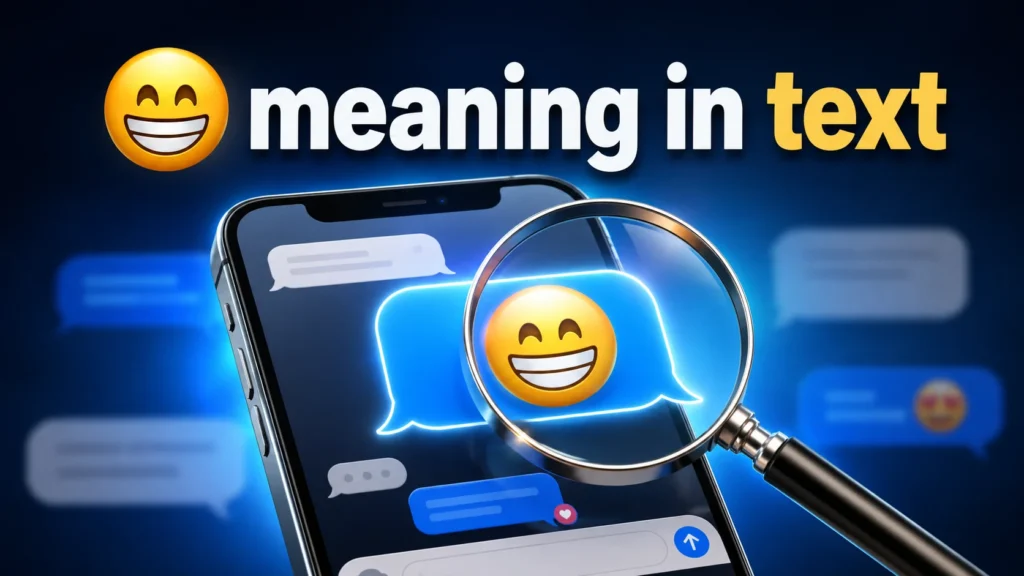
The 😁 meaning in text is usually connected with happiness, excitement, friendliness, playful confidence, or a slightly awkward smile. Officially known as the Beaming Face with Smiling Eyes emoji, 😁 shows a wide toothy grin with cheerful eyes.
But emojis rarely have just one meaning.
Someone may send 😁 because they are genuinely excited. Another person might use it after making a slightly embarrassing comment. In flirting, it can feel cute and playful. In a work chat, it may simply soften a message and make it sound more friendly.
That flexibility is exactly why people search for the meaning of 😁 in texting.
Was the sender genuinely happy? Were they nervous? Were they joking? Was the smile sarcastic?
The answer depends on the conversation, your relationship with the sender, and the words surrounding the emoji.
This guide explains what 😁 means in text messages, social media, friendships, relationships, professional conversations, and different cultural situations.
😁 Meaning in Text – Quick Meaning
The simplest 😁 meaning in text is:
“I’m happy, excited, friendly, or smiling really big.”
It often expresses positive energy without sounding overly emotional.
Depending on the situation, 😁 can mean:
- I’m really happy.
- I’m excited about this.
- That was funny.
- I’m being friendly.
- I’m slightly embarrassed.
- I’m trying to make this sound less serious.
- I’m proud of myself.
- I’m joking around.
Simple Text Examples
“I finally passed my exam 😁”
Here, 😁 shows genuine happiness and pride.
“Okayyy, maybe I did eat the last slice 😁”
In this example, the emoji creates a playful, guilty feeling.
“See you tomorrow 😁”
This usually communicates friendliness and positive anticipation.
The emoji becomes easier to understand when you look at what came before it.
Origin & Background of 😁
The 😁 emoji belongs to the family of smiling-face emojis that became widely used as digital communication moved from simple emoticons into colorful smartphone emoji keyboards.
Before emojis became common, people often expressed similar emotions through symbols such as:
:D
The old-fashioned “:D” represented a huge open smile. 😁 performs a similar job visually but adds smiling eyes and visible teeth, making the emotion clearer and more expressive.
From Simple Happiness to Contextual Emotion
At first glance, 😁 appears to represent pure happiness.
Online communication changed its emotional range.
People now use it for excitement, playful embarrassment, teasing, awkwardness, self-consciousness, and even light sarcasm.
A sentence such as:
“I totally knew that already 😁”
could express genuine confidence.
It could also mean:
“I definitely did not know that, but I’m pretending I did.”
That difference shows how much context matters.
Social Media Influence
Platforms like TikTok, Instagram, Snapchat, WhatsApp, X, and Discord have made emoji meanings more flexible.
Younger users especially combine emojis with irony and exaggerated expressions.
For example:
“Just spent all my money again 😁”
The person probably is not celebrating financial irresponsibility. The smile makes the statement humorous.
That type of usage has helped 😁 develop beyond a simple “happy face.”
READ MORE: Low-Key Meaning in Text: Hidden Feelings Explained
Real-Life Conversations Using 😁
Seeing an emoji inside a realistic conversation is often the easiest way to understand it.
WhatsApp Conversation
Person A: Did you finally finish your assignment?
Person B: Yes! Submitted five minutes before the deadline 😁
Person A: You seriously enjoy living dangerously.
Person B: Apparently 😭
Here, 😁 expresses relief, happiness, and a little pride.
Instagram DM
Person A: Your new haircut actually looks really good.
Person B: “Actually”? 😭
Person A: You know what I mean 😁
Person B: Hmm, I’ll let you survive this time.
The 😁 emoji softens the message and shows playful nervousness after a questionable compliment.
TikTok Comments
Person A: Bro really thought nobody would notice.
and,
Person B: I was hoping you wouldn’t 😁
Person A: Too late 😂
Here, 😁 represents playful guilt.
The commenter knows they were caught and responds with a cheerful “you got me” attitude.
Text Message Between Friends
Person A: Guess who got tickets for Saturday?
Person B: NO WAY.
and,
Person A: Me 😁
Person B: I officially forgive you for everything.
In this conversation, 😁 communicates excitement and proud satisfaction.
Emotional & Psychological Meaning of 😁
Emojis help people communicate emotions that plain text sometimes fails to capture.
Consider the sentence:
“I did it.”
It sounds neutral.
Now compare:
“I did it 😁”
Suddenly, the message feels happier, more energetic, and more personal.
What Emotion Does 😁 Express?
The strongest emotions associated with 😁 are:
- Joy
- Excitement
- Pride
- Playfulness
- Friendly enthusiasm
- Mild embarrassment
- Nervous happiness
The smiling eyes make the emoji feel warmer than a simple toothy grin.
Why People Use It
People often use 😁 when they want their message to feel positive without becoming overly sentimental.
For example:
“Thanks for helping me 😁”
feels friendly and appreciative.
Using ❤️ might feel more intimate.
Using 👍 could feel colder.
😁 sits comfortably between those extremes.
What It Reveals About Modern Communication
Digital conversations lack facial expressions and vocal tone.
If someone says:
“Fine.”
You may wonder whether they are genuinely fine or annoyed.
But:
“Fine 😁”
usually feels much more positive.
Emojis help replace some of the emotional information we normally receive from facial expressions.
A Personal-Style Scenario
Imagine telling a friend that you finally got accepted for something you had been working toward for months.
You type:
“They accepted me 😁”
Even without saying “I’m incredibly happy,” the emoji communicates that excitement instantly.
That is why simple emojis can carry more emotional weight than people realize.
Usage of 😁 in Different Contexts
The meaning of 😁 changes slightly depending on where and how it appears.
Social Media
On Instagram, TikTok, Snapchat, and similar platforms, 😁 usually represents:
- Excitement
- Proud happiness
- Playful confidence
- Lighthearted humor
Example:
“Finally posted the pictures 😁”
This sounds cheerful and confident.
Friends & Relationships
Among friends, 😁 often creates a playful tone.
Example:
“I may have told everyone what happened 😁”
The sender knows they did something mischievous and is smiling about it.
In relationships, the emoji can also feel cute or mildly flirty.
Example:
“Can’t wait to see you tonight 😁”
This usually suggests genuine excitement.
Work or Professional Settings
😁 can sometimes be appropriate in casual workplace communication.
Example:
“Finished the report ahead of schedule 😁”
It sounds positive and enthusiastic.
For highly formal emails, however, emojis may be unnecessary.
A professional environment with traditional communication standards may prefer plain language.
Casual vs Serious Tone
😁 works best in relaxed conversations.
It can soften:
- Jokes
- Mild apologies
- Friendly announcements
- Excited updates
- Playful teasing
It should not automatically be used in serious emotional situations.
When NOT to Use 😁
Although 😁 is generally positive, there are situations where it can feel inappropriate.
During Serious Conversations
Imagine someone saying:
“My grandfather is in hospital.”
Replying:
“Hope he gets better 😁”
would likely feel emotionally mismatched.
A softer emoji such as ❤️ or 🙏 may fit better depending on your relationship.
During Conflict
If someone is genuinely angry, replying with 😁 can appear sarcastic.
Example:
Person A: I’m really upset that you ignored my messages.
Person B: Okay 😁
The smile may make the response sound dismissive or mocking.
Formal Communication
Using 😁 in communication with clients, senior executives, professors, or official institutions may feel too casual unless you already have an informal relationship.
Cultural Sensitivity
Not everyone interprets emojis exactly the same way.
Some people read a large toothy smile as enthusiasm.
Others may interpret it as nervousness or forced friendliness.
When the topic is important, clear wording is safer than relying entirely on an emoji.
Common Misunderstandings About 😁
One reason people search what does 😁 mean in text is that the emoji does not always represent simple happiness.
Misunderstanding 1: It Always Means Extreme Happiness
Not necessarily.
Compare:
“I got promoted 😁”
with:
“I forgot your birthday again 😁”
The first shows real happiness.
The second communicates awkward humor or guilty embarrassment.
Misunderstanding 2: It Is Always Flirty
😁 can appear in flirting, but it is not automatically romantic.
A friend, coworker, sibling, classmate, or stranger may use it simply to appear friendly.
Misunderstanding 3: It Means the Same as 😂
Not exactly.
😂 strongly suggests laughter.
😁 suggests smiling, excitement, friendliness, or playful embarrassment.
Literal vs Figurative Meaning
Literally, 😁 represents a person smiling broadly.
Figuratively, it can communicate:
“Oops.”
“You caught me.”
“I’m proud.”
“I’m trying to stay positive.”
“I know exactly what I did.”
That flexibility makes context essential.
😁 Meaning Compared With Similar Emojis and Expressions
| Emoji/Expression | Common Meaning | How It Differs From 😁 |
|---|---|---|
| 😁 | Big happiness, excitement, playful awkwardness | Friendly toothy grin |
| 😀 | General happiness | More straightforward and neutral |
| 😊 | Warm happiness, kindness | Softer and more affectionate |
| 😄 | Cheerful excitement | Often feels more openly joyful |
| 😂 | Strong laughter | Focuses on something being funny |
| 😅 | Nervous relief or awkward laughter | Stronger sense of embarrassment |
| 🙂 | Mild friendliness | Can sometimes feel emotionally neutral |
| 😏 | Flirting or smug confidence | More suggestive than 😁 |
| 😬 | Awkwardness or discomfort | More nervous than happy |
| 😞 | Sadness or disappointment | Emotional opposite of 😁 |
Key Insight
😁 sits between pure happiness and playful awkwardness. It usually creates positive energy, but the surrounding message determines whether that energy feels excited, teasing, nervous, or proudly mischievous.
Variations and Types of 😁 Usage
The same emoji can communicate several slightly different emotions.
1. Excited 😁
Meaning: “I’m really happy!”
Example:
“Concert tickets secured 😁”
2. Proud 😁
Meaning: “I did something good.”
Example:
“Finished the whole project myself 😁”
3. Playfully Guilty 😁
Meaning: “Yes, I did it.”
Example:
“I might have eaten your chocolate 😁”
4. Nervous 😁
Meaning: “I’m smiling because this is awkward.”
Example:
“I accidentally sent that message to everyone 😁”
5. Friendly 😁
Meaning: “I’m being warm and approachable.”
Example:
“Nice meeting you today 😁”
6. Flirty 😁
Meaning: “I’m enjoying this conversation.”
Example:
“So when are you taking me out? 😁”
The flirting comes mostly from the sentence, not the emoji alone.
7. Relieved 😁
Meaning: “Thankfully, everything worked out.”
Example:
“Made it to the airport just in time 😁”
8. Teasing 😁
Meaning: “I know I’m annoying you a little.”
Example:
“I told you I’d win 😁”
9. Sarcastic 😁
Meaning: “Everything is definitely going wonderfully.”
Example:
“Three deadlines tomorrow 😁”
The contradiction creates humor.
10. Confident 😁
Meaning: “I’m pleased with myself.”
Example:
“Guess who got the highest score 😁”
How to Respond When Someone Uses 😁
Your reply should match the emotional context.
Casual Replies
You could reply:
- “Haha nice 😁”
- “Love that!”
- “You look happy 😂”
- “Good for you!”
Funny Replies
When 😁 feels mischievous:
- “Why are you smiling like that? 😂”
- “What did you do?”
- “That emoji is suspicious.”
- “I know you’re guilty 😭”
Mature Replies
For genuine good news:
- “That’s great to hear.”
- “You deserve it.”
- “I’m really happy for you.”
- “Glad everything worked out.”
Respectful Replies
In professional or less familiar conversations:
- “Great, thank you.”
- “Sounds good.”
- “Happy to hear that.”
- “Looking forward to it.”
You do not need to return the same emoji unless it feels natural.
Regional & Cultural Usage of 😁
Emoji meanings are increasingly global, but communication style still differs across cultures.
Western Culture
In North American and European digital conversations, 😁 commonly expresses enthusiasm, playful confidence, happiness, or mild awkwardness.
It is frequently used in casual messaging.
Asian Culture
In many Asian online communities, smiling emojis are also common, but subtle differences in politeness and emotional expression can affect interpretation.
😁 may appear when someone wants to sound cheerful, respectful, enthusiastic, or slightly embarrassed.
Middle Eastern Culture
Across many Middle Eastern social media communities, 😁 is commonly understood as a friendly or cheerful emoji.
It often appears in humorous conversations, friendly messages, and casual family or social chats.
Global Internet Usage
Online culture increasingly shapes emoji meaning more strongly than geography.
A TikTok user in Pakistan, the United States, Japan, or the UAE may understand the same ironic joke because they participate in similar internet communities.
Gen Z vs Millennials
Millennials may use 😁 more literally:
“I’m happy.”
Gen Z users are often more comfortable using traditionally positive emojis ironically.
For example:
“Failed my driving test again 😁”
Obviously, the person probably is not celebrating.
The exaggerated positivity makes the disappointment funny.
Still, these are tendencies rather than strict rules. Individual communication habits matter much more than age alone.
Is 😁 Safe for Kids?
Yes, 😁 is generally a child-friendly emoji.
It has no inherently sexual, offensive, or dangerous meaning.
Children may use it to express happiness, excitement, pride, or friendliness.
Parents should still remember that emojis can take on different meanings depending on surrounding messages. The emoji itself is harmless, but the conversation should always provide the final context.
FAQs About 😁 Meaning in Text
What does 😁 mean in texting?
😁 usually means happiness, excitement, friendliness, playful confidence, or mild embarrassment. Its exact meaning depends on the words and conversation around it.
What does 😁 mean from a girl?
If a girl sends 😁, she may be showing happiness, friendliness, excitement, nervousness, or playful interest. It does not automatically mean she is flirting.
What does 😁 mean from a guy?
When a guy sends 😁, it commonly expresses excitement, friendliness, confidence, joking, or playful awkwardness. The conversation determines whether it has romantic meaning.
Is 😁 a flirting emoji?
😁 can be used while flirting, especially with playful messages, but the emoji itself is not strongly romantic. Emojis such as 😏, 😘, or ❤️ usually communicate flirting more directly.
What is the difference between 😁 and 😊?
😁 feels more energetic, playful, and expressive, while 😊 usually feels softer, warmer, and more affectionate.
Can 😁 mean nervousness?
Yes. People sometimes use 😁 when they feel embarrassed or awkward but want to keep the conversation light.
For example:
“I may have broken it 😁”
Is 😁 sarcastic?
It can be.
A message like:
“Another Monday morning 😁”
may use exaggerated happiness sarcastically. Context determines whether the smile is sincere.
Conclusion
The 😁 meaning in text is usually positive, but it carries more personality than a simple happy face.
It can express genuine excitement, friendly energy, playful confidence, mild embarrassment, nervousness, teasing, or even sarcastic positivity.
The easiest way to understand it is to read the entire message rather than interpreting the emoji alone.
“I got the job 😁” clearly communicates happiness.
“I accidentally deleted everything 😁” tells a completely different emotional story.
That flexibility is what makes emojis such an interesting part of modern communication. They do not replace words, but they add tone, personality, and emotion that plain text sometimes struggles to communicate.
When someone sends you 😁, think of it as a big digital grin—but always check what that grin is reacting to.