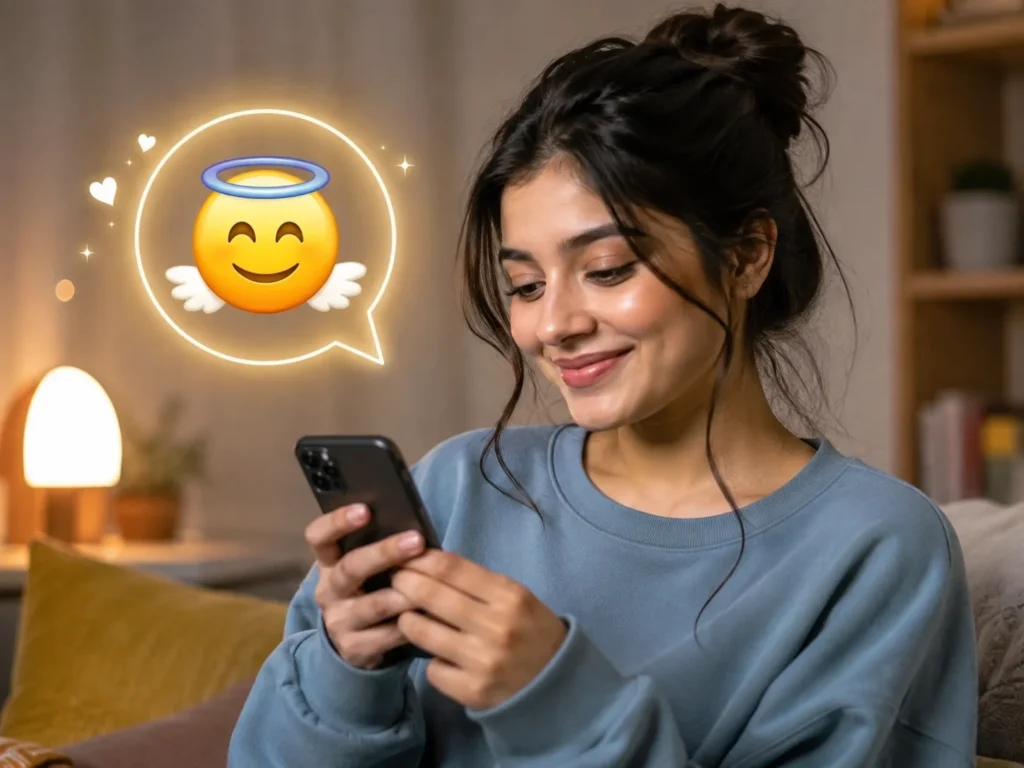
If a girl texts you 😇, it usually means “I’m innocent,” “I’m being sweet,” or “I’m acting like an angel.” Depending on the conversation, it can also be playful, sarcastic, teasing, or lightly flirty.
What Does 😇 Mean in Text From a Girl?
The 😇 emoji is officially called “Smiling Face with Halo.” When a girl sends it in a text, she is usually adding a sense of innocence, sweetness, kindness, or playful “angel” behavior to what she just said. Emojipedia describes the emoji as representing angels, prayers, blessings, and angelic behavior.
The important point is that 😇 does not have one fixed meaning. The words around it matter.
For example:
“I didn’t do anything 😇”
Here, 😇 probably means “I’m innocent… supposedly.”
But:
“Aww thank you 😇”
can simply mean “That’s sweet of you.”
And:
“Goodnight 😇”
may add a gentle, cute, or affectionate tone without necessarily being romantic.
So, if a girl sends you 😇, don’t automatically assume she is flirting. Look at what she said before the emoji, your relationship with her, and the overall tone of the conversation.
The Main Meanings of 😇 From a Girl
1. She Is Pretending to Be Innocent
This is one of the most recognizable uses of 😇 in casual texting.
A girl may use 😇 after saying something mischievous, cheeky, or slightly provocative. The halo creates a humorous contrast between what she said and the “innocent” image she is presenting.
For example:
“Maybe I took the last cookie 😇”
The message can mean:
“Yes, I did it, but I’m going to pretend I’m innocent.”
This use often carries a playful “Who, me?” feeling.
2. She Is Being Sweet or Kind
😇 can also have a completely sincere meaning.
A girl might send it when thanking you, appreciating something you did, or wishing you well.
“You’re so helpful, thank you 😇”
Here, there is no obvious sarcasm. She is simply adding sweetness to the message.
3. She Is Joking About Being a “Good Girl”
Sometimes 😇 means something like:
“Look how well-behaved I am.”
The sender may genuinely be behaving well, or she may be exaggerating it for humor.
For example:
“I finished all my work before watching Netflix 😇”
The emoji makes the statement playful rather than formal.
4. She Is Being Sarcastic
Context can completely reverse the meaning.
If she says:
“I definitely didn’t steal your fries 😇”
the emoji may communicate the opposite of literal innocence.
The humor comes from pretending to be angelic when the conversation suggests otherwise.
5. She May Be Lightly Flirting
😇 can sometimes appear in flirtatious conversations, especially when the conversation already contains teasing or romantic interest.
However, 😇 alone does not prove that a girl is flirting.
Compare:
“You look cute today 😇”
with:
“I didn’t say I was trying to impress you 😇”
The second example has more room for playful flirting because the emoji reinforces the teasing tone.
Is 😇 an Acronym, Abbreviation, or Slang Word?
No. 😇 is an emoji, not an acronym, abbreviation, or slang word.
Its official Unicode name is Smiling Face with Halo. Its Unicode code point is U+1F607. Unicode 6.0 included the character in 2010, and Emoji 1.0 included it in 2015.
The halo visually connects the emoji with ideas such as angels, innocence, goodness, and kindness.
Modern texting adds another layer: people can use the “angel” appearance ironically. That is why 😇 can mean both genuine innocence and deliberately fake innocence.
😇 on Different Texting Platforms
SMS and iMessage
In ordinary SMS and iMessage conversations, 😇 usually works as a tone marker.
It can soften a statement, show innocence, or make a joke more playful.
Examples include:
“I was actually productive today 😇”
“Okayyy, I’ll behave 😇”
“Thank you for helping me 😇”
The meaning comes primarily from the sentence, not from the emoji alone.
WhatsApp users commonly use 😇 in personal conversations to add warmth, innocence, or playful sarcasm.
For example:
“I didn’t tell anyone your secret 😇”
That can sound suspiciously innocent depending on the context.
Instagram DMs
In Instagram DMs, 😇 can appear in casual conversations, reactions, compliments, and teasing. A girl might use it after a playful statement or compliment.
For example:
“Maybe you are a little cute 😇”
Here, the emoji can make the compliment feel softer and more teasing.
Snapchat and Discord
In Snapchat and Discord chats, 😇 can similarly communicate innocence, sweetness, or joking self-defense.
There is no separate official Snapchat or Discord meaning for 😇. The underlying emoji meaning remains the same even when the platform changes.
Does 😇 Have Different Meanings Depending on Capitalization?
No.
Unlike abbreviations such as “LOL” and “lol,” an emoji does not become a different word when capitalized.
The emoji is simply:
😇
However, the surrounding words, punctuation, and other emojis can change how it feels.
Compare:
“Okay 😇”
with:
“Okayyy 😇😂”
and:
“Fine. 😇”
The first may sound sweet, the second playful, and the third potentially sarcastic.
How 😇 Functions in a Text
Part of Speech
Technically, 😇 is an emoji rather than a traditional grammatical part of speech. In digital communication, however, it can function like an emotional modifier, reaction, or tone marker.
Where It Appears
It most often appears at the end of a sentence or message.
Examples:
“I’m innocent 😇”
“Thank you 😇”
“I’ll be good 😇”
It can also appear by itself:
“😇”
A standalone 😇 usually requires previous context to interpret accurately.
Can 😇 Stand Alone?
Yes.
A girl could reply:
“😇”
to communicate something like:
“I’m innocent.”
“Who, me?”
“I’m being good.”
“Aww, thank you.”
The previous message determines which interpretation makes the most sense.
Formal or Informal?
😇 is primarily informal. It fits personal texts, casual DMs, and friendly conversations much better than formal professional communication.
😇 Tone Variations in Real Texts
Funny
A funny use usually involves pretending to be innocent after doing something obvious.
A: Did you eat my chocolate?
B: I have absolutely no idea what you’re talking about 😇
A: The empty wrapper is literally next to you.
B: Wow. What a coincidence 😂
Here, 😇 clearly adds fake innocence.
Sarcastic
Sarcasm happens when the sender uses the angel emoji to contradict the obvious meaning.
A: You told everyone I was late.
B: I merely provided accurate information 😇
A: You enjoyed telling them way too much.
B: Maybe a little.
The emoji makes the denial deliberately cheeky.
Playful
A playful use can simply make the conversation feel lighter.
A: Are you actually going to behave tonight?
B: Of course 😇
A: I don’t believe you.
B: You should have more faith in me.
Here, the emoji creates a harmless teasing tone.
Serious
😇 can also appear in a sincere message involving kindness, gratitude, or blessings.
A: Thanks for checking on me today.
B: Of course. I hope you’re feeling better 😇
A: That honestly meant a lot.
B: Anytime. Take care of yourself.
In this context, there is no obvious sarcasm. The emoji supports warmth and kindness.
10 Realistic Text Examples of 😇 From a Girl
1. Between Friends
A: Did you finish the assignment?
B: Yep, and I didn’t procrastinate this time 😇
A: That’s actually impressive.
B: I know. Character development 😂
2. Between a Couple
A: You said you wouldn’t tease me today.
B: I said I’d try 😇
A: That’s not the same thing.
B: Exactly.
3. From a Sister
A: Mom asked who finished the cake.
B: Not me 😇
A: You have frosting on your shirt.
B: Evidence can be misleading.
4. From a Brother or Sibling
A: Did you change my phone wallpaper?
B: Maybe 😇
A: Seriously?
B: You needed a better picture.
5. From a Coworker
A: Did you already send the report?
B: Yes, I’m being productive today 😇
A: I’m impressed.
B: Don’t expect this every day.
6. From a Parent
A: Did you clean your room?
B: Yes 😇
A: Completely?
B: Let’s not get carried away.
7. From Someone You Like
A: You were definitely trying to make me laugh earlier.
B: Maybe I was 😇
A: I knew it.
B: And it worked, didn’t it?
8. After a Compliment
A: You looked really nice today.
B: Aww, thank you 😇
A: You’re welcome.
B: That’s actually sweet of you.
9. From Someone You Barely Know
A: Did you recommend that restaurant?
B: Maybe 😇
A: Well, it was really good.
B: Glad you liked it!
10. After a Mischievous Comment
A: You told him I was going to be there, didn’t you?
B: I might have mentioned it 😇
A: You totally did.
B: I couldn’t help myself.
How to Reply When a Girl Sends 😇
Funny Reply
If she is clearly joking, match the humor.
“That halo is not fooling anyone 😂”
This works particularly well when she has just admitted to something mischievous.
Serious Reply
If she uses 😇 sincerely, respond naturally rather than forcing flirtation.
“You’re genuinely sweet. I appreciate that.”
Flirty Reply
If your conversation already has obvious romantic or teasing energy, you can play along.
“Innocent? I’m not convinced 😏”
This works because it responds to the playful “angel” idea without treating the emoji as proof of romantic interest.
Neutral or Unbothered Reply
If you aren’t sure what she means, simply continue the conversation.
“Haha, okay 😄”
You don’t need to decode every emoji immediately. The surrounding conversation usually reveals the intended tone.
Related Emoji Comparison
| Term | Meaning | Usage Context | Tone | Popularity | Confusion Risk |
|---|---|---|---|---|---|
| 😇 | Innocent, angelic, sweet, or fake innocence | Personal texts and DMs | Sweet/playful | High | Medium |
| 😊 | Warm, friendly happiness | Everyday texts | Friendly | Very high | Low |
| 😈 | Mischievous or suggestive behavior | Teasing and playful texts | Mischievous | High | Medium |
| 😉 | Wink, teasing, or implied meaning | Flirting and jokes | Playful/flirty | Very high | High |
| 😏 | Smirk, confidence, suggestive teasing | Flirty or sarcastic texts | Suggestive | High | High |
| 🙏 | Thanks, prayer, pleading, or appreciation | Texts and DMs | Respectful/sincere | Very high | Medium |
The biggest potential confusion is between 😇 and 😈. They sit at opposite ends of the “angel versus mischief” idea. 😇 presents innocence, while 😈 more directly signals mischief or a cheekier intention.
Who Uses 😇 in Texts?
Younger Users
Younger texters often use 😇 flexibly. It can be sincere, ironic, humorous, or teasing depending on the conversation.
The same person may use it sincerely in one conversation and sarcastically in another.
Gen Z vs. Millennials
There is no reliable rule that says Gen Z or Millennials use 😇 in only one way. Both groups use the emoji to communicate innocence, sweetness, and playful behavior.
The difference often comes from how much irony surrounds the message. Younger digital communication frequently uses emojis as tone markers, meaning the literal image may not represent the sender’s exact emotional state.
Regional Usage
😇 is a Unicode emoji, so it can appear across international messaging services rather than belonging to one specific English-speaking region. There is no reliable basis for claiming that a girl in the United States, United Kingdom, or another region automatically gives 😇 a different fixed meaning.
The safest approach is to interpret it from local conversation context rather than geography.
Where Did 😇 Come From?
😇 did not originate as TikTok slang.
The character was standardized as U+1F607, “Smiling Face with Halo,” in Unicode 6.0 in 2010. It later became part of Emoji 1.0 in 2015.
Its visual concept comes from the familiar cultural image of an angel or virtuous person represented with a halo. Unicode documentation lists it alongside other face emojis such as 😈, 😉, 😊, and 😍.
Digital communication then expanded the emoji’s practical meaning. Instead of using 😇 only literally for angels or religious ideas, people began using it to communicate “I’m innocent,” “I’m being good,” or “I totally didn’t do anything.”
That ironic use helps explain why the emoji remains useful in everyday texting.
Is 😇 Rude or Offensive?
Generally, no.
😇 is not profanity and does not inherently contain explicit language. It is normally harmless and can communicate kindness, innocence, or playful humor.
However, context can make it sarcastic. If someone is discussing a serious mistake, responding with 😇 could make you appear dismissive or insincere.
For school or work, it is safer to use 😇 only in genuinely casual conversations where emojis are already appropriate.
For example, texting a close coworker:
“Finally finished that spreadsheet 😇”
may be fine.
Texting a manager:
“I forgot the deadline 😇”
could look unprofessional because the emoji may make a serious mistake appear trivial.
Real-World Observation: Why 😇 Works So Well in Texting
The interesting thing about 😇 is that it often does more than describe an emotion. It changes how the reader hears the sentence in their head. A statement such as “I didn’t do it” can sound defensive, while “I didn’t do it 😇” can sound playful or suspiciously innocent. That makes the emoji useful in text conversations where voice tone and facial expressions are missing. The halo gives the reader an immediate visual cue: the sender wants to sound angelic, whether she genuinely means it or is joking about being anything but angelic.
Frequently Asked Questions
What does 😇 mean from a girl in a text?
From a girl, 😇 commonly means that she is being innocent, sweet, kind, or playfully angelic. It can also mean that she is pretending to be innocent after saying or doing something mischievous. The surrounding message determines which interpretation fits best.
Is 😇 from a girl a sign she likes you?
Not necessarily. A girl can use 😇 with friends, family members, coworkers, or someone she barely knows. If the conversation already contains flirting, teasing, compliments, or romantic interest, 😇 may contribute to that tone, but the emoji alone cannot establish attraction.
Is it rude to reply with just 😇 in a text?
Usually, no. A standalone 😇 can mean “I’m innocent,” “okay,” “I’m being good,” or simply “angelic/sweet,” depending on what came before it. However, replying with only 😇 to a serious message could seem dismissive or confusing.
What’s the difference between texting 😇 and saying it out loud?
😇 has no direct spoken equivalent because it is a visual symbol rather than a word. In conversation, you might express its meaning through your tone of voice, such as saying “I’m innocent,” “I didn’t do anything,” or “Aww, thank you.” Texting uses the emoji to provide some of the tone that speech would normally communicate.
Does 😇 mean the same thing in a group chat and a 1-on-1 text?
The basic meaning stays the same, but the context changes. In a group chat, 😇 may be used as a public joke or reaction to something another person said. In a 1-on-1 conversation, the emoji can feel more personal, especially when the surrounding conversation is affectionate or teasing.
Can 😇 be sarcastic?
Yes. Sarcasm is one of its common modern uses. Someone may use the angel emoji immediately after doing something mischievous to jokingly claim innocence.
Does 😇 mean she is flirting?
It can contribute to a flirty conversation, but it is not automatically flirtatious. Look for additional signals such as direct compliments, teasing, affectionate language, repeated romantic conversation, or other clearly flirtatious emojis. The context matters more than the emoji itself.
What does it mean when she sends 😇 after a compliment?
It often signals a sweet or slightly shy response to the compliment. For example, “Thank you 😇” can simply mean that she appreciated what you said. Whether it is romantic depends on the broader relationship and conversation.
PAA-Optimized Questions
What does 😇 mean when a girl sends it?
It usually means she is being sweet, innocent, angelic, or playfully pretending to be innocent. Context determines whether the emoji is sincere, sarcastic, or teasing.
What does 😇 mean from a girl after flirting?
It can soften a flirty or teasing statement and make it feel more playful. However, 😇 by itself does not prove that she is romantically interested.
What does 😇 mean from a girl after saying something naughty?
It often creates fake innocence. In that situation, she may be jokingly saying, “Who, me? I’m an angel,” even though the previous message suggests otherwise.
What does it mean if a girl texts “okay 😇”?
It can mean “okay, I’ll behave,” “okay, I’m innocent,” or simply “okay” with a softer tone. Her previous messages are the best clue.
Conclusion
The 😇 meaning in text from a girl usually centers on innocence, sweetness, angelic behavior, or playful fake innocence. It is officially the Smiling Face with Halo emoji, and its standardized Unicode identity dates back to 2010.
When a girl sends 😇, don’t automatically read it as flirting. However, Sometimes she is genuinely being sweet. Sometimes she is jokingly pretending she did nothing wrong. Sometimes she is responding warmly to a compliment. And sometimes the emoji simply makes an ordinary message feel softer.
Usage Tips
- Read the sentence before interpreting the emoji.
- Treat 😇 as a tone signal rather than a fixed secret code.
- Look for playful context when she uses it after mischief or teasing.
- Consider romantic meaning only when the wider conversation supports it.
Common Mistakes
- Assuming 😇 automatically means “she likes me.”
- Treating every use as religious or spiritual.
- Ignoring sarcasm when the surrounding message is clearly teasing.
- Assuming the emoji has a different official meaning because it appears on another platform.
When to Use 😇
Use 😇 in casual texts when you want to communicate innocence, sweetness, kindness, angelic behavior, or playful fake innocence.
When to Avoid 😇
Avoid it when a conversation requires a serious, direct, or professional tone. In those situations, the emoji can make your message sound less serious than you intended.
In short: when a girl texts 😇, think “sweet, innocent, or pretending to be innocent.” The exact meaning comes from the conversation around it.