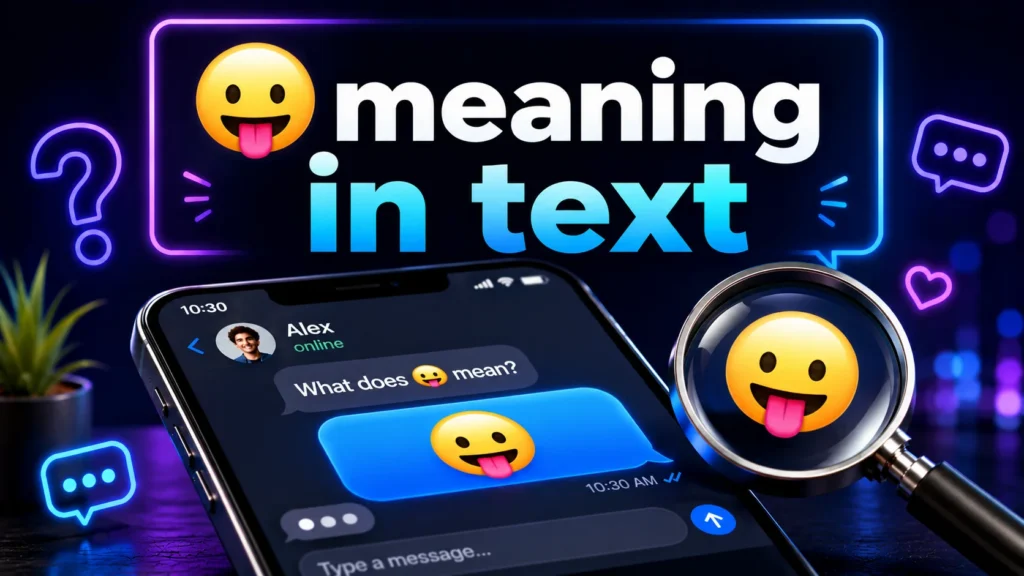
The 😛 meaning in text is usually playful, teasing, silly, or joking. It is officially known as the Face with Tongue emoji and is often used when someone wants to show they are not being completely serious.
If a friend texts, “I ate the last slice 😛,” the emoji softens the message. Instead of sounding rude, the sender is probably teasing you.
People often search for the meaning of 😛 because emojis can change tone depending on the conversation. The same tongue-out face might look funny between friends, flirtatious between two people who like each other, or slightly cheeky after a sarcastic comment.
That is why context matters.
In most cases, 😛 communicates a feeling similar to saying, “Just kidding,” “I’m teasing you,” “Oops,” or “Don’t take me too seriously.”
Understanding that emotional layer can help you avoid misreading a text and respond with the right energy.
😛 Meaning in Text – Quick Meaning
What Does 😛 Mean in Text?
The 😛 emoji usually means playfulness, teasing, silliness, or lighthearted joking.
It shows a yellow face with open eyes and a tongue sticking out. That expression resembles the playful face people sometimes make in real life when joking with friends.
Common meanings include:
- “I’m joking.”
- “I’m teasing you.”
- “I’m being silly.”
- “Don’t take this seriously.”
- “Oops, but I’m not too worried.”
- “I’m feeling playful.”
- “I’m flirting a little.”
For example:
“You know I’m better at this than you 😛”
Here, 😛 makes the statement sound playful rather than arrogant.
Another example:
“I stole one of your fries 😛”
The emoji gives the message a mischievous tone.
And:
“Maybe I missed you a little 😛”
In this case, 😛 may add a cute or slightly flirtatious feeling.
The exact interpretation depends on who sends it and what was being discussed.
Origin & Background of 😛
Where Did the Tongue-Out Expression Come From?
Sticking out the tongue existed as a human gesture long before emojis.
In many everyday situations, people stick out their tongue to act silly, tease someone, or show that they are joking. Children commonly use the gesture during playful arguments, while adults may use it sarcastically or flirtatiously.
Digital communication needed a way to reproduce those facial cues.
Before modern emojis became common, people often used text-based emoticons such as:
😛
or:
😛
These symbols represented a face with its tongue sticking out.
When colorful emojis became standard on smartphones, 😛 became a visual replacement for those older text expressions.
How Social Media Changed Its Meaning
Social media helped 😛 develop beyond simple silliness.
On Instagram, Snapchat, WhatsApp, TikTok, and other platforms, people started combining the emoji with jokes, selfies, flirting, food posts, challenges, and sarcastic comments.
Because online conversations lack body language and voice tone, emojis help people communicate emotional intent.
For example:
“You’re so annoying”
can sound harsh.
But:
“You’re so annoying 😛”
often sounds playful or affectionate.
That small emoji can completely change how a message feels.
Real-Life Conversations Using 😛
WhatsApp Conversation
Person A: Did you eat the chocolate I saved?
Person B: Maybe 😛
and,
Person A: I knew it 😂
Person B: You took too long!
Here, 😛 expresses playful guilt. Person B knows they did something slightly annoying but is joking about it.
Instagram DM
Person A: That selfie is actually really good.
Person B: Actually? 😛
Person A: Okay fine, you look amazing.
Person B: Much better 😂
In this conversation, 😛 adds a teasing and slightly flirtatious tone.
TikTok Comments
Person A: Nobody can convince me pineapple belongs on pizza.
and,
Person B: Best pizza topping ever 😛
Person A: Blocked 😂
The emoji tells readers that the disagreement is playful rather than aggressive.
Text Message
Person A: Are you coming tonight?
Person B: Maybe if you ask nicely 😛
and,
Person A: Pleaseeee 😂
Person B: Okay, I’ll come.
Here, 😛 suggests playful teasing and could also feel mildly flirtatious depending on the relationship.
Emotional & Psychological Meaning of 😛
The emotional purpose of 😛 is usually to make communication feel lighter.
Text messages do not contain facial expressions, voice pitch, or gestures. Because of that, even harmless words can sometimes sound cold or rude.
The tongue-out emoji helps signal:
“I’m not being too serious.”
That can reduce tension and make a message feel friendlier.
Why People Use 😛
People commonly use 😛 when they want to:
- Tease without sounding mean.
- Make a joke obvious.
- Show a mischievous mood.
- Add personality to a short reply.
- Flirt without becoming too serious.
- Admit something embarrassing in a playful way.
- Make sarcasm feel softer.
Imagine you tell a close friend:
“I’m definitely stealing your hoodie 😛”
Without the emoji, the message might sound demanding.
With 😛, it feels more like playful teasing.
That emotional softening is one of the biggest reasons tongue-out emojis remain popular in casual conversations.
Usage of 😛 in Different Contexts
😛 on Social Media
On social media, 😛 often appears in funny captions, comments, selfies, food posts, and teasing exchanges.
Someone might caption a photo:
“Looking innocent as always 😛”
The emoji suggests that the person knows the statement is probably not completely true.
😛 Between Friends
Friends frequently use 😛 when joking with one another.
For example:
“I won again 😛”
The sender may be celebrating while teasing their friend at the same time.
Because close friends understand each other’s personalities, the emoji usually feels harmless.
😛 in Relationships
In romantic conversations, 😛 can become flirtatious.
Examples include:
“Maybe I was thinking about you 😛”
or:
“You looked cute today 😛”
The tongue-out face can make romantic interest feel less serious and more playful.
It may show attraction, but it does not automatically mean someone likes you romantically.
The surrounding conversation matters much more.
😛 at Work or in Professional Messages
The emoji is usually too casual for formal communication.
Using 😛 with a close coworker in a relaxed team chat may be fine.
However, it is better to avoid it in:
- Job applications.
- Client emails.
- Academic communication.
- Serious workplace discussions.
- Messages to someone you do not know well.
A playful emoji can easily look unprofessional when the relationship does not support that level of informality.
Casual vs. Serious Tone
😛 works best in casual communication.
It is especially useful when joking, teasing, or making a small mistake seem less awkward.
However, it should not be used to soften serious topics where another person expects sincerity.
When NOT to Use 😛
During Serious Emotional Conversations
If someone is upset, grieving, angry, or sharing something deeply personal, 😛 can look insensitive.
For example:
“I’m sorry you’re going through that 😛”
would send a completely inappropriate emotional signal.
After Hurting Someone
Do not use 😛 to avoid responsibility.
Saying:
“Sorry I upset you 😛”
can make the apology seem fake or dismissive.
A sincere apology usually needs sincere language.
In Formal Communication
Professional situations require clearer emotional boundaries.
Avoid 😛 when communicating with employers, professors, customers, or people you barely know unless the environment is clearly casual.
When Teasing Could Be Misunderstood
Not every relationship has the same sense of humor.
A message such as:
“You finally did something right 😛”
might be funny between close friends but insulting to someone else.
Know your audience.
Across Cultural Boundaries
Tongue gestures can carry different social meanings depending on culture and situation.
Although 😛 is widely understood online as playful, people may still interpret it differently based on age, background, and communication habits.
Common Misunderstandings About 😛
😛 Always Means Flirting
No.
It can be flirtatious, but its most common emotional theme is general playfulness.
Friends, siblings, classmates, and coworkers may use it without romantic intentions.
😛 Means Someone Is Being Rude
Usually not.
The emoji often does the opposite by making a potentially rude statement feel less serious.
However, sarcastic messages can still feel irritating if the joke crosses a boundary.
😛 Means the Sender Is Lying
Not necessarily.
Sometimes people use it after saying something deliberately exaggerated, but the emoji itself does not indicate dishonesty.
It is better understood as a sign of joking or mischievousness.
😛 Has a Sexual Meaning
Not automatically.
The visible tongue may occasionally be used suggestively in flirtatious adult conversations, but ordinary usage is typically innocent and playful.
Context determines whether there is any suggestive meaning.
😛 and 😜 Mean Exactly the Same Thing
They are similar, but not identical.
😛 feels generally playful or silly.
😜 adds a wink, which often makes the message feel more teasing, cheeky, or flirtatious.
😛 Meaning Comparison Table
| Emoji/Expression | Common Meaning | Typical Tone | Example |
|---|---|---|---|
| 😛 | Playful teasing | Silly, friendly | “I won again 😛” |
| 😜 | Cheeky teasing | Playful/flirty | “Maybe I like you 😜” |
| 😝 | Extreme silliness | Wild, goofy | “That was hilarious 😝” |
| 🤪 | Crazy fun | Energetic | “Tonight was wild 🤪” |
| 😂 | Laughter | Funny | “I can’t believe you 😂” |
| 😉 | Hint or flirtation | Suggestive/playful | “You know what I mean 😉” |
| 🙄 | Annoyance | Irritated | “Here we go again 🙄” |
| 😐 | Neutral reaction | Serious/awkward | “Okay 😐” |
| 😒 | Displeasure | Annoyed | “Not funny 😒” |
Key Insight
The biggest difference is emotional intensity. 😛 is usually light, harmless, and playful, while emojis such as 😜 and 😉 may carry stronger teasing or flirtatious undertones.
Variations and Types of 😛
1. 😛 — Face With Tongue
Meaning: Playfulness or teasing.
Used when someone is joking, acting silly, or being mischievous.
2. 😜 — Winking Face With Tongue
Meaning: Cheeky teasing or flirting.
The wink makes this version feel more knowingly playful.
3. 😝 — Squinting Face With Tongue
Meaning: Extreme silliness or excitement.
It often expresses a bigger, more energetic reaction than 😛.
4. 🤪 — Zany Face
Meaning: Wild or crazy fun.
Used when someone wants to exaggerate how silly or chaotic they are feeling.
5. 😛
Meaning: Old-school tongue-out emoticon.
It communicates almost the same playful attitude as 😛.
6. 😛😂
Meaning: Playful joke with laughter.
This combination strongly signals that the sender is not being serious.
7. 😛❤️
Meaning: Affectionate teasing.
The heart can make the message feel sweeter or more romantic.
8. 😛😉
Meaning: Cheeky or flirtatious teasing.
Combining the tongue-out face with a wink can strengthen the flirting.
9. 😛🙈
Meaning: Playful embarrassment.
It may suggest, “I probably shouldn’t have said that.”
10. 😛🔥
Meaning: Playful admiration or attraction.
Depending on context, it may be used after complimenting someone’s appearance, outfit, or post.
How to Respond When Someone Uses 😛
Your response should match the sender’s tone.
Casual Replies
If they are simply joking:
- “Haha okay 😂”
- “You’re impossible.”
- “I knew it 😭”
- “Very funny.”
- “Okayyy 😛”
Funny Replies
If you want to tease them back:
- “Don’t start 😂”
- “I’m remembering this.”
- “You wish 😛”
- “Keep dreaming 😂”
- “The confidence is crazy.”
Flirty Replies
If the conversation is already romantic:
- “Oh really? 😉”
- “Careful now 😏”
- “You’re trouble 😂”
- “Maybe I like that 😛”
- “Is that your way of flirting?”
Only use flirty replies when the relationship and conversation clearly support them.
Mature Replies
If you are unsure what they mean:
- “Are you joking?”
- “I can’t tell if you’re serious 😂”
- “What do you mean?”
- “You’re teasing me, right?”
Clarifying tone is completely normal in text communication.
Respectful Replies
If you do not want to encourage teasing:
- “Haha, okay.”
- “Got it.”
- “Fair enough.”
- “I understand.”
You do not need to match someone else’s playful tone if it does not feel natural.
Regional & Cultural Usage of 😛
Western Culture
In Western digital communication, 😛 is commonly associated with silliness, jokes, playful teasing, and casual flirting.
It is often used between friends and people who already have a relaxed relationship.
Asian Culture
Across Asian social media communities, tongue-out emojis are also widely used to communicate cuteness, humor, playfulness, and embarrassment.
Emoji meanings can still vary between countries and communities, especially when English is mixed with local languages.
Middle Eastern Culture
In Middle Eastern digital conversations, 😛 can appear in multilingual chats involving Arabic, English, Urdu, Persian, or Romanized text.
Its online meaning is generally playful, but users may be more selective about using teasing or flirtatious emojis depending on the relationship.
Global Internet Usage
Because emojis are visual, they can travel across language barriers more easily than slang words.
That does not make their meaning completely universal.
The relationship between sender and receiver still determines how 😛 feels.
Gen Z vs. Millennials
Gen Z users may combine 😛 with irony, exaggerated humor, or other emojis to create layered meanings.
Millennials often recognize 😛 as the modern version of the classic “:P” emoticon used in older internet chats.
Both generations typically understand its basic playful meaning.
Is 😛 Safe for Kids?
Yes, 😛 is generally safe for kids.
Its ordinary meaning is playful, silly, or teasing, and children may use it when joking with friends or family.
Parents should still consider conversation context because almost any emoji can take on a different meaning in mature conversations.
The emoji itself is not inherently inappropriate.
In most everyday messages from children or teenagers, 😛 simply represents joking, goofiness, or playful teasing.
FAQs About 😛 Meaning in Text
What does 😛 mean in a text message?
😛 usually means the sender is joking, teasing, being silly, or acting playful. It can also soften a statement so it does not sound too serious.
What does 😛 mean from a guy?
From a guy, 😛 may mean he is joking, teasing you, or feeling playful. In a romantic conversation, it can sometimes suggest mild flirting, but context is essential.
What does 😛 mean from a girl?
From a girl, 😛 usually communicates playful teasing or humor. If the surrounding conversation is romantic, the emoji may also add a cute or flirtatious tone.
Is 😛 a flirting emoji?
It can be, but not always. 😛 is primarily playful. It becomes flirtatious when paired with romantic compliments, teasing, affectionate language, or an already flirty conversation.
What is the difference between 😛 and 😜?
😛 represents general silliness or playful teasing, while 😜 includes a wink and often feels more cheeky, intentional, or flirtatious.
What does 😛 mean after a compliment?
If someone writes, “You looked really good today 😛,” the emoji may make the compliment feel playful, shy, teasing, or mildly flirtatious.
Is 😛 rude?
Normally, no. It is usually friendly and playful. However, it can feel rude if used during a serious conversation, apology, argument, or situation where teasing is inappropriate.
Conclusion
The 😛 meaning in text is mainly about playfulness. When someone sends this tongue-out emoji, they are usually joking, teasing, acting silly, or trying to make their message feel less serious.
A text like “I’m better than you 😛” probably is not meant as a serious insult. The emoji signals playful competition.
Likewise, “Maybe I missed you 😛” could add a cute or flirtatious layer without turning the message into a serious romantic confession.
The most important rule is to read the whole conversation.
Look at the words before the emoji, your relationship with the sender, and the emotional tone of previous messages. Those details reveal far more than the emoji alone.
Once you understand that, 😛 becomes easy to read. It is usually the digital equivalent of sticking out your tongue with a smile—a small sign that says, “I’m only teasing.”