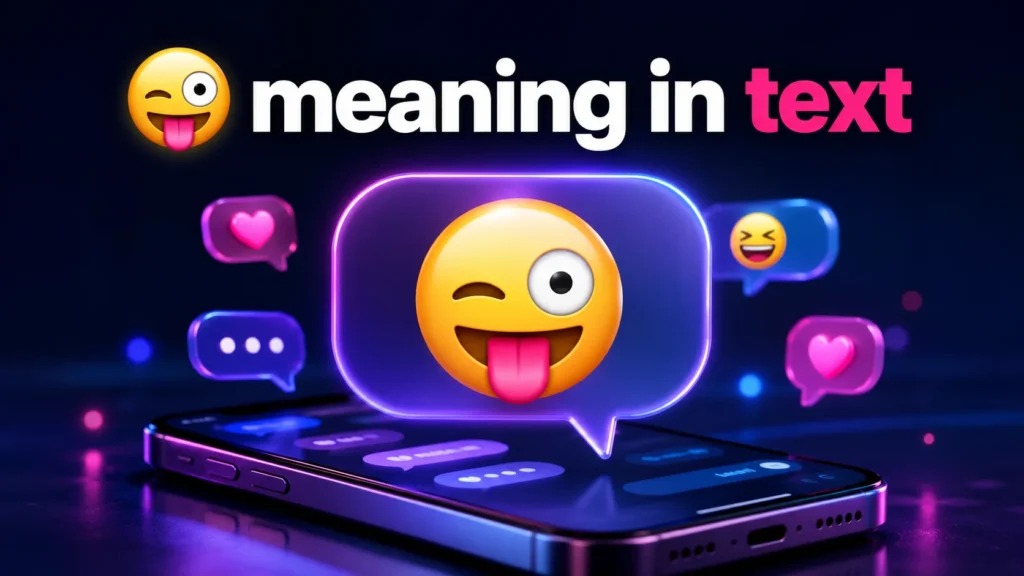
The 😜 meaning in text is usually playful teasing, silliness, cheeky humor, or lighthearted flirting. Known as the “winking face with tongue” emoji, it helps someone show that a message should not be taken too seriously.
People often search for its meaning because tone can be difficult to understand through a screen. A comment that looks rude, bold, or flirtatious may feel completely different when 😜 appears at the end.
For example, “You wish you were as talented as me 😜” sounds like friendly teasing rather than genuine arrogance. Likewise, “Maybe I was thinking about you 😜” can introduce a playful romantic tone.
However, context still matters. The relationship between the people, the topic being discussed, and the words surrounding the emoji all influence its meaning. This guide explains how to interpret 😜 confidently in texts, chats, comments, and direct messages.
😜 Meaning in Text – Quick Meaning
The 😜 meaning in text is “I’m joking,” “I’m being silly,” or “I’m teasing you.” It combines a wink with a tongue-out expression, creating a mischievous but generally friendly mood.
People commonly use 😜 to express:
- Playful teasing
- A joke that should not be taken literally
- Cheeky confidence
- Friendly sarcasm
- Light flirting
- Excitement or silliness
- A harmless challenge
- Mischievous intentions
The wink adds secrecy or playful intention, while the tongue suggests fun and unserious behavior. Together, they make the message feel cheekier than a simple smile.
Consider these examples:
“I ate the last slice of pizza 😜”
“You know I’m always right 😜”
“Maybe I’ll tell you later 😜”
In each example, the sender is adding playful energy. They may be teasing, joking, or deliberately acting mysterious.
Simple Definition
😜 means that someone is joking, teasing, flirting, or behaving playfully. It normally softens the words before it and signals that the sender does not want the message interpreted too seriously.
READ MORE: Off Meaning in Text: 12 Meanings You Should Know
Origin and Background of 😜
The 😜 emoji is officially known as Winking Face with Tongue. It developed from older text-based emoticons such as ;P, ;-P, and ;p.
Before smartphones displayed colorful emojis, people created facial expressions using punctuation marks. A semicolon represented a wink, while the letter “P” looked like a tongue sticking out.
For example:
“You can’t beat me at this game ;P”
That expression carried almost the same playful meaning as 😜 does today.
Cultural Influence
Sticking out the tongue can communicate different ideas in real life. Among friends, it may express silliness, mock annoyance, or playful defiance. When paired with a wink, the gesture becomes more obviously humorous or mischievous.
Digital communication adopted this expression because people needed quick ways to show emotion. A short text cannot reproduce facial expressions, gestures, or vocal tone. Therefore, 😜 became a useful emotional signal.
Social Media Impact
Messaging apps and social platforms made the emoji increasingly popular. It appears regularly in:
- WhatsApp conversations
- Instagram captions and DMs
- TikTok comments
- Snapchat messages
- Dating-app chats
- Casual group conversations
Its meaning has also expanded over time. Although it originally represented silly teasing, people now use it for playful flirting, mild sarcasm, bold jokes, and cheeky confessions.
Real-Life Conversations Using 😜
The clearest way to understand the 😜 meaning in text is to observe how it works in realistic conversations.
WhatsApp Conversation Between Friends
Person A: You said you were starting your diet today.
Person B: I did start it.
Person A: Then why are you eating cake?
Person B: Cake has eggs, so technically it’s protein 😜
Here, 😜 makes it clear that Person B knows the explanation is ridiculous. The emoji turns the excuse into a playful joke.
Instagram DM With a Flirty Tone
Person A: You looked really good in that picture.
Person B: Only in that picture? 😜
Person A: Okay, you always look good.
Person B: That’s a much better answer.
In this exchange, 😜 creates a flirtatious challenge. Person B is not genuinely offended. Instead, the sender is inviting another compliment in a confident, playful way.
TikTok Comment
Creator: I definitely made this recipe without burning anything.
Commenter: We can literally see the burned pan behind you 😜
Creator: I was hoping nobody would notice!
The commenter uses 😜 to point out something funny without sounding harsh. It communicates, “I caught you, but I’m only teasing.”
Text Message Between Partners
Person A: Are you still annoyed with me?
Person B: Maybe just a little.
Person A: Can I fix it with coffee and dessert?
Person B: Add flowers and we might have a deal 😜
In this case, the emoji softens the request. Person B may still want an apology, but the conversation has shifted toward playful reconciliation.
Emotional and Psychological Meaning
The 😜 emoji often expresses emotional safety. It lets someone say something bold, sarcastic, or slightly embarrassing while reducing the social risk.
A person may use it after a compliment because direct affection feels vulnerable. For instance, “You’re looking pretty good today 😜” can reveal attraction without creating an intensely serious moment.
Likewise, someone might write, “Obviously, I’m the smartest person here 😜.” Without the emoji, the statement could appear arrogant. With it, readers understand that the sender is exaggerating for humor.
Why People Use It
People use 😜 because written language often hides intention. The emoji can function like a playful facial expression that says:
- “Please don’t take this literally.”
- “I’m teasing you because we are comfortable.”
- “I’m interested, but I’m keeping things light.”
- “I know this sounds cheeky.”
- “I’m trying to make you laugh.”
Psychologically, it also gives the sender room to retreat. If a flirtatious message is not received positively, the person can present it as a joke. Consequently, 😜 sometimes serves as a small emotional shield.
A Personal-Style Scenario
Imagine receiving this message from a close friend: “Thanks for finally replying after a hundred years 😜.”
At first, the words may sound critical. Yet the emoji shows affectionate frustration rather than serious anger. The friend probably noticed the delayed reply, but they want to reconnect without starting an argument.
That small symbol can change the emotional temperature of the entire conversation.
Usage in Different Contexts
The meaning of 😜 changes slightly depending on who sends it and where it appears.
On Social Media
On Instagram, TikTok, and Snapchat, 😜 often communicates carefree confidence. Someone might add it to a funny caption, an exaggerated claim, or a playful response.
Examples include:
- “Main character energy today 😜”
- “I definitely didn’t practice this dance 50 times 😜”
- “Who said I can’t cook? 😜”
In public comments, however, the relationship between users may be unclear. A teasing comment from a stranger can feel more disrespectful than the same words from a close friend.
Between Friends
Friends commonly use 😜 for inside jokes, mock competition, or harmless teasing.
For example:
“I won again. Try to keep up 😜”
The sender is celebrating while inviting friendly competition. Because both people understand the relationship, the emoji usually feels warm rather than offensive.
In Romantic Relationships
The emoji can signal light flirting, playful attraction, or cheeky affection. A crush might use it to test whether the other person welcomes a more romantic conversation.
For instance:
“Maybe I dressed up because I knew you’d be there 😜”
This message suggests possible attraction, but the sender keeps the tone relaxed. One emoji alone does not confirm romantic interest, though. Look for repeated compliments, personal attention, and continued conversation.
In Professional Settings
😜 is generally unsuitable for formal workplace communication. It can appear immature, overly familiar, or even flirtatious when sent to a manager, client, teacher, or new colleague.
It may be acceptable among coworkers who already share a friendly relationship. Even then, the topic should remain casual.
Appropriate:
“I promise I’ll stop bringing donuts to the office 😜”
Risky:
“Maybe you can approve my leave request faster 😜”
The second example could sound manipulative or disrespectful because it concerns a professional decision.
Casual Versus Serious Tone
😜 works best during casual, positive conversations. It should not be used to dismiss serious feelings, avoid responsibility, or make painful situations seem unimportant.
A playful emoji can soften a joke. However, it cannot repair genuinely hurtful words.
When Not to Use 😜
Although 😜 is usually harmless, certain situations require a more thoughtful tone.
Avoid using it:
- During serious disagreements
- When offering condolences
- In formal emails or applications
- After insulting someone
- While discussing illness or loss
- When apologizing for significant harm
- With someone who dislikes teasing
- In culturally sensitive conversations
- When professional boundaries matter
For example, “Sorry I forgot your important appointment 😜” does not sound apologetic. Instead, it may suggest that the sender does not care.
Similarly, adding 😜 after an inappropriate comment does not automatically transform that comment into a joke. Humor depends on mutual comfort, timing, and respect.
Cultural Sensitivity
Tongue gestures do not carry identical meanings everywhere. Some people view them as childish, disrespectful, or overly suggestive. Therefore, consider the recipient’s age, culture, and communication style.
When you do not know someone well, a simple smile such as 🙂 may be safer.
Common Misunderstandings About 😜
It Does Not Always Mean Flirting
One of the most common mistakes is assuming that 😜 always shows romantic interest. Friends and family members also use it for ordinary jokes.
A single emoji rarely proves attraction. Instead, examine the overall pattern of communication.
It Is Not Necessarily an Insult
A cheeky sentence can look rude when separated from its context. However, 😜 often signals friendly teasing rather than hostility.
Still, the sender’s intention does not erase the recipient’s feelings. If the “joke” repeatedly embarrasses someone, the emoji does not make the behavior acceptable.
It Is More Playful Than 😏
People sometimes confuse 😜 with the smirking face 😏. While both can appear flirtatious, 😏 usually feels more suggestive, confident, or knowing. In contrast, 😜 tends to feel sillier and less serious.
It Is Not the Same as Mockery
Friendly teasing depends on affection and shared understanding. Mockery attempts to make someone feel small. The words, history, and power dynamic matter more than the emoji itself.
Tone Can Change Its Meaning
Compare these messages:
- “You’re impossible 😜” — playful affection
- “Nobody likes you 😜” — potentially cruel
- “I might steal your hoodie 😜” — cheeky flirting
- “I ignored your message on purpose 😜” — possibly dismissive
The emoji influences tone, but the sentence still carries its own meaning.
😜 Compared With Similar Emojis and Expressions
| Emoji or expression | Common meaning | Tone compared with 😜 |
|---|---|---|
| 😛 | Silliness or tongue-out fun | Less mischievous because it has no wink |
| 😝 | Wild laughter or exaggerated silliness | More energetic and chaotic |
| 😏 | Smirking, confidence, or suggestion | More flirtatious and potentially sexual |
| 😉 | A joke, hint, or flirtation | Subtler and more mature |
| 😂 | Strong laughter | Focuses on finding something funny |
| 🤪 | Crazy, goofy behavior | More exaggerated and unpredictable |
| 🙃 | Awkwardness, irony, or hidden frustration | More sarcastic or emotionally complicated |
| 😇 | Innocence, sometimes pretend innocence | Sweeter or ironically innocent |
| “Just kidding” | Directly identifies a joke | Clearer but less expressive |
| “I’m serious” | Emphasizes sincerity | Generally opposite in tone |
Key Insight
😜 sits between harmless silliness and cheeky flirting. It is more mischievous than 😛, less suggestive than 😏, and more expressive than simply writing “just kidding.”
Variations and Types of 😜 Usage
1. The Friendly Tease
Meaning: “I’m making fun of you affectionately.”
Example: “You finally remembered your password 😜”
2. The Playful Boast
Meaning: “I’m pretending to be overly confident.”
Example: “Another victory because I’m obviously unbeatable 😜”
3. The Flirty Hint
Meaning: “I may be attracted to you, but I’m keeping it casual.”
Example: “Maybe I saved that seat for you 😜”
4. The Cheeky Confession
Meaning: “I did something mischievous and I’m admitting it.”
Example: “I may have eaten your chocolate 😜”
5. The Silly Excuse
Meaning: “I know my explanation is not completely serious.”
Example: “I was late because my bed refused to let me leave 😜”
6. The Mock Challenge
Meaning: “I’m inviting playful competition.”
Example: “You’ll never beat my score 😜”
7. The Playful Correction
Meaning: “I noticed your mistake, but I’m not judging you.”
Example: “You wrote ‘Tuesday,’ but today is Wednesday 😜”
8. The Fake Innocence
Meaning: “I know exactly what I did.”
Example: “Me? Cause trouble? Never 😜”
9. The Sarcastic Reaction
Meaning: “I am jokingly pretending to agree.”
Example: “Yes, waking up at 6 a.m. is my favorite thing 😜”
10. The Mysterious Reply
Meaning: “I know something, but I’m not telling you yet.”
Example: “You’ll find out soon enough 😜”
How to Respond When Someone Uses 😜
Your reply should match the sender’s tone while respecting your comfort level.
Casual Replies
- “Haha, I knew you were joking!”
- “You’re impossible 😂”
- “Okay, I’ll let you have that one.”
- “Sure, keep telling yourself that 😜”
Funny Replies
- “The confidence is impressive.”
- “Caught in 4K!”
- “I’m saving this message as evidence.”
- “That emoji won’t save you now 😂”
Flirty Replies
- “Is that your way of flirting with me? 😉”
- “Maybe I like your mischievous side.”
- “Careful, I might believe you.”
- “You’re not as subtle as you think 😏”
Use a flirty response only when the relationship and conversation make it welcome.
Mature Replies
- “I understand you’re joking, but that topic is sensitive for me.”
- “I know you meant it playfully, although it came across differently.”
- “Let’s talk seriously for a moment.”
- “No problem—I just wanted to understand your tone.”
Respectful Replies
- “I see what you mean.”
- “Thanks for clarifying.”
- “Haha, understood.”
- “All good—I wasn’t sure whether you were serious.”
If the message makes you uncomfortable, you do not need to imitate the playful tone. Clear communication is always an appropriate response.
Regional and Cultural Usage
Western Culture
In many Western online conversations, 😜 commonly signals joking, teasing, or casual flirtation. Friends may use it frequently without any romantic implication.
However, it can look unprofessional in formal communication. Older adults may also interpret it as childish or overly familiar.
Asian Culture
Across Asian cultures, emoji use varies greatly by country, generation, and relationship. Younger users may treat 😜 as ordinary playful slang, while others may prefer softer symbols, stickers, or different emoticons.
Because respect and social hierarchy can strongly shape communication, using 😜 with a senior colleague, teacher, or elder may appear too casual.
Middle Eastern Culture
Young people throughout the Middle East commonly use 😜 in friendly online conversations. It can show humor, teasing, or playful confidence.
Nevertheless, flirtatious interpretations may carry greater sensitivity in conservative communities. The recipient, relationship, and privacy of the conversation are particularly important.
Global Internet Usage
Across global platforms, 😜 has become a broadly understood symbol of unserious intent. Yet it is not a universal permission slip. Humor does not always translate across languages, and a translated sentence may sound harsher than intended.
Gen Z Versus Millennials
Millennials often use 😜 as a direct marker of teasing or joking, partly because it resembles the older ;P emoticon.
Gen Z users may still use it, although some consider it intentionally exaggerated, ironic, or slightly old-fashioned. They may choose 😭, 💀, 🤪, or combinations of emojis to express humor instead.
Even so, personal habits matter more than broad generational trends. One person may use 😜 daily, while another never uses it at all.
Is 😜 Safe for Kids?
Yes, 😜 is generally safe for children. It normally represents silliness, joking, or sticking out the tongue playfully.
Parents should still teach children that context matters. The emoji should not be used to excuse bullying, disrespect, or hurtful comments. Kids also need to understand that jokes can be misunderstood when facial expressions and voice are absent.
If 😜 appears in a strange or uncomfortable conversation with an unknown person, adults should examine the entire message rather than judging the emoji alone.
Frequently Asked Questions
What does 😜 mean in a text message?
😜 usually means the sender is joking, teasing, acting silly, or being playfully mischievous. It tells the reader not to interpret the message too literally.
What does 😜 mean from a guy?
From a guy, 😜 may indicate friendly teasing, cheeky humor, or light flirting. Romantic interest is more likely when it appears alongside compliments, personal questions, and consistent attention.
What does 😜 mean from a girl?
From a girl, 😜 can express silliness, playful confidence, teasing, or flirtation. The relationship and surrounding message provide more reliable clues than gender alone.
Is 😜 a flirting emoji?
It can be a flirting emoji, especially after a compliment, romantic hint, or playful challenge. However, friends also use it casually, so it does not always indicate attraction.
What is the difference between 😜 and 😉?
😉 is a simple wink that may suggest a joke, secret, or subtle flirtation. 😜 adds a tongue-out expression, making the message feel sillier, bolder, and more mischievous.
Is 😜 rude or disrespectful?
The emoji itself is not usually rude. Nevertheless, it can feel disrespectful during serious discussions, formal communication, or conversations involving sensitive feelings.
What does 😜 mean after a compliment?
After a compliment, 😜 often makes the praise feel playful or flirtatious. The sender may genuinely mean the compliment while trying to avoid sounding overly serious or vulnerable.
Conclusion
The 😜 meaning in text usually centers on playful teasing, silly humor, mischievous confidence, or light flirting. It helps people recreate the wink and tongue-out expression that would normally clarify a joke during face-to-face communication.
Still, an emoji never exists in isolation. A message from a close friend may feel affectionate, while the same message from a stranger could seem uncomfortable. Look at the words, relationship, timing, and previous conversation before deciding what the sender intends.
Use 😜 when you want to keep a conversation cheerful and unserious. Just remember that good humor should create connection—not hide disrespect. When used with awareness, this cheeky little face can make digital conversations feel warmer, funnier, and more human.