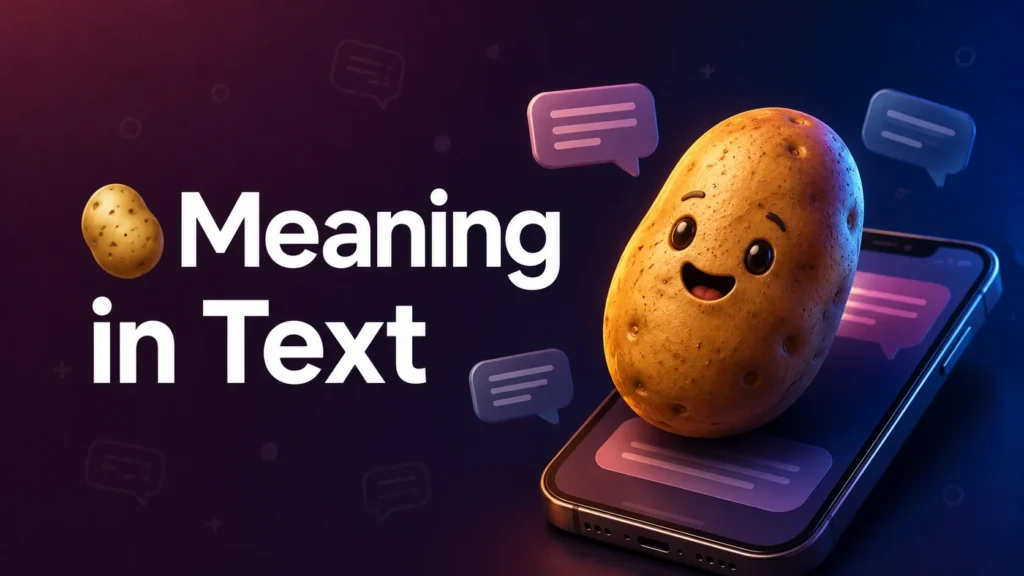
Receiving a potato emoji can feel surprisingly confusing. Is the sender talking about food, calling you lazy, teasing your appearance, or making an affectionate joke?
The 🥔 meaning in text changes dramatically with context. Its literal meaning is simply a potato, but online conversations have given it several playful and emotional interpretations. People use it to describe laziness, awkwardness, simplicity, poor-quality technology, and even a person they find imperfectly adorable.
Unlike heart or smile emojis, 🥔 does not communicate one universal emotion. The relationship between the sender and receiver matters. A potato emoji from your best friend may be loving banter, while the same emoji from a stranger may feel insulting.
This guide explains its common meanings, realistic conversation examples, cultural background, emotional tone, and the best ways to respond without misunderstanding the message.
🥔 Meaning in Text – Quick Meaning
The 🥔 emoji officially represents a regular potato. In texting and social media, it commonly means food, laziness, awkwardness, simplicity, poor image quality, or a playfully unattractive but lovable person.
According to Unicode’s emoji list, 🥔 is officially named the “potato” emoji and belongs to the food-and-vegetable category.
Its most common interpretations include:
- A literal potato: Cooking, groceries, farming, or food.
- Feeling lazy: Doing nothing or spending the day on the couch.
- Looking awkward: Feeling unphotogenic, plain, or messy.
- Affectionate teasing: Calling someone a cute or lovable potato.
- Poor quality: Describing a blurry camera, weak computer, or bad microphone.
- Simplicity: Representing something basic, ordinary, or uncomplicated.
- An insult: Criticizing someone’s appearance or intelligence.
- Random humor: Sending an unexpected vegetable for comic effect.
Examples include:
“I stayed in bed all day 🥔”
“Why do I look like a potato in every photo? 🥔”
“Your camera was recording on a literal 🥔.”
The first expresses laziness, the second shows self-deprecating humor, and the third criticizes poor video quality.
Origin and Background of the 🥔 Emoji
Its official beginning
The potato emoji was approved as part of Unicode 9.0 in 2016. It is identified by the code point U+1F954 and appears as a brown or golden potato with small marks or “eyes” on its skin.
Its original function was straightforward: to represent potatoes, cooking, vegetables, agriculture, and food. Like many food emojis, however, its online meaning quickly expanded beyond the literal object.
From vegetable to personality
Long before the emoji existed, English speakers used “potato” in humorous phrases. A “couch potato” described someone spending a long time sitting, watching television, or avoiding physical activity.
People also compared awkward or unflattering appearances to potatoes. The comparison came from the vegetable’s uneven, ordinary shape rather than any fixed beauty standard.
Online communities softened this idea by turning the potato into a lovable character. Calling someone a “cute potato” could communicate affection for their awkwardness, shyness, or imperfect charm.
Meme and gaming influence
Internet memes gave 🥔 another major meaning: weak or outdated technology. Users joked that a blurry video had been “filmed with a potato” or that a slow computer was a “potato PC.”
The joke suggests that the device is so underpowered that it might as well be an ordinary vegetable.
Gaming communities helped spread phrases such as “potato aim,” meaning inaccurate shooting, and “potato graphics,” meaning low-resolution visuals. These uses remain common in gaming chats, livestreams, and technology discussions.
Real-Life Conversations Using 🥔
WhatsApp conversation
Hira: Are you coming to the gym this morning?
Sana: Absolutely not. I’m staying under this blanket 🥔
Hira: Couch-potato day?
Sana: Exactly. I have earned it.
Here, 🥔 expresses harmless laziness and the desire to rest. Sana is not insulting herself; she is playfully describing her mood.
Instagram DMs
Maya: Delete that picture immediately.
Noah: Why? You look adorable.
Maya: I look like a confused potato 🥔
Noah: A very cute potato, though.
Maya uses self-deprecating humor because she dislikes the photo. Noah turns the same comparison into a warm compliment.
TikTok comments
Creator: Sorry about the video quality. My old phone is struggling.
Commenter: Was this recorded on a 🥔? 😭
The potato represents a poor-quality camera. The crying emoji suggests exaggerated humor, although the comment could still feel rude if the creator is sensitive about their equipment.
Text message between partners
Adam: I’m wearing your hoodie, eating fries, and refusing to leave the couch.
Lina: My cozy little potato 🥔❤️
Adam: That may be the nicest thing anyone has called me.
In this affectionate exchange, “potato” means cozy, lovable, and slightly lazy. The heart makes the positive intention clear.
Emotional and Psychological Meaning
The potato emoji often communicates comfort with imperfection. Social media can create pressure to appear polished, attractive, productive, and confident. Calling yourself a potato rejects that pressure for a moment.
A person who texts, “I look like a 🥔 today,” may be acknowledging insecurity while using humor to make it easier to express. They could want reassurance without directly asking, “Do I still look okay?”
The emoji can also symbolize emotional rest. “I’m becoming a couch potato tonight” may mean the person feels tired, socially drained, or ready to stop being productive.
Affectionately calling someone a potato creates a specific kind of warmth. It does not usually mean glamorous or impressive. Instead, it can mean safe, soft, familiar, silly, and loved despite visible imperfections.
Imagine sending your closest friend a photograph after waking up, with messy hair and a tired expression. You write, “Morning from this exhausted 🥔.” Your friend replies, “Still my favorite potato.” The exchange works because trust changes a potentially negative comparison into emotional reassurance.
That trust is essential. Without it, the same label can sound like criticism.
Usage in Different Contexts
On social media
The 🥔 emoji appears in food posts, recipe captions, farming content, memes, gaming clips, and self-deprecating selfies.
Common examples include:
- “Homemade fries tonight 🥔🍟”
- “Productivity level: 🥔”
- “My phone camera is basically a 🥔”
- “Another beautiful selfie from this awkward potato.”
- “My aim was pure potato in that match.”
The surrounding words usually reveal whether it means food, laziness, technology, or appearance.
Between friends
Friends may use 🥔 as an affectionate nickname or lighthearted insult. It can describe the friend who always wants to stay home, makes awkward jokes, or looks sleepy in every group photo.
This use depends heavily on shared humor. A joke that feels loving in one friendship may feel hurtful in another.
In romantic relationships
Partners sometimes use “potato” to express comfortable affection. Names such as “my potato,” “cute potato,” or “sweet potato” can suggest that someone is lovable in an unpolished, authentic way.
It may also describe a cozy evening together:
“Let’s cancel everything and be potatoes on the couch.”
The meaning is usually nonsexual and wholesome unless the couple has created a private meaning for it.
In gaming
Gaming communities use potato-related expressions frequently:
- Potato aim: Poor shooting accuracy
- Potato PC: A slow or underpowered computer
- Potato graphics: Low visual quality
- Potato internet: A weak or unstable connection
- Potato player: A joking or insulting label for an unskilled player
Tone matters. Friends may laugh about “potato aim,” while strangers may use it to mock someone.
At work
The potato emoji is generally too casual for formal workplace communication. It may be acceptable in a friendly team chat about lunch or a lighthearted conversation:
“My brain has turned into a potato after six meetings 🥔”
Avoid using it to describe a coworker, customer, or employee. Even playful comments about appearance, intelligence, or performance can feel disrespectful at work.
Casual versus serious tone
🥔 usually creates a casual, silly, or self-mocking tone. It is less appropriate during serious discussions about body image, mental health, professional performance, or personal conflict.
When the subject is sensitive, complete and considerate language is safer than an ambiguous vegetable emoji.
When Not to Use the 🥔 Emoji
Do not call someone a potato if you do not know how they feel about teasing. The word can target appearance, intelligence, energy level, or physical ability, even when the sender intends it as a joke.
Avoid using 🥔 in these situations:
- Commenting negatively on a stranger’s appearance
- Responding to someone’s genuine insecurity
- Criticizing a person’s intelligence
- Mocking a beginner’s gaming ability
- Evaluating someone at work
- Discussing body image or eating concerns
- Communicating in formal or professional settings
- Making jokes across cultural or language barriers
Be especially careful when someone sends a vulnerable photo. Replying with only “🥔” offers no positive context and may feel like a direct insult.
If you mean “adorably sleepy,” “comfortably lazy,” or “cute and awkward,” include those words. A heart or smiling emoji can help, but it cannot repair language that the receiver already finds hurtful.
Humor works when both people feel included. If only the sender is laughing, the message probably needs reconsideration.
Common Misunderstandings About 🥔
It does not always mean food
The literal interpretation is common, particularly in recipe or grocery conversations. In memes and personal chats, however, it may represent laziness, awkwardness, or low quality.
A message saying “Need 🥔 for dinner” is about food. “I am 🥔 today” is probably about mood or energy.
Calling someone a potato is not always an insult
Close friends and partners may use “potato” affectionately. It can mean the person is cute, comfortable, silly, or lovable without trying to appear perfect.
Relationship tone determines whether the label feels warm or cruel.
It is not a universal symbol for “I love you”
Some couples or friend groups may privately use 🥔 as a symbol of love. That meaning is not universal. Do not assume a potato emoji is a romantic confession without other affectionate clues.
“Potato camera” is about poor quality
When someone asks whether a video was filmed with a potato, they are criticizing its technical quality. They are not usually discussing the person appearing in the video.
Even so, the joke may sound dismissive toward someone using older or inexpensive equipment.
🥔 and 🍠 are different
🥔 represents a regular potato. 🍠 officially represents a roasted sweet potato. Their uses can overlap in food discussions, but they are visually and culturally different emojis.
🥔 Compared With Similar Emojis and Expressions
| Emoji or expression | Common meaning | Typical tone | Example |
|---|---|---|---|
| 🥔 | Potato, laziness, awkwardness, low quality | Funny or insulting | “I’m a tired 🥔 today.” |
| 🍠 | Roasted sweet potato, warmth, autumn food | Cozy or literal | “Perfect winter snack 🍠” |
| 🛋️ | Resting or staying on the couch | Relaxed | “No plans tonight 🛋️” |
| 😴 | Sleepiness or boredom | Tired | “I can barely stay awake 😴” |
| 🦥 | Laziness or moving slowly | Playful | “That’s me every morning 🦥” |
| 🤓 | Nerdiness, enthusiasm, or awkwardness | Playful | “Time for another history fact 🤓” |
| 🫠 | Embarrassment, exhaustion, or emotional melting | Relatable | “That meeting lasted forever 🫠” |
| 🍟 | Fries or fast food | Cheerful and literal | “I need fries immediately 🍟” |
| Couch potato | A person relaxing and doing little | Teasing | “I was a couch potato all weekend.” |
| Potato PC | A weak or outdated computer | Humorous criticism | “My potato PC cannot run this game.” |
| Potato aim | Poor gaming accuracy | Self-mocking or insulting | “Sorry, my aim was potato.” |
| Hot potato | A difficult issue passed between people | Figurative | “Nobody wants that political hot potato.” |
Key Insight
The potato emoji is unusually flexible because it can represent an object, mood, personality, appearance, or piece of technology. The words around it provide more reliable meaning than the symbol alone.
Variations and Types of the Potato Emoji
Literal potato 🥔
Represents potatoes, vegetables, cooking, farming, or groceries.
Example: “Can you buy some 🥔 on your way home?”
Couch potato 🛋️🥔
Describes someone relaxing, watching shows, or avoiding activity.
Example: “Today’s plan: 🛋️🥔.”
Cute potato 🥔❤️
An affectionate name for someone lovable, shy, sleepy, or awkward.
Example: “Good morning, my little 🥔❤️.”
Sad potato 🥔😔
Expresses feeling low, unattractive, ignored, or emotionally flat.
Example: “Everyone went out, and I’m home being a sad 🥔.”
Tired potato 🥔😴
Describes mental or physical exhaustion.
Example: “After that exam, I’m a tired 🥔😴.”
Awkward potato 🥔😅
Represents social awkwardness or embarrassment.
Example: “I waved at someone who wasn’t waving at me 🥔😅.”
Potato camera 📷🥔
Criticizes blurry photographs or low-quality video.
Example: “Did you take this picture with a 📷🥔?”
Potato PC 🖥️🥔
Describes an old, slow, or low-powered computer.
Example: “My 🖥️🥔 crashes whenever I open the game.”
Potato aim 🎮🥔
Means poor accuracy in a shooting game.
Example: “I missed every shot—full 🎮🥔 mode.”
Mashed potato 🥔🫠
A humorous way to express complete exhaustion or mental overload.
Example: “My brain is mashed potato after studying all night.”
How to Respond When Someone Uses 🥔
Your response should match the sender’s intention and your relationship.
Casual replies
- “Potato mood.”
- “Are we talking about food or feelings?”
- “Same—I have no energy today.”
- “Should I bring fries?”
- “That is extremely relatable.”
Funny replies
- “Boil me, mash me, let me nap.”
- “A premium-quality potato, obviously.”
- “Welcome to the potato club.”
- “At least potatoes become fries.”
- “Please respect my vegetable era.”
- “Certified organic couch potato.”
Affectionate replies
- “You’re my favorite potato.”
- “The cutest potato I know.”
- “Come here, little spud.”
- “Still adorable, even in potato mode.”
- “My cozy potato 🥔❤️”
Mature replies
- “Are you joking, or are you feeling insecure?”
- “Please don’t be so hard on yourself.”
- “You look human, not imperfect.”
- “Did that comment upset you?”
- “I want to understand what you mean.”
Respectful replies
If someone calls you a potato and you dislike it, you can say:
- “I know you may be joking, but I don’t like that nickname.”
- “What did you mean by the potato emoji?”
- “Please don’t make comments about my appearance.”
- “I’m okay with playful teasing, but that one feels uncomfortable.”
- “Could you say what you mean directly?”
Regional and Cultural Usage
Western culture
In Western online culture, 🥔 commonly represents couch-potato behavior, awkward appearance, or poor-quality technology. It is also used as a cute nickname between friends and romantic partners.
The phrase “filmed with a potato” is especially recognizable in meme, gaming, and technology communities.
Asian culture
Across many Asian communities, the emoji’s literal food meaning remains common. Potatoes appear in dishes ranging from curries and stir-fries to street snacks and stews.
Young social media users may also adopt the global meanings of laziness, awkwardness, and low-quality technology. English-language meme culture strongly influences these uses.
The separate 🍠 emoji may have stronger seasonal or comfort-food associations in places where roasted sweet potatoes are popular.
Middle Eastern culture
In Middle Eastern and South Asian conversations, 🥔 may literally represent potatoes used in familiar dishes, snacks, or shopping lists. It can appear alongside words such as aloo, batata, or other regional names.
Multilingual users also employ it for global internet jokes about laziness and technology. The affectionate “cute potato” meaning may be understood among younger users but not necessarily across all generations.
Global internet usage
Globally, the potato has become a symbol of being ordinary but relatable. Unlike glamorous symbols, it often celebrates low-energy days, messy appearances, and imperfect moments.
That emotional flexibility helps explain why the emoji continues to appear in memes, usernames, gaming communities, and private nicknames.
Gen Z versus Millennials
Gen Z users often send 🥔 as absurd humor, self-deprecation, or an affectionate identity. Someone may describe their entire mood with one potato emoji.
Millennials are more likely to connect it with “couch potato,” “potato camera,” or early internet jokes about weak computers. Both generations use it to make imperfection feel funny and relatable.
Is the 🥔 Emoji Safe for Kids?
The potato emoji is generally safe for children. Its official meaning is a common vegetable, and most alternative uses involve food, laziness, gaming, or silly humor.
Adults should still notice how it is being used. Repeatedly calling another child ugly, stupid, or unskilled through potato jokes can become bullying.
Children can be taught a simple rule: a nickname is only affectionate when the person receiving it enjoys it. If someone asks them to stop, the joke should stop.
Frequently Asked Questions
What does 🥔 mean in a text message?
The 🥔 emoji can mean a literal potato, laziness, awkwardness, simplicity, poor technology, or an adorably imperfect person. Context reveals the intended meaning.
What does it mean when someone calls you a potato?
They may be affectionately teasing you for being cute, lazy, awkward, or sleepy. It can also be an insult about appearance or intelligence, so consider your relationship and the tone.
Is the potato emoji flirty?
🥔 can be mildly flirty when a romantic partner uses phrases such as “my cute potato” or combines it with a heart. The emoji alone is not automatically romantic.
Does 🥔 mean “I love you”?
Not universally. Some couples and friends use the potato as a private symbol of affection, but its standard meaning is not “I love you.”
What does potato mean in gaming?
In gaming, “potato” usually describes weak performance or equipment. “Potato aim” means poor accuracy, while a “potato PC” is a slow or underpowered computer.
Is calling someone a potato rude?
It can be rude if it criticizes their appearance, intelligence, or ability. Among close friends, it may be affectionate teasing. The receiver’s feelings matter more than the sender’s intention.
What does “filmed with a potato” mean?
It means a video or photograph has very poor image or sound quality. The phrase jokingly suggests that the recording device was extremely basic.
Conclusion
The 🥔 meaning in text can be literal, emotional, affectionate, or insulting. It may represent food, a lazy day, an awkward selfie, a slow computer, or someone whose imperfect personality feels lovable.
The key is to examine the full message. Food words point toward the literal meaning. Gaming or camera language suggests poor quality. Hearts and affectionate nicknames usually make the emoji warm, while direct comments about appearance may make it hurtful.
A potato may be plain, but its digital meaning is surprisingly rich. Use it when the relationship supports the joke, and add enough context to make your intention clear. The best emoji conversations do more than look funny—they leave both people feeling understood.