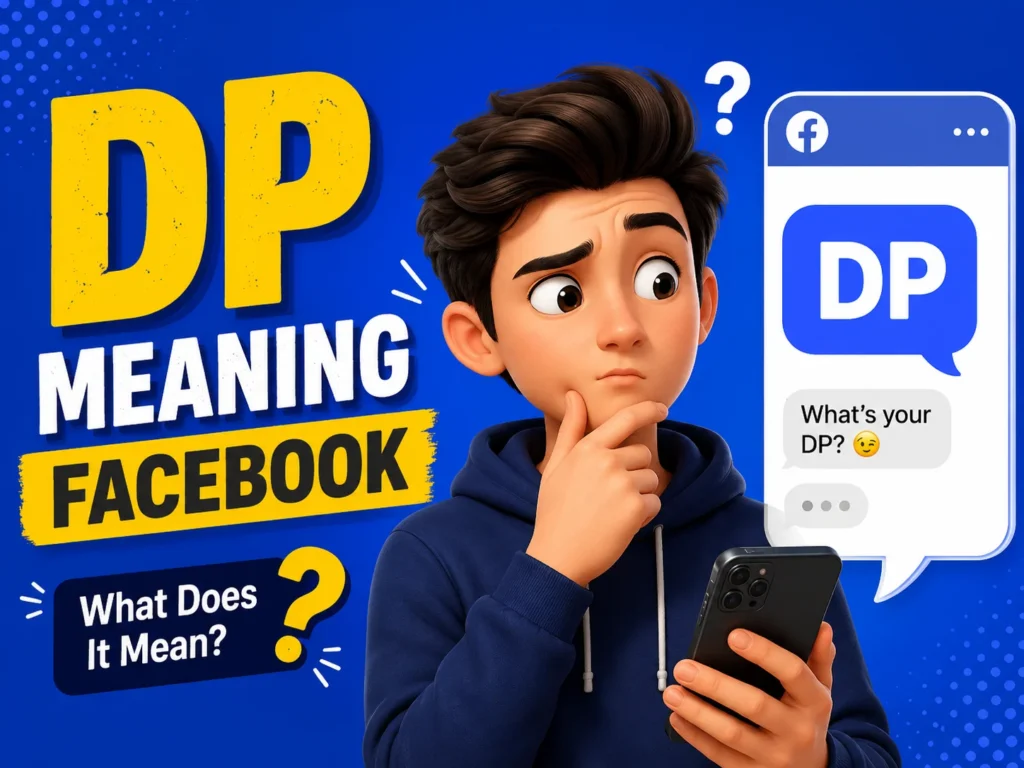
DP on Facebook usually means “Display Picture,” which is another way of saying profile picture. When someone texts you “Nice DP” or asks “Why did you change your DP?” they’re talking about the photo displayed on your Facebook profile. Facebook itself generally uses the term profile picture, while “DP” is informal internet and texting language.
What Does DP Mean on Facebook?
On Facebook, DP means “Display Picture.” It refers to the image you use to represent your account, which Facebook officially calls your profile picture.
So, if someone sends you:
“Your DP looks amazing!”
They simply mean:
“Your Facebook profile picture looks amazing!”
Likewise, if a friend says:
“Change your DP 😂”
They’re asking you to change your Facebook profile photo.
The term can seem confusing because Facebook’s own interface uses “profile picture,” not “DP.” That means you may hear someone use “DP” in a Facebook chat even though you won’t necessarily see the abbreviation in Facebook’s settings.
DP meaning in simple words
DP = Display Picture = Profile Picture
It is the image associated with your Facebook account. It might be a selfie, family photo, cartoon, illustration, logo, landscape, pet photo, or another image you choose.
The important distinction is that DP isn’t a special Facebook feature. It’s simply an informal term people use for the picture displayed on a person’s profile.
What Does DP Mean When Someone Texts It to You?
If someone sends you “DP” in a Facebook Messenger conversation, the surrounding message usually makes the meaning obvious.
For example:
Friend: “Did you see my new DP?”
You: “Yeah, that’s a great picture!”
Here, “DP” means display picture.
Another example:
Friend: “Why haven’t you changed your DP?”
You: “I like the old one 😂”
Again, they’re talking about your Facebook profile picture.
When someone says “nice DP,” “new DP,” “old DP,” or “change your DP,” you can normally read DP as profile picture.
That interpretation is especially straightforward when the conversation concerns Facebook profiles, photos, selfies, or account settings.
Is DP an Acronym, Abbreviation, or Slang?
DP is best described as an initialism or abbreviation for “Display Picture.”
The letters come from the first letters of Display and Picture:
- D = Display
- P = Picture
- DP = Display Picture
People generally pronounce it as the individual letters “D-P”, rather than as one word.
It is informal digital language rather than an official Facebook feature name.
You may also see related expressions such as:
- DP — Display Picture
- Display pic — shortened form of display picture
- Profile pic — shortened form of profile picture
- Profile photo — another common expression
- PFP — profile picture
In everyday Facebook conversations, these expressions can refer to essentially the same image.
READ MORE: What Does Cap Mean? Slang Meaning, No Cap Explained
DP vs Profile Picture on Facebook
The biggest source of confusion is the difference between what people say and what Facebook calls the feature.
| Term | Meaning | Status on Facebook |
|---|---|---|
| DP | Display Picture | Informal user language |
| Profile picture | Main image representing your account | Facebook’s standard terminology |
| Profile pic | Short form of profile picture | Informal |
| PFP | Profile picture | Internet abbreviation |
So, if you’re looking through Facebook’s settings and wondering, “Where is my DP?” you should look for your profile picture.
There isn’t normally a separate Facebook setting called “DP.”
That’s why the terms can appear inconsistent. A friend might say “Send me your DP,” while Facebook describes the same image as your profile picture.
How People Use DP on Facebook
People use “DP” in several ordinary ways when talking about Facebook.
“Nice DP”
This is usually a compliment.
A: “Nice DP!”
B: “Thanks! I took it last weekend.”
The person is complimenting your profile picture.
“Change your DP”
This means someone wants you to update your profile picture.
A: “Change your DP already 😭”
B: “What’s wrong with this one?”
A: “It’s from 2019!”
“New DP”
This means someone has noticed that you have uploaded a different profile picture.
A: “New DP?”
B: “Yep 😂 Thought I’d finally change it.”
“Send me your DP”
Depending on the situation, this can mean “send me the picture you’re using as your profile photo.”
A: “Send me your DP, I need that photo.”
B: “Sure, I’ll send you the original.”
The exact wording can vary, but the central meaning remains the same.
Where Is DP Used?
Although your keyword focuses on Facebook, DP isn’t limited to Facebook conversations. The expression can appear in texting and on other social or messaging platforms as well.
SMS and iMessage
Someone might text:
“Did you change your DP?”
In this context, DP generally means the profile picture associated with whatever account you’re discussing.
“DP” is especially familiar in casual conversations about profile photos.
For example:
“Your new DP is so cute.”
The person means your profile picture.
Facebook Messenger
Messenger conversations can contain expressions such as:
“I saw your new DP.”
The sender is referring to your Facebook profile image.
Instagram and Other DMs
People may also use “DP” informally when talking about someone’s profile image on other platforms. However, terminology varies by community. Some users prefer PFP or simply profile picture.
The key point is that DP is user language, not a universal official label used by every platform.
Funny DP Meaning in Facebook Chats
Sometimes people use “DP” in a playful way rather than simply making a factual comment.
Conversation
A: “Why did you change your DP?”
B: “Because I looked good for once.”
A: “Finally, an honest answer.”
B: “Don’t ruin this moment 😂”
Here, DP still means display picture. The humor comes from the conversation, not from a different meaning of DP.
Another example:
A: “Your DP is doing too much 😂”
B: “What does that even mean?”
A: “You know exactly what I mean.”
B: “I’m keeping it anyway.”
The abbreviation stays simple while the tone changes around it.
Sarcastic DP Meaning in Facebook Chats
“DP” can also appear in sarcastic exchanges.
A: “Nice DP. Very mysterious.”
B: “It’s literally just me wearing sunglasses.”
A: “Exactly. Mysterious.”
B: “I’ll take it.”
The word itself isn’t sarcastic. The surrounding message creates the sarcasm.
Playful DP Meaning in Facebook Chats
Friends, siblings, or partners may mention someone’s DP while teasing them.
A: “You finally changed your DP!”
B: “You noticed?”
A: “Of course. You’ve had the old one forever.”
B: “So you’re saying I needed the upgrade?”
Again, DP simply means profile picture.
Serious DP Meaning in Facebook Chats
DP can also appear in more serious conversations.
A: “Are you changing your DP for the campaign?”
B: “Yes, we’re all using the same image.”
A: “Okay, I’ll update mine tonight.”
B: “Perfect.”
The abbreviation doesn’t automatically make the conversation casual. The context determines the tone.
10 Real Facebook and Messenger Examples
Here are realistic ways you might encounter DP in an actual conversation.
1. Friends
A: “Bro, change your DP.”
B: “Why?”
A: “That picture is ancient.”
B: “It’s a classic.”
2. Siblings
A: “Did you see my new DP?”
B: “Yeah. Mom is going to ask why you cropped everyone out.”
A: “Already happened.”
3. Partners
A: “You changed your DP without telling me 😭”
B: “It’s just a picture.”
A: “And I liked the old one.”
B: “Fine, I’ll let you vote next time.”
4. Coworkers
A: “Is that your new DP?”
B: “Yes, I updated my Facebook profile yesterday.”
A: “Looks professional.”
5. Parent and child
A: “Why did you change your DP?”
B: “I wanted a newer photo.”
A: “Okay, this one is nice.”
6. Old friend
A: “I recognized you from your DP.”
B: “Good, because I haven’t seen you in years.”
A: “You still look the same.”
B: “I’ll take that as a compliment.”
7. Casual acquaintance
A: “Nice DP!”
B: “Thanks!”
A: “Where was that taken?”
B: “At the lake last month.”
8. Teasing
A: “New DP again?”
B: “I got bored.”
A: “You change that thing every week.”
B: “And I’ll probably change it tomorrow.”
9. Family group
A: “Everyone is changing their DP for Grandma’s birthday.”
B: “Okay, I’m updating mine too.”
A: “Perfect!”
10. Messenger conversation
A: “Can you send me your DP?”
B: “Sure. Do you want the original photo?”
A: “Yes, please.”
B: “Sending it now.”
These examples show how naturally DP fits into ordinary digital conversations.
How to Use DP Correctly in a Sentence
DP usually works as a noun.
You can put it after words such as “your,” “my,” “his,” or “her.”
For example:
- “I like your DP.”
- “She changed her DP.”
- “Did you see his new DP?”
- “I’m updating my DP.”
- “Your DP looks great.”
You can also use it by itself in short exchanges.
A: “New DP?”
B: “Yep!”
In this example, “DP” works as shorthand for “profile picture.”
Can DP stand alone?
Yes. In informal messaging, it can.
Someone might simply send:
“DP?”
Depending on context, they could be asking about your profile picture or asking which picture you’re using.
Because “DP” is informal, it’s more natural in casual digital communication than in formal writing.
DP Capitalization: DP vs dp
The standard written form is DP, with both letters capitalized.
However, people may type dp in casual texting because mobile conversations often use lowercase abbreviations.
Compare:
- “Nice DP!”
- “nice dp!”
The meaning generally stays the same.
Capital letters can sometimes make an abbreviation look more deliberate, while lowercase can feel more casual. But Facebook users don’t normally interpret DP and dp as two completely different terms.
Is DP Formal or Informal?
DP is informal.
It’s perfectly normal in a casual Facebook Messenger conversation:
“Love your DP!”
But you probably wouldn’t use it in a formal business document.
For example, instead of:
“Please update your DP before the meeting.”
A professional message would usually say:
“Please update your profile picture.”
“Profile picture” is clearer and more widely understood in formal communication.
Who Uses DP?
DP usage varies by language community, region, age group, and online habits. The expression is particularly familiar in South Asian digital communication, where people commonly use “display picture” and “DP” when referring to profile images.
Gen Z
Younger users may understand DP but often encounter PFP as another abbreviation for profile picture, particularly across newer online communities.
That doesn’t mean Gen Z never says DP. It means the preferred abbreviation can depend on which apps and online communities someone uses.
Millennials
Millennials who used earlier messaging and social-networking services may be very familiar with “DP,” especially if they use the phrase in everyday conversation.
Older users
People who don’t regularly use internet abbreviations may be more familiar with “profile picture” than “DP.”
There isn’t a strict age rule, though. Personal online experience matters more than age alone.
Regional Usage of DP
“Display picture” and its abbreviation “DP” have notable use in South Asian English-language internet communication. Contemporary references describe the expression as particularly familiar in countries such as India and Pakistan.
In the United States and other English-speaking communities, profile picture and PFP may be more familiar choices, although people can still understand DP from context.
The important point is not to assume that everyone uses the same abbreviation. If someone doesn’t understand “DP,” simply saying “profile picture” removes the confusion.
Where Did DP Come From?
The expression “display picture” predates today’s major social-media apps. It developed in the culture of online messaging and social networking, where users could attach an image to their account or username.
Early messaging services helped make small user-selected images part of online identity. As people communicated quickly through chats and messages, shortening “display picture” to DP made the phrase easier to type.
The term later continued alongside newer platform language.
That history explains an interesting detail: the expression can remain common among users even when the platform itself chooses a different official term.
Facebook uses “profile picture,” but someone can still say “DP” when talking to a friend.
So DP isn’t really a new Facebook feature or a term invented specifically for Facebook. It is informal vocabulary that users carried into social media.
Why Do People Say DP Instead of Profile Picture?
The answer is mostly convenience and habit.
“DP” takes two letters, while “profile picture” takes much longer to type. Once an abbreviation becomes familiar within a community, people don’t need to think about the full expression.
There is also a cultural element. In some online communities, “DP” became a normal everyday term for a profile image.
That’s why someone may naturally say:
“Send me your DP.”
rather than:
“Send me your profile picture.”
Both convey essentially the same idea.
Does DP Mean Anything Else?
Yes. DP can have different meanings in other contexts.
For example, in technology, DP can refer to DisplayPort. In programming, it can refer to dynamic programming. In finance, it can sometimes mean down payment. The correct interpretation depends on the conversation.
There are also adult meanings for DP in explicit online contexts, so the abbreviation shouldn’t automatically be interpreted without looking at surrounding text.
However, when the conversation is clearly about Facebook, photos, profiles, selfies, or changing an account image, “Display Picture” is the natural interpretation.
Context is what separates these meanings.
Is DP Rude or Offensive?
No. DP is not inherently rude or offensive when it means “Display Picture.”
Saying:
“Nice DP!”
is normally a friendly compliment.
Saying:
“Change your DP.”
is casual and may be playful, depending on the relationship.
The abbreviation itself doesn’t carry an insulting meaning in ordinary Facebook conversation.
Still, tone matters. Telling someone that their DP is “terrible” or making unwanted comments about their appearance can be rude even though the word DP itself is harmless.
Is DP Appropriate for School or Work?
DP is fine for casual communication with friends, but “profile picture” is safer in formal communication.
For example, with a friend:
“Your DP looks great!”
With a teacher or manager:
“I updated my profile picture.”
The second option sounds clearer and more professional.
If you’re unsure whether someone knows the abbreviation, avoid it and use “profile picture” instead.
How to Reply When Someone Says “Nice DP”
Your response depends on the relationship.
Funny reply
“Thanks 😂 It took approximately 47 attempts.”
Friendly reply
“Thank you! I really liked that photo.”
Neutral reply
“Thanks!”
Playful reply
“Finally someone noticed 😂”
Flirty reply
If the conversation is already romantic or flirtatious:
“You like it? 😉”
There’s no special response you need to use. A simple “thanks” works perfectly.
Comparison: DP and Related Terms
| Term | Meaning | Usage Context | Tone | Popularity | Confusion Risk |
|---|---|---|---|---|---|
| DP | Display Picture | Social media and messaging | Informal | Common in some communities | Medium |
| PFP | Profile Picture | Social media, gaming, online communities | Informal | Common online | Medium |
| Profile picture | Main account image | Facebook and other platforms | Neutral | Very common | Low |
| Profile photo | Photo representing an account | Social and messaging apps | Neutral | Common | Low |
| Avatar | Digital representation of a user | Forums, gaming, online communities | Neutral | Common in specific contexts | Medium |
| DM | Direct Message | Private social-media conversation | Informal | Very common | High if confused with DP |
The closest direct match for DP is profile picture.
DM is different: it refers to a private message, not an image.
DP vs PFP: What’s the Difference?
In terms of the image itself, there is usually no meaningful difference.
DP means “Display Picture,” while PFP means “Profile Picture.”
Both can refer to the picture representing your account.
The difference is mainly in terminology and community preference. Someone might say “DP” while another person says “PFP.”
For Facebook specifically, profile picture is the clearest term because it matches Facebook’s own terminology.
Real-World Observation: Why “DP” Has Lasted
One interesting thing about DP is that it survives even when the platforms themselves don’t use the phrase.
Facebook calls the image a profile picture, yet users can still casually call it a DP. That shows how online vocabulary often develops outside a platform’s official interface. Once a phrase becomes part of everyday conversation, people don’t necessarily replace it just because an app chooses different wording.
The term also works especially well in short messages. “Change your DP” feels quick and natural because the reader already knows what the two letters represent. In that sense, DP is less about a Facebook feature and more about a shared piece of internet vocabulary.
Frequently Asked Questions
What does DP mean on Facebook?
DP usually means Display Picture on Facebook. It refers to the image that represents your account, which Facebook officially calls your profile picture. If someone says “Nice DP,” they’re complimenting your Facebook profile photo.
Is DP the same as a profile picture?
Yes, in ordinary Facebook conversations, DP and profile picture usually refer to the same thing. DP stands for Display Picture, while “profile picture” is the standard platform term. The difference is mainly the wording, not the image.
What does “nice DP” mean on Facebook?
“Nice DP” means “I like your profile picture.” It’s normally a friendly compliment about the image displayed on your Facebook profile. You can simply reply with “Thanks!” or respond playfully if the conversation allows it.
Is it rude to say “change your DP”?
Not necessarily. “Change your DP” simply means “change your profile picture,” but the tone depends on who says it and how they say it. Between friends, it can be harmless teasing; in another situation, it could sound overly critical.
What’s the difference between texting DP and saying it out loud?
There is usually no difference in meaning. In both cases, DP means Display Picture when the conversation concerns a social-media profile. People normally pronounce the letters individually as “D-P.”
Does DP mean the same thing in a group chat and a one-on-one message?
Usually, yes, if everyone is discussing Facebook profiles or profile photos. In either setting, DP commonly means Display Picture. However, because DP has other meanings in unrelated contexts, the surrounding conversation still matters.
Is DP the same as PFP?
They generally refer to the same type of image. DP means Display Picture, while PFP means Profile Picture. Which abbreviation someone prefers depends on their online community, platform habits, and region.
Does Facebook officially call it a DP?
No. Facebook generally uses the term profile picture for the main image representing your account. “DP” is informal language used by users rather than the standard Facebook interface terminology.
How to Use DP in Facebook Messages
If you’re chatting casually, DP is easy to use.
Use it when:
- Talking with friends or family.
- Discussing someone’s Facebook profile photo.
- Complimenting a friend’s new profile picture.
- Asking whether someone has changed their profile image.
- Messaging people who already understand the abbreviation.
Use “profile picture” instead when:
- Writing a formal message.
- Communicating with someone unfamiliar with internet abbreviations.
- Writing professional or academic content.
- You want to avoid ambiguity.
Common Mistakes With DP
A few mistakes can cause confusion.
- Assuming DP is an official Facebook feature: It isn’t. It’s informal terminology.
- Thinking DP and profile picture are completely different: In this context, they’re usually the same thing.
- Assuming DP always means Display Picture: Context matters because DP has other meanings.
- Using DP in formal writing: “Profile picture” is usually clearer.
- Confusing DP with DM: DP refers to an image; DM means Direct Message.
Final Takeaway
The DP meaning on Facebook is “Display Picture.” In everyday conversation, it means your profile picture—the image you use to represent your Facebook account.
Facebook itself generally uses “profile picture,” but users may say “DP” in Messenger, texts, and casual conversations. You might hear “Nice DP,” “Change your DP,” or “Did you see my new DP?” and all three examples point to the same basic thing: someone’s profile photo.
Quick tips
- DP = Display Picture.
- On Facebook, DP usually means profile picture.
- “DP” is informal; “profile picture” is more formal.
- PFP can also mean profile picture.
- Always consider context because DP has other meanings.
When to use DP
Use DP when you’re having a casual conversation with someone who understands the abbreviation.
When to avoid DP
Choose profile picture instead for professional, academic, or formal communication.
Once you know that DP simply means Display Picture, phrases such as “Nice DP!” and “Change your DP” become much easier to understand.