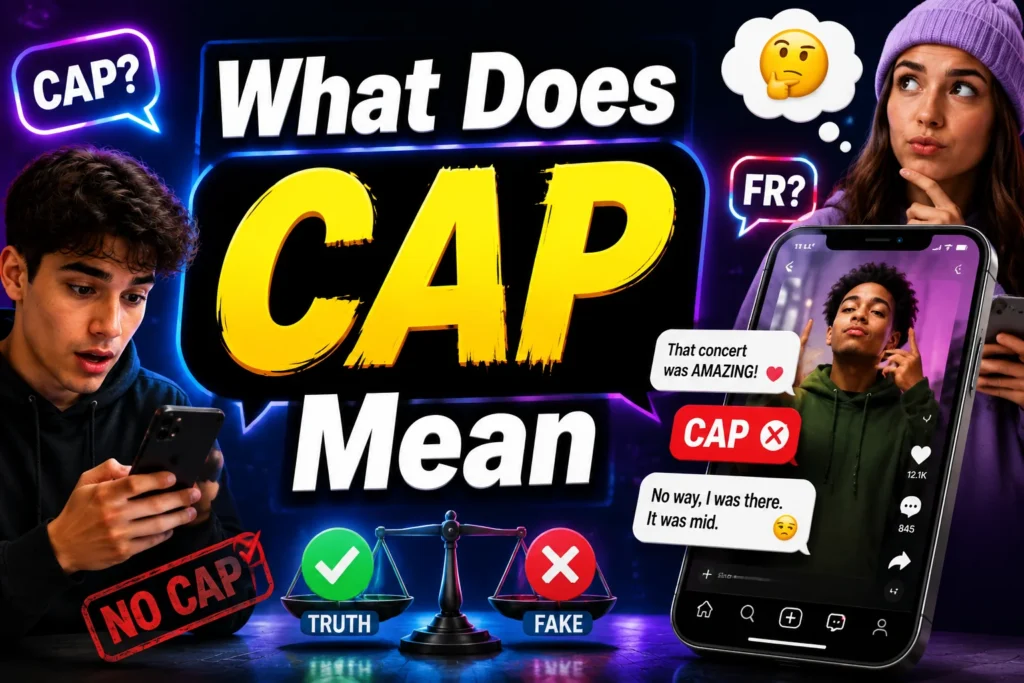
If you spend time on TikTok, Instagram, texting apps, or online communities, you may have seen people write “cap” or “no cap” and wondered what they mean.
The phrase “what does cap mean” is frequently searched because this slang word appears everywhere in modern internet conversations. Unlike the traditional meaning of a cap (a type of hat), online slang uses the word in a completely different way.
In digital communication, cap means a lie, exaggeration, or something that is not true. When someone says “no cap,” they mean they are being honest or serious.
For example:
“That story is cap.”
Meaning:
“That story is a lie.”
“No cap, this is the best restaurant I’ve ever tried.”
Meaning:
“I’m being completely honest; this is the best restaurant I’ve tried.”
The slang became popular through music, social media, gaming communities, and everyday conversations among younger generations.
This guide explains what cap means, where it came from, how people use it, real-life examples, emotional meaning, and how to respond naturally.
What Does Cap Mean? Quick Meaning
The most common meaning of cap in slang is “a lie” or “false information.”
People use it when they believe someone is exaggerating or not telling the truth.
Simple Definition
Cap means:
- A lie
- A fake statement
- An exaggeration
- Something unbelievable
No Cap Meaning
No cap means “I’m telling the truth.”
It is used to emphasize honesty.
Examples:
“No cap, that movie was amazing.”
Meaning:
“I’m honestly saying that movie was amazing.”
“You got a million views overnight? That’s cap.”
Meaning:
“I don’t believe that; it sounds fake.”
READ MORE: What Do TB Mean in Text? Meaning, Uses & Examples
Common Examples of Cap in Text
Example 1
“I finished the whole project in ten minutes.”
“Cap.”
Meaning:
“I don’t believe you.”
Example 2
“No cap, this pizza is incredible.”
Meaning:
“I’m being honest; this pizza is really good.”
Example 3
“Bro said he never gets tired.”
“That’s cap.”
Meaning:
“That statement is probably false.”
Origin and Background of Cap Slang
The slang meaning of cap has roots in African American Vernacular English (AAVE) and hip-hop culture.
The phrase developed from the idea of “capping,” which means lying, exaggerating, or pretending.
Over time, the term became more common through music and online communities.
Artists and influencers helped spread expressions like:
- “No cap”
- “Stop capping”
- “You’re capping”
Influence of Hip-Hop Culture
Hip-hop has played an important role in introducing slang words into mainstream communication.
Many expressions that started in specific communities later became widely used through songs, videos, and social media.
Social Media Impact
Platforms such as TikTok and Instagram helped make cap one of the most recognizable slang terms online.
People began using it in:
- Comments
- Memes
- Videos
- Text conversations
- Gaming chats
Real-Life Conversations Using Cap
TikTok Comment Conversation
Person A:
I learned a new language in one week.
Person B:
That’s cap 💀
and,
Person A:
I’m serious!
Person B:
One week sounds impossible.
Here, cap means the person thinks the claim is exaggerated.
WhatsApp Conversation
Person A:
I didn’t sleep at all and still finished everything perfectly.
Person B:
No cap?
and,
Person A:
No cap. I actually did it.
Here, no cap asks if the person is being honest.
Gaming Chat Conversation
Person A:
I beat the hardest level without losing once.
Person B:
Cap.
and,
Person A:
Check my record 😂
Here, cap means disbelief.
Instagram Comment Conversation
Person A:
This is the best photo ever taken.
Person B:
No cap, this picture is amazing.
Here, no cap emphasizes genuine approval.
Emotional and Psychological Meaning of Cap
Although cap is a simple slang word, it reflects how people communicate trust online.
When someone says “no cap,” they are trying to make their statement feel more believable.
It adds emotional emphasis.
For example:
“I like this song.”
sounds different from:
“No cap, this song is incredible.”
The second statement shows stronger confidence and personal feeling.
Why People Use Cap
People use cap because it helps them:
- Challenge exaggerated claims
- Show honesty
- Create humor
- Express disbelief
- Build connection
In online conversations, people often use humor to question whether something is realistic.
Saying “cap” is usually playful rather than aggressive.
Usage of Cap in Different Contexts
Cap on Social Media
On TikTok and Instagram, cap is commonly used in comments.
Examples:
- “That’s cap.”
- “No cap, this is amazing.”
- “Stop capping.”
It is often used with jokes, reactions, and viral content.
Cap Between Friends
Friends use cap casually when teasing each other.
Example:
“I can run faster than everyone here.”
“Bro, that’s cap.”
The response is usually playful.
Cap in Relationships
Couples and friends may use cap to call out exaggerations.
Example:
“You said you weren’t hungry, but you ate my fries.”
“That’s cap.”
It creates a humorous conversation.
Cap in Gaming Communities
Gamers frequently use cap when someone makes an unbelievable claim.
Examples:
- “I got the rare item on my first try.”
- “No way, that’s cap.”
Gaming culture helped spread this slang widely.
Cap in Professional Settings
Cap should usually be avoided in formal communication.
Instead of saying:
“That information is cap.”
A professional message should say:
“That information appears incorrect.”
Slang is better suited for casual conversations.
Casual vs Serious Tone
Cap is mostly informal.
Suitable for:
- Friends
- Social media
- Gaming
- Casual texting
Not suitable for:
- Work emails
- Academic writing
- Official communication
When Not to Use Cap
Although cap is popular, there are situations where it may create confusion.
Professional Conversations
Many people outside internet culture may not understand the meaning.
Serious Discussions
Calling someone’s statement “cap” may sound disrespectful during serious topics.
With Older Generations
People unfamiliar with modern slang may think you are talking about a hat.
Formal Writing
Avoid slang in:
- Essays
- Reports
- Business communication
Common Misunderstandings About Cap
Thinking Cap Always Means a Hat
The traditional meaning of cap is still valid.
Example:
“I bought a new cap.”
means a piece of clothing.
The slang meaning depends on context.
Thinking Cap Always Means Lying
Sometimes cap is used jokingly.
A person may say:
“You’re capping.”
without seriously accusing someone of lying.
Confusing Cap With No Cap
These have opposite meanings.
Cap:
“That is false.”
No cap:
“I am being honest.”
Thinking It Is Always Negative
Cap can be playful and humorous between friends.
Cap Meaning Comparison Table
| Expression | Meaning | Usage |
|---|---|---|
| Cap | Lie or exaggeration | Calling something false |
| No cap | Honestly / truthfully | Showing sincerity |
| Stop capping | Stop lying | Calling out exaggeration |
| Facts | Agreement with truth | Supporting a statement |
| Bet | Okay / agreement | Accepting something |
| For real | Honestly | Showing seriousness |
Key Insight
Cap and no cap are opposites. Cap questions whether something is true, while no cap emphasizes honesty.
Variations and Types of Cap
1. Cap
Meaning: A lie or false statement.
Example:
“That’s cap.”
2. No Cap
Meaning: Honestly or seriously.
Example:
“No cap, I love this.”
3. Capping
Meaning: Lying or exaggerating.
Example:
“You’re capping right now.”
4. Stop the Cap
Meaning: Stop lying.
Example:
“Stop the cap, everyone knows the truth.”
5. Big Cap
Meaning: A very obvious lie.
Example:
“That’s a big cap.”
6. Small Cap
Meaning: A minor exaggeration.
Example:
“That’s a little cap.”
7. Maximum Cap
Meaning: Extreme exaggeration.
Example:
“That story is maximum cap.”
8. Zero Cap
Meaning: Completely honest.
Example:
“Zero cap, this changed my life.”
9. Cap Alert
Meaning: Warning that something sounds fake.
Example:
“Cap alert 🚨”
10. Certified Cap
Meaning: A confirmed lie.
Example:
“That is certified cap.”
How to Respond When Someone Says Cap
Casual Replies
- “No cap, I’m serious.”
- “I’m telling the truth.”
- “Trust me.”
Funny Replies
- “The cap detector is broken 😂”
- “No lies detected.”
- “You caught me.”
Mature Replies
- “I understand why it sounds unbelievable, but it’s true.”
- “I can explain if you want more details.”
Respectful Replies
- “I appreciate your honesty.”
- “Thanks for clarifying.”
Regional and Cultural Usage of Cap
Western Culture
Cap is widely used in American internet culture, especially among younger users.
It appears often in:
- Music
- Sports discussions
- TikTok
- Gaming
Asian Culture
Young internet users in Asian countries often learn cap through global social media trends.
It is common among online communities.
Middle Eastern Culture
English internet slang, including cap, is increasingly used among younger social media users.
Global Internet Usage
Social media has made cap a worldwide slang expression.
People use it even outside English-speaking countries because of online trends.
Generational Differences
Gen Z
Gen Z users commonly use cap and no cap naturally.
Millennials
Many millennials understand the term but may use phrases like:
- “That’s a lie.”
- “You’re exaggerating.”
Is Cap Safe for Kids?
Yes, the word cap itself is generally safe.
However, children should understand the difference between:
- Playful teasing
- Hurtful accusations
Calling someone a liar repeatedly can become disrespectful.
Parents can teach children that slang should be used carefully and with awareness of context.
FAQs About Cap Meaning
What does cap mean in slang?
Cap means a lie, exaggeration, or something that is not true.
What does no cap mean?
No cap means someone is being honest or serious.
Is cap a bad word?
No. Cap is casual slang and is usually used jokingly.
Where did cap slang come from?
Cap slang developed from African American Vernacular English and hip-hop culture before spreading online.
What does “stop the cap” mean?
It means stop lying or stop exaggerating.
What does cap mean on TikTok?
On TikTok, cap usually means someone thinks a statement is fake or exaggerated.
Is cap the opposite of no cap?
Yes. Cap means false, while no cap means truthful.
Conclusion
Understanding what does cap mean helps you follow modern online conversations more easily.
In slang, cap means a lie, exaggeration, or something unbelievable. When people say “no cap,” they are emphasizing that they are being honest.
The word has become popular through hip-hop culture, TikTok, gaming communities, and everyday texting. Although it may seem confusing at first, the meaning is simple when you understand the context.
Whether someone says “that’s cap” as a joke or uses “no cap” to show honesty, this slang term has become an important part of modern digital communication.
Use it casually with people who understand internet language, but remember that clear communication matters more than trendy words.