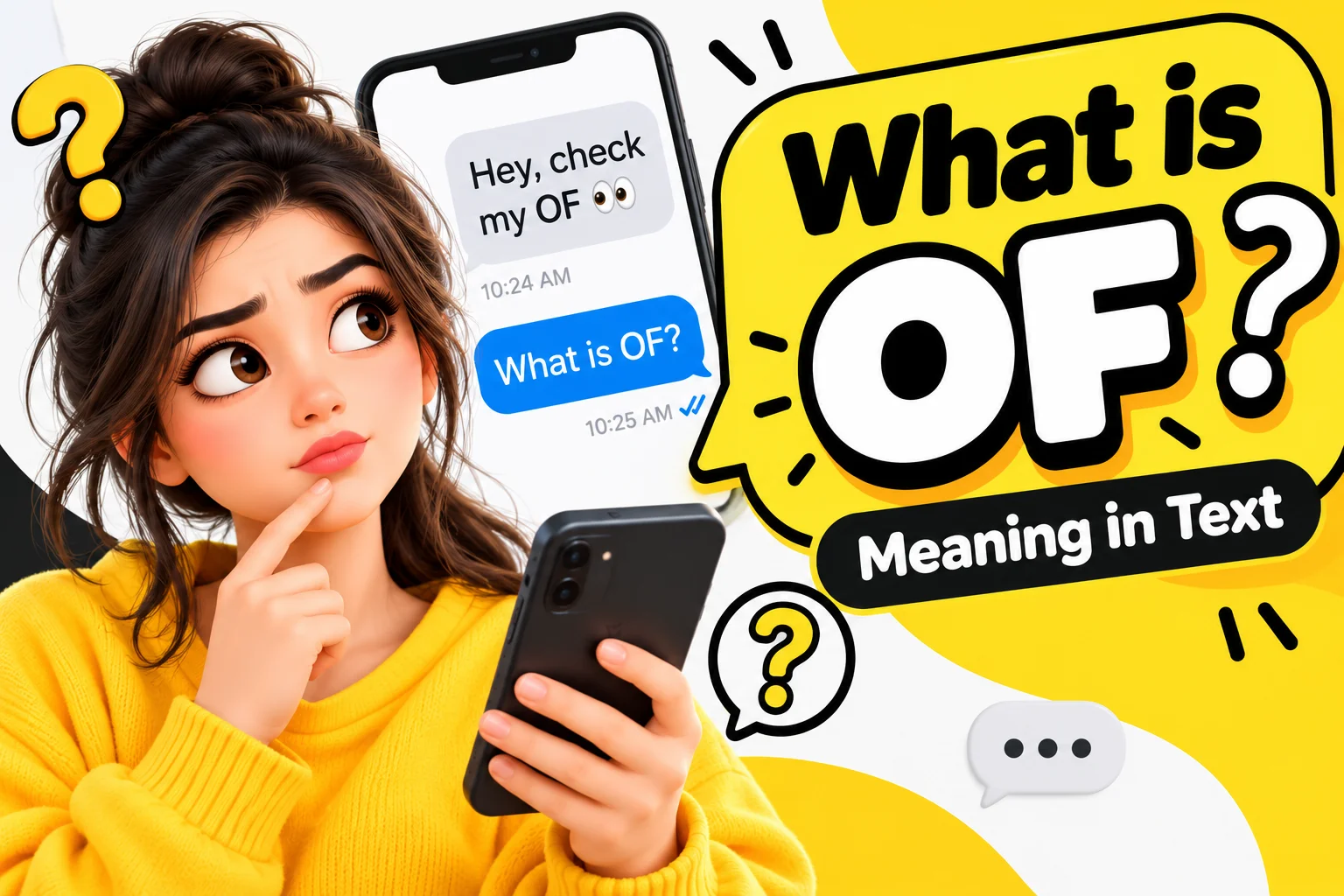

OF meaning in text depends on context. Most of the time, lowercase “of” is simply the normal English word, but uppercase “OF” can also mean OnlyFans in online conversations. When someone texts it to you, look at the surrounding words before assuming it is slang.
What Does OF Mean in Text?
There are two meanings you are most likely to encounter:
- “of” — the ordinary English preposition.
- “OF” — an abbreviation for OnlyFans when people are discussing the platform or someone’s account.
This makes OF unusual compared with many texting abbreviations. The same two letters can be completely ordinary in one message and internet shorthand in another.
For example:
“She is one of my friends.”
Here, of has no slang meaning.
But:
“Does he have an OF?”
In this context, OF means OnlyFans.
OnlyFans launched in 2016 as a subscription-based platform for creators, which helps explain why its shortened name can appear in online conversations.
READ MORE: IMA Meaning in Text — What Does IMA Mean?
Is OF an Acronym, Abbreviation, or Slang Word?
It depends on which meaning you mean.
When of appears in normal English, it is a preposition, not slang.
When OF is used as a short form of OnlyFans, it is an abbreviation or internet shorthand. It is not necessary to treat every uppercase “OF” as OnlyFans, because capitalization can result from typing habits, autocorrect, or emphasis.
Context matters more than capitalization alone.
What Does OF Mean When Someone Texts It to You?
If someone sends OF as part of an ordinary sentence, it probably means the word “of.”
Examples:
“One of them is coming.”
“I’m thinking of you.”
“A friend of mine called.”
However, if the conversation is about creators, subscriptions, online profiles, or someone’s social-media presence, OF may mean OnlyFans.
For example:
A: “She has a new account.”
B: “On OF?”
Here, the abbreviation refers to OnlyFans.
OF Meaning on Different Platforms
SMS, iMessage, and WhatsApp
In ordinary text messaging, of is overwhelmingly likely to be the regular English word when it appears inside a sentence.
For example:
“That’s one of my favorite songs.”
If the conversation specifically concerns online creator accounts, however, OF may be used as shorthand for OnlyFans.
Instagram and Snapchat DMs
The abbreviation can appear more naturally when people discuss social-media creators or online accounts.
“Did you see that she made an OF?”
The surrounding subject makes the meaning clear.
Discord
Discord conversations can contain either meaning. A gaming conversation might use of as a normal English word, while a discussion about an online creator could use OF to mean OnlyFans.
TikTok and X
OF can appear in social-media conversations when users are discussing creators or online content. However, do not automatically interpret every “OF” as OnlyFans. The normal English word of remains extremely common.
OF Tone Variations in Text
Funny
A funny use usually comes from deliberately misunderstanding the abbreviation.
A: “He said she has an OF.”
B: “Of what?”
A: “No, OF as in OnlyFans.”
B: “Ohhh. I was about to ask what subject we were studying.”
Sarcastic
A: “Did you seriously think I meant OnlyFans?”
B: “You wrote OF in all caps.”
A: “That was autocorrect.”
B: “Sure it was 😂”
Playful
A: “Wait, does she have an OF?”
B: “Why are you suddenly investigating?”
A: “I’m just curious.”
B: “That sounded very investigative.”
Serious
A: “Someone mentioned an OF account in the group.”
B: “Are they talking about an actual account?”
A: “Yes, that’s what they meant.”
B: “Got it. I wasn’t sure from the abbreviation.”
Real Chat Examples
1. Normal English
A: “She’s one of my classmates.”
B: “Oh, I thought she was your cousin.”
A: “No, just one of my classmates.”
B: “Got it.”
2. OnlyFans context
A: “Did you hear she started an OF?”
B: “Seriously?”
A: “Yeah, apparently.”
B: “That explains what everyone was talking about.”
3. Family text
A: “Can you bring some of the cake home?”
B: “Sure.”
A: “Please save me a piece.”
B: “Of course 😂”
4. Friend conversation
A: “Which one of these is your favorite?”
B: “Probably one of the first three.”
A: “Same.”
B: “They’re all good.”
5. Social-media discussion
A: “Does that creator have an OF?”
B: “I don’t know.”
A: “I keep seeing people mention it.”
B: “Maybe check their public profile.”
6. Partner conversation
A: “Thinking of you.”
B: “Thinking of you too ❤️”
A: “Hope your meeting went well.”
B: “It did.”
7. Coworker text
A: “Can you send me a copy of the report?”
B: “Sure, give me five minutes.”
A: “Thanks.”
B: “No problem.”
8. Confusing capitalization
A: “I saw OF in your message.”
B: “I just meant ‘of.’”
A: “Oh 😂”
B: “You made that much more complicated.”
9. Stranger or online contact
A: “Does she have an OF?”
B: “I don’t know her personally.”
A: “Fair enough.”
B: “Better not assume.”
10. Group chat
A: “One of you needs to choose the restaurant.”
B: “Not me.”
C: “Same.”
A: “Very helpful, guys.”
Grammar and Language Role
When of means the ordinary English word, it functions as a preposition.
It commonly appears between two parts of a sentence:
- “a cup of tea”
- “one of my friends”
- “the end of the movie”
- “thinking of you”
It normally does not stand alone as a texting reply.
By contrast, OF meaning OnlyFans can function as a noun-like abbreviation:
“She has an OF.”
“Is he on OF?”
“They were talking about her OF.”
Lowercase of is grammatically normal. Uppercase OF can signal an abbreviation, but capitalization by itself does not prove that meaning.
How Should You Reply to OF?
Your response depends on the context.
Funny reply
“OF as in ‘of course’ or OF as in something else? 😂”
Serious reply
“Do you mean OnlyFans?”
Flirty reply
Only use a flirty response if the conversation is already clearly romantic and you understand what the person means. Do not assume that OF automatically has a sexual meaning.
Neutral reply
“What do you mean by OF?”
When you genuinely cannot tell, asking is better than guessing.
OF vs. Related Terms
| Term | Meaning | Usage Context | Tone | Popularity | Confusion Risk |
|---|---|---|---|---|---|
| OF | Of / OnlyFans | Normal English or online platform context | Neutral/contextual | High | High |
| OFC | Of course | Texts and chats | Casual | High | Medium |
| OnlyFans | Creator subscription platform | Online/social-media discussions | Neutral/contextual | High | Low |
| ONG | On God | Casual texting | Emphatic | Medium | Medium |
| FR | For real | Texting and DMs | Casual | High | Low |
| OF COURSE | Of course | Regular conversation | Emphatic | High | Low |
One particularly important distinction is OF vs. OFC. If someone writes “ofc,” they generally mean “of course,” not OnlyFans.
Who Uses OF?
There is no reliable basis for saying that one specific age group “owns” the abbreviation. Of is a basic English word used by virtually every age group.
The OF = OnlyFans meaning is more dependent on internet context. Younger and older internet users can understand it, particularly when discussing creators or social-media accounts.
Gen Z vs. Millennials
The main difference is often not the definition but the surrounding texting style. Younger users may be more comfortable with short forms and platform-specific shorthand, while older users may write OnlyFans in full when there is any possibility of confusion.
That said, these are tendencies rather than strict rules.
Regional Usage
The normal English word of is used broadly in English-speaking regions, including the US and UK. The OnlyFans abbreviation is also understandable internationally in online contexts. There is not enough reliable evidence to claim a specific regional slang meaning for OF.
Origin and Internet Culture
The ordinary word of is much older than internet culture and does not have a texting-slang origin.
The OF = OnlyFans usage is different. It developed as a shortened reference to the platform’s name. OnlyFans was launched in 2016, and the abbreviation became useful as the platform became part of broader online conversation.
This is an important distinction: OF did not originate as a traditional texting abbreviation like BRB or LOL. Its platform-related meaning comes from shortening a proper name.
Is OF Rude or Offensive?
The word of is completely ordinary and not offensive.
OF meaning OnlyFans is more context-sensitive. Mentioning OnlyFans can lead to adult-content associations, although the platform itself describes its creator community as covering different genres.
For school, workplace, or professional conversations, avoid using OF when you mean OnlyFans unless the topic genuinely requires it. Writing the full name or explaining what you mean can prevent misunderstandings.
Real-World Observation
The interesting thing about OF is that capitalization creates a false sense of certainty. Seeing “OF” in a message can make you immediately think of OnlyFans, but the same letters appear constantly as the ordinary word “of.” In real conversations, the words around it do most of the interpretive work. A message such as “one of my friends” needs no decoding, while “she has an OF” clearly points toward the platform. That double life makes OF more confusing than many conventional texting abbreviations.
FAQ
What does OF mean in texting?
OF can mean different things in texting. Most commonly, lowercase of is simply the standard English preposition. In online conversations about creators or social-media accounts, OF can mean OnlyFans. Always check the surrounding message before deciding.
Is OF slang?
Sometimes. When of is used normally in a sentence, it is not slang at all. When OF is used as shorthand for OnlyFans, it functions as an internet abbreviation. The context determines which one you are seeing.
Is it rude to reply with just OF in a text?
If someone sends OF by itself, the message may be unclear. It could be an abbreviation, a typo, or part of a context you are missing. If you are unsure, asking “What do you mean by OF?” is the safest response.
What’s the difference between texting OF and saying it out loud?
When you say “of” aloud, listeners usually understand it from the sentence. The OnlyFans abbreviation is different because you are referring to a platform name rather than the grammatical word. In speech, saying “OnlyFans” can be clearer than simply saying “O-F.”
Does OF mean the same thing in a group chat and a 1-on-1 text?
Not necessarily. The topic of the conversation still determines the meaning. A group discussing social-media creators may use OF to mean OnlyFans, while a normal family group chat may simply contain the word “of” in ordinary sentences.
Does OF always mean OnlyFans?
No. This is one of the most common mistakes people make. Of is an extremely common English word, so you should not interpret every uppercase or lowercase version as OnlyFans. Look at the complete sentence and conversation topic.
Is OF appropriate for school or work?
If you mean the normal word of, obviously yes. If you mean OnlyFans, the abbreviation may be inappropriate in school or workplace conversations unless the subject is relevant. When in doubt, avoid introducing the topic casually.
Is OF the same as OFC?
No. OFC normally means “of course” in texting. OF can mean the ordinary word “of” or, in certain online contexts, OnlyFans. The extra C changes the abbreviation completely.
Conclusion
The answer to “OF meaning in text” is simple once you look at context. In ordinary English, of is just a common preposition. In conversations about online creators or accounts, OF can be shorthand for OnlyFans.
Quick usage tips
- Read the entire sentence before interpreting OF.
- Do not assume uppercase OF automatically means OnlyFans.
- Remember that OFC means “of course.”
- Ask for clarification when the message is genuinely ambiguous.
Common mistakes
- Assuming every “OF” means OnlyFans.
- Confusing OF with OFC.
- Treating ordinary grammar as internet slang.
- Making assumptions about someone’s account based only on the abbreviation.
When to use or avoid OF
Use OF as shorthand for OnlyFans only when the context is clear and informal. In professional, school, or sensitive conversations, spelling out what you mean can prevent unnecessary confusion.