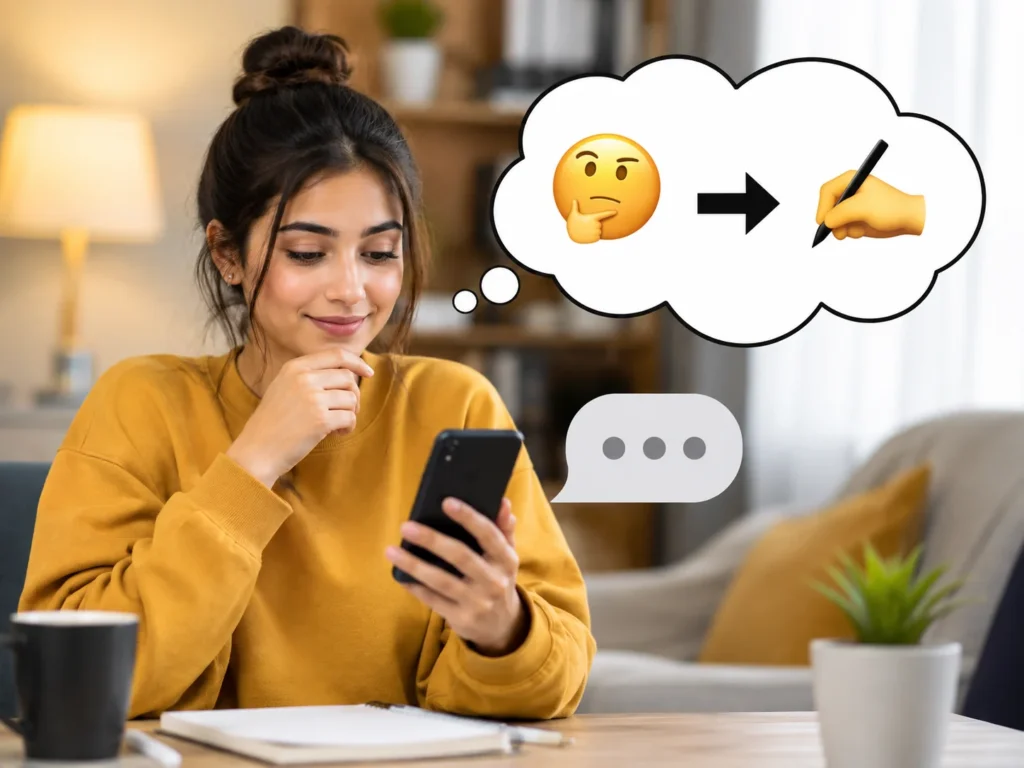
IMA usually means “I’m going to” or “I’m gonna” in text messages. When someone texts you “IMA,” they’re generally saying what they intend to do next, such as “IMA call you later” meaning “I’m going to call you later.”
What Does IMA Mean in Text?
The most common texting meaning of IMA is “I’m going to” or “I am going to.” It is an informal spelling that represents the way “I’m gonna” can sound in casual speech. Cambridge Dictionary lists ima, imma, I’ma, and I’mma as slang forms of “I’m going to.”
So, if someone texts:
“IMA call you tonight.”
they mean:
“I’m going to call you tonight.”
People use IMA when they want to describe an upcoming action, intention, decision, or plan. It can refer to something happening immediately or later, depending on the rest of the sentence.
For example:
“IMA go to bed.”
means:
“I’m going to go to bed.”
And:
“IMA finish this tomorrow.”
means:
“I’m going to finish this tomorrow.”
The word can look strange if you haven’t encountered it before. That’s why people often search “what do ima mean” or “what does IMA mean in text.” It isn’t usually a typo. It’s a casual representation of spoken English.
What Does IMA Stand For?
In texting, IMA generally represents “I’m going to” or “I am going to.”
However, it isn’t best understood as a traditional acronym where each letter directly represents one separate word.
Instead, ima is a phonetic or slang spelling that developed from spoken forms such as “I’m gonna.” Slang references also describe IMA as a shortened form of “I’m gonna.”
The progression can be understood like this:
I am going to → I’m going to → I’m gonna → I’ma / imma / ima
For example:
“I am going to call her.”
becomes:
“I’m gonna call her.”
and then:
“Ima call her.”
That makes IMA easier to understand once you hear it as spoken language rather than trying to read each letter separately.
Is IMA an Acronym, Abbreviation, or Slang Word?
IMA is best described as an informal slang contraction or phonetic spelling.
Calling it an “acronym” is common in online slang dictionaries, but technically it doesn’t work like a typical acronym such as NASA or FOMO.
It represents a spoken contraction of “I’m gonna,” which itself is an informal form of “I’m going to.” Cambridge identifies ima and related spellings as slang short forms of “I’m going to.”
This distinction matters because IMA isn’t normally pronounced as three separate letters:
“I-M-A”
Instead, it is generally pronounced approximately like:
“I’m-uh.”
What Does IMA Mean When Someone Texts It to You?
When someone sends IMA as part of a message, look at the words that follow it.
If they say:
“IMA call you later.”
they’re telling you about a future action.
If they say:
“IMA go now.”
they’re saying they’re leaving.
If they say:
“IMA be honest with you.”
they’re preparing to give an honest opinion.
In other words, IMA generally introduces something the sender intends to do or say.
It doesn’t automatically indicate anger, excitement, flirting, or sarcasm. The words surrounding it create the tone.
Examples of IMA in Text Messages
Here are some simple examples:
“IMA text you when I get home.”
= “I’m going to text you when I get home.”
“IMA grab some food.”
= “I’m going to get some food.”
“IMA sleep early tonight.”
= “I’m going to sleep early tonight.”
“IMA tell her tomorrow.”
= “I’m going to tell her tomorrow.”
“IMA be late.”
= “I’m going to be late.”
“IMA finish it tonight.”
= “I’m going to finish it tonight.”
The important thing is that IMA normally appears before a verb or action.
IMA on SMS and iMessage
IMA works naturally in ordinary text messages because texting encourages short, conversational language.
For example:
A: “Are you coming tonight?”
B: “Yeah, IMA leave in 10.”
A: “Okay, see you soon.”
Here, “IMA leave” means “I’m going to leave.”
Another example:
A: “Are you still working?”
B: “Yeah, but IMA finish soon.”
A: “Good. Call me when you’re done.”
In both cases, IMA expresses an upcoming action.
IMA on WhatsApp
You may also see IMA frequently in WhatsApp conversations, particularly in casual chats.
For example:
A: “What are you doing?”
B: “IMA make some coffee.”
A: “Make me one too 😂”
Or:
A: “Are you coming to the party?”
B: “Yeah, IMA head over around 8.”
A: “Perfect.”
WhatsApp doesn’t give IMA a separate meaning. It generally keeps the same informal “I’m going to” meaning.
IMA in Instagram and Snapchat DMs
IMA can also appear in direct messages on Instagram and Snapchat.
For example:
A: “You still watching that show?”
B: “Yeah, IMA finish the episode.”
A: “Let me know if it’s good.”
On Snapchat, you might see:
“ima sleep lol”
This simply means:
“I’m going to sleep.”
The spelling may be lowercase because lowercase typing is common in informal DMs.
Does IMA Mean the Same Thing on TikTok?
The basic meaning remains the same when IMA appears in TikTok comments, captions, or messages: it can represent “I’m going to.”
However, if you’re specifically searching for the meaning in text, the most relevant contexts are private messages, SMS, WhatsApp, Instagram DMs, Snapchat, and similar chat environments.
IMA isn’t exclusively a TikTok term. It existed in informal speech and online communication before modern short-video platforms became popular.
IMA vs. IMMA vs. I’MMA vs. I’Ma
You may see several spellings of the same expression.
Common variants include:
- ima
- IMA
- imma
- IMMA
- I’ma
- I’mma
Cambridge Dictionary specifically lists imma, I’mma, Ima, and I’ma as forms of the same slang expression.
For example:
“ima call you.”
“imma call you.”
“I’ma call you.”
These can all mean:
“I’m going to call you.”
There isn’t usually a major difference in meaning. The choice often reflects the writer’s personal typing style.
Does Capitalization Change the Meaning?
Usually, no.
IMA, ima, and Ima generally communicate the same idea.
Lowercase:
“ima go now”
often looks more casual.
Uppercase:
“IMA GO NOW”
can look more emphatic, but capitalization alone doesn’t create a new definition.
Tone and Context Variations
IMA itself is mostly neutral. The surrounding words determine whether the message sounds funny, sarcastic, playful, or serious.
Funny IMA
A: “What are you doing tonight?”
B: “IMA eat an entire pizza.”
A: “Again?”
B: “Don’t judge me 😂”
Here, IMA simply introduces the speaker’s plan.
Sarcastic IMA
A: “Are you finally going to start studying?”
B: “Yeah, IMA become a genius tonight.”
A: “Sure 😂”
B: “Have some faith.”
The sarcasm comes from the rest of the conversation, not from IMA itself.
Playful IMA
A: “What are you doing after work?”
B: “IMA steal your fries.”
A: “You always do.”
B: “Because you always order the good ones.”
Here, IMA makes the statement sound casual and playful.
Serious IMA
A: “What are you going to do about the situation?”
B: “IMA talk to him tomorrow.”
A: “Okay. I think that’s the right decision.”
B: “I just want to clear everything up.”
In this conversation, IMA introduces a serious intention.
12 Real Text Examples of IMA
1. Friends
A: “You coming out tonight?”
B: “Yeah, IMA leave in like 20 mins.”
A: “Cool, we’re waiting for you.”
B: “Be there soon.”
2. Partners
A: “Are you still at work?”
B: “Yeah, IMA head home soon.”
A: “Okay ❤️ Drive carefully.”
B: “I will.”
3. Siblings
A: “Did you eat?”
B: “No, IMA order something.”
A: “Get me fries.”
B: “You owe me.”
4. Coworkers
A: “Can you send me the file?”
B: “Sure, IMA send it now.”
A: “Thanks.”
B: “No problem.”
5. Classmates
A: “Did you finish the assignment?”
B: “Not yet. IMA do it tonight.”
A: “Same 😭.”
B: “We’ll survive.”
6. Parent and child
A: “Are you coming home for dinner?”
B: “Yeah, IMA leave work soon.”
A: “Okay, I’ll save you some food.”
B: “Thanks.”
7. Stranger or new online friend
A: “Are you joining the game?”
B: “Yeah, IMA join in a minute.”
A: “Okay, we’re waiting.”
B: “Be there soon.”
8. Group chat
A: “Who wants coffee?”
B: “IMA make some.”
C: “Make me one too.”
D: “Same.”
B: “Fine 😂.”
9. Making plans
A: “What time are you leaving?”
B: “IMA leave around 7.”
A: “Perfect, I’ll meet you there.”
B: “Sounds good.”
10. Ending a conversation
A: “Still watching Netflix?”
B: “Nope, IMA sleep.”
A: “Goodnight.”
B: “Night.”
11. Serious conversation
A: “Have you decided what you’re going to do?”
B: “Yeah, IMA talk to her tomorrow.”
A: “I think that’s best.”
B: “Hopefully it works out.”
12. Casual joke
A: “You said you were saving money.”
B: “I am.”
A: “Then why are you shopping?”
B: “IMA save money after I buy this 😂.”
How IMA Works Grammatically
IMA normally functions as a future-intention marker.
It appears before the main action:
IMA + verb
Examples:
- “IMA go.”
- “IMA call you.”
- “IMA eat.”
- “IMA study.”
- “IMA tell him.”
- “IMA buy it.”
It can also introduce a longer phrase:
“IMA go to the store after work.”
or:
“IMA call you when I get home.”
Can IMA Stand Alone?
Usually, no when it means “I’m going to.”
A message such as:
“IMA”
is incomplete because the reader normally expects to know what you’re going to do.
However, in a highly contextual conversation, someone might understand it as a shortened response.
For example:
A: “Are you going to tell him?”
B: “IMA.”
Even then, the message is very informal and relies heavily on context.
It’s more natural to write:
“IMA tell him.”
Is IMA Formal or Informal?
IMA is strongly informal.
It’s appropriate for:
- Friends
- Family
- Casual DMs
- Group chats
- Informal texting
- Gaming chats
- Casual online conversations
It’s generally not appropriate for:
- Academic assignments
- Formal emails
- Job applications
- Business reports
- Professional correspondence
- Formal workplace communication
Instead of:
“IMA send the report tomorrow.”
a professional message would say:
“I’m going to send the report tomorrow.”
How to Reply When Someone Texts IMA
Because IMA usually introduces an action, you don’t need a special response to the slang itself. Simply respond to what the person says they’re going to do.
Funny Reply
“Okay, but don’t disappear for three hours 😂”
Serious Reply
“Okay. Let me know when you’ve done it.”
Flirty Reply
If the conversation is already romantic:
“IMA miss you if you leave 😏”
Neutral Reply
“Okay, sounds good.”
The key is to respond to the message’s actual content, not the abbreviation.
IMA vs. Similar Texting Terms
| Term | Meaning | Usage Context | Tone | Popularity | Confusion Risk |
|---|---|---|---|---|---|
| IMA | I’m going to / I’m gonna | Future intention | Casual | High | Medium |
| IMMA | I’m going to / I’m gonna | Future intention | Very casual | High | Low |
| I’MMA | I’m going to | Informal speech/text | Very casual | Medium | Medium |
| GONNA | Going to | Future intention | Casual | Very high | Low |
| I’M GONNA | I am going to | Plans/actions | Casual | Very high | Low |
| I’M NOT | I am not | Negative statement | Neutral | Very high | Low |
The closest equivalents are “I’m gonna” and “I’m going to.”
IMA vs. IMMA
These are essentially the same in casual texting.
“IMA call you.”
and:
“IMMA call you.”
both mean:
“I’m going to call you.”
The spelling differs, but the intended meaning usually doesn’t.
Who Uses IMA?
IMA is not limited to a single age group, although it is particularly associated with informal spoken and digital English.
You may see it among:
- Gen Z
- Millennials
- Older internet users who are comfortable with slang
- People who use informal English dialects
- Online communities
The form isn’t simply a modern texting invention. I’ma/imma has roots in spoken varieties of English, and its use in writing reflects pronunciation rather than merely a desire to save characters.
Gen Z vs. Millennials
A younger texter may write:
“ima go sleep 😭”
A millennial might write:
“I’mma head home.”
But this isn’t a reliable generational rule. Both groups can use either spelling.
The important point is that IMA represents informal speech, not a slang term belonging exclusively to Gen Z.
Regional Usage
IMA is especially associated with American informal English and appears in varieties of English influenced by African American English. Modern internet communication has spread forms such as ima and imma far beyond their original speech communities. Wiktionary describes imma as a written form of relaxed pronunciation of “I’m gonna” and notes its association with African American Vernacular English while also noting broader modern use.
It’s therefore important not to treat the spelling as something invented solely by social media users.
Where Did IMA Come From?
The history of ima/imma/I’ma is more interesting than simply saying it was created to type faster.
The form represents a relaxed pronunciation of “I’m gonna,” and dictionaries recognize it as a slang form meaning “I’m going to.” Cambridge lists the forms imma, I’mma, Ima, and I’ma.
The form is also associated with African American English, where “I’ma” can function as an immediate-future construction. Wiktionary notes both the AAVE connection and the possibility that the form originated in Gullah, although the precise historical pathway remains debated.
That means it would be misleading to claim that IMA was invented by texting or TikTok.
Texting helped make the spelling more visible because people began writing informal speech exactly as they might say it:
“I’m gonna go.”
became:
“I’mma go.”
and:
“Ima go.”
Modern social media has spread these spellings further, but the underlying spoken form has a deeper history.
Is IMA Rude or Offensive?
No. IMA isn’t inherently rude or offensive.
It simply indicates an intention to do something.
For example:
“IMA call you later.”
is completely neutral in an informal conversation.
However, the sentence following IMA can change the tone:
“IMA tell you something.”
is neutral or serious.
But:
“IMA block you.”
can sound confrontational.
So if you’re wondering whether someone is being rude because they used IMA, focus on what they said after it.
Is IMA Appropriate at School or Work?
It’s fine in casual messages to friends or classmates.
For formal school or workplace communication, use standard English:
“I’m going to send it tomorrow.”
instead of:
“IMA send it tomorrow.”
IMA isn’t offensive, but it is informal and can make professional writing look careless.
What Does IMA Mean When Someone Texts It to You?
If someone writes:
“IMA call you later.”
they’re saying:
“I’m going to call you later.”
If they write:
“IMA go home.”
they mean:
“I’m going to go home.”
If they write:
“IMA tell him tomorrow.”
they mean:
“I’m going to tell him tomorrow.”
The simplest way to understand IMA is:
IMA = I’m going to / I’m gonna.
Don’t automatically read extra emotion into it. The rest of the sentence determines whether the speaker sounds excited, annoyed, funny, serious, or neutral.
Real-World Observation
IMA is interesting because it shows how spoken language can move directly into written texting. Unlike abbreviations such as LOL or IDK, IMA doesn’t primarily exist because someone wanted to save letters. It reflects the sound of casual speech: “I’m gonna” naturally compresses into something close to “I’ma.” Texting simply gives people a way to spell that pronunciation. That’s also why forms such as ima, imma, and I’ma can coexist without changing the basic meaning.
Frequently Asked Questions About IMA
What does IMA mean in text?
IMA most commonly means “I’m going to” or “I’m gonna.” People use it to introduce an action they intend to take. For example, “IMA call you later” means “I’m going to call you later.”
Is IMA the same as IMMA?
Yes, in most casual texting contexts. IMA and IMMA are alternative spellings of the informal expression meaning “I’m going to.” Cambridge lists both forms as slang versions of the phrase.
Is it rude to use IMA in a text?
No. IMA itself isn’t rude or offensive. It’s simply an informal way to express a future intention. The tone comes from the rest of the message.
What’s the difference between IMA and “I’m going to”?
The meaning is essentially the same, but the register differs. “I’m going to” is standard English and works in formal situations, while IMA is casual slang and better suited to informal texting or speech.
What’s the difference between IMA and “I’m gonna”?
They communicate the same basic idea. “I’m gonna” is a common informal spoken form, while IMA is a more compressed spelling that represents how the phrase can sound in casual speech.
Does IMA mean the same thing in a group chat and a private text?
Generally, yes. In both settings, IMA usually means “I’m going to.” The surrounding conversation may change the tone, but the basic meaning remains the same.
Can IMA mean something other than “I’m going to”?
Yes, depending on context. Some slang references list other interpretations, such as “I must admit” or “I might add,” but these are much less common in ordinary texting than “I’m going to.”
Does capitalization change the meaning of IMA?
Usually not. IMA, ima, Ima, and I’ma generally refer to the same informal expression. Capitalization usually reflects typing style rather than a different definition.
READ MORE: What Does SMD Mean in Text? Slang Meaning Explained
Conclusion
IMA means “I’m going to” or “I’m gonna” in most text messages. It’s an informal slang form used to describe an upcoming action, plan, or intention.
If someone texts:
“IMA call you later.”
they simply mean:
“I’m going to call you later.”
Usage Tips
- Use IMA mainly in casual texts and DMs.
- Read the words after IMA to understand the complete message.
- Remember that ima, imma, and I’ma can all represent the same idea.
- Use “I’m going to” instead in formal writing.
Common Mistakes
- Don’t assume IMA is always a traditional acronym.
- Don’t confuse IMA with I’m a without checking the sentence.
- Don’t assume IMA is exclusively Gen Z slang.
- Don’t use it in formal academic or professional writing.
When to Use IMA
Use IMA when you’re chatting casually and want your writing to sound conversational:
“ima call you later.”
When you’re writing to a teacher, boss, client, or professional contact, use:
“I’m going to call you later.”
In short, if you see IMA in a casual text, the safest interpretation is “I’m going to.”