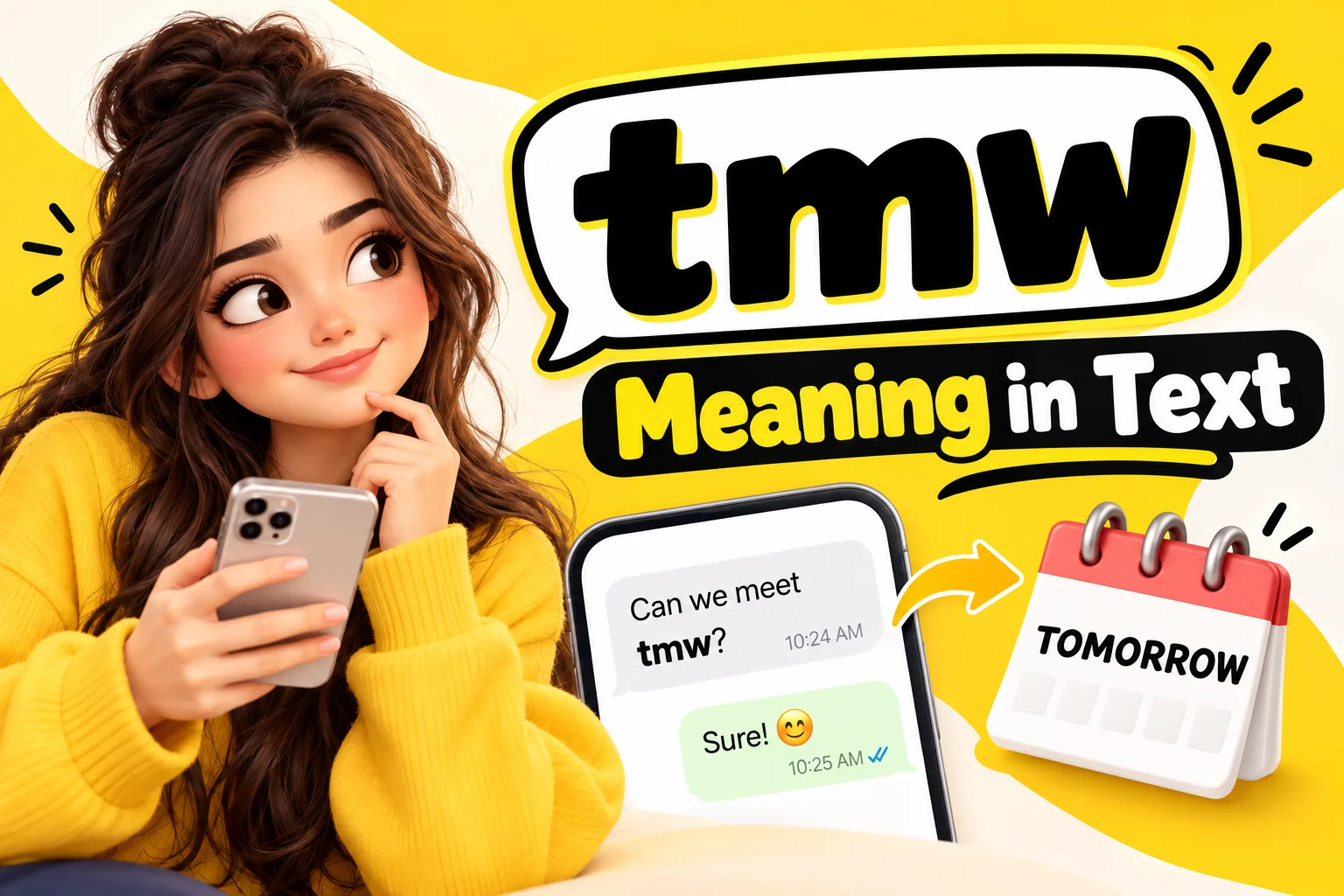

TMW usually means “tomorrow” in text messages and online chats. When someone texts you “tmw,” they are almost always referring to the day after today. It is a casual abbreviation used to save time when texting, especially in messages about plans, appointments, or something that will happen the next day.
What Does TMW Mean in Text?
In texting, TMW = tomorrow.
It is an abbreviation rather than an acronym because the letters do not represent separate words. People shorten “tomorrow” to “tmw” because the meaning is easy to understand from context.
For example:
“Are we meeting tmw?”
means:
“Are we meeting tomorrow?”
The abbreviation commonly appears in SMS/iMessage, WhatsApp, Instagram DMs, Snapchat, and Discord chats. It is especially natural when someone wants to type quickly.
READ MORE: IDT Meaning in Text — What Does IDT Mean?
Does TMW Always Mean Tomorrow?
In ordinary texting, yes, “tmw” generally means tomorrow.
Unlike some slang terms that can have several competing meanings, TMW is relatively straightforward. The main confusion usually comes from similar-looking abbreviations such as TMR, TMRW, or 2MORO, which can also mean tomorrow.
How TMW Is Used in Text Messages
TMW can appear at the beginning, middle, or end of a sentence.
At the beginning
“Tmw I have to wake up early.”
Meaning: “Tomorrow I have to wake up early.”
In the middle
“Can you send it tmw morning?”
Meaning: “Can you send it tomorrow morning?”
At the end
“Let’s talk about it tmw.”
Meaning: “Let’s talk about it tomorrow.”
As a short reply
A: When are you free?
B: Tmw.
Here, “tmw” works almost like a complete answer because the context already establishes the question.
TMW in Different Tones
The abbreviation itself is neutral. The surrounding message determines whether it sounds funny, sarcastic, playful, or serious.
Funny
A: Did you finish the assignment?
B: Absolutely.
A: Really?
B: No 😂 tmw.
Sarcastic
A: You said you’d clean your room today.
B: I will.
A: You’ve said that three times.
B: Okay, okay. Tmw™.
Playful
A: Movie night?
B: Yes!
A: Tmw?
B: Tmw 😌🍿
Serious
A: Did you talk to the manager?
B: Not yet.
A: When will you?
B: Tmw morning. I’ll handle it first thing.
10 Realistic TMW Text Examples
1. Friends
A: You coming over tonight?
B: Can’t, I’m busy.
A: What about tmw?
B: Yeah, tmw works.
2. Partners
A: Are we still going out tomorrow?
B: Yes ❤️
A: What time?
B: I’ll let you know tmw morning.
3. Coworkers
A: Can you send me the updated file?
B: I’m finishing it now.
A: Okay.
B: I’ll send it tmw.
4. Siblings
A: Mom said you need to pick me up.
B: Today?
A: No, tmw.
B: Okay, remind me.
5. Parent and child
A: Did you pack your school bag?
B: Not yet.
A: Do it tonight.
B: I’ll do it tmw morning.
6. Making plans
A: When should we go shopping?
B: I’m free tmw.
A: Afternoon?
B: Perfect.
7. A classmate
A: Did you understand today’s lecture?
B: Mostly.
A: Can you explain one part to me?
B: Sure, tmw at lunch.
8. Casual DM
A: You still need that link?
B: Yeah.
A: I’ll find it tmw.
B: Thanks!
9. Stranger or casual contact
A: Is the item still available?
B: Yes.
A: Can I come tomorrow?
B: Sure, tmw is fine.
10. Group planning
A: Guys, are we meeting today?
B: I can’t make it.
A: Tmw instead?
B: Works for me.
TMW Grammar and Language Role
TMW is an informal abbreviation for “tomorrow.”
It normally functions as an adverb of time, just like the full word “tomorrow.”
You can use it:
- At the beginning: “Tmw I’m working.”
- In the middle: “I’ll call you tmw.”
- At the end: “See you tmw.”
- Alone: “Tmw.”
Because it is informal, tmw belongs mainly in casual digital communication.
TMW vs. TMW in All Caps
There is generally no different dictionary meaning between “tmw” and “TMW.”
Lowercase feels natural and relaxed:
“see you tmw”
Uppercase can look more emphatic:
“SEE YOU TMW!”
That change comes from the surrounding writing style, not from a different definition.
How Should You Reply to TMW?
Your response depends on what the person is saying.
Funny reply
“Tmw again? 😂”
Serious reply
“Okay, I’ll be ready tomorrow morning.”
Flirty reply
“Looking forward to seeing you tmw 😉”
Neutral reply
“Sounds good. See you tmw.”
If someone simply sends “tmw” after you ask when something will happen, there is usually no hidden meaning. They are simply answering “tomorrow.”
TMW vs. Similar Texting Abbreviations
| Term | Meaning | Usage Context | Tone | Popularity | Confusion Risk |
|---|---|---|---|---|---|
| TMW | Tomorrow | Casual texting | Casual | High | Low |
| TMR | Tomorrow | Texting/chat | Casual | High | Medium |
| TMRW | Tomorrow | Texting/social media | Casual | High | Low |
| 2MORO | Tomorrow | Informal texting | Playful/dated | Lower | Medium |
| Today | This day | Standard English | Neutral | Very high | Low |
| Yesterday | Previous day | Standard English | Neutral | Very high | Low |
The most important distinction is between TMW, TMR, and TMRW. All three can communicate the same basic idea, but people may have different personal preferences for which abbreviation they type.
Who Uses TMW?
TMW is primarily associated with informal digital communication, particularly texting and online messaging.
Gen Z
Younger texters often favor short, lowercase abbreviations when the meaning is obvious from context. A message such as “see u tmw” can feel faster and more conversational than spelling everything out.
Millennials
Millennials also commonly understand and use abbreviations such as tmw, especially in quick messages, although individual texting styles vary considerably.
Regional Usage
There is no strong reason to treat TMW as a US-only expression. English-language texters in different countries can understand it because “tomorrow” is the same underlying word.
However, individual preferences for TMW, TMR, TMRW, or the complete word “tomorrow” can vary by person and messaging community.
Where Does TMW Appear?
SMS and iMessage
TMW is useful when making plans:
“Can we talk tmw?”
It works naturally in casual conversations:
“I’ll send you the details tmw.”
Instagram and Snapchat DMs
People may use it while discussing plans or arranging a meeting:
“You free tmw?”
Discord
It can appear in ordinary conversations, particularly when users are discussing schedules:
“I’ll finish it tmw.”
The key point is that TMW is a texting abbreviation, not a platform-specific slang term.
Origin of TMW
TMW comes directly from the ordinary English word “tomorrow.”
Unlike newer internet slang that may emerge from memes or short-form video platforms, TMW does not need a TikTok-specific origin story. It fits the broader tradition of shortening frequently used words in digital communication.
The attraction is simple: “tomorrow” is relatively long, while “tmw” communicates the same idea in only three characters.
Over time, abbreviations like this became normal in SMS, instant messaging, and later social-media messaging.
Is TMW Rude or Offensive?
No. TMW is not rude or offensive.
The issue is formality, not politeness.
Using it with a close friend is completely normal:
“See you tmw!”
Using it in a formal email to a professor, client, manager, or employer is less appropriate. In professional communication, simply write “tomorrow.”
TMW does not contain profanity or an inherently inappropriate expression.
A Real-World Observation About TMW
One interesting thing about tmw is how little explanation it needs. If someone asks, “When can you come?” and you answer simply “tmw,” the abbreviation can function as an entire sentence because the conversation supplies the missing grammar. That makes TMW particularly useful in scheduling conversations: it removes a longer word without removing any information.
Frequently Asked Questions
What does TMW mean in text?
TMW usually means “tomorrow” in text messages and online chats. It is an informal abbreviation rather than an acronym. People use it when discussing plans, appointments, deadlines, or anything happening the following day.
Is TMW the same as tomorrow?
Yes. In ordinary texting, TMW and “tomorrow” have the same basic meaning. TMW is simply a shorter way to type the word.
Is it rude to reply with just TMW in a text?
Not normally. If someone asks, “When are you free?” and you answer “tmw,” the reply is clear and practical. However, in a serious conversation, a complete sentence may sound warmer or more considerate.
What’s the difference between texting TMW and saying tomorrow out loud?
There is no meaningful difference in the basic meaning. TMW is primarily a written abbreviation, while “tomorrow” is the normal spoken form. You would generally say “tomorrow” rather than pronounce the letters T-M-W.
Does TMW mean the same thing in a group chat vs. a 1-on-1 text?
Yes. The basic meaning remains tomorrow in both situations. Context can change what the sender is referring to, but it does not normally change the definition of TMW.
Is TMW formal or informal?
TMW is informal. It works well in texts, DMs, and casual chats. For professional emails, academic writing, or formal messages, spell out “tomorrow.”
Is TMW an acronym or abbreviation?
TMW is best described as an abbreviation. It shortens the word “tomorrow” rather than representing a phrase whose words begin with T, M, and W.
Is TMW the same as TMRW?
Generally, yes. TMW and TMRW can both mean “tomorrow.” The difference is mainly the spelling convention chosen by the person texting.
TMW: Quick Usage Guide
Use TMW when:
- You’re texting friends or family.
- You’re making casual plans.
- You’re answering a question about the next day.
- You’re chatting through WhatsApp or DMs.
Avoid TMW when:
- You’re writing a formal email.
- You’re communicating with a professor or employer formally.
- You’re writing an academic document.
- The audience may not understand texting abbreviations.
Common mistakes
- Assuming TMW has a secret slang meaning when the context clearly means tomorrow.
- Using it in formal writing.
- Confusing it with another abbreviation such as TMR or TMRW.
- Assuming capitalization creates a different definition.
Conclusion
TMW means “tomorrow” in text. It is a simple, informal abbreviation commonly used in SMS, WhatsApp, iMessage, DMs, and other casual digital conversations.
If someone writes “see you tmw,” they mean “see you tomorrow.” If they answer your scheduling question with “tmw,” they are simply telling you that the next day works.
Quick tip: Use tmw with people you normally text casually, but write “tomorrow” when the message needs a more professional or polished tone.