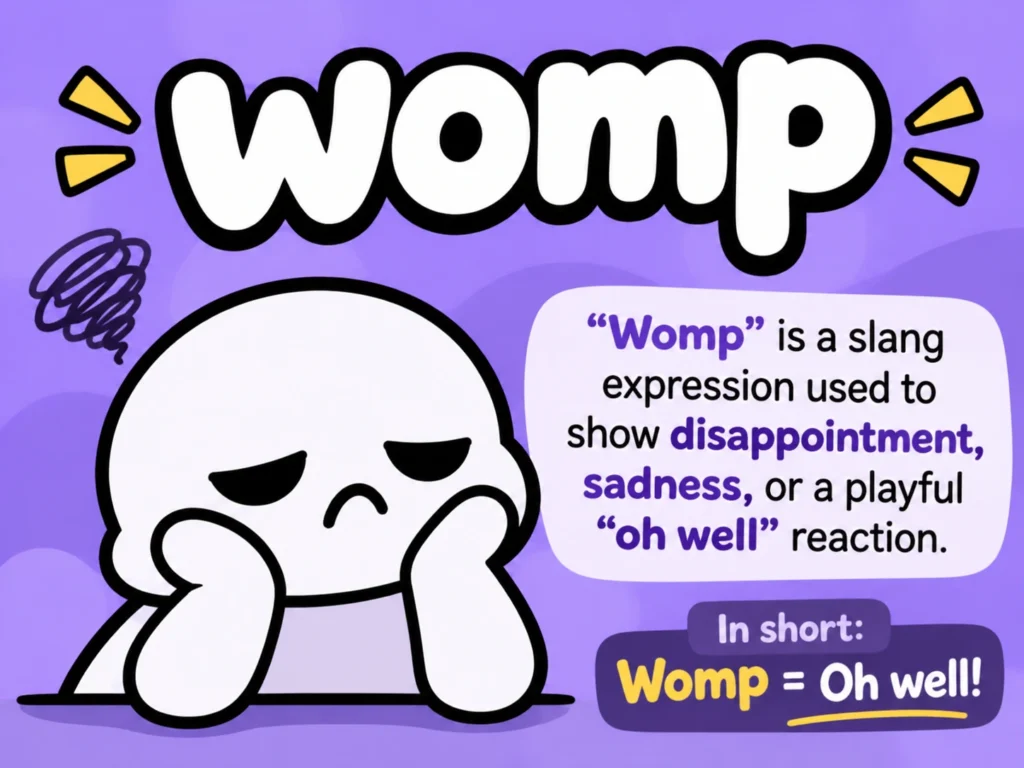
Womp in text means a playful way of expressing disappointment, failure, or sympathy when something goes wrong. It is often used sarcastically to mean “too bad,” “that’s unfortunate,” or “what a shame.” When someone texts you “womp,” they are usually reacting to bad news with humor rather than offering serious comfort.
The word can sound funny, dismissive, teasing, or slightly insensitive depending on the conversation. Although it is not an acronym, womp has become a recognizable internet expression used in casual messages, group chats, and social media conversations.
READ MORE: IDTS Meaning in Text: What Does IDTS Stand For?
What Does Womp Mean in Text Messages?
The most common meaning of womp is an expression of disappointment or an unfortunate outcome. It works similarly to saying “oh well,” “too bad,” or “that sucks,” but it often carries a humorous or sarcastic tone.
For example:
- Friend: I missed the bus again.
- You: Womp 😭
Here, the reply acknowledges the problem without making the conversation overly serious.
Is Womp an Acronym or Slang Word?
Womp is an informal slang expression, not an abbreviation or acronym. Its letters do not stand for separate words.
It is also associated with the sound effect commonly written as “womp womp,” used to imitate a sad trombone or a comically disappointing moment. That association explains why the word can sound playful even when someone is describing an actual problem.
Different Meanings of Womp
Depending on the situation, womp can communicate several related reactions:
- Disappointment: Something did not go as planned.
- Sarcasm: Someone is joking about an unfortunate situation.
- Mock sympathy: The sender acknowledges your problem but is not offering much comfort.
- Playful teasing: A friend uses it to make light of a minor mistake.
The surrounding messages and relationship between the people determine which interpretation makes the most sense.
How People Use Womp on Different Messaging Platforms
Womp is not limited to one social media platform. Its meaning generally stays consistent across casual digital conversations.
SMS, iMessage, and WhatsApp
In regular texting, someone might use womp after hearing about a missed opportunity, a canceled plan, or a small everyday problem.
For example:
- A: The restaurant is fully booked.
- B: Womp womp. We should have reserved earlier.
It can also appear with crying, laughing, or disappointed emojis.
Instagram, Snapchat, and Discord
In direct messages and group chats, womp often works as a short reaction to disappointing news.
On Snapchat, someone might send it after a friend shares an embarrassing mistake. In Discord chats, gaming friends might use it when a teammate loses a match or misses an important opportunity.
The spelling usually stays the same, although womp womp is a common doubled form.
Womp Tone and Context Variations
The same word can feel friendly or rude depending on how someone uses it. Here are four common ways it appears in actual conversations.
1. Funny Womp
Used when something goes wrong in a silly or harmless situation.
- A: I dropped my sandwich before taking a bite.
- B: Womp 😭
- A: Five-second rule didn’t save it.
- B: That’s a tragic lunch story.
2. Sarcastic Womp
Used to tease someone who made a mistake or experienced an expected setback.
- A: I stayed up all night and still failed the quiz.
- B: Womp womp.
- A: You’re supposed to support me!
- B: I support better study decisions 😂
3. Playful Womp
Used between friends who are comfortable joking with each other.
- A: My favorite team lost again.
- B: Womp womp, maybe next season.
- A: You’re not helping.
- B: Just keeping your expectations realistic.
4. Serious Womp
Sometimes people use it to acknowledge disappointing news, but it may sound insensitive when the situation is genuinely serious.
- A: I didn’t get the job I interviewed for.
- B: Womp. Sorry, that really sucks.
- A: Yeah, I was hoping for it.
- B: I hope the next opportunity works out.
Notice how the additional sentence changes the tone from dismissive to supportive.
10 Real Text Conversations Using Womp
Here are more examples showing how people might naturally use the expression in different relationships.
1. Between friends
- A: I forgot my headphones at home.
- B: Womp.
- A: Now I have to travel in silence.
- B: Your worst nightmare 😂
2. Between a couple
- A: Our dinner reservation got canceled.
- B: Womp womp.
- A: I was actually excited about that place.
- B: Let’s find somewhere else tonight.
3. Between siblings
- A: Mom said I can’t use the car.
- B: Womp 😂
- A: Stop laughing at me.
- B: Should’ve asked earlier.
4. Between coworkers
- A: The meeting got moved to Monday morning.
- B: Womp. There goes our Friday plan.
- A: At least we can finish the report first.
- B: True.
5. Between classmates
- A: I forgot we had homework due today.
- B: Womp womp.
- A: Did you finish yours?
- B: Obviously!
6. In a gaming conversation
- A: We lost the final round.
- B: Womp.
- A: One more match?
- B: Let’s get that win.
7. Between parent and child
- A: Dad, my favorite show isn’t available anymore.
- B: Womp womp.
- A: That’s not funny!
- B: Let’s see if it’s on another service.
8. With a close friend
- A: She didn’t reply to my message.
- B: Womp.
- A: I guess she’s busy.
- B: Probably. Don’t overthink it.
9. In a group chat
- A: Guys, the trip is postponed.
- B: Womp womp.
- A: We need to choose another weekend.
- B: I’m free next Saturday.
10. With someone you barely know
- A: Sorry, I can’t make it today.
- B: Womp, no worries.
- A: Maybe another time?
- B: Sure, sounds good.
Grammar: How to Use Womp in a Sentence
Womp functions primarily as an interjection. It expresses a reaction rather than naming an object or describing an action.
| Grammar feature | Explanation |
|---|---|
| Part of speech | Interjection |
| Sentence position | Usually at the beginning or as a standalone reply |
| Capitalization | Lowercase is casual; uppercase adds emphasis |
| Standalone use | Yes |
| Mid-sentence use | Yes, often as a humorous aside |
| Register | Informal |
Examples:
- Standalone: Womp.
- Beginning: Womp, that’s unfortunate.
- Mid-sentence: I missed the deadline, womp womp.
- Emphasized: WOMP WOMP!
Capitalization does not create a different dictionary meaning. However, uppercase can make the reaction feel louder or more sarcastic.
How Should You Reply to Womp?
Your response should match the sender’s intention.
- Funny: “My life is a comedy at this point 😂”
- Serious: “Yeah, I was actually disappointed.”
- Flirty: “Womp, unless you’re planning to cheer me up 😉”
- Neutral: “Haha, it happens.”
If someone uses womp after sharing genuinely upsetting news, a more thoughtful response is usually better than another sarcastic comment.
Womp vs. Other Texting Slang
These expressions can appear in similar conversations, but their meanings are not identical.
| Term | Meaning | Usage Context | Tone | Popularity | Confusion Risk |
|---|---|---|---|---|---|
| Womp | Disappointment | Bad news | Sarcastic | Recognizable | Low |
| Oof | Reaction to something painful or awkward | Mistakes, problems | Sympathetic | Common | Medium |
| SMH | Shaking my head | Frustration | Disapproving | Common | Low |
| Welp | Resigned acceptance | Unexpected outcomes | Casual | Common | Medium |
| RIP | Rest in peace; also humorous loss | Failed plans or situations | Humorous | Common | Medium |
| Yay | Expression of happiness | Good news | Positive | Common | Low |
The most important distinction is that womp communicates disappointment, while yay expresses the opposite reaction: happiness or excitement.
Who Uses Womp?
Age Groups
Womp is recognizable in informal internet communication, particularly among people familiar with online humor and reaction-based slang. However, there is no reliable demographic survey establishing exact age-group usage percentages.
- Gen Z: Often uses womp as a quick sarcastic reaction, sometimes alongside emojis.
- Millennials: May use it as a humorous response to everyday disappointments.
- Older adults: May recognize the expression through television, internet memes, or conversations with younger people.
Regional Usage
The expression is particularly documented in American English. Cambridge Dictionary labels womp womp as informal US usage. It can also be understood internationally through online communication, but exact regional popularity is not established. definition in the Cambridge English Dictionary+1
Where Did Womp Come From?
Womp comes from the sound associated with a descending trombone effect, commonly called the sad trombone. This musical sound is traditionally used in entertainment to signal a wrong answer, failure, or disappointing result.
The written expression has a documented history dating back to at least 2006, when an Urban Dictionary entry described it as a lighthearted expression indicating a loss. The Chronicle of Higher Education+1
Over time, the expression moved beyond sound effects and became a written reaction in internet conversations.
One interesting detail is that the original sound effect is not necessarily connected to modern social media. Online platforms helped circulate the expression, but the underlying joke is older than today’s texting culture. Merriam-Webster+1
Is Womp Rude or Offensive?
Womp is not profanity, and it does not contain an explicit expression. However, it can sound dismissive.
Consider these situations:
- With friends: Usually acceptable as playful teasing.
- With a partner: Fine when both people understand the joke.
- At school: Generally harmless in casual conversations.
- At work: Better avoided in professional messages.
- During serious situations: Avoid using it when someone is discussing grief, illness, financial difficulties, or other sensitive problems.
The biggest mistake is assuming everyone will interpret womp as a joke.
Real-World Observation: Why Womp Is Interesting
What makes womp different from many texting abbreviations is that it imitates a sound rather than shortening a sentence. Even when someone types only one word, the reader can imagine the familiar descending musical effect. Another interesting feature is that repeating it as womp womp makes the disappointment feel more exaggerated, almost like adding an imaginary soundtrack to someone’s bad luck. This makes it especially useful for joking about minor failures, although the same expression can feel insensitive when the situation is genuinely serious.
Frequently Asked Questions About Womp
1. What does womp mean from a girl?
When a girl texts you womp, she is usually reacting to something disappointing or unfortunate. She might be joking, teasing you, or showing mild sympathy. Check the conversation before assuming she is upset or being rude.
2. Is womp the same as womp womp?
They have essentially the same meaning. Both express disappointment or a sarcastic reaction to something going wrong. However, repeating the word often makes the reaction sound more dramatic or humorous.
3. Is it rude to reply with just womp in a text?
Not necessarily. Among close friends, it can be a harmless joke about a minor problem. However, sending only womp after someone shares serious personal news may appear insensitive.
4. What does womp mean on Snapchat?
On Snapchat, womp generally expresses disappointment, teasing, or sarcastic sympathy. Someone might send it after hearing that your plans were canceled or that you made a silly mistake. Its meaning remains similar to regular texting.
5. What’s the difference between texting womp and saying it out loud?
In texting, womp is usually a short written reaction. When spoken aloud, it can imitate the descending sound of a sad trombone. Both communicate disappointment, but spoken delivery can make the sarcasm more obvious.
6. Does womp mean the same thing in a group chat and a private text?
Generally, yes. In a group chat, it may become a shared joke about someone’s unfortunate situation. In a private conversation, it can feel more personal, especially when directed at someone who expects sympathy.
7. Can I use womp in professional messages?
It is better to avoid it in formal workplace communication. The expression is informal and can sound dismissive without the right context. Use phrases such as “That’s unfortunate” or “I’m sorry to hear that” instead.
8. Is womp a Gen Z word?
Womp is not exclusive to Gen Z. Its sound-effect roots and documented written use go back further than today’s Gen Z internet culture. Younger internet users may encounter it through memes and online conversations, but people from different generations can understand it.
Conclusion: Understanding Womp in Text
Womp is a casual expression used to communicate disappointment, sarcastic sympathy, or playful reactions to unfortunate situations. It is especially useful when something minor goes wrong and a serious response is unnecessary.
Usage tips:
- Use womp when reacting to small disappointments.
- Add emojis to make playful intentions clearer.
- Use womp womp for extra emphasis.
- Consider your relationship with the person before sending it.
Common mistakes to avoid:
- Assuming womp is an acronym.
- Treating it as a serious expression of sympathy.
- Using it when someone needs genuine emotional support.
- Confusing it with positive reactions such as yay.
Use womp with friends when the situation calls for humor, but avoid it in sensitive conversations and formal communication.
3 thoughts on “Womp Meaning in Text: What Does Womp Mean?”